MOTHER JONES BY E-MAIL

Medical Apartheid

Arts: Compelling, if at times gruesome, Medical Apartheid connects past medical experiments and the woeful current state of health care for blacks.

January 5, 2007


TOOLS

EmailE-mail article
PrintPrint article


BACKTALK

E-mail the editor


Google


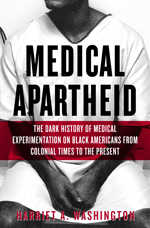
Medical Apartheid: The Dark History of Medical Experimentation on Black Americans From Colonial Times to the Present
By Harriet A. Washington. Doubleday. $27.95.

In this provocatively titled book, Harriet Washington argues that the infamous “Tuskegee Experiment”—the 40-year study in which black men with syphilis were allowed to die untreated so that their cadavers could be used for research—was not an isolated incident, but rather one example of the medical establishment’s long history of mistreating African Americans. Compelling, if at times gruesome, Medical Apartheid draws a connection between past medical experiments and the woeful current state of health care for blacks.

Medical Apartheid is peppered with chilling anecdotes of racist exploitation, curiosity, and control. There is the story of John Brown, a slave purchased in Georgia in the 1820s, whose owner, a doctor, blistered his legs and arms on a daily basis to see how deep his black skin went. Far from merely cataloging horrors, Washington, a journalist and former fellow in ethics at Harvard Medical School, also illustrates what she calls the “dual face” of these abuses, pointing out that the exploitation of black subjects made numerous medical advances possible. For example, Dr. Marion Sims, a 19th-century gynecological pioneer, was only able to achieve his breakthroughs by performing horrific surgeries without anesthesia on his female slaves.

These tales are not limited to the less enlightened past. The forced sterilization of black women (what civil rights activist Fannie Lou Hamer plaintively called her “Mississippi appendectomy”) got its start during slavery, but has persisted in less overt forms in recent years. A 1991 experiment that implanted the now-defunct birth control device Norplant into African American teenagers in Baltimore was applauded by some observers as a way to “reduce the underclass.” Washington also finds that racist assumptions still creep into high-level medical research. A 1992 Columbia University study looking for a genetic link to violent behavior only recruited young black boys from poor neighborhoods in New York City. Researchers misled the parents, claiming their children were simply coming in for a series of tests and questions, when in fact they were given potentially risky doses of the same drug found in the Fen-Pfen weight loss pill.

One of the most harmful contemporary legacies of this history of abusive medical experimentation is that many African Americans are wary of participating in potentially life saving medical studies. A recent study in the American Journal of Law and Medicine estimated that only 1 percent of the nearly 20 million Americans enrolled in biomedical studies are black. This reluctance, though justified, has meant that blacks often miss out on the latest treatments and breakthroughs. In the 1980s, for instance, virtually no African Americans were used in trials of the HIV inhibitor AZT. When the drug came into widespread use in 1991, the Food and Drug Administration had scant research on blacks and erroneously reported that it was not effective for black patients. If more blacks had been included in the original studies, Washington wonders, “would the number of HIV-infected African Americans be lower today?”

Washington’s book is a rallying call for change within the medical and African American communities. While doctors must understand their black patients’ fears of exploitation, African Americans, Washington writes, “cannot afford passivity.” Increased participation in ethically designed medical studies would not only be a boon to African Americans suffering from serious diseases but would also lead to better preventive care in general. As she concludes, “Physicians, patients, and ethicists must…understand that acknowledging abuse and encouraging African Americans to participate in medical research are compatible goals.”


Amaya Rivera is a Mother Jones editorial fellow.


Post a Comment

Your Name: 

Your Comment: 
 
Please press "Submit" only once to avoid double-posting.
All HTML formatting is removed from comments.
Read the Mother Jones community rules here.

Comments:

And U.S. citizens, paticularly those in the medical profession, have the nerve to talk about Britain's Muslim doctors who supposedly played parts in their recent bombings. At the least the Muslims are at war. Even medical professionals will [understandably] kill to preserve their race(s). Let's not forget the medical/ill-health practices on the Native Indians.
Posted by:Dr. KevorkianJuly 4, 2007 10:21:55 AMRespond ^
what happens if Dr Nulls is right and Hiv is a hoax.
Posted by:Herbert ProvidenceSeptember 16, 2007 4:41:45 AMRespond ^
HIV and AIDS is NOT a hoax. Why would you think that? Thats as dumb as saying that the Holocaust never happened even though there are thousands of people who can testify to being present and accounted for. They experienced it just like people today experience HIV and AIDS
Posted by:AnonymousOctober 12, 2007 10:09:38 AMRespond ^
Why is it that blacks are discriminated against in the medical field. So our skin is darker big freakin deal!! There needs to be research done on diseases that affect mostly black people, Sickle Cell Anemia being one.
Posted by:AnonymousOctober 12, 2007 10:11:39 AMRespond ^
I am reading this book and Im so angry because they treated the African American slaves as equally brutal as they did with the Holocaust victims and it disgusts me that A, it still goes on in small ways and B, its no as well known about.
Posted by:AmandaNovember 7, 2007 5:43:25 PMRespond ^
When the drug came into widespread use in 1991, the Food and Drug Administration had scant research on blacks and erroneously reported that it was not effective for black patients. If more blacks had been included in the original studies, Washington wonders, “would the number of HIV-infected African Americans be lower today?” I believe that all humans are the same, so, that the experiments done on one group of people probably will work on others. With the same or similar benefits.
Posted by:Christine HarrisJanuary 14, 2008 7:53:20 PMRespond ^
It really hurts my heart that people could hurt children and women. The more I learn about my history the more I dislike this country.
Posted by:Dwayne L. BarnesApril 23, 2008 11:11:17 PMRespond ^
Anger naturally being African American. We do still have numerous health issues and must continue to stay involved in medical testing for treatments that are available
Posted by:Mark MoultrieJune 25, 2008 1:36:10 PMRespond ^

Jail.org - Inmate Search
Criminal records, instant public records & people search & current court records. www.jail.org

U.S. Public Records Search
Search County & State Court Records, Criminal records, Vital and Adoption Records www.PublicRecordsInfo.com

Records.com - People Search
Public Records and Background Checks. Instantly Search Criminal Records, Addresses and Court Records www.Records.com

Court Records & County Records
Find Instant Public Records, Criminal Records as Well as County Property Records Search. www.PublicRecordsIndex.com


bookIN PRINT

CLICK HERE
for more great reading

headphones IN TUNE
New music every issue

CLICK TO LISTEN


This article has been made possible by the Foundation for National Progress, the Investigative Fund of Mother Jones, and gifts from generous readers like you.

© 2007 The Foundation for National Progress

About Us   Support Us   Advertise   Ad Policy   Privacy Policy   Contact Us   Subscribe   RSS