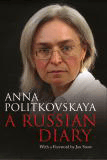
Anna Politkovskaya’s reporting was never meant for beach reading. In A Russian Diary, the late investigative journalist, who was murdered last October outside her Moscow apartment, depicts life in Vladimir Putin’s Russia with some of the sweep of Tolstoy and a lot of the darkness of Dostoyevsky.
For those of us who have spent the last few years poring over news from the Middle East and ignoring the dragon in the Kremlin, Politkovskaya’s posthumous diary offers a welcome tutorial in recent Russian history. She begins with the basics: How, after being elected in 2000, Putin rigged the 2003 parliamentary elections and then convinced the Duma to give him the power to appoint previously elected regional leaders, effectively ending the near-autonomy of the provinces and their ability to protest Kremlin policy (One of his supporters, the current prime minister of Chechnya, Ramzan Kadryov, appears memorably as an illiterate psychopath). She describes Putin’s crackdown on dissent, the jailing of independent scholar Igor Sutyagin and oligarch-turned-opposition figure Mikhail Khodorkovsky on trumped-up charges. And she suggests that Putin possibly orchestrated the murders of journalist Paul Klebnikov and the human-rights activist Nicolai Girenko. Whether or not Putin gave the orders, he certainly benefited from their protests being silenced.
Much of this has been reported in the West, if not much remarked upon. But in her diary, Politkovskaya also enters territory that has been all but unmentioned outside of Russia, where the government strictly controls the media and limits access for foreign journalists. She describes the country’s rapidly metastasizing xenophobia, and her horror upon reading of a 9-year-old Tadjik girl murdered by skinheads in St. Petersburg. She reports on the hunger strike conducted by Russia’s Heroes, a collection of state-recognized civil and military stand-outs who balked when the Kremlin reduced their benefits and stripped them of burial honors. Putin acquiesced to the Heroes, but he refused to budge for the family members of victims from the 2004 Beslan hostage crisis. When the families leveraged their grief to seek the unreleased findings of the official investigation into the bloody siege, Putin stonewalled. At that moment, he appears at his inhuman worst, an autocrat accountable only to own conveniently absent conscience.
Politkovskaya believes that under Putin, Russia has essentially reverted to a Soviet-style system in which the individual counts for little, if anything. Conscripted soldiers are still treated like cattle. In one instance, a young conscript was tortured to death by his comrades for having feet too big for the standard-issue boots; in another, Politkovskaya meets a 28-year-old veteran of the Chechen war, paralyzed from the chest down, who lives with his elderly mother on $43 a month. And as in the Brezhnev era, ambitious journalists and politicians know they can advance themselves with well-placed gestures of fealty, such as adoringly quoting Putin to his face. But Politkovskaya says the roots of the new wave of corruption stretch farther back than the Soviet era. In Putin the strongman, she claims, the “myth of the tsar” has been resurrected.
Politkovskaya is an erudite guide through the mess of modern Russia. She refers to Putin and the resurgent Communists as the Scylla and Carybdis between whom Russia sails. Putin’s theory of governance is summed up as l’etat, c’est Putin. But she is also combative and often cynical about her countrymen’s anemic opposition to him. “Anyone who hasn’t been hit in the pocket has nothing to say,” she writes. It’s easy for us to see why her friends and colleagues found her a bit of a nuisance—and why Putin hated her. Upon her death, he commented dryly that her influence in Russia had been minimal.
Amid the diary’s pervasive gloom there are a few small flickers of hope. Though she describes the post-Soviet democratic movement in Russia as fragmented and internecine, Politkovskaya nonetheless is cautiously optimistic about the staunchest of the new political opposition leaders. Pro-Western entrepreneur and Putin critic Irina Khakamada and former chess champion Gary Kasparov gain her respect with their uncompromising challenges to Putin. Indeed, Khakamada’s defiant rhetoric echoes Politkovskaya’s own. “In private [my friends] warn that I will simply be killed if I tell the truth,” Khakamada says, “I am not afraid of this terrorist regime…Our children must grow up free people.”
Like Khakamada, Politkovskaya knew that her refusal to surrender to the forces of lawlessness and repression that rule Russia put her in grave danger. Sadly, it is her tragic death, as much as her reporting, that has assured her legacy.