

Adam Serwer

Adam Serwer

Reporter

Adam Serwer is a reporter at Mother Jones. Formerly a staff writer at the American Prospect, he has written for the Washington Post, the Root, the Village Voice, and the New York Daily News

Get my RSS |

Bush-Appointed Judge Smacks Down Bush and Obama's Military Commissions

| Tue Oct. 16, 2012 12:14 PM PDT
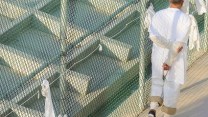
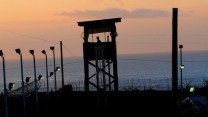
gitmoA detainee at the Guantanamo Bay detention facility tosses a soccer ball.

In a decision that could ban the military's favorite methods of prosecuting Guantanamo Bay detainees, a federal appeals court on Tuesday overturned the 2008 military commission conviction of Salim Hamdan, Osama bin Laden's former driver.

Judge Brett Kavanaugh, a George W. Bush appointee, wrote for a three-judge DC Circuit panel that Hamdan could not be prosecuted for acts that were not crimes at the time they were committed. That's because the Constitution prohibits Congress from passing laws ex post facto—after the fact. The government cannot make something a crime after you've already done it and then charge you for doing it. But that's exactly what Congress seemed to do in 2006 when it made "material support for terrorism" a war crime and encouraged the military to prosecute Gitmo detainees—who had already been imprisoned for years—for committing it.

"This is a massive blow to the legitimacy of the military commissions system," says Zachary Katznelson, a senior attorney at the ACLU. The commissions "have been trying people for years for something that isn't even a war crime." 

War crime or not, prosecutors love material support charges because they're vague and relatively easy to prove. Material support often involves conduct that might not necessarily be violent—like driving bin Laden's car or cooking his food—that somehow helps a terrorist group.

It's not just a few Gitmo detainees who have faced these charges. Every single detainee at Gitmo who has been convicted by military commission has been at some point charged with material support for terrorism. Now a federal judge—one appointed by Bush!—says that's all bogus. And it's not just material support charges that could be affected. Conspiracy charges, which were also not a war crime under United States law before 2006, could be thrown out for similar reasons.

Advertise on MotherJones.com

How Obama Could Lose This Debate, Too

| Tue Oct. 16, 2012 3:08 AM PDT

On the eve of the second presidential debate of 2012, which will be held in a town hall type format, President Barack Obama's campaign is telling reporters that their candidate is planning to "be more aggressive and show more passion this time around." Mitt Romney's advisers are saying he "intends to build on the progress he made in the first debate by conveying authenticity."

Although it may be hard to imagine the president compounding the error of a debate performance that left Romney with a lead in many polls, the reports about the candidates' debate preparation suggest Obama may have the wrong idea about what he faces on Tuesday. The town hall is technically a "debate," but winning depends very little on actually debating one's opponent. In the town hall format, victory often depends on looking like you're relating to the audience. This is partly because of the media's predilection for covering debates as if they're stage plays. But it's also built into the format itself.

Take, for example, this classic moment from 1992, in which then-President George H.W. Bush almost face-palms himself after challenger Bill Clinton takes a question about how the national debt personally affects the candidates and knocks it out of the park. Bush rambles about interest rates and gets defensive about being rich. Clinton starts off by asking the questioner how the debt has affected them, then starts talking about all the people he personally knows who've been laid off: 

Now, in fairness, Clinton does give a substantive answer about government being in the grip of a "failed economic theory," which happens to be the same one Mitt Romney is pushing. He also turns around the question around and explains the debt is not the only cause of the recession. But for people who don't write or think about politics every day, it's the delivery that makes the difference here.

Meanwhile, the past offers us an example of what it looks like when a candidate trying to make up for lost ground mistakes a town hall debate for pistols at dawn. In 2000, Al Gore, frustrated by media coverage of the previous two debates that prized superficial behavior by the candidates over substantive policy differences, walked up to Bush in a confrontational manner at the third town hall style debate and allowed Bush to make a fool out of him:

In sum, town hall debates aren't so much arguments as acting competitions. The nature of the town hall format carries substantial risk for a rusty incumbent president and a candidate with something to prove. Obama is both. Romney, by practicing his Clinton impression, may be better prepared this time around, too. 

Paul Ryan's Ridiculous Talking Points on Libya

| Fri Oct. 12, 2012 12:49 PM PDT

The Obama administration is facing justified scrutiny over its handling of the terrorist attack in Libya that killed four Americans. But GOP vice presidential candidate Paul Ryan—seeking to exploit the incident and paint the administration as weak—has run with a patently ridiculous explanation for why the incident occurred, and has failed to articulate a plausible explanation for how it might have been prevented.

At Thursday night's VP debate, moderator Martha Raddatz opened with a question on Libya, and here was Ryan's response:

When you take a look at what has happened just in the last few weeks, they sent the U.N. ambassador out to say that this was because of a protest and a YouTube video. It took the president two weeks to acknowledge that this was a terrorist attack. He went to the U.N. and in his speech at the UN he said six times—he talked about the YouTube video. Look, if we're hit by terrorists we're going to call it for what it is, a terrorist attack. Our ambassador in Paris has a Marine detachment guarding him. Shouldn't we have a Marine detachment guarding our ambassador in Benghazi, a place where we knew that there was an Al Qaida cell with arms? This is becoming more troubling by the day. They first blamed the YouTube video. Now they're trying to blame the Romney-Ryan ticket for making this an issue.

For starters, Ryan's allegation that it took two weeks for Obama to acknowledge a terrorist attack is plain wrong: The president referred to the attack as an "act of terror" the day after it occurred. Second, while it's true that the administration wrongly insisted at the outset that the attack sprang from protests over an anti-Islam film on YouTube, there were conflicting strains of intelligence—one from the CIA that said there was a protest, and one from the State Department that said there wasn't—that help explain the administration's remarks in the early going.

Sorry, Team Obama: Scrutinizing the Libya Attacks Isn't Just Partisan Politics

| Thu Oct. 11, 2012 4:34 PM PDT

President Obama's deputy campaign manager Stephanie Cutter made the ill-advised assessment Thursday that the deaths of four Americans in an attack on the US consulate in Benghazi, Libya, was only a "political topic" because of Mitt Romney's campaign. Her remarks, first spotlighted by Andrew Kaczynski at Buzzfeed, drew an onslaught of retort. Cutter's defenders have insisted she was taken out of context; here is a transcript of her full comments:

Well, we are still investigating. In fact, we are today still investigating and, you know, there are two things that as soon as that attack occured, two things. One, getting to the bottom of that attack to figure out exactly what happened and bringing those people to justice. And that's what the administration has been focused on. You know, what you saw there is the administration giving you their best intelligence, what their best intelligence were telling them of what was happening on the ground and had we had any different information we would have put it out. We would have told the American people what we know and, you know, in terms of the politicization of this, we are here at a debate and I hope we get to talk about the debate, but the entire reason that this has become the, you know, political topic it is is because of Mitt Romney and Paul Ryan. It's a big part of their stump speech and it's reckless and irresponsible what they're doing—[Cutter is cut off]

I've written before about the wrongheadedness of arguing that "tragedies" should be kept outside the realm of politics, because politics are in fact how societies negotiate solutions to difficult problems. The murder of Americans abroad is, by definition, an important political topic, and it involves key questions about the Obama administration's handling of matters in Libya.

Tue Apr. 30, 2013 2:20 PM PDT
Wed Apr. 24, 2013 6:01 AM PDT
Tue Apr. 23, 2013 11:42 AM PDT
Fri Apr. 19, 2013 3:12 PM PDT
Tue Mar. 19, 2013 9:44 AM PDT
Mon Mar. 11, 2013 8:30 AM PDT
Fri Mar. 8, 2013 12:24 PM PST
Thu Feb. 7, 2013 5:35 PM PST