


Adam Serwer

Adam Serwer

Reporter

Adam Serwer is a reporter at Mother Jones. Formerly a staff writer at the American Prospect, he has written for the Washington Post, the Root, the Village Voice, and the New York Daily News

Get my RSS |

At Howard University, Rand Paul Falsely Claims He Never Opposed the 1964 Civil Rights Act

| Wed Apr. 10, 2013 9:45 AM PDT

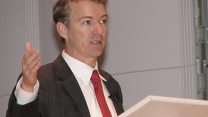
Following an awkward, earnest speech to an audience at Howard University, Sen. Rand Paul (R-Ky.) insisted several times that he did not oppose the Civil Rights Act of 1964. 

"I've never been against the Civil Rights Act, ever," Paul told a questioner, following what was the first speech by a Republican legislator at the historically black university in decades. "This was on tape," the questioner responded. 

That's true. It is on tape. Here it is:

In 2010, during an interview with the Louisville Courier-Journal flagged by ThinkProgress, Paul made it very clear that he opposed a key part of the Civil Rights Act of 1964 that banned discrimination on the basis of race in "places of public accommodation," such as privately owned businesses that are open to the public. Here's the transcript:

PAUL: I like the Civil Rights Act in the sense that it ended discrimination in all public domains, and I'm all in favor of that.

INTERVIEWER: But?

PAUL: You had to ask me the "but." I don't like the idea of telling private business owners—I abhor racism. I think it’s a bad business decision to exclude anybody from your restaurant—but, at the same time, I do believe in private ownership. But I absolutely think there should be no discrimination in anything that gets any public funding, and that's most of what I think the Civil Rights Act was about in my mind.

If federal civil rights laws only outlawed segregation in "anything that gets any public funding," the state would still be called upon to enforce racism by enforcing the property rights of business owners who did not want to serve people on the basis of skin color (or religion, or national origin). Only by extending the ban on discrimination to all places of public accommodation, including privately owned businesses, could freedom against discrimination actually be upheld. Paul elaborated later in the interview when he said that he "became emotional" reading the speeches of Martin Luther King Jr.

INTERVIEWER: But under your philosophy, it would be okay for Dr. King not to be served at the counter at Woolworths?

PAUL: I would not go to that Woolworths, and I would stand up in my community and say that it is abhorrent, um, but, the hard part—and this is the hard part about believing in freedom—is, if you believe in the First Amendment, for example—you have to, for example, most good defenders of the First Amendment will believe in abhorrent groups standing up and saying awful things and uh, we're here at the bastion of newspaperdom, I'm sure you believe in the First Amendment so you understand that people can say bad things. It's the same way with other behaviors. In a free society, we will tolerate boorish people, who have abhorrent behavior, but if we're civilized people, we publicly criticize that, and don't belong to those groups, or don't associate with those people.

Paul expressed similar sentiments in interviews with MSNBC and NPR

So Paul made it quite clear in 2010 that he didn't believe in federal law banning discrimination in privately owned businesses that are open to the public. At Howard, Paul seemed to be saying he never opposed the Civil Rights Act in its entirety, but he certainly opposed a key part of it that completely reshaped American society. Supporting the right of white business owners not to serve blacks may be the "hard part of freedom" for someone, but not for anyone who looks like Rand Paul.

Paul got a warm reception from the Howard audience for some of his positions on foreign policy and the war on drugs. But in what seems like a tacit acknowledgement that his past position on a piece of historic civil rights legislation is embarrassing, Paul fibbed about what that position actually was. 

Advertise on MotherJones.com

Who Is Sri Srinivasan, Obama's "Supreme Court Nominee in Waiting"?

| Wed Apr. 10, 2013 7:15 AM PDT
sri srinivasanPrincipal Deputy Solicitor General Sri Srinivasan argues in front of the US Supreme Court.

The New Yorker's Jeffrey Toobin calls Sri Srinivasan, the government lawyer Barack Obama has nominated to the prestigious US Court of Appeals for the DC Circuit, "the Supreme Court nominee in waiting." But you could also call him a mystery.

On Wednesday, the Senate Judiciary Committee will hold a hearing on Srinivasan's nomination to the DC Circuit—often considered a place for potential future Supreme Court nominees. He would be the first Asian American and Indian American judge on that court.

Srinivasan's background is as a litigator, meaning he's spent most of his career defending other people's positions rather than his own. That means that although he's well regarded among legal elites of all stripes, his own views are less than clear. At a time when Republican obstruction has ground the confirmation process to a halt, and the outspoken progressivismor even mild progressivism—of prior Obama nominees has run into GOP filibusters, Srinivasan's unclear record offers Republicans few legitimate reasons to block him. It also means that liberals can't be sure that Srinivasan actually shares their views.

"I don't think anybody is going to suggest that he's being put forth as the next Thurgood Marshall or Justice Brennan. He does not come out of that kind of background," says Caroline Fredrickson, president of the progressive American Constitution Society. But, she argues, he is "extremely well qualified" and "probably has the perfect resume for anyone who would be nominated to the DC Circuit." Doug Kendall, president of the liberal Constitutional Accountability Center, calls Srinivasan "unquestionably brilliant" but acknowledges that Srinivasan's record "is not progressive-forward; it is as non-ideological as you can find." (Neither organization has formally endorsed Srinivasan's nomination).

Did Mitch McConnell Use Senate Employees for Oppo Research on Ashley Judd?

| Tue Apr. 9, 2013 2:11 PM PDT

A secret recording of Sen. Mitch McConnell (R-Ky.) and aides discussing in February how they might attack actor/activist Ashley Judd, then a potential 2014 challenger to McConnell, attracted widespread attention after Mother Jones published it Tuesday morning. Much of the news coverage focused on the McConnell team's comments about Judd's religious views and her mental-health history. But the tape might raise ethics questions for McConnell and his staff.

Senate ethics rules prohibit Senate employees from participating in political activities while on government time. But the tape indicates that several of McConnell's legislative aides, whose salaries are paid by the taxpayer, were involved with producing the oppo research on Judd that was discussed at the February 2 meeting.

Here's the relevant section of the transcript:

Presenter: So I'll just preface my comments that this reflects the work of a lot of folks: Josh, Jesse, Phil Maxson, a lot of LAs, thank them three times*, so this is a compilation of work, all the way through. The first person we'll focus on, Ashley Judd—basically I refer to her as sort of the oppo research situation where there's a haystack of needles, just because truly, there's such a wealth of material. [Laughter.]

Ah, you know Jesse slogged through her autobiography. She has innumerable video interviews, tweets, blog posts, articles, magazine articles.

The presenter was explaining that the opposition research on Judd was compiled by several people. "LAs" is congressional parlance for legislative assistants; one of the legislative assistants, Phil Maxson, gets his own shout-out. The question is whether Maxson and the other McConnell LAs were digging up material on Judd while on government time. If they were engaged in this research while on annual leave or vacation—or working outside Senate hours—they wouldn't be violating Senate rules. But if this was done on Senate time, McConnell could have a problem.

[UPDATE: The Weekly Standard's Daniel Halper suggests that the aide in the transcription isn't saying "thank them three times," he's saying "in their free time." That's plausible, and if it's true, McConnell and his aides are in the clear. You can listen for yourself here. UPDATE 2: On even closer listen, "in their" isn't plausible, but "free time" is. You should decide for yourself.]

Here's how Tara Malloy, an expert on ethics rules at the Campaign Legal Center, described the issue in an email:

Any assessment under the Ethics rules would require some more facts—most particularly whether any official resources were used in connection to the conversation or oppo research, and/or whether the conversation or other activities took place on government property. In general, however, the ethics rules do not bar staffers from engaging in campaign activity provided they do it on their own time and do not involve government resources or property.

Here is the relevant excerpt from the Senate Ethics Manual:

As discussed more fully below, Senate Rule 41 prohibits Senate staff, with the exception of specified "political fund designees," from handling federal campaign funds. Subject to that restriction, however, and as long as they do not neglect their official duties, Senate employees are free to engage in campaign activities on their own time, as volunteers or for pay, provided they do not do so in congressional offices or otherwise use official resources.  An employee's "own time" includes time beyond regular working hours, any accrued annual leave, or non-government hours of a part-time employee. Staff may not be required to do political work as a condition of Senate employment. Just as Senate employees are free to campaign for their employing Members on their own time, they may also use their free time or, with the permission of their employing Members, reduce their Senate hours (with a commensurate reduction in pay) to campaign for presidential candidates, other federal candidates, or state or local aspirants. With respect to the question of leave time to perform campaign activities, it is the Committee's understanding that the Senate does not recognize a "leave of absence."

We asked Jesse Benton, McConnell's campaign manager; Allison Moore, a spokeswoman for his Senate office; and Phil Maxson, the LA named on the tape, to explain whether the oppo work was done on Senate time, but they did not respond.

Guy Cecil, the executive director of the Democratic Senatorial Campaign Committee, which is working to defeat McConnell, sent out a series of tweets on Tuesday noting this issue:

Cuccinelli Campaign Won't Say If He's Committed Any Crimes Against Nature

| Thu Apr. 4, 2013 12:38 PM PDT
Virginia Attorney General Ken Cuccinelli at the Values Voters Summit in 2011

The campaign of Virginia state attorney general Ken Cuccinelli won't say if he's committed any crimes against nature.

Cuccinelli, who is running to be Virginia's next governor, recently petitioned a federal court to reverse its ruling that the state's archaic "Crimes Against Nature" law is unconstitutional. That statute outlaws oral and anal sex between consenting adults—gay or straight, married or single—making such "carnal" acts a felony. The law is unconstitutional because of the Supreme Court's ruling in Lawrence v. Texas, which invalidated such "anti-sodomy laws" across the country.

As my colleague Kate Sheppard notes, Cuccinelli's office claims that it is appealing the decision because the state's regular statutory rape law doesn't allow it to pursue the harshest punishment against a 47-year-old man who solicited oral sex from teenagers (who were above the age of consent at the time). But as Josh Israel recounts at ThinkProgress, Cuccinelli helped kill an effort to reform the Crimes Against Nature law in order to make it comply with the Supreme Court's ruling in Lawrence, possibly because the proposed law didn't focus on homosexuality. "My view is that homosexual acts, not homosexuality, but homosexual acts are wrong," Cuccinelli said in 2009. "They're intrinsically wrong. And I think in a natural law-based country it's appropriate to have policies that reflect that…They don’t comport with natural law."

If Virginia's ban on "unnatural" sex acts applied nationwide, the Virginia law would make 90 percent of men and women in the United States between the age of 25 and 44 criminals. Here's a chart from the National Center on Health Statistics on sexual behavior in the US:

Violating Virginia's Crimes Against Nature statute was a class six felony in the state, and carried a penalty of between one and five years in prison. The Virginia Department of Corrections only has a capacity of around 30,000. Given that 64.6 percent of Virginia's 8 million residents are between the ages of 18 and 65, the state most likely lacks the prison capacity to house millions of Virginians who, in Cuccinelli's view, have committed crimes against nature.

But what about Cuccinelli and his aides? Mother Jones asked his campaign if Cuccinelli or anyone working for his campaign had ever engaged in any of the prohibited conduct and whether Cuccinelli would fire any campaign staff who had done so. We have received no response. But if Cuccinelli's campaign is being run by criminals against nature, don't the voters have a right to know?

Thu Jan. 26, 2012 9:15 PM PST
Wed Jan. 25, 2012 9:25 AM PST
Mon Jan. 23, 2012 11:08 PM PST
Fri Jan. 20, 2012 2:58 PM PST
Fri Jan. 20, 2012 8:13 AM PST
Tue Jan. 17, 2012 10:51 AM PST
Wed Jan. 11, 2012 9:43 AM PST
Mon Jan. 9, 2012 10:34 AM PST
Sun Jan. 8, 2012 9:16 AM PST
Sat Jan. 7, 2012 8:37 PM PST
Thu Dec. 22, 2011 12:15 AM PST
Wed Dec. 21, 2011 9:11 AM PST
Tue Dec. 20, 2011 2:03 PM PST
Tue Dec. 20, 2011 12:51 PM PST
Fri Dec. 16, 2011 3:34 PM PST
Fri Dec. 16, 2011 1:38 PM PST
Thu Dec. 15, 2011 12:21 PM PST
Wed Dec. 14, 2011 2:25 PM PST
Wed Dec. 14, 2011 11:03 AM PST