






Erik Kain

Erik Kain writes about politics at The League of Ordinary Gentlemen, and technology and video games at Forbes. His work has also appeared in The Atlantic and elsewhere. For smaller doses, you can follow him on Twitter.

Get my RSS |

Mitt Romney Knows About Crony Capitalism

| Fri Jun. 1, 2012 3:20 AM PDT

Mitt Romney has been playing the crony capitalism card lately, talking up the Solyndra stimulus-money debacle and falsley accusing the Obama administration of lining the pockets of "friends and family." But it turns out that Romney may need to take a long, hard look in a mirror:

When Romney was governor, the state handed out $4.5 million in loans to two firms run by his campaign donors that have since defaulted, leaving taxpayers holding the bag.

The two companies—Acusphere and Spherics Inc.—stiffed the state on nearly $2.1 million in loans provided through the state's Emerging Technology Fund, a $25 million investment program created while Romney was governor in 2003 that benefitted 13 local firms.

Acusphere, a biotechnology firm headed by a Romney campaign donor, got $2 million in 2004 that it was supposed to put toward a $20 million manufacturing facility in Tewksbury, which never became fully operational...

The loans were approved by a seven-person advisory board that included two Romney appointees and three Romney campaign contributors, a Herald review found.

Meanwhile, stimulus funds have actually been remarkably well managed. Michael Grunwald at Time's Swampland blog writes:

The Department of Energy has handled $37 billion in stimulus money, more than its annual budget. Overall, the federal government has distributed over $800 billion in stimulus money. Where are the sweetheart deals? Where are the actual outrages that are provoking outrage? During the debate over the stimulus, experts warned that as much as 5% to 7% of the stimulus could be lost to fraud. But by the end of 2011, independent investigators had documented only $7.2 million in fraud, about 0.001%. As I've written, reasonable people can disagree whether the stimulus was a good thing, but it's definitely been a well-managed thing.

If you want to talk about actual crony capitalism at the federal level, the problem isn't so much a vast conspiracy as it is a magnificently complex web of elected officials who want to keep their own jobs by keeping jobs in their home districts and states. That bland reality makes the real problems with more equitable spending at the federal level even more intractable.

Meanwhile, Romney's broader argument against the stimulus is incoherent. He blasts Obama for job losses during his administration, but under a Romney administration during that same period of economic crisis, with no stimulus money, job losses almost certainly would have been much more severe. There's a time for austerity, and it isn't during a recession.

Advertise on MotherJones.com

New York City Should Tax Soda, Not Ban It

| Fri Jun. 1, 2012 3:00 AM PDT

John Cole reacts to the new anti-large-soda ban that Mayor Michael Bloomberg is pushing in New York City:

Stupid, paternalistic, and completely unenforceable. My old platoon sergeant once told me that when it comes to keeping the guys in line, you never make a rule you won't enforce, you never make a rule you can't enforce, and you never make a rule you shouldn't enforce. This new ban fails on at least the first two.

Cole's platoon sergeant gives the same advice parents get. Don't make rules for kids that you can't or won't enforce, and if you do make rules then you'd better stick to them or your kids will just ignore them entirely.

Majiscup - The Papercup & Sleeve Log/FlickrI get the feeling we'll see a lot of that kind of ignoring going on in New York City when this ban goes into effect. As John points out, people can just buy two 16-ounce sodas instead of one 32-ounce soda. So what's next? A ban on the number of sodas you can buy at one time?

Whatever public-health costs the ban may defer could be offset by the costs of attempting to enforce it in the first place. Meanwhile, Bloomberg lends credence to the "nanny state" alarmists who will rightfully hold this up as a bad example of government interfering in the economy.

Rather than banning soda, how about having the government just raise taxes on it? Taxing sugary drinks would put downward pressure on consumption of those drinks without any enforcement, and revenue could be pumped into public health and education efforts, effectively killing two birds with one stone.

The other day George Will said: "Donald Trump is redundant evidence that if your net worth is high enough, your IQ can be very low and you can still intrude into American politics." I don't think Bloomberg has fallen quite so low as Trump, but his reckless policies have more dire implications for the people of New York than the birther-bloviations of a reality TV star.

Money can buy a lot of things, but it can't buy common sense.

Erik Kain is guest blogging while Kevin Drum is on vacation.

Will Bill Clinton Help Oust Scott Walker?

| Thu May. 31, 2012 3:35 PM PDT
Bill Clinton

If there's any justice in the universe, Scott Walker will lose his job and never get another one that grants him power over the lives of other people ever again. Unfortunately, evidence of justice in the universe remains inconclusive at best, and downright contradictory at worst. And that's not even taking luck into consideration.

Still, it's probably good news that former president Bill Clinton is on his way to Wisconsin to campaign against the governor, whose anti-worker and anti-beer legislation has led to a recall election in that state.

For one thing, the recall effort is risky. If Democrats fail to unseat Walker on Tuesday, and Tom Barrett is defeated, Republican morale in the state is sure to surge, possibly leading to Wisconsin swinging for Romney in November. Meanwhile Walker will have even more of a mandate to tinker with workers' rights, women's rights, and education than ever before.

The Wisconsin protests last year were huge and impressive, but Walker has remained surprisingly popular. Budget concerns and middle class squabling between public and private sector workers have made Walker's policies more popular than they would be outside of a recession.

Can Bill Clinton work his magic and rally voters to the polls? Maybe. But it's going to be a close one.

A Victory Against the War on Drugs

| Thu May. 31, 2012 1:33 PM PDT

Eight-term incumbent Silvestre Reyes won't be returning to Congress next year. He was ousted from his El Paso district by pro-marijuana legalization candidate Beto O'Rourke. The two Democrats had very different ideas about the war on drugs, and apparently even the above "Just Say No" ad featuring a bunch of small kids is as dated as it is infuriating.

Why infuriating? For those of us who care a great deal about ending the war on drugs, and at the very least ending the federal ban on medical marijuana, the "do it for the children" argument rankles. I can't recall how many times I've heard "the children" invoked when anybody suggests that maybe ending this violent domestic conflict against poor people could actually be really good for everyone, including children.

The war on drugs disproprtionally targets minorities. Communities ravaged by drug use are just as ravaged by the violent conflict that comes from the perpetuation of a black market. It's expensive, and not just for the prison beds and police (though these are extremely expensive). It takes a human toll as well, removing fathers from their children and workers and consumers from the economy, driving away legitimate business investment and replacing it with coercive black market forces, gangs, and so forth. In Mexico, the war on drugs has taken an even bloodier toll, claiming tens of thousands of lives in just the past few years.

The simple answer is to say "I'm fighting to keep drugs illegal for the children." It sounds nice. Drugs are bad, and children are good, and obviously the only way to keep the former out of the hands of the latter is to keep drugs illegal. Right?

Except that it isn't working, and apparently voters in Texas and across the country are starting to figure that out.

Adam Serwer pointed out the other day that Obama actually had a pretty healthy relationship with marijuana as a youth. Many other politicians—including conservative Republican Mitch Daniels—have smoked pot in the past as well, and I'm willing to bet they've all inhaled. This dabbling with drugs didn't hinder their careers or prevent them from attaining higher office—but that's only because they never went to jail for it, and they didn't grow up in communities where the war on drugs has a literal, and not just a figurative, meaning.

The Defense of Marriage Act and States' Rights

| Thu May. 31, 2012 12:51 PM PDT
rainbow flags

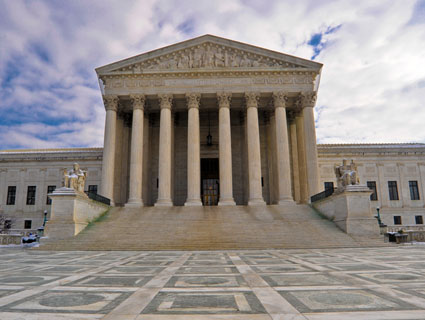
The gay-marriage debate hit a major milestone today. A federal appeals court has found section 3 of the Federal Defense of Marriage Act unconstitutional in violation of the Equal Protection Clause.* The groundbreaking ruling will no doubt end up before the Supreme Court.

Interestingly, the three judge panel was comprised of two Republican appointees. The unanimous decision was made at least partly on federalist, states' rights grounds.

"One virtue of federalism is that it permits this diversity of governance based on local choice, but this applies as well to the states that have chosen to legalize same-sex marriage," Judge Michael Boudin wrote for the court. "Under current Supreme Court authority, Congress' denial of federal benefits to same-sex couples lawfully married in Massachusetts has not been adequately supported by any permissible federal interest."

Now, there's a dark and a light side to federalism. States' rights—and really, we should put "rights" in quotation marks here—have been an excuse for plenty of atrocities, including slavery and segregation. The states in question are home to plenty of their own tyrannies, great and small.

On the other hand, right now a handful of states have stood in defiance of bad federal laws, including DOMA and the federal ban on medical marijuana. When gay couples married in Massachussettes are denied federal healthcare benefits, or when federal agents take down marijuana dispensaries in California, it's hard not to sympathize with a little federalism. It's a facet of our democracy that has, like democracy itself, been used for good and ill.

In other words, federalist arguments aren't easily dilineated into conservative and liberal camps. I think this actually complicates things for the "traditional marriage" forces. We've already seen some major conservatives like Ted Olson take on the gay-marriage ban in California, and federalist/small govermnet arguments rest at the heart of Olson's case.

These unlikely allies for pro-gay rights activists underscore why I'm mostly optimistic about the future of this country: However messed up the Republican party is, and however out of control the conservative movement may be, American conservatism is still rooted in a version of liberalism. Very little of the European traditionalism that defined conservatives in the past has survived in American conservatism.

Sometimes I think that's part of the reason the conservative movement seems so off-kilter so much of the time—so quick to latch onto strict rhetorical and ideological positions that aren't really guided by a coherent set of principles. But it also means that buried beneath the wreckage of so many contemporary conservative arguments is a strand of liberalism that actually does value progress, individual rights, and equality.

Americans are increasingly becoming more pro-gay rights, and the next generation will be even more so, across all polititical ideologies. Maybe conservative acceptance of gay marriage will be based on federalist or small-government arguments, but I suspect a lot of it will eventually be about freedom.

This post has been updated to clarify the scope of the ruling. Erik Kain is guest blogging this week while Kevin Drum is on vacation.

Tue Apr. 30, 2013 12:57 PM PDT
Tue Feb. 12, 2013 5:21 AM PST
Thu Dec. 13, 2012 4:03 AM PST
Mon Nov. 5, 2012 4:20 PM PST
Fri Jun. 1, 2012 3:20 AM PDT
Fri Jun. 1, 2012 3:00 AM PDT
Thu May. 31, 2012 3:35 PM PDT
Thu May. 31, 2012 1:33 PM PDT
Thu May. 31, 2012 12:51 PM PDT
Tue May. 29, 2012 3:27 PM PDT
Tue May. 29, 2012 12:24 PM PDT