



Gavin Aronsen

Gavin Aronsen

Reporter

Gavin is a Mother Jones reporter in the DC bureau.

Full Bio | Get my RSS |

Gavin is an Iowa native, and covered the 2008 first-in-the-nation presidential caucuses for the Ames Tribune. He has also contributed to the Agence France-Presse, Daily BeastIowa Independent, Manhattan Media, and Village Voice.

Under Obama, Feds Holster Gun Cases

| Fri Feb. 15, 2013 4:01 AM PST

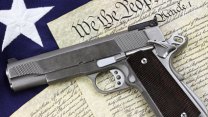
Despite the amped-up claims that President Obama is just waiting to crack down on gun owners, a new report reveals that his administration has been pursuing significantly fewer gun crimes than the predeceeding one. Under Obama, federal weapons prosecutions have declined to their lowest levels nearly a decade, according to a new report from the Transactional Records Access Clearinghouse, a research group associated with Syracuse University.

After 9/11, the Bush administration's firearms prosecutions shot up, peaking at about 11,000 cases in 2004. In 2012, the feds prosecuted fewer than 8,000 gun cases:

TRAC

The prosecutions' most common target are felons who illegally possess or sell weapons—not legal owners or sellers who run afoul of the law. And, TRAC notes, counting on federal prosecutions misses the majority of gun cases: "Because of the very different number of the enforcers and prosecutors working at the two levels, state and local gun prosecutions almost certainly dwarf anything that is done by the federal government."

It's not entirely clear how the gun lobby's efforts to hamstring the Bureau of Alcohol, Tobacco, Firearms and Explosives's ability to enforce weapons laws has influenced the decline in gun cases. But of the 3,741 weapons cases referred to federal attorneys in 2012 that weren't investigated, about 40 percent were determined to lack sufficient evidence to pursue. And since 2005, the number of cases referred by the ATF has exceeded the number of weapons crimes prosecuted by federal authorities.

TRAC

Advertise on MotherJones.com

Was Hitler Really a Fan of Gun Control?

| Fri Jan. 11, 2013 4:01 AM PST

Near the outset of his rant on Piers Morgan Tonight on Monday, conspiracy peddler Alex Jones warned that the Second Amendment is all that stands between democracy and dictatorship. "Hitler took the guns, Stalin took the guns, Mao took the guns, Fidel Castro took the guns, Hugo Chávez took the guns, and I'm here to tell you, 1776 will commence again if you try to take our firearms!" he screamed.

Two days later, the Drudge Report published this visual echo of Jones' claim:

Meanwhile, Google searches for "Hitler gun control" are spiking.

Of course, attempts to equate gun control with fascism are bogus. But the "Hitler took the guns" argument has long had a prominent and fairly effective role in America's gun control debate despite its obvious reductionism.

Its origins can be traced back to at least the early 1980s, when opponents of a Chicago proposal to ban handguns invoked it in the largely Jewish suburb of Skokie by "reminding village residents that the Nazis disarmed the Jews as a preliminary to sending them to the gas chambers," the Chicago Tribune reported. In 1989, a new pro-gun group called Jews for the Preservation of Firearms Ownership began arguing that the 1968 federal gun control bill once favored by the NRA's old guard "was lifted, almost in its entirety, from Nazi legislation." (That false claim is still being repeated.)

In 1994, JPFO founder Aaron Zelman implored the NRA's board to seize on the alleged Nazi connection:

Some of you may even have figured out that unless the NRA changes its strategy, the law abiding firearm owner in America will go the way of the Jews in Nazi occupied Europe: extermination…The choice is yours; you can turn your back on a failed strategy—one of compromise with evil-doers—and attack the concept of "gun control" by exposing the Nazi roots of "gun-control" in America. Or, you can persist in a failed strategy, and accept your own extinction.

Whether or not the NRA was influenced by his advice, that same year its CEO, Wayne LaPierre, published Guns, Crime, and Freedom, in which he claimed, "In Germany, firearm registration helped lead to the holocaust," leaving citizens "defenseless against tyranny and the wanton slaughter of a whole segment of its population." The following year, President George H.W. Bush famously resigned from the NRA after LaPierre attacked federal law enforcement officials as "jack-booted government thugs" who wore "Nazi bucket helmets and black storm trooper uniforms." More recently, Stephen Halbrook, a lawyer who has represented the NRAargued (PDF) that "if the Nazi experience teaches anything, it teaches that totalitarian governments will attempt to disarm their subjects so as to extinguish any ability to resist crimes against humanity."

So did Hitler and the Nazis really take away Germans' guns, making the Holocaust unavoidable? This argument is superficially true at best, as University of Chicago law professor Bernard Harcourt explained in a 2004 paper (PDF) on Nazi Germany's impact on the American culture wars. As World War I drew to a close, the new Weimar Republic government banned nearly all private gun ownership to comply with the Treaty of Versailles and mandated that all guns and ammunition "be surrendered immediately." The law was loosened in 1928, and gun permits were granted to citizens "of undoubted reliability" (in the law's words) but not "persons who are itinerant like Gypsies." In 1938, under Nazi rule, gun laws became significantly more relaxed. Rifle and shotgun possession were deregulated, and gun access for hunters, Nazi Party members, and government officials was expanded. The legal age to own a gun was lowered. Jews, however, were prohibited from owning firearms and other dangerous weapons.

SEC Could Require Corporations to Disclose Their Dark Money

| Tue Jan. 8, 2013 12:26 PM PST

In August 2011, a group of 10 law professors submitted a petition (PDF) to the Securities and Exchange Commission urging the agency to consider requiring publicly held companies to fully disclose their political spending to their investors. After the proposal received more than 320,000 public comments, an unprecedented number, the SEC placed it on its 2013 agenda on the Friday before Christmas.

As it stands now, corporations must publicly disclose much of their political spending, but there is no way to know their total spending, partly because they can cloak their contributions by channeling them through outside-spending groups with lax disclosure requirements. For example, the insurance giant Aetna handed over more than $7 million to the American Action Network and Chamber of Commerce to quietly influence recent elections; those donations were only revealed inadvertently.

The Corporate Reform Coalition, a collection of campaign-finace reform groups led by Public Citizen, is applauding the SEC's willingness to consider the new rules. "Investors have been clamoring for this information from the SEC for some time," said Robert Jackson, a Columbia University law prof who cosponsored the SEC petition, during a conference call organized by the coalition this morning.

Some corporations already voluntarily disclose all of their political spending; others argue that mandatory disclosure would be too burdensome. Rep. John Sarbanes (D-Md.), a member of a newly formed House task force on election reform that's taking aim at Citizens United and one of 42 members of the House to publicly support the SEC proposal, has rejected that argument, calling for the agency to "mandate uniform disclosure of a minimum dataset" of political spending.

Corporate response to shareholders' demands for political spending disclosure, based on figures from the Center for Political Accountability.


While proponents of the proposal expect strong opposition from corporate America, they are hopeful that the SEC, influenced by what Pennsylvania state treasurer Rob McCord called a "moderate, centrist, good-government impulse," will implement the new rule this year. One of the SEC's four commissioners, Luis Aguilar, is already an outspoken proponent of uniform disclosure requirements. Without them, he's said, "it is impossible to have any corporate accountability or oversight."

And for all the controversy surrounding Citizens United, the Supreme Court overwhelmingly upheld the constitutionality of disclosure requirements as part of its ruling. (Only Justice Clarence Thomas dissented.) The CU decision explicitly acknowledged the importance of shareholders' "corporate democracy" in "determin[ing] whether their corporation’s political speech advances the corporation’s interest in making profits."

Rep. Sarbanes has called the SEC's willingness to consider the rule-change proposal "an incredibly important development." On this morning's conference call, he referred to outside spending groups as "money drones": "You're walking down the street running your campaign, next thing you know they come at you with a lot of money, and the people operating those drones are hidden because we don't have proper disclosure."

Wed May. 15, 2013 5:55 PM PDT
Tue Apr. 23, 2013 3:22 PM PDT
Thu Mar. 21, 2013 3:56 PM PDT
Tue Mar. 19, 2013 8:51 AM PDT
Mon Mar. 18, 2013 1:03 PM PDT
Fri Mar. 15, 2013 3:00 AM PDT
Fri Mar. 1, 2013 3:29 PM PST
Fri Feb. 15, 2013 4:01 AM PST
Fri Jan. 11, 2013 4:01 AM PST
Fri Nov. 30, 2012 4:08 AM PST
Thu Nov. 15, 2012 5:00 PM PST
Fri Nov. 9, 2012 4:03 AM PST
Wed Nov. 7, 2012 2:26 PM PST
Fri Nov. 2, 2012 3:08 AM PDT
Fri Oct. 26, 2012 4:28 PM PDT
Fri Oct. 26, 2012 3:03 AM PDT