



Gavin Aronsen

Gavin Aronsen

Reporter

Gavin is a Mother Jones reporter in the DC bureau.

Full Bio | Get my RSS |

Gavin is an Iowa native, and covered the 2008 first-in-the-nation presidential caucuses for the Ames Tribune. He has also contributed to the Agence France-Presse, Daily BeastIowa Independent, Manhattan Media, and Village Voice.

Advertise on MotherJones.com

SCOTUS to Consider Challenge to Campaign Donation Limits

| Tue Feb. 19, 2013 1:15 PM PST

This morning, the Supreme Court agreed to hear McCutcheon v. Federal Election Commission (PDF), a case challenging the nearly 40-year-old cap on aggregate contributions to federal candidates, parties, and political action committees (PACs) as a violation of donors' right to free speech.

Thanks to the court's Citizens United decision in January 2010, donors can already give unlimited funds to super-PACs and 501(c)(4) groups, which are ostensibly prohibited from coordinating directly with the candidates they support. However, under federal law, donors are limited to giving no more than a total of $46,200 to federal candidates and $70,800 to parties and PACs during any two-year election cycle. Overturning those limits would not affect how much a donor could give an individual candidate (currently $2,600 per year), but a donor would potentially be able to cut a single multimillion-dollar check to a joint fundraising committee set up to distribute funds to multiple House and Senate candidates and state party committees. That committee could technically funnel the entire donation to a single candidate through a series of transfers.

When the Supreme Court ruled in Citizens United that restricting outside spending violated the First Amendment, it overturned 100 years of legal precedents. If it takes a similar track in McCutcheon, laws limiting campaign contributions that date back to 1974—and affirmed by the court in 1976 in Buckley v. Valeo—would be overturned.

"If the Supreme Court reverses its past ruling in Buckley, the Court would do extraordinary damage to the nation's ability to prevent the corruption of federal officeholders and government decisions," Fred Wertheimer, president of the reform group Democracy 21, said in a statement. "It would also represent the first time in history that the Court declared a federal contribution limit unconstitutional." Democracy 21 has been involved in the McCutcheon case since it was dismissed by a DC district court and subsequently appealed; the group is preparing an amicus brief defending the constitutionality of the current donation limits.

Rick Hasen, a law professor at the University of California-Irvine, told Politico that the outside spending groups that arose from Citizens United made aggregate limits less important but wrote that the "broader significance" of the McCutcheon case is that it could make future constitutional challenges against contribution limits much harder to defeat.

Yet the current justices have shown that they are sympathetic to some limits on campaign fundraising. Justice Anthony Kennedy, the swing vote in Citizens United, argued in 2003 that donor caps on loosely regulated "soft money" were constitutional "under Buckley's anticorruption rationale."

Under Obama, Feds Holster Gun Cases

| Fri Feb. 15, 2013 4:01 AM PST

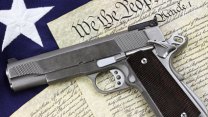
Despite the amped-up claims that President Obama is just waiting to crack down on gun owners, a new report reveals that his administration has been pursuing significantly fewer gun crimes than the predeceeding one. Under Obama, federal weapons prosecutions have declined to their lowest levels nearly a decade, according to a new report from the Transactional Records Access Clearinghouse, a research group associated with Syracuse University.

After 9/11, the Bush administration's firearms prosecutions shot up, peaking at about 11,000 cases in 2004. In 2012, the feds prosecuted fewer than 8,000 gun cases:

TRAC

The prosecutions' most common target are felons who illegally possess or sell weapons—not legal owners or sellers who run afoul of the law. And, TRAC notes, counting on federal prosecutions misses the majority of gun cases: "Because of the very different number of the enforcers and prosecutors working at the two levels, state and local gun prosecutions almost certainly dwarf anything that is done by the federal government."

It's not entirely clear how the gun lobby's efforts to hamstring the Bureau of Alcohol, Tobacco, Firearms and Explosives's ability to enforce weapons laws has influenced the decline in gun cases. But of the 3,741 weapons cases referred to federal attorneys in 2012 that weren't investigated, about 40 percent were determined to lack sufficient evidence to pursue. And since 2005, the number of cases referred by the ATF has exceeded the number of weapons crimes prosecuted by federal authorities.

TRAC
Wed May. 15, 2013 5:55 PM PDT
Tue Apr. 23, 2013 3:22 PM PDT
Thu Mar. 21, 2013 3:56 PM PDT
Tue Mar. 19, 2013 8:51 AM PDT
Mon Mar. 18, 2013 1:03 PM PDT
Fri Mar. 15, 2013 3:00 AM PDT
Fri Mar. 1, 2013 3:29 PM PST
Fri Feb. 15, 2013 4:01 AM PST
Fri Jan. 11, 2013 4:01 AM PST
Fri Nov. 30, 2012 4:08 AM PST
Thu Nov. 15, 2012 5:00 PM PST
Fri Nov. 9, 2012 4:03 AM PST
Wed Nov. 7, 2012 2:26 PM PST
Fri Nov. 2, 2012 3:08 AM PDT
Fri Oct. 26, 2012 4:28 PM PDT