




James Ridgeway

James Ridgeway

In 1965, James Ridgeway helped launch the modern muckraking era by revealing that General Motors had hired private eyes to spy on an obscure consumer advocate named Ralph Nader. He worked for many years at the Village Voice, has written 16 books, and has codirected Blood in the Face, a film about the far right. In 2012, he was named a Soros Justice Media Fellow.

Get my RSS |

Advertise on MotherJones.com

Nearly 6 Million Americans Can't Vote Due to Felon Disenfranchisement Laws

| Fri Jul. 13, 2012 2:30 AM PDT

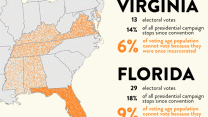
In an updated study released Thursday, the Sentencing Project reports that close to 6 million Americans are now unable to vote thanks to felon disenfranchisement laws. "Approximately 2.5 percent of the total US voting age population—1 of every 40 adults—is disenfranchised due to a current or previous felony conviction," notes the report, authored by Christopher Uggen and Sarah Shannon of the University of Minnesota and Jeff Manza of New York University.

The numbers have risen dramatically over the decades, due both to the rise of mass incarceration in the United States and to the spread of restrictive state voting laws. As we reported last week, nearly all states bar imprisoned felons from voting, 29 states bar them even after they have served their time, and a handful—including several battleground states—effectively bar them for life. The number of affected Americans has ballooned from 1.2 million people in 1976 to 3.3 million in 1996. As of 2010, the figure stands at 5.9 million.

Rates of disenfranchisement vary dramatically by state due to broad variations in voting prohibitions. In six states—Alabama, Florida, Kentucky, Mississippi, Tennessee, and Virginia—more than 7 percent of the adult population is disenfranchised.

In what amounts to a modern-day version of Jim Crow-era statutes, felon disenfranchisement takes a substantial bite out of the black vote. According to the report, nearly 8 percent of voting-age black Americans (1 in 13) is disenfranchised, compared with roughly 2 percent of their non-black counterparts. In three states—Florida, Kentucky, and Virginia, at least 1 in 5 black Americans will be out of luck come Election Day. In the cases of Florida and Virginia, the numbers are sizeable enough to change the outcome in November. As Desmond Meade of the nonprofit Florida Rights Restoration Coalition put it to us last week: If these people were able to vote, "Florida would no longer be a swing state."

Senators Finally Ponder the Question: Is Solitary Confinement Wrong?

| Tue Jun. 19, 2012 12:58 PM PDT
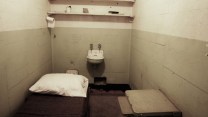
The ACLU set up this realistic mock solitary cell in the hearing room.

The cell placed at the back of the hearing room in the Dirksen Senate Office Building was a pretty accurate replica of a real isolation cell—the kind that exists in supermax prisons and solitary confinement units all over the country. It measured about 7 feet by 10 feet, with a tiny covered window too high to see out of and nothing inside but a bunk and a toilet. The door contained a slot through which a guard slides a food tray; for many prisoners, this represents their only human contact for the day. These are the conditions in which some 80,000 inmates live on any given day in American prisons and jails. They spend at least 23 hours a day in their cells, and some remain in solitary for years or even decades.

Solitary confinement in our prisons and jails may be the most pressing domestic human rights problem to which most Americans remain largely oblivious. But today, supporters and foes of the practice descended on Capitol Hill for a hearing of the Senate Judiciary Committee Subcommittee on the Constitution, Civil Rights and Human Rights, convened by subcommittee chairman Dick Durbin. An overflow crowd of some 200 spectators came there to witness—somewhat amazingly—the first-ever congressional hearing on solitary confinement.

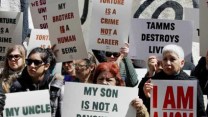
Durbin opened the proceedings with a surprisingly strong indictment of solitary confinement as it is practiced in US prisons. The senator, who had visited the notorious Tamms supermax in his home state of Illinois and was apparently much-affected by the experience, called on his colleagues to visit prisons in their states and witness the conditions for themselves. "America has led the way with human rights around the world," Durbin said. But "what do our prisons say about our American values?"

Smackdown: ACLU Calls Out Private Prison Giant

| Wed May. 16, 2012 12:09 AM PDT
ACLU vs CCA

The American Civil Liberties Union has invited the leader of the nation's largest private prison enterprise, Corrections Corporation of America, to a public debate on the merits of prison privatization.

The organization's May 8 letter to CEO Damon T. Hininger notes that CCA "has repeatedly criticized the views of the ACLU regarding for-profit incarceration. If you truly believe that private prisons are right for our country, we see no reason why you would be unwilling to defend that position in a public debate." The letter, signed by David Fathi, director of the ACLU’s National Prison Project and David Shapiro, a staff attorney, goes on to suggest that Hininger debate Shapiro for 90 minutes "at a mutually agreeable time and public venue."

Tue May. 19, 2009 1:43 PM PDT
Mon May. 11, 2009 12:00 PM PDT
Fri May. 1, 2009 10:26 AM PDT
Thu Apr. 30, 2009 11:48 PM PDT
Wed Apr. 29, 2009 2:47 PM PDT
Mon Apr. 27, 2009 7:08 AM PDT
Fri Apr. 24, 2009 12:55 PM PDT
Fri Apr. 24, 2009 11:42 AM PDT
Thu Apr. 23, 2009 11:32 AM PDT
Tue Apr. 21, 2009 11:23 AM PDT
Tue Apr. 14, 2009 11:28 AM PDT
Mon Apr. 13, 2009 1:23 PM PDT
Fri Apr. 10, 2009 12:30 PM PDT
Thu Apr. 9, 2009 2:17 PM PDT
Wed Apr. 8, 2009 11:14 AM PDT
Tue Apr. 7, 2009 1:17 PM PDT
Mon Apr. 6, 2009 1:36 AM PDT
Tue Mar. 24, 2009 10:01 AM PDT
Thu Mar. 5, 2009 3:22 PM PST
Sat Feb. 14, 2009 6:44 PM PST
Thu Feb. 5, 2009 7:46 AM PST
Tue Feb. 3, 2009 11:00 AM PST
Tue Jan. 27, 2009 8:47 AM PST
Wed Jul. 14, 2010 11:11 AM PDT