
Julia Whitty

Julia Whitty

Environmental Correspondent

Julia is an award-winning author of fiction and nonfiction (Deep Blue Home, The Fragile Edge, A Tortoise for the Queen of Tonga), and a former documentary filmmaker. She also blogs at Deep Blue Home.

Full Bio | Get my RSS |

Julia is a writer and former documentary filmmaker and the author of The Fragile Edge: Diving & Other Adventures in the South Pacific, winner of a PEN USA Literary Award, the John Burroughs Medal, the Kiriyama Prize, the Northern California Books Awards, and finalist for the Dayton Literary Peace Prize, and Deep Blue Home: An Intimate Ecology of Our Wild Ocean. Her short story collection A Tortoise for the Queen of Tonga won an O. Henry and was a finalist for the PEN Hemingway Award. She also blogs at Deep Blue Home.

Reef Sharks Vanishing Around Populated Islands

| Fri Apr. 27, 2012 1:45 PM PDT

Gray reefs sharks: Albert kok via Wikimedia CommonsGray reefs sharks: Albert kok via Wikimedia Commons

A new study finds that sharks living on reefs near areas populated by people have declined by between 90 and 97 percent compared to relatively pristine reefs where few or no people live.

"We estimate that reef shark numbers have dropped substantially around populated islands, generally by more than 90 percent compared to those at the most untouched reefs," says Marc Nadon, lead author of the study.

The authors of the paper in early view at Conservation Biology deployed 1,607 towed-diver surveys—that's where scientists are used as shark bait (kidding, sort of)—to count sharks at 46 reefs in the central-western Pacific Ocean. They combined those data with information on human population, habitat complexity, and reef area, as well as with satellite-derived measurements of sea surface temperature and oceanographic productivity.

These methods allowed them to fill in the blanks on the numbers of missing sharks. Their models showed that:

  • Densities of gray reef sharks (Carcharhinus amblyrhynchos), whitetip reef sharks (Triaenodon obesus), and other reef sharks increased substantially as human population decreased. 
  • Densities of reef sharks increased substantially as primary productivity and minimum sea surface temperature (which correlates to reef area) increased.

From the paper:

Simulated baseline densities of reef sharks under the absence of humans were 1.1–2.4 [per hectare] for the main Hawaiian Islands, 1.2–2.4 [per hectare] for inhabited islands of American Samoa, and 0.9–2.1 [per hectare] for inhabited islands in the Mariana Archipelago, which suggests that density of reef sharks has declined to 3–10% of baseline levels in these areas.


Blacktip reef sharks: Jon Rawlinson via Wikimedia CommonsBlacktip reef sharks: Jon Rawlinson via Wikimedia Commons

"[Sharks] like it warm, and they like it productive," said Julia Baum, Assistant Professor at the University of Victoria, Canada, referring to the increase in reef sharks the team found in areas with higher water temperatures and productivity. "Yet our study clearly shows that human influences now greatly outweigh natural ones."

The paper:

  • NADON, M. O., BAUM, J. K., WILLIAMS, I. D., MCPHERSON, J. M., ZGLICZYNSKI, B. J., RICHARDS, B. L., SCHROEDER, R. E. and BRAINARD, R. E. (2012), Re-Creating Missing Population Baselines for Pacific Reef Sharks. Conservation Biology. doi: 10.1111/j.1523-1739.2012.01835.x


Advertise on MotherJones.com

Big Changes in Ocean Salinity Intensifying Water Cycle

| Thu Apr. 26, 2012 1:56 PM PDT

Surface salinity changes for 1950 to 2000. Red indicates regions becoming saltier, and blue regions becoming fresher: P.J. Durack, et al. 2012. Science. DOI:10.1126/science.1212222

Surface salinity changes from 1950 to 2000. Red shows regions becoming saltier, blue regions becoming fresher:  P.J. Durack, et al. Science. 2012. DOI:10.1126/science.1212222

A paper in Science today finds rapidly changing ocean salinities as a result of a warming atmosphere have intensified the global water cycle (evaporation and precipitation) by an incredible 4 percent between 1950 and 2000. That's twice the rate predicted by models. 

These same models have long forecast that dry areas of Earth will become drier and wet areas wetter in a warming climate—an intensification of the water cycle driven mostly by the capacity of warmer air to hold and redistribute more moisture in the form of water vapor.

satellite image shows the distribution of water vapor over Africa and the Atlantic Ocean on  2 Sept 2010: NASASatellite image shows the distribution of water vapor over Africa and the Atlantic Ocean on 2 Sept 2010: NASA

But the rate of intensification of the global water cycle is happening far faster than imagined: at about 8 percent per degree Celsius of ocean warming since 1950.

At this rate, the authors calculate:

  • The global water cycle will intensify by a whopping 16 percent in a 2°C warmer world
  • The global water cycle will intensify by a frightening 24 percent in a 3°C warmer world


A schematic representation of the global water cycle, with the key role of the ocean and surface rainfall and evaporation fluxes expressed: Durack et al. Science. 2012. DOI:10.1126/science.1212222

A schematic representation of the global water cycle, with the key role of the ocean and surface rainfall and evaporation fluxes expressed: Durack et al. Science. 2012. DOI:10.1126/science.1212222 

The changes will not be uniform across the globe, but trend toward increased drying of arid areas and  increased flooding of wet areas.

And the resulting changes in freshwater availability are likely to be far more destabilizing to human societies and ecosystems than warming alone. 

"Changes to the global water cycle and the corresponding redistribution of rainfall will affect food availability, stability, access, and utilization," says lead author Paul Durack at the University of Tasmania and the Lawrence Livermore National Laboratory.

The paper:

  • Paul J. Durack, Susan E. Wijffels and Richard J. Matear. Ocean Salinities Reveal Strong Global Water Cycle Intensification During 1950 to 2000. Science 2012. DOI:10.1126/science.1212222

Antarctic Ice Melting From Below by Warming Ocean

| Wed Apr. 25, 2012 11:20 AM PDT


First map of Antarctica's moving ice: Image courtesy Eric Rignot, NASA Jet Propulsion Laboratory and University of California IrvineFirst map of Antarctica's moving ice: Image courtesy Eric Rignot, NASA Jet Propulsion Laboratory and University of California Irvine

A paper published today in the science journal Nature reveals that the melting of Antarctica's ice sheet is being driven by a warming ocean more than a warming atmosphere.

Which means even though summer air temperatures have not yet warmed enough to substantially melt Antarctica's surface snows, the oceans are undermining the frozen continent from below—fueling a recent, widespread, and intensifying glacier acceleration and its accompanying rise in sea levels.

The results are based on 4.5 million measurements made by a laser instrument mounted on NASA's now defunct ICESat satellite between 2003 and 2008, which mapped the thickness of most floating ice shelves around Antarctica. The results:

  • Of 54 ice shelves mapped, 20 are being melted by warm ocean currents, most of those in West Antarctica.
  • In all cases the inland glaciers that flow down to the coast and feed into these thinning ice shelves have accelerated, draining more ice into the sea and contributing to sea-level rise.

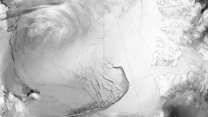
The Ronne-Filchner Ice Shelf in West Antarctica on the afternoon of 12 January 2010 .: NASA images courtesy Jeff Schmaltz, MODIS Rapid Response Team at NASA GSFC.

The Ronne-Filchner Ice Shelf in West Antarctica on the morning of 13 January 2010: NASA images courtesy Jeff Schmaltz, MODIS Rapid Response Team at NASA GSFC

The Ronne-Filchner Ice Shelf in West Antarctica  rapidly breaking up. Top image taken on the afternoon of 12 January 2010. Bottom image taken 24 hours later on the afternoon of 13 January 2010: NASA images courtesy Jeff Schmaltz, MODIS Rapid Response Team at NASA GSFC

The melting is happening fastest where deep troughs cut through the underwater continental shelf, allowing warmer water access to the undersides of the ice shelves. 

Lead author Hamish Pritchard at the British Antarctic Survey says:

"What’s really interesting is just how sensitive these glaciers seem to be. Some ice shelves are thinning by a few meters a year and in response the glaciers drain billions of tons of ice into the sea. This supports the idea that ice shelves are important in slowing down the glaciers that feed them, controlling the loss of ice from the Antarctic ice sheet... We think [the cause is] linked to changes in wind patterns. Studies have shown that Antarctic winds have changed because of changes in climate and that this has affected the strength and direction of ocean currents. As a result warm water is funnelled beneath the floating ice. These studies and our new results therefore suggest that Antarctica’s glaciers are responding rapidly to a changing climate. 


You can see that happening in this NASA video which shows warm ocean currents attacking the underside of ice shelves. Ice shelves colored red are thicker (greater than 1,800 feet / 550 meters). Those colored blue are thinner (less than 650 feet / 200 meters).  

The ice2sea project team behind the new paper will be releasing its projections on sea level rise into the 21st and 22nd centuries later this year. 

5 Pieces of Good News From Planet Earth

| Fri Apr. 20, 2012 3:00 AM PDT

Credit: NASA.Credit: NASA.

Most news from nature is depressing—species extinctions, changing climate, dying oceans. Yet it's not all bad... though we might never know it, since positive news is underreported. 

I wrote about this tendency in my latest MoJo print piece about my old friend Enriqueta Velarde and her work to save an island and a whole ecosystem called Can One Incredibly Stubborn Person Save a Species?

That article grew from a call-to-arms in a science paper in TREE last year: Conservation science must engender hope to succeed. The authors persuasively argued that by not reporting good conservation news, both the media and science journals facilitate a climate of despair and pessimism and create a self-defeating positive feedback loop. They suggested we work harder to broadcast successes stories and the people behind them. 

So what works and where? Here are a few stories that caught my eye recently.

Credit: Scott Schliebe via Wikimedia Commons.Credit: Scott Schliebe via Wikimedia Commons.

1) Huge Drop in PCB Levels in Norwegian Polar Bears 

Nothing we hear about polar bears these days is good. Except this. Researchers from the Norwegian University of Science and Technology have found that levels of toxic PCBs and related contaminants in bears from the island of Svalbard have dropped by as much as 59 percent in cubs, and by as much as 55 percent in their mothers, between 1998 and 2008. Biologist Jenny Bytingsvik says the sharp downward trend is a sign that international agreements to ban PCBs are working.


Credit: Amur Leopard via Wikimedia Commons.Credit: Amur Leopard via Wikimedia Commons.

2) Amur Cats Get Their Own National Park 

Extremely rare Amur leopards (wild population: 30) have won a long-fought battle to establish a safer home for them with the establishment of the 650,000-acre (262,000-hectare) Land of the Leopard National Park in Russia's Far East. The park is also home to 10 rare Amur tigers. Since some cats cross the border into China, the World Wildlife Fund hopes to establish a cross-border reserve to allow the leopards to expand their habitat and hop the border at will. China already has two wildlife reserves on its side.


Credit: Toby Hudson via Wikimedia Commons.Credit: Toby Hudson via Wikimedia Commons.

3)  Half Billion Dollars Funds Most Ambitious Conservation Programs Ever

The Global Environment Facility based in Washington DC, which administers huge honking trust funds for conservation, allocated $516.4 million to 40 individual projects and nine larger program last November—its most ambitious round of funding ever. Included: a proposal to protect at least 5 percent of Brazil's ocean territory through marine protected areas; and a project to investigate the potential of creating 'blue forest' preserves in the ocean to facilitate the storage of carbon over time by mangrove and coral ecosystems. 


Credit: Oregon State University via Flickr.Credit: Oregon State University via Flickr.

4) Right Whales Return to New Zealand

Southern right whales have been extinct from ancestral calving grounds off New Zealand for more than a century. So presumably no living whales remembered how to get to New Zealand from their sub-Antarctic feeding grounds. Yet some whales are finding their way home again. And recently published research by a team from the US, New Zealand, Canada, and Australia suggests they're a genetically distinct group—the likely descendants of whales that once lived off New Zealand. Prior to whaling, 30,000 whales bred in the sandy bays of Kiwi Land. A few dozen have returned since 2005, hopefully the pioneers of a new wave.


 Credit: Tamar Assaf via Wikimedia Commons.

Credit: Tamar Assaf via Wikimedia Commons.

5) Arabian Oryx Returns from Extinction

This beautiful antelope was believed to be extinct in the wild since ~1973 when the last individual was shot in Oman. Captive breeding efforts went into cooperative overdrive with a program called Operation Oryx, a collaboration between the Phoenix Zoo, Fauna & Flora International, and the World Wildlife Fund. Today after successful reintroductions and a lot of hard work from antelope moms, ~1,000 individuals are again living in the wild, with ~6,00-7,000 in captive herds. The species has ratcheted up three levels on the Red List: from "Extinct in the Wild" to "Critically Endangered" to "Endangered" now to "Vulnerable." Only two more stops before "Least Concern."

Bonus: Did you know that earth's protected areas cover 8 million square miles of land and sea—more than twice the size of Canada? We've sure come a long way since 1872. Charts and maps here.

Wed May. 30, 2007 3:33 PM PDT
Tue May. 29, 2007 6:14 PM PDT
Tue May. 29, 2007 5:06 PM PDT
Tue May. 29, 2007 4:32 PM PDT
Fri May. 25, 2007 6:22 PM PDT
Thu May. 24, 2007 2:36 PM PDT
Thu May. 24, 2007 12:23 PM PDT
Thu May. 24, 2007 11:54 AM PDT
Wed May. 23, 2007 11:32 AM PDT
Wed May. 2, 2007 5:56 PM PDT
Wed May. 2, 2007 4:20 PM PDT
Mon Apr. 30, 2007 12:30 PM PDT
Mon Apr. 30, 2007 12:15 PM PDT
Wed Apr. 25, 2007 5:07 PM PDT
Wed Apr. 18, 2007 5:30 PM PDT
Wed Apr. 18, 2007 5:09 PM PDT
Mon Apr. 16, 2007 3:13 PM PDT
Mon Apr. 16, 2007 2:38 PM PDT
Sun Apr. 15, 2007 1:08 PM PDT
Wed Apr. 11, 2007 4:52 PM PDT
Sat Apr. 7, 2007 12:25 PM PDT
Fri Apr. 6, 2007 1:23 PM PDT
Thu Apr. 5, 2007 4:25 PM PDT
Tue Apr. 3, 2007 5:38 PM PDT