
Mountainous star coral (Montastraea faveolata) spawns, releasing sperm and eggs that will combine to produce larvae: National Oceanic and Atmospheric Association
Results are in from the first controlled laboratory tests on how Deepwater Horizon oil and the dispersant Corexit® 9500 affect coral larvae. Conclusion: Baby corals of at least some species are likely to be killed when exposed to oil and are especially likely to die when exposed to dispersants. The results have just been published in the science journal PLOS ONE.
Coral larvae are delicate little beings that drift away from their parents (see video below) to settle on near or distant reefs. The study from Mote Marine Laboratory scientists focused on two coral species—mustard hill coral(Porites astreoides) and mountainous star coral(Montastraea faveolata)—from the Florida Keys, an area not directly impacted by the spill. Both species are common reef builders in the Gulf and the Caribbean.
The researchers tested larvae in water containing 1) the dissolved components of Deepwater Horizon oil from the source; 2) weathered oil; 3) the dispersant Corexit® 9500; and 4) the combined oil and dispersant. They monitored the coral larvae for 72 hours at different concentrations of each solution, and tested how the mountainous star coral larvae fared in solutions that were slowly diluted over 96 hours.
Larvae exposed to oil components died sooner and settled less than control larvae given only seawater.
Mustard hill coral larvae were significantly less likely to survive and settle amid high concentrations of oil components (0.62 parts per million).
Mountainous star coral had significantly lower survival rates even at the lowest oil concentration (0.49 ppm diluted over time).
Larvae exposed to weathered crude oil had significantly lowered survival rates and stopped settling after 72 hours, while the control larvae continued to settle through 96 hours.
Settlement by larvae exposed to crude oil. Mean percent (% 6 SE) new settlement by P. astreoides larvae exposed to Louisiana weathered crude oil (solid bars) and a seawater control (open bars) observed at each time point (24, 48, 72 and 96-hr). Mean percent (% 6 SE) cumulative settlement by P. astreoides larvae after 24, 48, 72 and 96-hr exposure to Louisiana weathered crude oil (dashed line) and a seawater control (solid line)" doi:10.1371/journal.pone.0045574.g001
Both species were highly vulnerable to Corexit® 9500:
"Our results support the growing knowledge that certain coral species may fare worse than others during oil spills," said Kim Ritchie, principal investigator.
No mountainous star coral larvae settled or survived at the medium and high concentrations (50 and 100 ppm).
No mustard hill coral larvae settled or survived at the high concentration (100 ppm).
Both species of coral larvae were significantly less likely to survive and settle amid medium concentrations (4.28 ppm for mustard hill coral and 18.56 ppm for mountainous star coral) or high concentrations (30.99 for mustard hill and 35.76 ppm for mountainous star) of oil mixed with dispersant.
Even at a low concentration (0.86 ppm) of oil-dispersant mixture diluted over 96 hours, most of the mountainous star coral did not survive.
"To understand how oil and dispersant could affect wild corals, more research is needed on their complex natural life cycles," said Kim Ritchie, principal investigator on the emergency Protect Our Reefs grant supporting this study and manager of the Marine Microbiology Program at Mote. "Coral larvae seem to settle with help from landing pads called 'biofilms' that are formed by microbes like marine bacteria. This delicate natural process might be interrupted by dispersant and its mixture with oil, so it's important to know how it works in detail."
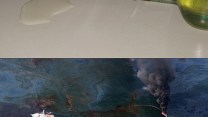
Aerial view of the oil leaked from Deepwater Horizon, May 6 2010: Reuters/Daniel Beltra via Flickr
The Deepwater Horizon rig spewed more than 200 million gallons of oil into the Gulf of Mexico and responders used nearly 2 million gallons of dispersant to try and keep the slicks from reaching shore—a mitigation that likely exacerbated the threats from oil toxins underwater.
The open access paper:
Gretchen Goodbody-Gringley, Dana L. Wetzel, Daniel Gillon, Erin Pulster, Allison Miller, Kim B. Ritchie. Toxicity of Deepwater Horizon Source Oil and the Chemical Dispersant, Corexit® 9500, to Coral Larvae. PLOS ONE. doi:10.1371/journal.pone.0045574.g001
*The coral larvae in this study were collected under the government research permit FKNMS-2010-080-A2 issued by the Florida Keys National Marine Sanctuary. Coral reefs within the Sanctuary are protected by federal law.
The science journal PNAS (Proceedings of the National Academy of Sciences) has published a Deepwater Horizon Oil Spill Special Feature taking a look back 20 months after the explosion that killed eleven people and upended countless lives along the Gulf Coast. Specifically at what happened, what we learned, and what could be done better the next time around. The introduction is authored by Jane Lubchenco, administrator of NOAA, and Marcia McNutt, director of the USGS, among others. They write about the unprecedented scientific and engineering challenges suddenly thrown down in an arena of chaos:*
[S]topping the flow of oil, estimating the amount of oil, capturing and recovering the oil, tracking and forecasting surface oil, protecting coastal and oceanic wildlife and habitat, managing fisheries, and protecting the safety of seafood. Disciplines involved included atmospheric, oceanographic, biogeochemical, ecological, health, biological, and chemical sciences, physics, geology, and mechanical and chemical engineering. Platforms ranged from satellites and planes to ships, buoys, gliders, and remotely operated vehicles to laboratories and computer simulations... Many valuable lessons were learned that should be applied to future events.
High on their wish list:
The importance of preparedness. The consequences of lack of investment in recent decades in scientific understanding and technological development were brutally obvious during BP's mess.
Preparedness means a better basic understanding of the places likely to be affected by a spill at the scale of 'large marine ecosystems' such as the the Gulf of Mexico.
We need to mobilize funding for research fast during a spill, especially early on.
We need a better way for government to talk to the broadly-dispersed scientific community during a spill.
We need a new way for scientists to maintain intellectual property of their data so that it will still be considered publishable by journals later on, even as it's released so the media and public can know what's going on in as it happens.
Here's a quick look at the findings of a few of the other papers in the special feature.
This paper begins by noting that the biological consequences of the Deepwater Horizon oil spill are unknown especially for plants and animals that live year-round in areas that were oiled. The authors studied killifish—small dwellers of the coastal marshes of the Gulf coast—during the first four months of the spill. They found that fish living in oiled areas showed significant biological changes including genetic changes. The embryos and larval forms of killifish exposed to contaminated waters showed genetic changes of the type that lead to developmental abnormalities, decreased hatching success, and decreased survival. Overall the levels of biological and genetic changes in Gulf killifish in oiled waters were similar to what was seen in fish, sea otters, and harlequin ducks who initially survived theExxon Valdez oil spill in Alaska but who afterwards suffered population declines.
This paper assessed the impacts of the Deepwater Horizon oil spill on deep-water coral communities of the Gulf of Mexico. The authors examined 11 sites three to four months after the well was capped. They found healthy coral communities at all sites (map here) more than 12 miles / 20 kilometers from the Macondo well. But one site less than 7 miles / 11 kilometers away got walloped. The coral colonies there showed widespread signs of stress including: varying degrees of tissue loss; enlargement of sclerites (small bonelike supports); excess mucous production (think: snot); brittle stars (like the one wrapped around the coral sea fan in the photo above) that were bleached (think: stressed and unhealthy); and corals smothered with brown fluffy material called floc. Forty-three corals colonies were photographed at the contaminated site. About half of those colonies showed signs of stress in more than half the colony. A quarter of those colonies showed signs of stress in >90 percent of the colony. The brittle stars living commensally with the deep-water corals were hard hit too, with 53 percent displaying abnormal colors and/or attachment to the corals. Petroleum biomarkers in the floc bore the signature of oil from Deepwater Horizon. The authors write:
The presence of recently damaged and deceased corals beneath the path of a previously documented plume emanating from the Macondo well provides compelling evidence that the oil impacted deep-water ecosystems. Our findings underscore the unprecedented nature of the spill in terms of its magnitude, release at depth, and impact to deep-water ecosystems.
This paper reports on a wide range of gases and aerosols measured from aircraft around, downwind, and away from the Deepwater Horizon site, plus hydrocarbon measurements made from ships in the area. As you might guess air quality issues were different for workers at the site than for people living along the Gulf coast. Four sources of primary air pollutants attributable to the oil spill were detected including: hydrocarbons evaporating from the oil; smoke from deliberate burning of the oil slick; combustion products from the flaring of recovered natural gas; and ship emissions from the recovery and cleanup operations. Secondary organic aerosols that formed over the oil spill were dispersed in a wide plume which continued to increase in mass downwind, likely increasing aerosol particles in coastal communities. Hydrocarbons and ozone were also found downwind of the spill site though confined to narrower plumes.
Other papers in the special issue deal with estimating the flow rate of the well after blowout, plus the decision to cap the well, federal seafood safety response, and a lot more. All the Deepwater Horizon papers in this PNAS issue are open access so you can read without a subscription.
This paper and this one looked at the effects of the microbial communities in reponse to the sudden eruption of oil and gas into the surface and deep waters of the Gulf. The blowout fed a deep sea bacterial bloom that ate hydrocarbons, formed a localized low-oxygen (hypoxic) zone, and altered the microbiology of the region. Blooms of microbes arose in the plumes of oiled and gassed water, plumes which then sometimes cycled on currents back to the spill site now ready populated with microbes ready to eat more erupting oil and gas. This made for an efficient natural compost system. Since crude oil is composed of thousands of different hydrocarbon compounds that biodegrade at different rates in different depths and water temperatures, the erupted plumes were colonized by different species of microbes at different stages, depths, and ages. (Thanks microbes!)
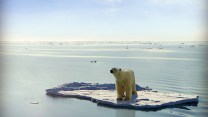
polar bear photo: Ansgar Walk via Wikimedia Commons
The National Oceanic and Atmospheric Administration (NOAA) published its seventh-annual Arctic Report Card this week, and though they didn't hand out a grade as they have in the past, it might as well be marked "G" for grim. Here are six of the biggest problems up north.
Virtually the entire length and width of the surface of the Greenland ice sheet melted for the first time in 2012. This year was also the longest melt season ever witnessed. Plus Greenland's ice lost some of its glitter as exposed soot, dust, and other particles blew onto the snow, darkening it and making it even more susceptible to melt. The more Greenland melts the more sea level rises.
Snow cover extent in both Eurasia and North America hit new record lows in June—the third time in five years that North America has set a new record low and the fifth year in a row that Eurasia has. The rate of June snow cover loss over Northern Hemisphere lands between 1979 and 2012 is -17.6 percent per decade—a faster decline than sea ice loss. Loss of spring snow cover affects the length of the growing season, the timing and dynamics of spring river runoff, permafrost thawing, and the yearly breeding and migratory clocks of wildlife. These schedule changes can throw species wildly out of sync with their environment—animals might migrate after their forage food has passed peak nutrition, for example—threatening their survival.
Arctic sea ice reached its smallest coverage, or extent, on record, 18 percent smaller than the previous record low set only five years ago and 49 percent below the 1979-2000 average. As the ice pack shrinks the ocean absorbs more sunlight and warming accelerates causing even more ice loss. Consequently wind patterns, clouds, ocean currents, and ecosystems are undergoing rapid transformations.
Arctic sea ice used to persist for many years, getting older and thicker with each passing year. Nowadays, not only is the area or extent of sea ice dwindling, but its volume too. The loss of old, thick, melt-resistant ice can easily become a self-reinforcing process. When old ice melts away—or when young ice fails to survive melt seasons—the ice that remains in the Arctic is predisposed to melt quickly the following summer. And that's what's happening in the 21st century, as you can see in the animation showing ice volume from 1987 to 2012 (below). Watch how old sea ice, on which so much Arctic life depends, is fast disappearing.
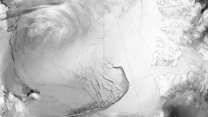
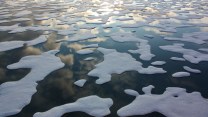
High primary productivity created by blooms of phytoplankton are normal at the edge of sea ice. But when this image was captured scientists at sea discovered a massive bloom reaching up to 62 miles / 100 kilometers under the thinning ice—yet another change in yet another Arctic ecosystem.
The loss of the polar ice cap over the Arctic Ocean exposes the waters to rising levels of atmospheric carbon dioxide like never before. No one yet knows what scary changes will ripple out from that.
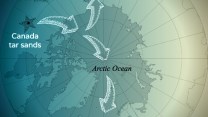
All background maps and data visualizations courtesy of the NOAA climate.gov team. See originals and more here. All graphic mashups: Julia Whitty.
Daily Arctic sea ice volume in thousands of cubic kilometers 1979-Aug 2012: Photo of melting ice by ironpoison via Flickr. Graph modeled ice volume data from the Polar Science Center at the University of Washington. Mashup: Julia Whitty
The seventh annual Arctic Report Card released by NOAA finds the rapid melting underway in northern lands and waters is unlikely to diminish in the face of continued global warming. The single biggest finding: Despite fewer weird warm spells in the Arctic in 2012, compared to the past ten warm years, snow and ice extent continued to melt at a record-breaking pace.
Ominously a new mechanism seems to be driving these changes. Disappearing ice and snow no longer reflect as much sunlight from the Earth. Meanwhile increasingly open waters and snow-free lands absorb more sunlight. This creates a self-reinforcing cycle of continued melting even during cooler times. It bodes poorly for recovery or stability in the far north.
No one is more amazed at the staggering rate of change than the scientists observing it. Bob Pickart, a physical oceanographer at the Woods Hole Oceanographic Institution and co-author of the Report Card (also principle investigator of the icebreaker cruise I tagged along on in the Arctic Ocean in October: see my Arctic Ocean Diaries)—tells me:
It is mind-boggling how quickly the Arctic system is changing and how unstable it appears to be. It is clear that there are strong, disturbing trends, but it is also evident how complex the system is and hence how hard it is to predict what all the consequences will be. In some ways I feel that the scientific community simply can't respond quickly enough to sort all these issues out.
The 2012 Arctic Report Card is another stark reminder of how quickly the Arctic is charging. Sea ice extent is diminishing in summer at an unprecedented rate and we do not yet understand the biological consequences for other stressors such as ocean acidification. While there is no base-line left to study in the Arctic we should increase our efforts to monitor and anticipate how the rapid changes we our observing today will impact high latitude ecosystems and the charismatic megafauna that they support.
Global warming is amplified in the Arctic, where no part of was cooler than the long-term average in the past decade: NOAA climate.gov teamStay tuned. I'll be writing more in-depth about other changes in NOAA's Arctic Report Card in the coming days.
Female rotifer, Brachionus manjavacas, with eggs: R. Rico-Martinez et al. Environmental Pollution. http://dx.doi.org/10.1016/j.envpol.2012.09.024
A new study finds that adding Corexit 9500A to Macondo oil—as BP did in the course of trying to disperse its 2010 oilspill disaster—made the mixture 52 times more toxic than oil alone. The results are from toxicology tests in the lab and appear in the scientific journal Environmental Pollution.
Using oil from the Deepwater Horizon blowout and Corexit the researchers tested the toxicity of oil, dispersant, and a mixture of oil and dispersant on five strains of rotifers—the lab rats of marine toxicology testing. Among the results:
The oil-dispersant mixture killed adult rotifers
As little as 2.6 percent of the mixture inhibited egg hatching by 50 percent
The inhibition of egg hatching in bottom sediments is particularly ominous because rotifer eggs hatch each spring to live as adults in the water column where they are important food sources for larval and juvenile fish, for shrimp, crabs and other marine life in estuarine and shoreline ecosystems—including fisheries humans depend on.
"Dispersants are preapproved to help clean up oil spills and are widely used during disasters," said lead author Roberto-Rico Martinez currently at the Universidad Autonoma de Aguascalientes, Mexico. "But we have a poor understanding of their toxicity. Our study indicates the increase in toxicity may have been greatly underestimated following the Macondo well explosion."
I wrote here about the dramatic decline in microscopic life on BP's dispersed oil beaches and here about how using dispersant allowed oil to penetrate much more deeply into beaches possibly extending the toxic lifespan of the mix. I wrote here about how BP's oilspill has hammered Gulf fish.
The paper:
Roberto Rico-Martínez, Terry W. Snell, Tonya L. Shearer. Synergistic toxicity of Macondo crude oil and dispersant Corexit 9500A® to the Brachionus plicatilis species complex (Rotifera). Environmental Pollution. http://dx.doi.org/10.1016/j.envpol.2012.09.024