





Kate Sheppard

Kate Sheppard

Reporter

Kate Sheppard is a staff reporter in Mother Jones' Washington bureau. She was previously the political reporter for Grist and a writing fellow at The American Prospect. She can be reached by email at ksheppard (at) motherjones (dot) com.

Full Bio | Get my RSS |

Her work has also been featured in the New York Times' Room for Debate blog, the Guardian's Comment Is Free, Foreign Policy, High Country News, The Center for Public Integrity, the Washington Independent, Washington Spectator, Who Runs Gov, In These Times, and Bitch. She was raised on a vegetable farm in southern New Jersey (yes, they do exist), but has adapted well to life in the nation's capital. She misses trees and having a congressional representative with voting power, but thinks DC is pretty great anyway.

Quick Reads: Dan Fagin's "Toms River"

| Mon Apr. 1, 2013 5:01 PM PDT
book cover 

Toms River: A Story of Science and Salvation

By Dan Fagin

BANTAM

As a native of southern New Jersey, I vaguely remember the news stories about mysterious cancers plaguing the children of Toms River, but until now I never had a clear understanding of what happened there. In an account equal parts sociology, epidemiology, and detective novel, veteran environmental journalist Dan Fagin chronicles the ordeal of this quiet coastal town, which for decades was a dumping ground for chemical manufacturers. Fagin's compelling book raises broader questions about what communities are willing to sacrifice in the name of economic development.

Advertise on MotherJones.com

Why Won't Exxon Come Clean on the Arkansas Oil Spill Details?

| Mon Apr. 1, 2013 10:47 AM PDT

UPDATE: Apparently Exxon is using Craigslist to hire cleanup workers. "Need 40 HR Hazmat trained laborers. Emergency cleanup of oil," requests this ad posted on the Little Rock site on Monday morning.

An ExxonMobil pipeline broke on Friday evening, dumping thousands of gallons of tar sands oil in Mayflower, Arkansas. The Pegasus pipeline starts in Illinois and carries 95,000-barrels of oil per day from Alberta's tar sands to refineries in Texas.

At least 22 homes had to be evacuated after the spill, and local residents have posted some alarming photos and video of the mess in their streets and backyards. The group HAWK Center (Helping Arkansas Wild Kritters) is also posting photos of oiled birds that have been rescued and brought in.

Exxon was cagey, at first, about giving an estimate of how much spilled, initially telling reporters it was "a few thousand" barrels or declining to give an estimate. In an interview with Inside Climate, a local official gave an estimate of 2,000 barrels (or 84,000 gallons). When I asked for a specific figure on the number of barrels spilled, this is what I got from Charlie Engelmann, a media relations adviser for Exxon Mobil Corporation:

A few thousand barrels of oil were observed in the area; a response for 10,000 barrels has been undertaken to ensure adequate resources are in place. Approximately 12,000 barrels of oil and water have been recovered. Crews are steam cleaning oil from property.

That's still not a very specific answer. This actual figure is something that people will want to know, given that the spill is igniting even more debate about pipeline safety in general and the proposed Keystone XL pipeline in particular.

Meanwhile, an eagle-eyed tipster points out to Mother Jones that the company that provided the fuzzy map of where the oil spilled posted on the response site is the Center for Toxicology and Environmental Health, or CTEH, a contractor that has been criticized in the past for using bad data and a "long pattern of tainted results" in its environmental analysis. Based in Little Rock, the company also contracted with BP to test workers during the Gulf spill, prompting others in the field to complain that the company's results were often skewed to favor whatever company had hired them. "They're paid to say everything's OK," a toxicologist told Greenwire at the time. Here's CTEH's less-than-helpful map of the spill:

Engelmann told Mother Jones via email that CTEH is "conducting continuous air quality monitoring" at the spill site. "The air quality does not likely present a human health risk, with the exception of the high pooling areas, where cleanup crews are working with safety equipment," he added.

When called, the phone number listed for the Mayflower Incident Unified Command Joint Information Center on the town's website on Monday morning, the call went straight to an Exxon operations center in Fairfax, Virginia, where an Exxon press flack answered the phone.

This is a bit of a flashback to the 2010 Gulf spill—we'd call the joint information press line, and it would often be a BP employee on the line. I also asked Engelmann if it was all Exxon staff at the information office, to which he responded, "We are working with a number of entities, including the EPA, Arkansas Department of Environmental Quality, Arkansas Department of Health, Faulkner County and ExxonMobil Pipeline Company, among others, on response efforts."

Of course company staff can answer some of my questions, but it's hard to know if you're getting reliable information when the responsible party is the one fielding the press calls.

EPA to Study Flame Retardant Chemicals. Finally.

| Fri Mar. 29, 2013 9:46 AM PDT

The EPA announced this week that it will study the health and environmental risks of 23 chemicals, with an emphasis on chemical flame retardants that are found in many common products.

Even though they were phased out of baby clothes back in the 1970s due to health concerns, flame retardants are still used in baby cribs and car seats, couches, and electronics. Many have been linked to cancer and neurological and developmental problems, particularly in children. And we use so much of them that they're turning up in our food, too.

The EPA's announcement came just as a new study found extremely high levels of flame retardant chemicals on airplanes—"some of the highest measurements I've ever seen," according to the paper's co-author. This is less of a concern for airline passengers than it is for the pilots and flight attendants, but it does raise questions about yet another way we're being exposed to potentially dangerous chemicals.

The EPA plans to evaluate four common flame retardants—TBB, TBPH, TCEP, and HBCD—under the Toxic Substances Control Act (TSCA), the 37-year-old law governing chemical regulation. As we've reported here before, that law is both weak and outdated, an issue that the EPA noted in its announcement on Wednesday:

"EPA is committed to more fully understanding the potential risks of flame retardant chemicals, taking action if warranted, and identifying safer substitutes when possible," said James J. Jones, Acting assistant administrator for the Office of Chemical Safety and Pollution Prevention. "Though today’s announcement represents a significant step forward on chemical safety, it's important to remember that TSCA, this country’s chemicals management legislation, remains in dire need of reform in order to ensure that all Americans are protected from toxic chemicals in their environment."

TSCA reform advocates point to flame retardants as an example of why current chemical regulations are a total failure. EPA is just now evaluating their safety, after decades of human exposure to these chemicals. "Flame retardants have become exhibit A for our nation's failed chemical policy," said Andy Igrejas, executive director of Safer Chemicals, Healthy Families. "Many have have turned out to be very toxic, and yet they have found their way into our homes and our bodies through their use in consumer products."

82 Percent of Americans Think We Should Do More To Prepare for Climate Change

| Fri Mar. 29, 2013 3:00 AM PDT
Hamilton Beach, NY after Superstorm Sandy.

Eighty-two percent of Americans think that we should be doing more to prepare for sea level rise and extreme weather caused by global warming, according to new survey data released by researchers from Stanford University on Thursday. The survey, taken in the wake of the $70 billion in damage caused by Superstorm Sandy, shows strong support for doing more before disasters strike.

The study was conducted by Jon Krosnick, a senior fellow at the Stanford Woods Institute for the Environment. Among the other findings:

  • 62 percent support strengthening building codes for new structures along the coast
  • 51 percent support barring new buildings from being built near the coast
  • 48 percent support sand dune restoration
  • 33 percent support efforts to maintain beaches with sand replenishment
  • 37 percent support relocating structures away from the coast
  • 33 percent support constructing sea walls

"People are least supportive of policies that try to hold back Mother Nature," Krosnick said. "They think it makes more sense to recognize risk and reduce exposure."

The survey also found that most respondents felt that coastal homeowners and businesses located in high-risk areas should pay for these measures, rather than the government. Most interesting, however, is that they found that even 60 percent of the respondents who don't think that climate change is real supported adaptation measures. Adaptation to … whatever it is they think is causing these rising seas and extreme storms, I guess.

Train Derailment Spills Oil, Ignites Keystone Debate

| Thu Mar. 28, 2013 1:16 PM PDT
tar sands protesters

A mile-long Canadian Pacific Railway train derailed in Minnesota on Wednesday, spilling 15,000 gallons. Reuters reports that 11 of the 94 train cars came off the tracks about 150 miles northwest of Minneapolis. 

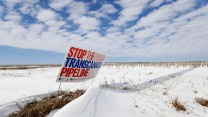
Officials did not say whether the oil was from Canada's tar sands, but the derailment is sparking still more debate over the controversial proposed Keystone XL pipeline that would carry tar sands oil into the US. Here's a relevant excerpt from another Reuters piece:

Some experts have argued oil-by-rail carries a higher risk of accidents and spills.
"It is good business for the rails and bad safety for the public," said Jim Hall, a transportation consultant and former chairman of the National Transportation Safety Board.
"Railroads travel through population centers. The safest form of transport for this type of product is a pipeline. This accident could—and ought to—raise the issue for discussion," he added.
Others note that spills from rail cars are rare, and that delivering crude by rail has opened up opportunities in recent years for producers to develop huge volumes of oil production in areas of the United States that are not connected to markets by pipeline.
"It's not very good publicity, but railroads are incredibly safe, they don't spill often," said Tony Hatch, independent transportation analyst with ABH Consulting in New York who has done work for major railroads. "It should not change the opportunity railroads have to make us more energy independent."

We import more oil from Canada than any other country, so it's worth noting that with or without the pipeline, we're already moving oil into the US and there is a potential for spills.

Wed Feb. 22, 2012 12:39 PM PST
Tue Feb. 21, 2012 2:09 PM PST
Tue Feb. 14, 2012 3:47 PM PST
Mon Feb. 13, 2012 3:24 PM PST
Tue Feb. 7, 2012 10:02 AM PST
Fri Feb. 3, 2012 11:13 AM PST
Tue Jan. 31, 2012 10:48 AM PST
Mon Jan. 30, 2012 1:47 PM PST
Mon Jan. 30, 2012 11:14 AM PST
Fri Jan. 27, 2012 3:45 PM PST
Fri Jan. 27, 2012 2:45 PM PST
Fri Jan. 27, 2012 12:54 PM PST
Thu Jan. 26, 2012 1:44 PM PST
Thu Jan. 26, 2012 6:00 AM PST
Wed Jan. 25, 2012 10:35 AM PST
Mon Jan. 23, 2012 8:34 PM PST
Mon Jan. 23, 2012 3:01 PM PST
Mon Jan. 23, 2012 12:38 PM PST
Thu Jan. 19, 2012 10:24 AM PST
Thu Jan. 19, 2012 9:33 AM PST
Wed Jan. 18, 2012 10:12 AM PST
Tue Jan. 17, 2012 3:59 PM PST
Mon Jan. 9, 2012 4:05 PM PST
Mon Jan. 9, 2012 4:00 AM PST
Fri Jan. 6, 2012 4:06 PM PST
Wed Jan. 4, 2012 9:35 AM PST
Wed Dec. 28, 2011 1:44 PM PST