



Nick Baumann

Nick Baumann

News Editor

Nick is based in our DC bureau, where he covers national politics and civil liberties issues. Nick has also written for The Economist, The Atlantic, The Washington Monthly, and Commonweal. Email tips and insights to nbaumann [at] motherjones [dot] com. You can also follow him on Facebook.

Get my RSS |

Obama on Coakley: Issues Do Matter

| Sun Jan. 17, 2010 3:25 PM PST

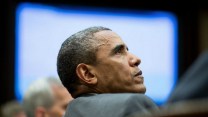
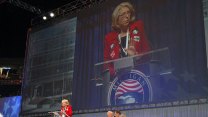
President Barack Obama just finished up a speech in support of Martha Coakley, the Democratic candidate in the Massachusetts special election set for Tuesday to determine who will fill out the remainder of Ted Kennedy's term in the Senate. Republican candidate Scott Brown spoke at his own rally today, too. The contrast was illuminating. Obama's speech focused on all the issues where Brown, being a Republican, will almost certainly vote with Senate Republicans: climate change legislation, financial regulatory reform ("He'll park his truck on Wall Street," Obama said), and, of course, health care reform. The president's message was clear: voters should looks past Coakley's flaws as a candidate (although he didn't acknowlege them, his very presence in the state spoke to her failings), forget about her gaffes, and focus on her issue positions. Coakley's positions prove that she would "be on your side," Obama said.

Brown's speech, by contrast, had little to do with the issues. There were few GOP dignitaries or officeholders by his side. Instead, sports stars like Curt Schilling and Doug Flutie and actor John Ratzenberger (Cliff from "Cheers") joined Brown on stage. The cast of characters mirrored the substance—or lack thereof—in Brown's speech. He spoke about his "underdog" status, his truck (Brown campaigned in a pickup—a tactic Obama repeatedly referenced in his own speech, asking voters to "look under the hood"), and sports.

It's pretty obvious what's going on here. Massachusetts voters don't like Martha Coakley too much. They like the tall, handsome, hangs-out-with-sports-stars Scott Brown. But most Bay Staters aren't as conservative as Scott Brown issues or beliefs-wise (unlike Brown, they certainly don't seem to think President Obama was born out of wedlock, for example). So Coakley, Obama, and the Democrats are trying to get voters to focus on the issues. Brown's trying to get them to focus on narrative: how he's the "underdog," he's cool, he drives a truck, etc. Issue positions are what actually matter when it comes to votes in Washington that affect peoples' lives. But, unfortunately for Coakley, too often it's narrative—political mythmaking—that matters most in electoral politics. Barack "Hope and Change" Obama knows that better than anyone. It will be interesting to see what matters most on Tuesday.

Advertise on MotherJones.com

Dems Unleashing Full OFA List in Mass. Senate Race (Finally)

| Fri Jan. 15, 2010 2:25 PM PST

Democrats will be using the full Organizing for America email list in an attempt to rescue Massachusetts Senate candidate Martha Coakley, a party official tells Mother Jones. Democrats hope that Coakley, the Democratic candidate in the special election to fill Ted Kennedy's Senate seat, will benefit from the energy of the activists on the massive email list President Barack Obama assembled during his campaign for the White House. In the wake of the White House's announcement that Obama himself will campaign for Coakley on Sunday, the move to fire up the full 13-million-person list is just the latest sign that national Democrats are panicked about Republican Scott Brown's momentum and polling leads. David Corn wrote about OFA—and journalist Ari Melber's 73-page report on it—yesterday:

So far, Obama has mostly stuck to familiar presidential pathways when it comes to using power, communicating with the public, and interacting with the citizenry and his supporters. (His use of electronic town halls and the like have been mostly gimmicks.) Though he entered the White House with a network unlike any amassed by a predecessor—both larger and more engaged—he has not tried to deploy it to reshape the operating system of Washington.

Republicans all over the country are phonebanking for the Massachusetts race (Democrats say they are, too), and Brown has reportedly been raising a million dollars a day online. Can the OFA list save Coakley? Can anything? The Dems are definitely pulling out all the stops.

Obama To Massachusetts

| Fri Jan. 15, 2010 12:37 PM PST

White House photo/Pete Souza (Government Work).White House photo/Pete Souza (Government Work).President Barack Obama will campaign in Massachusetts on Sunday in a last-ditch effort to save Martha Coakley, the Democratic candidate to replace Ted Kennedy in the Senate. The stakes couldn't be higher. If Scott Brown wins, health care reform is probably dead. The media will take the loss—in Massachusetts, of all places—as further evidence that the party is in huge trouble in the November midterms. Congressional Democrats could face a wave of retirements as vulnerable Democrats pass on tough reelection fights. Sure, if Obama goes in and Coakley still loses—a definite possibility—it will be painted as a major defeat for the president. But since the White House's agenda is finished anyway if Brown wins, the Obama team probably figured they have nothing to lose.

Needless to say, it would be truly crushing for Democrats to come so close to the goal they've been pushing towards for 60 years and fall short. Base enthusiasm would fall even further. The president's agenda would be permanently stalled by a rock-solid GOP filibuster in the Senate. The party might not recover for years. (It's ridiculous, of course, that a bill with 59 votes in the Senate can't pass. But that's the system we have.)

The only bright spot for liberals in all this is that maybe, deep in the recesses of Obama's brain, there is finally a twinkle of realization that he needs his base. As economist James Galbraith says in an email, "This could possibly be a watershed moment, when the President finally realizes that he has to have an army, if he wants to win the war." We can hope that's right. I'm a big believer in the importance of process and compromising to push things through a corrupt and dysfunctional Congress. But it's incredibly important to get people energized and excited about politics—to have them hoping and wanting. That was the magic Obama brought to his campaign, and he's definitely lost it in the White House. Can he get it back? Does he want to?

Issues Don't Matter, Apparently

| Fri Jan. 15, 2010 11:47 AM PST

Flickr/rachelpasch (Creative Commons).Flickr/rachelpasch (Creative Commons).It never ceases to amaze me how little elections have to do with actual issues. It's widely acknowleged that the Democrat, Martha Coakley, is in big trouble in the Massachusetts special election race to replace the late Sen. Ted Kennedy. But her troubles seem to have very little to do with her actual positions on the issues.

Even if Scott Brown, the conservative Republican candidate, wins on Tuesday, Massachusetts will still be a very liberal state. Coakley's issue positions will be far closer than Brown's to the state's median voter. And yet he would be the senator—not because more Bay Staters agree with him, but simply because he proved to be much, much better at politics than she is. Politics isn't about being right, or even about having people think you're right. It's more about making people like you. And as Christina Bellantoni reports here, people—even partisan Dems—don't seem to like Coakley very much. (And it certainly doesn't hurt Brown that he's tall and good-looking.)

If Brown wins, a lot of normally left-leaning folks will probably have voted for him. That's their right. But voting for members of Congress based on likability doesn't make a whole lot of sense. Now more than ever, you're really voting for a party, not an individual. If you prefer the Republicans' approach to the issues, you should vote for the Republican. If you prefer the Democrats' approach, you should vote for the Democrat. No one should be under any illusions that Brown is likely to be anything more than a partisan Republican—or that Coakley will be anything more than a partisan Democrat. That's the real choice on Tuesday.

Election 2010: Dem Disaster?

| Fri Jan. 15, 2010 11:15 AM PST

It's generally a bad idea to publish your election predictions on the internet unless you're Nate Silver. But I'm going to go out on a limb and say this much: right now, the 2010 midterms are looking really bad for Democrats.

In the Massachusetts special election scheduled for Tuesday, Scott Brown, a conservative Republican, has all the momentum, leads in the most recent poll, and looks set to win the seat once held by Ted Kennedy. This is in Massachusetts, people. If Brown beats Martha Coakley (who has run perhaps the worst campaign in recent memory), the state attorney general, health care reform probably won't happen. The Democrats will have held a 60-vote majority for just four months, and the Republicans' strategy of obstruction and delay will be vindicated. It will be their model going forward. Democrats will struggle to pass much of anything.

Even if Coakley pulls it out, the Dems have real problems. If you look at Silver's list of the top fifteen Senate seats that are up-for-grabs in November, at least six Democrats appear to be in big trouble. North Dakota and Delaware seem to be in the bag for Republicans (unless Beau Biden gets in the Delaware race—and even if he did I think Mike Castle would still be the favorite.) Harry Reid in Nevada and Blanche Lincoln in Arkansas are deeply unpopular incumbents in purple states. They might hold on in a big Democratic year, but 2010 won't be one. Mike Bennet looks to be struggling in Colorado. And party-switcher Arlen Specter could easily lose in Pennsylvania (which, after all, elected Rick Santorum just ten years ago). In the states where Republicans are playing defense, most of their candidates currently lead in the polls. Even Missouri—once thought to be the Democrats' best chance for a pickup—seems eminently winnable for the GOP. And things just get better for them from there.

This looks to me like a miniature wave election, in which Democrats could lose six or so Senate seats (and Lieberman might switch) and 20 to 30 in the House. No governing party fares well while the economy is in the dumps, but with Democrats holding the presidency and both houses of Congress, they bear all the burden for the country's economic woes. People are deeply resentful of the bank bailouts, and the establishment (read: incumbents) will feel the brunt of their wrath.  And if you think the media narrative favors conservatives now, just wait until after the Republicans romp to a midterm victory.

Of course, there are many variables here, and a lot could happen between now and November. Maybe I'll look back on this day from November and marvel at how wrong I was. But time is ticking away. Get ready for a bumpy 2010.

Mon Feb. 4, 2013 8:23 AM PST
Tue Nov. 6, 2012 6:47 PM PST
Fri Sep. 21, 2012 2:40 PM PDT
Sun Aug. 19, 2012 3:21 PM PDT
Mon Jul. 30, 2012 8:16 AM PDT
Mon Jul. 9, 2012 7:04 AM PDT
Thu Jun. 28, 2012 9:40 AM PDT
Wed Jun. 20, 2012 4:30 AM PDT
Mon Jun. 11, 2012 7:32 AM PDT
Mon Jun. 4, 2012 6:43 AM PDT
Wed May. 9, 2012 12:01 AM PDT
Tue Mar. 20, 2012 8:15 AM PDT
Fri Feb. 10, 2012 10:56 AM PST
Mon Jan. 23, 2012 8:08 PM PST
Wed Jan. 18, 2012 5:56 AM PST
Mon Dec. 12, 2011 4:30 AM PST