




Nick is based in our DC bureau, where he covers national politics and civil liberties issues. Nick has also written for The Economist, The Atlantic, TheWashington Monthly, and Commonweal. Email tips and insights to nbaumann [at] motherjones [dot] com. You can also follow him on Facebook.
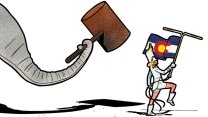
In November 2010, I reported that GOP control of all elements of state government in key swing states—including but not limited to Wisconsin, Michigan, Ohio, Indiana, and Pennsylvania—could ensure a "Republican decade" in control of the House of Representatives. The Democrats' massive 2010 losses couldn't have come at a worse time for the party. Because the census was taken in 2010, GOP control of state legislatures and governors mansions around the country gave Republicans the power to draw congressional district lines largely as they chose. They seized that chance, aggressively gerrymandering so as to protect Republican incumbents and endanger any remaining Democrats. The Dems would have done the same thing, of course, had they won control of these crucial states in 2010. But they didn't.
On Tuesday, the GOP cartographers' hard work paid off. Despite sweeping wins for Democrats in US Senate races and a broad Electoral College victory for President Barack Obama, it was clear early in the night that Republicans would hold on to the House. As Slate's Dave Weigel noted, "ridiculous gerrymanders saved the House Republican majority." In many states the president won convincingly, Democrats elected a minority of the House delegation. Here are the numbers for states that Obama won or came close and where Republicans drew the congressional map:
North Carolina, which Obama lost by around 2 percentage points: 9-4 GOP
Florida, which Obama won by around half a percentage point: 17-10 GOP
Ohio, which Obama won by nearly 2 percentage points: 12-4 GOP
Virginia, which Obama won by around 3 percentage points: 8-3 GOP
Pennsylvania, which Obama won by more than 5 percentage points: 13-5 GOP*
Wisconsin, which Obama won by 6 percentage points: 5-3 GOP
Michigan, which Obama won by 8 percentage points: 9-5 GOP
It goes to show that when you get to choose the ground on which electoral battles are fought, you're very likely to win them.
*Correction: This post originally said that Pennsylvania was 8-5 GOP. It's actually 13-5 GOP.
Ultimately, it wasn't enough. The blue lean of Connecticut was too great for even McMahon's vast fortune to overcome, and Rep. Chris Murphy, a 39-year-old liberal Democrat, will replace retiring Sen. Joe Lieberman (I) in the Senate come January. Between this campaign and her last losing bid, in 2010, McMahon has now spent a cumulative total of nearly $100 million of her own money in pursuit of federal office. That is more than any other American in history.
Republicans who want to take something good out of the McMahon situation might point to the fact that her spending forced the Democratic Senatorial Campaign Committee to spend money supporting Murphy. That money could have otherwise been spent in closer races in less-blue states. But that's not much comfort compared to the rejoicing progressives will feel after replacing Lieberman with a young, charismatic, liberal.
There's no Senate election in Connecticut in 2014. So if McMahon wants to spend even more of her money in pursuit of a Senate seat, she'll have to wait—or move.
A small record company has launched a video vendetta against Sen. Scott Brown, claiming that the Massachusetts Republican and his daughter Ayla, a singer, backed out of a deal to develop and promote the American Idol semifinalist's career.
Wayne Laakko, a co-owner of Double Deal Brand Records, says losing Ayla Brown "nearly bankrupted" his company. He says she agreed to make at least two more albums and that the Browns owe the label a "substantial amount of money" for merchandise, production, and public relations work. (Brown's attorney denies the allegations.) Now, Laakko says, he's "disgruntled" and is "having a little fun." On Sunday, Laakko posted a bizarre video to Double Deal's YouTube page in which Brown, egged on by an interviewer, answers a question about whom he might like to "stalk."
"Uh, let's see, who would I stalk?…How about, uh, probably one or all of those pussycat girls," Brown replies, apparently referring to the burlesque troupe-turned-singing group the Pussycat Dolls.
Laakko edited the video—recorded in 2006, and one of six he says he plans to release—to intersperse it with video, music, and images of the Dolls. You can see that version below. Here is the raw footage, which Laakko provided to Mother Jones:
According to Laakko, relations between the Browns and Double Deal crumbled after Scott Brown was elected to the Senate in a January 2010 special election. "My company was the one that worked for Ayla right after she got off [American] Idol" in 2006, Laakko says. "Once [Scott Brown] entered the national stage he told us to get lost."
Brown's reelection campaign referred Mother Jones to the senator's attorney, Richard Edlin, who flatly denied Laakko's claims in an email:
These unfounded allegations related to events that are many years old, and involve Senator Brown's daughter Ayla's music career. They do not involve the Senator. The fact that they surface now, less than a month away from the election, make it clear that they are politically motivated. Other than to assure the public that these claims have no merit, we do not intend to discuss these issues in public, and will respond to them in due course in the appropriate venue.
Documents obtained by Mother Jones show Brown managed Ayla's relationship with Double Deal, and was a partner in the venture.
For his part, Laakko says: "From my experience in the four years we worked together, Scott was intimately involved in all aspects of the project. I talked to him more than Ayla during the partnership."
Scott Brown helped to manage his daughter's career until "a few weeks" after he was elected, according to a Boston Magazine profile of Ayla. But Laakko says he remained in "constant contact" with Brown through April 2010, and anything the label planned for Ayla had to be cleared by either Brown or one of his aides, including Boston political consultant Eric Fehrnstrom. Fehrnstrom was a top adviser for Brown's 2010 Senate campaign. He is currently working for Brown's reelection effort, and he's pulling double duty as a top strategist for Mitt Romney's presidential campaign. (Fehrnstrom did not respond to requests for comment.)
Laakko claims that he still has a contract with Ayla but can't afford to sue her or her father to enforce the deal. That's because the label spent a "great deal of money" promoting Ayla Brown before Scott Brown "walked away from the very large amount of money that he owed us," claims Ed Gertler, Laakko's business partner and a minority owner of the label. (Gertler says he "very much" supports Brown's Democratic rival in the Massachusetts Senate race, Elizabeth Warren.)
Laakko says Ayla backed out of her obligations to Double Deal in May 2010. He adds that Ayla told him in a phone call that she was quitting music to focus on working as a correspondent for CBS News. "She said CBS was not allowing her to be a musician," Laakko says.
Jim McGregor, Brown's former producer, says Brown did tell Double Deal she was quitting music for CBS, but that "wasn't accurate…because obviously she went down to Nashville and did a lot of other stuff." And as the January 2011 Boston Magazine article on her career makes clear, Ayla Brown was back to making music again shortly after her break with the label:
[S]ince graduating in May, Ayla's entire focus has been her singing career. Now she logs up to 70 hours a week writing, networking, tweeting, making appearances, and performing live shows wherever she can get them: at malls, fairs, festivals, games. She spent the summer touring New England to promote Circles, her latest self-released EP; signing CDs; and selling Ayla Brown T-shirts, posters, and other merchandise. All those $5 laminated backstage passes add up. She's been able to buy her own condo (though she rents it out and, like a good girl, continues to live at her parents’ house in Wrentham).
Ayla Brown's "Fizzically Fit" tour—when she played shows in Massachusetts and Rhode Island—also occurred during the summer of 2010. (Ayla Brown did not respond to requests for comment.)
"My company offered their lawyers the ability to walk away with our work, our years of help and work and guidance, and we basically asked them to pay us back to zero," Laakko says. "I wasn't asking for millions of dollars. I was asking to walk away even."
The settlement negotiations broke down by February 2011, Laakko says.
Laakko says the clip he released was shot on June 7, 2006, while the Double Deal team and the Browns were hanging around outside Raw Sugar Media in Dutchess County, New York. Laakko says he is the man in the chair next to Brown.
Here's a rough transcript of the video, which was filmed by the art director for Ayla's first album, according to Laakko:
Scott Brown: Uh, let's see…
Interviewer: Who else would you stalk?
Brown: …No, just kidding, that was a joke.
[Laughter]
Brown: Uh, let's see, who would I stalk? That's a good [unintelligible]. You can get me [garbled] I'm taking pictures, I'm doing paperwork. How about, uh, probably one or all of those pussycat girls.
Interviewer: Oh there we go, the Pussycat Dolls
Brown: (Laughter) You know, whatever they are.
Laakko's first video ends with a title card that says, "On the next episode: Scott Brown discusses integrity. Here it is:
Mitt Romney's "47 percent," meet Paul Ryan's "takers."
Romney is finally backing off his controversial comments, but the theme that the nation is divided into makers and government-dependent takers is one of long standing for both Romney and his running mate, Paul Ryan. The GOP vice presidential candidate has repeatedly made statements that suggest he sees America in Ayn Randian terms—that many citizens are just takers, parasites who leech off productive citizens, the makers. As this collection of rarely seen videos shows, this has been a recurrent talking point for Ryan in small gatherings for years.
"Right now about 60 percent of the American people get more benefits in dollar value from the federal government than they pay back in taxes," he said on the June 2010 edition of Washington Watch. "So we're going to a majority of takers versus makers." By November 2011, in an address he gave at an American Spectator event, Ryan put the number of takers at 30 percent. (That remark was first reported by Ryan Grim of the Huffington Post.)
Ryan has also warned about President Barack Obama creating "more of a permanent class of government dependents"—language that echoes Romney's take on the "47 percent who are with [Obama], who are dependent upon government, who believe that they are victims, who believe the government has a responsibility to care for them, who believe that they are entitled to health care, to food, to housing, to you-name-it."
In 2010, Rep. Paul Ryan (R-Wis.), now Mitt Romney's running mate, called the Cayman Islands "the place you hide your money," arguing that the United States needs to slash tax rates below those of other countries in order to make this country "a haven for capital formation." But in previously unreported comments, from an interview with American Business Magazine in August 2011, Ryan went even further on the same topic, saying, "let's make this country a tax shelter for other countries instead of having other countries be a tax shelter for America."
James Henry, a former chief economist at McKinsey & Co., describes offshore tax havens like the "bar scene in Star Wars." He explains, "Dictators and kleptocrats used them to conceal stolen loot. Arms dealers and drug dealers use them to launder their deals. Google and Apple and Pfizer use them to park their intellectual property and pay themselves tax-free royalties. Banks use them to park lousy loans and stash the offshore accounts and assets under management of their wealthy individual clients, many of which are paying zero taxes back home…And so on."
As you can see in the charts below, the United States already raises significantly less money (as a percentage of GDP) from corporate taxes than most other first-world nations, and although corporate tax rates are high here, corporations' effective tax rates—what they actually pay—are lower than those in most other first-world economies.
The United States' reliance on corporate taxes has fallen dramatically over the last 60 years. In 1952, the government got over 30 percent of its revenue from corporate taxes; today, that number is less than 10 percent. Many big companies, including Boeing, General Electric, and Verizon, had negative effective tax rates between 2008 and 2011, despite raking in billions of dollars of profits.
Parts of the United States are already effectively global tax shelters. Delaware, which has very lax business formation requirements and disclosure rules, as well as low corporate taxes, "today regularly tops lists of domestic and foreign tax havens," according to the New York Times. (Multiple entities associated with Romney and Bain Capital, the private equity firm he founded, were established in Delaware.) The Times' Leslie Wayne has more:
"What is so galling about secrecy in the United States is that there is no attempt to document who owns a corporation," said Richard Murphy, a senior adviser at the Tax Justice Network, an independent organization based in London that researches tax havens. "Two million corporations are formed each year in the United States, more than anywhere else in the world. Delaware, in turn, is the biggest single source of anonymous corporations in the world."
Mr. Murphy adds: "Why go to the Caymans when you can just go down the street?"
In 2009, the Tax Justice Network named the United States as No. 1 on its Financial Secrecy Index, ahead of Luxembourg and Switzerland. It cited Delaware as one of the reasons.
That, Mr. Murphy says, elicited howls in Wilmington. "The reaction was: 'This cannot be true.' Not only can it be true, it is true." (The United States has since fallen to fifth place, behind Switzerland, the Caymans, Luxembourg and Hong Kong, after the group changed its method.)
[…]
Delaware subsidiaries are especially popular with global energy and mining companies like Exxon, Chevron and Rio Tinto. Among the top 10, some 915 subsidiaries have been set up in Delaware, compared with 51 in Switzerland and 49 in the Caymans, according to a report last September by the Norway chapter of Publish What You Pay, a London-based group that studies natural resources. The study said that this allows these resource extraction companies to put up a "wall of silence" about their far-flung operations and profits, especially from poor countries that may want a greater slice of the revenue. Exxon, Chevron and Rio Tinto declined to comment.
So, to review: The United States already collects comparatively low amounts of corporate tax. But Ryan wants to make the whole country like Delaware. He says this "would ultimately raise revenues and promote economic growth." But if the US lowers its rates, there's nothing to stop other countries—including the Caymans and Switzerland—from slashing their taxes and fees and making their restrictions on corporations even lower, too.
Here's ABM's question and Ryan's full answer:
ABM: What would you do to limit or slow the migration of domestic business overseas?
PR: I would go to a territorial tax system. We should make the top American tax rate 25 percent for individuals and businesses. As you know, all the partnerships and LLCs are taxed at the individual rate. What the past Republican budget says is bring those tax rates down to 25 percent on the corporate side, as well. I think we’re shooting ourselves in the foot the way we tax ourselves. The rest of the world has moved toward a territorial system and we have not.
I just met with the chief of staff to the Council in Britain who stated not only have they just moved to a territorial system, they’re moving their top tax rate on businesses down to 23 percent. Ireland is at 12.5 percent. The international average corporate tax rate is 25 percent. We are the highest now at 35 percent. So, we are, literally, pushing capital overseas. Corporations are looking overseas and the US government is making it impossible for them to come back with their capital. That’s giving an incentive to keep capital overseas, not to domicile your company here, and we’re making ourselves ripe for takeover targets. Foreign companies are taking over US companies. This is occurring at an alarming pace—eventually the loyalties of these corporations will leave, as well.
I think we need to have a tax system that makes America a haven for capital formation. Let’s make this country a tax shelter for other countries instead of having other countries be a tax shelter for America. This would ultimately raise revenues and promote economic growth.
The way we should look at increasing revenues to the government should not be class warfare or a bigger than ever tax increase approach. Economic growth comes from job creation and better economic growth policies that raise revenue through higher growth. Lowering tax rates at a broader base of income brings in more revenues and would help us close our fiscal gap.