


Tim McDonnell joined the Climate Desk after stints at Mother Jones and Sierra magazine, where he nurtured his interest in environmental journalism. Originally from Tucson, Tim loves tortillas and epic walks.
Climate change is one of the defining stories of our time: rising sea levels, bigger storms, peak oil, colder winters and hotter summers. That begs the questions: Why aren't we talking about it more, and what the hell are we going to do about it?
Fortunately, there is a host of scientists, politicians, educators, artists, entrepreneurs, community leaders, journalists, and others who spend every day thinking about the answers to those questions. Maybe you're one of them. Ultimately, the story of climate change is theirstory—your story. But the media could still do a better job of telling it.
That's where the Climate Desk comes in.
Two years ago (the hottest year on record, by the way), a group of forward-thinking news outlets (The Atlantic, Center for Investigative Reporting, Grist, Mother Jones, PBS' Need to Know,Slate, and Wired) launched an innovative journalistic collaboration to explore the impact—human, environmental, economic, political—of a changing climate. Climate Desk has been gathering pace ever since, and today we're proud to announce our revamped website and the addition of a new partner: The Guardian. It's one of the UK's oldest and most distinguished newspapers, and has a substantial digital footprint in the US. The first UK newspaper to launch a dedicated environment section, the Guardian has one the biggest and most prolific environmental coverage teams in the world.
We're here to sift through the policy, protests, and polar bears to bring you the most important climate change stories: the ones that affect you, your corner of the world, the changes in your own backyard.
Check out our latest video, Pond Scum to the Rescue, to understand how algae might battle political derision to become a vital fuel source. Your Town Is Fracked shows how Pennsylvania limits local control over oil and gas drilling—potentially jeopardizing residential neighborhoods, watersheds, and even school zones. Climate Desk's one-on-one with Michael Mann, reported and written by Suzanne Goldenberg, of the Guardian, is the climate scientist's account of attacks by entrenched interests seeking to undermine his “hockey stick” graph.
We want to hear from you. What are you concerned by, or want to know more about? Tellus and keep checking back with the Climate Desk for more from this unfolding story .
The Shins' 2007 album Wincing the Night Away got rave reviews and debuted at number 2 on the Billboard 200, spawning a yearlong tour and snagging a Grammy nomination for Best Alternative Music Album. It was a wild ride for a band that had spent nearly a decade working its way up from obscurity in Albuquerque, and front man James Mercer came away from it exhausted and ready to quit. The last thing on his mind was the next Shins project. "It was a bit of a crisis in a way," he says. "What do you do if you decide the band you've been with for the last 10 years, you just suddenly don't want to do?" So Mercer took a breather in the form of Broken Bells, an excellent collaboration with Brian Burton (a.k.a. Danger Mouse), as a way to "open up my horizons." A few years later, with a new label and rejiggered lineup, Mercer has decided to take a fresh crack at the Shins. The band's new album, Port of Morrow, out next week, takes a smoothed-out, matured approach to the Shins' characteristic electro-folk-rock. I spoke with Mercer about his favorite rock and roll singers, being raised a military brat, and why you can't get a decent American-made microphone anymore—dammit!
Mother Jones: So after the Wincing tour, you were hitting some roadblocks with the Shins?
James Mercer: Mainly I was tired of being right in the middle and everything sort of revolving around me, including the friendship dynamics-slash-bandmate dynamics and the creative aspect. It was a bit much. It had never been so big, and I had never been someone who was ever in the center of any kind of social circle. And in the midst of that, Brian Burton kind of came up with the idea of us working on a new band where he was writing in a more traditional sense. It was kind of perfect timing. I was a bit intimidated by it, but I had also recently decided to start saying "Yes" to things.
A cleanup crew member at the site of the Kalamazoo River spill in July 2010.
This week, as Senate Democrats narrowly defeated a renewed—and some say misguided—call to rush construction of the Keystone XL oil pipeline, residents and officials at the site of the country's largest-ever tar sands oil spill are still reeling nearly two years after the fact. A look at the fallout from that incident in Michigan reveals that a spill of diluted bitumen, the kind from Alberta's tar sands that Keystone would carry, is a far nastier beast than your typical spill of conventional crude. It also shows that cleaning it up can be just as damaging to the environment as the spill itself.
A story this week in the Canadian online magazine The Tyee outlines how, 20 months after a pipe carrying tar sands "dil-bit" burst on the Kalamazoo River near Marshall, residents and local Environmental Protection Agency officials are still struggling to clean up the river. It was the first-ever major spill of this type of heavy oil, and it blindsided EPA cleanup crews: recovering the 1.2 million gallons of oil that have been cleaned up so far has cost the pipe's owner, Enbridge Energy Partners, roughly $725 million—10 times as much, per liter, as the average spill of conventional crude. Ralph Dollhopf, who led the EPA's response to the incident, told local media that the agency had to "write the book" on dealing with a cleanup of tar sands bitumen.
The underlying issue, Natural Resources Defense Council attorney Anthony Swift told me, is that US and Canadian officials don't know just how different dil-bit is from conventional crude. With US imports of tar sands bitumen projected to shoot up to 1.5 million barrels per day by 2019 (up from 100,000 barrels in all of 2000), Swift said there remains a serious deficit in US and Canadian officials' understanding of how to manage potential spills. "The pipeline safety issue is just one of many areas where tar sands production hasn't been fully evaluated," he said. That didn't deter Alberta Premier Alison M. Redford from telling reporters she was "very optimistic" that the Keystone pipeline, which would likely be an economic windfall for her province, would be approved by the Obama administration should the president win reelection.
Flickr / Pink Sherbet PhotographyOne of the more unsettling items from the recent leak of an internal fundraising document from the conservative Heartland Institute think tank was a plan laying out how K-12 schools could adopt "educational materials" criticizing the notion of man-made global warming. According to the document, "principals and teachers are heavily biased toward the alarmist perspective."
Here at the Climate Desk, it got us thinking: How do our readers engage with kids about climate change, not just in the classroom, but also at home? We put out a call, and here's what we heard back.
A few readers shared their thoughts with Climate Desk's Tim McDonnell via video chat:
Parents also shared insights with us via social media:
If it wasn't already hard enough to talk about climate change, parents are now fighting a battle on another front: children's books. According to a new study [PDF], America's finest illustrated books for kids are teaching less and less about the natural world. The study analyzed nearly 8,100 images from 296 kids' books awarded medals or honors in the annual Caldecott prize from 1938 through 2008. Climate Desk's James West spoke with coauthor Chris Podeschi from Bloomsburg University of Pennsylvania about the findings:
With pictures of trees, toads, and other flora and fauna on the decline in kids' books these days, author Lynne Cherry is taking a different approach. Cherry's 1990 book The Great Kapok Tree is widely used in schools to teach about the value of preserving rainforest. But a few years ago, she swapped out her paintbrushes for a video camera to combat what she sees as a growing sense of powerlessness among kids. Her rationale, she told Tim, was that film has the potential to reach more kids.
You can get involved in more Climate Desk conversations by following us on Twitter, and liking us on Facebook.
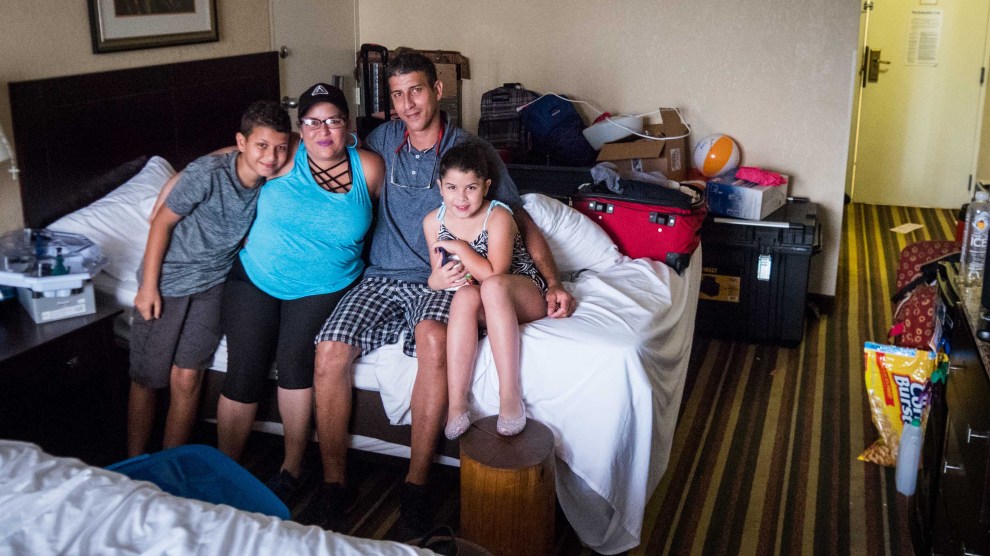
In 2008, Maggie Anderson was doing pretty well. She had a successful career in business consulting, a loving husband and two lovely daughters, a nice house in a trendy Chicago suburb, and attended the same church as the Obamas*. But looking around at her mostly white neighbors, she couldn't shake the guilty feeling that she'd left the black community behind. A simple solution, she decided, would be to spend more money in the impoverished neighborhoods on Chicago's West Side. "The whole point," she said, "was, 'You know what, we care about the West Side. We need to help those people, those are our people, and we need to do what we can to make a difference there.' So we thought, instead of buying groceries here in Oak Park we could go buy groceries on the West Side. And it was not that simple at all."
The problem, Anderson realized, was that most businesses in predominantly black neighborhoods weren't owned by African Americans; most of the money spent in those concerns would leave the community come closing time. So she persuaded her family to embark on a far more challenging mission: For a full year, they would attempt to spend their cash exclusively at black-owned businesses.
The ensuing adventure, dubbed The Empowerment Experiment and chronicled in Anderson's book Our Black Year (coauthored by Chicago Tribune reporter Ted Gregory), took them from gritty corner stores at the epicenter of urban decay to Texas megachurches to the boardrooms of the nation's most powerful trade organizations. By the end, the Andersons emerged from the maw of racial-economic inequality with powerful insights into how black Americans might better wield their collective $913 billion buying power to improve their communities. I spoke with Anderson, whose book comes out this week, about the backlash she encountered, economic segregation in the black community, and the near-impossibility of finding black-made products at Walmart.