- ‹ previous
- 1510 of 1542
- next ›
Bush Administration Sees New Climate Change Report, Says, "Whatever"
From the AP, via Yahoo! News:
White House rejects mandatory CO2 caps
Despite a strongly worded global warming report from the world's top climate scientists, the Bush administration expressed continued opposition Friday to mandatory reductions in heat-trapping "greenhouse" gases.
Sigh. Why expect anything else? By the way, one of the reasons the Bushies have put forward for why we don't need CO2 caps is that they are already doing enough.
"This administration's aggressive, yet practical strategy to reduce greenhouse gas emissions is delivering real results," added Stephen Johnson, administrator of the Environmental Protection Agency.
Uh huh. Check out this massive Mother Jones report called "George W. Bush's Ungreening of America" to know why that's a load of crock. Also check out the archives at the bottom of our new Environment and Health page for everything you need to know.


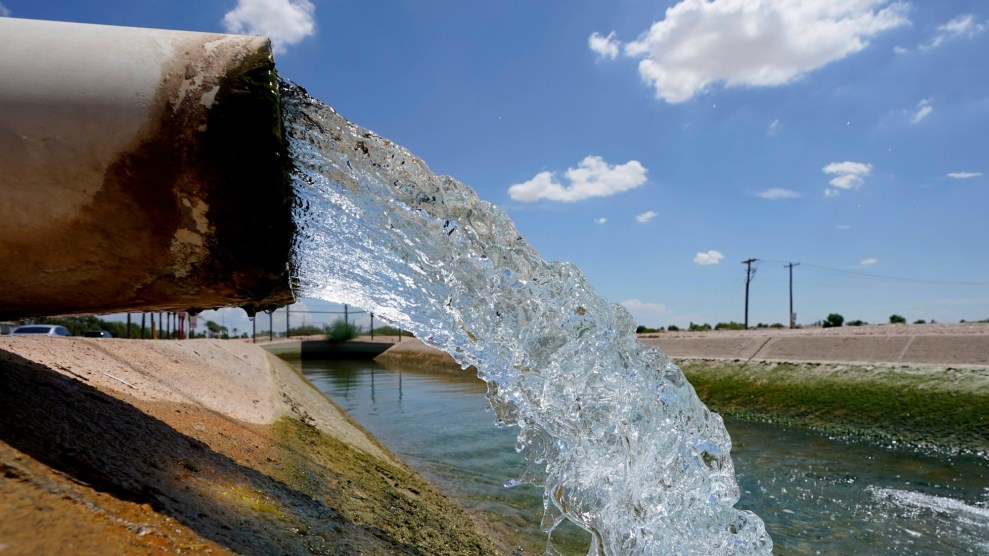






A Canadian Perspective on The Commons: Our Water, Our Air & Our Bodies from Montreal, Canada:
I forwarded this letter to hundreds of stakeholders in Canada, including the Prime Ministers Office.
"It takes a licking but keeps on ticking". That was the Timex commercial we all fondly remember.
They say that time heals all wounds. Wounds of the heart perhaps. But what about wounds of the environment? What amount of time will it take to heal the wounds to the Canadian environment?
This is a letter about the Commons: Toxic Chemicals (our bodies), Cyanobacterie (our water), and Climate Change (our air).
A Second Child is Born
On December 18, 2006 my brother's wife gave birth to their second child. My godchild has a little sister. When I went to the hospital the morning of the birth, in the room were child mother and grandmother. Birth is magnificent. However, I could not help but silently ponder some questions:
* How many toxic chemicals are already in her?
* Will she be able to swim in our lakes in the summer?
* Will she ever see snow in the winter?
As I left the Royal Victoria hospital, in the parking lot above Pine, between two parked cars, was an elderly gentleman receiving CPR. He was having, I presume, a heart attack. There was a second person lending assistance. By his style and tone he was probably a doctor as well. He was on his cell. He was calling his colleagues in the emergency room for reinforcements.
Moreover he straddled a bicycle and had a bicycle helmet. He biked to work. He was health conscience and did his part towards reducing his carbon footprint. I recalled my morning and evening bicycle commutes to McGill as an undergraduate in the 1980s, both in the fall and winter semesters.
I asked if I could be of assistance. "Where could I go" I asked instinctively knowing that the Vic is a maze of buildings, tunnels, and entrances. The doctor, as persons of authority do, dismissed me with his glare. As I approached Pine I noticed 2 doctors running out of the building looking for the scene. They did not know where to go. I directed them up the parking lot road.
I did my good deed of the day. But is it enough?
And what was the larger lesson of that morning?
Introduction
There are four critical issues of our times. Three encompass the environment. The fourth reflects Canada role in foreign affairs, peace and Afghanistan.
* Toxic chemicals in our consumer products,
* Cyanobacterie in our lakes,
* Climate change in our atmosphere, and
* Canada and its role in the world.
1. Toxic Chemicals & Our Bodies
Back in February of 2006, I wrote my first letter which I forwarded to hundreds of politicians, media and companies. The letter began with
I am forwarding a letter because of my concern for my health, the health of my 2 godchildren Chloe and Bianca, and the health of all Canadians. This letter was inspired by a CBC Marketplace television show co-hosted by Wendy Mesley in March 2006 entitled, "Chasing the Cancer Answer". I hope that Canadian politicians and Health Canada, in association with the Canadian Medical Association, and the Canadian Cancer Society do the right thing and initiate/support legislation that would ban carcinogens in our consumer product supply. There are too many products that are killing us. Safe and healthy products should be a Canadian right! Manufacturers of consumer products will continue to make profits but not at the expense of our health.
The statistics, according to the Canadian Cancer Society, are mind blowing:
*In Canada, 1 in 2.3 men and 1 in 2.6 women will have cancer in their lifetime.
*In Canada, about 14 million kilograms of carcinogens are released into the environment every year.
Moreover, over the next 30 years, the Canadian Strategy for Cancer Control estimates:
* Almost 6 million Canadians will be diagnosed with cancer.
* About 3 million will die from cancer.
* Direct cancer healthcare costs will be more than $176 billion.
* Over $248 billion in tax revenues will be lost because of disability due to cancer.
In the final week of May, environment reporter Martin Mittlestaedt ran an excellent 5-part series of articles entitled Toxic Shock in the Globe and Mail.
At the same time Environmental Defence, issued a report entitled Polluted Children, Toxic Nation: A Report on Pollution in Canadian Families, tested the blood and urine of 13 people from communities across Canada. Seven children and six adults from British Columbia, Ontario, Quebec and New Brunswick were checked for 68 different toxins. The lab tests found a total of 46 of the 68 chemicals in the volunteers, including toxins that can cause cancer, reproductive disorders, disrupt the hormone system and cause developmental delays. On average, adults had 32 toxins, and 23 were found in children.
Real changes must occur:
* Consumers have the basic right-to-know, through explicit labeling, of known chemicals in consumer products.
* Patients have the basic right-to-be-informed by their health care professionals of the carcinogenic risks of prescription drugs.
* Provincial and local governments must utilize public databases to inform local citizens about carcinogenic hazards posed by chemical industries in their communities.
All federal parties must do the right thing and support the four recommendations of Environmental Defence:
* Eliminate the use of toxic chemicals.
* Make industry accountable for chemicals it produces.
* Regulate chemicals in consumer products through the Canadian Environmental Protection Act.
* Focus on reducing pollution in the Great Lakes basin.
The Canadian government must do the right thing: Eliminate the use of toxic chemicals and carcinogens. Cancer odds like 1 of 2 means either you or you're wife! It means one of your two children!
2. Cyanobacteria & Our Water
"Blue-green algae contaminated 43 Quebec lakes and rivers in 2004 and wreaked havoc in 50 more in 2005", biologist Sylvie Blais said this week according to reporter Cheryl Cornacckia in an article in the September 29, 2006 Montreal Gazette. Blais is head of Quebec's blue-green algae intervention program, the provincial Sustainable Development, Environment and Parks Department, which began in 2004. As per the article,
"It's a problem that is getting worse everywhere," Blais said, noting Lake Massawippi in the Eastern Townships, which was hard hit this week, is by no means alone. This month, blue-green algae closed Lac Archambault in the Mont Tremblant tourist area to swimmers and boaters. Lac St. Joseph, a favourite of cottagers in the Quebec City area, had an outbreak this summer. Just across the U.S. border, communities along the Vermont side of Lake Champlain have had trouble with toxic algae in bays and inlets.
Blue-green algae feed on phosphorus and nitrogen. These elements, the non-biodegradable by-products of pesticides and fertilizers, can run off into a lake or watershed.
Over at Lac Simon, my father and his brother built cottages in the 1950's. The family, as do many Montrealers, loves the water during the hot and humid summer months. Last year Lac Simon's "Baie Ours" was closed due to cyanobacteries. Just as the air temperature is going to increase because of climate change, lakes across Quebec will continue to be closed because of cyanobacteries.
At the municipal level, with respect to Lake Mercier, the December edition of Info Mont- Tremblant bulletin reads
It is still forbidden to consume the water, to boil it, or to use it to make ice cubes, prepare or cook food or brush one's teeth. The restrictions remain in place until the Ministry of the Environment is convinced, by means of another sampling, that the species present still do not constitute a toxin potential.
Here are some bylaws that we must all promote and respect:
*Respect for the waterside buffer strip: Citizens living by the water must respect a buffer zone of 10 -15 metres or more where, in general, no landscaping, tree cutting or other work is permitted.
*Retention of a percentage of natural space: Landowners must retain a percentage of natural space (with three layers of vegetation) per their zoning regulations.
*Ban on use of fertilizers and pesticides: Use of pesticides is banned at all times, with few exceptions. Chemical fertilizers are banned within 100 metres of water, organic fertilizers within 15 metres.
*Pumping out septic systems: Residents must pump out septic tanks every 2 - 4 years depending on property use.
*Agreements related to municipal works: Contractors must prevent sediment from being transported into a body of water.
*Wetlands: Measures to preserve wetlands are similar to those in waterside buffer zones.
3. Climate Change & Our Air
My grandfather had a cottage in Val Morin in the Laurentians. My father fondly recounted his younger days around the house and at the lake in the 1920's with his older brothers and sisters. Unfortunately my grandfather died in July 1929.
My father and his brother had cottages in St-Sauveur in the Laurentians. They skied Mont-Tremblant and Mont St-Sauveur in the 1940s, 1950s, 1960s, 1970s, and the 1980s.
I now have a place in Mont-Tremblant. I continue to ski. If we do not halt climate change will my brother's two girls be able to play in the snow? Or make a snowfort or snowman as I did with my friends as a child? Or tobagan or ski?
My Car Lease Expires
While I have always tried not to overconsume, I have changed my personal comsumption patterns over the years to lessen my carbon footprint. But what is my New Years' resolution for 2007?
On December 31, 2006 the four year old lease to my Volvo XC 70 expires. I want to buy a more fuel efficient vehicle. Like the Volkswagen I had before. Or even a more fuel efficient model. I have visited the showrooms of Volvo, BMW and Volkswagen. I checked out Toyota, Honda and Nissan. I have even checked out the Chrysler, Ford and GM dealerships. What was most disheartening was
* the general lack of fuel efficiency of all models,
* the lack of hybrids,
* the lack of tax incentives to buy hybrid cars. As per my experience at the Toyota dealership, the federal government gives a meager $1000.00 rebate on the Prius. Could not all taxes be exempt to entice more people to drive an earth friendly car. Moreover there should be a myriad of tax incentives on all sorts of products to help Canadians go green!
* Could not car manufacturers build a really cool line up of earth friendly green cars. Could not the GTI be low carbon? Low carbon footprint AND visually sleek!
* Why can't Volkwagen - The People's Car, for example, build ALL their cars with a low carbon footprint? The people car becomes the People's Planet Earth Car!
Along with Canadian NGO's - WWF, Sierra Club, Suzuki foundation, Greenpeace, and Environmental Defense, I look to BBC Planet under Pressure as well as 2 of the best newspapers for environment reporting: Guardian Environment and The Independent Environment. In an article at The Independent, For the first time, an inhabited island has disappeared beneath rising seas Geoffrey Lean writes,
Rising seas, caused by global warming, have for the first time washed an inhabited island off the face of the Earth. The obliteration of Lohachara island, in India's part of the Sundarbans where the Ganges and the Brahmaputra rivers empty into the Bay of Bengal, marks the moment when one of the most apocalyptic predictions of environmentalists and climate scientists has started coming true.
As the seas continue to swell, they will swallow whole island nations, from the Maldives to the Marshall Islands, inundate vast areas of countries from Bangladesh to Egypt, and submerge parts of scores of coastal cities.
Eight years ago, as exclusively reported in The Independent on Sunday, the first uninhabited islands ? in the Pacific atoll nation of Kiribati ? vanished beneath the waves. The people of low-lying islands in Vanuatu, also in the Pacific, have been evacuated as a precaution, but the land still juts above the sea. The disappearance of Lohachara, once home to 10,000 people, is unprecedented.
Canada, Quebec, and Montreal must have a climate change policy that includes the following:
* Annual targets for emission reductions
* Decentralise energy production
* Rethink aviation policy
* Curb road pollution
* Step up the drive for renewable energy
* Insist on greener homes
* Fight inefficiency
* Reduce industrial emissions.
* Invest in green transport
4. Foreign affairs, Peace & Afghanistan
Both my father (Albert in the artillery) and his brother (Edward in the Royal Air Force) volunteered to serve in WWII. Both survived and returned home to their family and Montreal. I recognize that sometimes a nation has to go to war. However, Afghanistan is not one of those times. The need for the Canadian government to revise its foreign and military policies becomes more urgent each day as:
* the numbers of Canadian soldiers and civilians are killed or wounded in Afghanistan grows,
* humanitarian crises in other parts of the world worsen, and
* Canada's international reputation for independence and the promotion of peace suffers.
Clearly as the Council of Canadians have stated,
Canada must move away from its increasingly uncritical support for and integration with U.S. foreign and military policies and reclaim the more enlightened, valued role of an independent, neutral power committed to peacekeeping. Canada must call for the immediate, safe and orderly withdrawal of Canadian troops from Afghanistan and a return to Canada fulfilling its traditional international role of peacekeeper.
Is it not sad and ironic that as Bush Blair Howard and Harper go in/extend missions into Iraq and Afghanistan for oil and gas, those very same vices are increasing the exponentially rate of growth of climate change to the tipping point of our civilization?
As Catherine Whelan Costen said in an open letter at Vive Le Canada entitled Christmas and democracy - I want Both,
I can't help but wonder if the vast amount of effort, the money, the thought and preparation that goes into the holiday season is a little like playing a game of pretend. If we create the illusion and capture the tiny piece of humanity just for those few days, or even a moment in the midst of the rush, might it be enough to satisfy us so that we don't worry about the other 364 days of the year while we live in the other world?
Do you suppose that acting out the festivities is so enticing that one magic Christmas we will decide that we can hold onto the ideals of peace, joy and goodwill long enough to create a truly open, transparent, living democracy for ourselves and our children? Every year during the Christmas season we hear people say, 'Peace to You, Goodwill to all Men and all the best to you and yours', would't it be truly magical if we meant it?
We must act locally. We must act collectively. Municipalities must act. Provinces must act. The federal government must act. Industry must change their ways. Citizens must change their ways. Contrary to Bush's repeated refrain that citizens must continue to act as consumers; Consumption is not our sole function on this planet. It seems that to the corporate elites we are not citizens but consumers, not unlike cattle, or pigs or chickens to be probed and poked into patterns of behavior. Much like farm contolled animals we are conditioned by the corporate media to shop until we drop.
Next year come Christmas day with your child parent or best friend, share an experience as a gift.
Conclusion
I once watched a documentary on US Senator Barry Goldwater. It showed Daisy Girl, a famous campaign television advertisement. Though aired only once, during the Movie of the Week on September 7, 1964, it was a factor in Lyndon B. Johnson's defeat of Barry Goldwater in the 1964 presidential election and an important turning point in political and advertising history.
The advertisement begins with a little girl standing in a meadow with chirping birds, picking the petals of a daisy while counting each petal slowly. When she reaches "9", an ominous-sounding male voice is then heard counting down a missile launch, and as the girl's eyes turn toward something she sees in the sky, the camera zooms in until her pupil fills the screen, blacking it out. When the countdown reaches zero, the blackness is replaced by the flash and mushroom cloud from a nuclear explosion.
As the firestorm rages, a voiceover from Johnson states, "These are the stakes! To make a world in which all of God's children can live, or to go into the dark. We must either love each other, or we must die." Johnson's line echoes W. H. Auden's poem "September 1, 1939" in which line 88 reads "We must love one another or die".
It should now read "We must love one another and the environment or die a very slow death".
As the quantity of toxic chemicals in our environment and in our bodies increases, as the number of lakes in Quebec are closed increases, as the incidents of severe weather increases, the planet continues to take a licking. Can it keep on ticking? Tipping point or turning points?
Recommendation
As a society we are at overlaping crossroads of consumption and fate. We should not have to silently ponder whether any newborn child has toxic chemical, will be able to swim in a Quebec lake, or play in the snow.
We must look at ourselves in the mirror New Years day morning and every morning:
Ask how to be part of the green solution?
and
Act New Years Day and ever after.
The planet and Canada's environment takes a licking but can it keep ticking? Along with the aforementioned recommendations, Canada must:
* Develop a Canadian energy strategy.
* Update Canada's national water policy.
* Protect public healthcare from privatization
* Discontinue all negotiations and actions that are leading Canada toward deeper integration with the U.S.
What are your plans to address these critical issues, and can I be assured that you will take action on it.
Be well.
Paul Malouf
Montreal, Canada
December 2006
A Canadian Perspective on The Commons: Our Water, Our Air & Our Bodies from Montreal, Canada:
I forwarded this letter to hundreds of stakeholders in Canada, including the Prime Ministers Office.
"It takes a licking but keeps on ticking". That was the Timex commercial we all fondly remember.
They say that time heals all wounds. Wounds of the heart perhaps. But what about wounds of the environment? What amount of time will it take to heal the wounds to the Canadian environment?
This is a letter about the Commons: Toxic Chemicals (our bodies), Cyanobacterie (our water), and Climate Change (our air).
A Second Child is Born
On December 18, 2006 my brother's wife gave birth to their second child. My godchild has a little sister. When I went to the hospital the morning of the birth, in the room were child mother and grandmother. Birth is magnificent. However, I could not help but silently ponder some questions:
* How many toxic chemicals are already in her?
* Will she be able to swim in our lakes in the summer?
* Will she ever see snow in the winter?
As I left the Royal Victoria hospital, in the parking lot above Pine, between two parked cars, was an elderly gentleman receiving CPR. He was having, I presume, a heart attack. There was a second person lending assistance. By his style and tone he was probably a doctor as well. He was on his cell. He was calling his colleagues in the emergency room for reinforcements.
Moreover he straddled a bicycle and had a bicycle helmet. He biked to work. He was health conscience and did his part towards reducing his carbon footprint. I recalled my morning and evening bicycle commutes to McGill as an undergraduate in the 1980s, both in the fall and winter semesters.
I asked if I could be of assistance. "Where could I go" I asked instinctively knowing that the Vic is a maze of buildings, tunnels, and entrances. The doctor, as persons of authority do, dismissed me with his glare. As I approached Pine I noticed 2 doctors running out of the building looking for the scene. They did not know where to go. I directed them up the parking lot road.
I did my good deed of the day. But is it enough?
And what was the larger lesson of that morning?
Introduction
There are four critical issues of our times. Three encompass the environment. The fourth reflects Canada role in foreign affairs, peace and Afghanistan.
* Toxic chemicals in our consumer products,
* Cyanobacterie in our lakes,
* Climate change in our atmosphere, and
* Canada and its role in the world.
1. Toxic Chemicals & Our Bodies
Back in February of 2006, I wrote my first letter which I forwarded to hundreds of politicians, media and companies. The letter began with
I am forwarding a letter because of my concern for my health, the health of my 2 godchildren Chloe and Bianca, and the health of all Canadians. This letter was inspired by a CBC Marketplace television show co-hosted by Wendy Mesley in March 2006 entitled, "Chasing the Cancer Answer". I hope that Canadian politicians and Health Canada, in association with the Canadian Medical Association, and the Canadian Cancer Society do the right thing and initiate/support legislation that would ban carcinogens in our consumer product supply. There are too many products that are killing us. Safe and healthy products should be a Canadian right! Manufacturers of consumer products will continue to make profits but not at the expense of our health.
The statistics, according to the Canadian Cancer Society, are mind blowing:
*In Canada, 1 in 2.3 men and 1 in 2.6 women will have cancer in their lifetime.
*In Canada, about 14 million kilograms of carcinogens are released into the environment every year.
Moreover, over the next 30 years, the Canadian Strategy for Cancer Control estimates:
* Almost 6 million Canadians will be diagnosed with cancer.
* About 3 million will die from cancer.
* Direct cancer healthcare costs will be more than $176 billion.
* Over $248 billion in tax revenues will be lost because of disability due to cancer.
In the final week of May, environment reporter Martin Mittlestaedt ran an excellent 5-part series of articles entitled Toxic Shock in the Globe and Mail.
At the same time Environmental Defence, issued a report entitled Polluted Children, Toxic Nation: A Report on Pollution in Canadian Families, tested the blood and urine of 13 people from communities across Canada. Seven children and six adults from British Columbia, Ontario, Quebec and New Brunswick were checked for 68 different toxins. The lab tests found a total of 46 of the 68 chemicals in the volunteers, including toxins that can cause cancer, reproductive disorders, disrupt the hormone system and cause developmental delays. On average, adults had 32 toxins, and 23 were found in children.
Real changes must occur:
* Consumers have the basic right-to-know, through explicit labeling, of known chemicals in consumer products.
* Patients have the basic right-to-be-informed by their health care professionals of the carcinogenic risks of prescription drugs.
* Provincial and local governments must utilize public databases to inform local citizens about carcinogenic hazards posed by chemical industries in their communities.
All federal parties must do the right thing and support the four recommendations of Environmental Defence:
* Eliminate the use of toxic chemicals.
* Make industry accountable for chemicals it produces.
* Regulate chemicals in consumer products through the Canadian Environmental Protection Act.
* Focus on reducing pollution in the Great Lakes basin.
The Canadian government must do the right thing: Eliminate the use of toxic chemicals and carcinogens. Cancer odds like 1 of 2 means either you or you're wife! It means one of your two children!
2. Cyanobacteria & Our Water
"Blue-green algae contaminated 43 Quebec lakes and rivers in 2004 and wreaked havoc in 50 more in 2005", biologist Sylvie Blais said this week according to reporter Cheryl Cornacckia in an article in the September 29, 2006 Montreal Gazette. Blais is head of Quebec's blue-green algae intervention program, the provincial Sustainable Development, Environment and Parks Department, which began in 2004. As per the article,
"It's a problem that is getting worse everywhere," Blais said, noting Lake Massawippi in the Eastern Townships, which was hard hit this week, is by no means alone. This month, blue-green algae closed Lac Archambault in the Mont Tremblant tourist area to swimmers and boaters. Lac St. Joseph, a favourite of cottagers in the Quebec City area, had an outbreak this summer. Just across the U.S. border, communities along the Vermont side of Lake Champlain have had trouble with toxic algae in bays and inlets.
Blue-green algae feed on phosphorus and nitrogen. These elements, the non-biodegradable by-products of pesticides and fertilizers, can run off into a lake or watershed.
Over at Lac Simon, my father and his brother built cottages in the 1950's. The family, as do many Montrealers, loves the water during the hot and humid summer months. Last year Lac Simon's "Baie Ours" was closed due to cyanobacteries. Just as the air temperature is going to increase because of climate change, lakes across Quebec will continue to be closed because of cyanobacteries.
At the municipal level, with respect to Lake Mercier, the December edition of Info Mont- Tremblant bulletin reads
It is still forbidden to consume the water, to boil it, or to use it to make ice cubes, prepare or cook food or brush one's teeth. The restrictions remain in place until the Ministry of the Environment is convinced, by means of another sampling, that the species present still do not constitute a toxin potential.
Here are some bylaws that we must all promote and respect:
*Respect for the waterside buffer strip: Citizens living by the water must respect a buffer zone of 10 -15 metres or more where, in general, no landscaping, tree cutting or other work is permitted.
*Retention of a percentage of natural space: Landowners must retain a percentage of natural space (with three layers of vegetation) per their zoning regulations.
*Ban on use of fertilizers and pesticides: Use of pesticides is banned at all times, with few exceptions. Chemical fertilizers are banned within 100 metres of water, organic fertilizers within 15 metres.
*Pumping out septic systems: Residents must pump out septic tanks every 2 - 4 years depending on property use.
*Agreements related to municipal works: Contractors must prevent sediment from being transported into a body of water.
*Wetlands: Measures to preserve wetlands are similar to those in waterside buffer zones.
3. Climate Change & Our Air
My grandfather had a cottage in Val Morin in the Laurentians. My father fondly recounted his younger days around the house and at the lake in the 1920's with his older brothers and sisters. Unfortunately my grandfather died in July 1929.
My father and his brother had cottages in St-Sauveur in the Laurentians. They skied Mont-Tremblant and Mont St-Sauveur in the 1940s, 1950s, 1960s, 1970s, and the 1980s.
I now have a place in Mont-Tremblant. I continue to ski. If we do not halt climate change will my brother's two girls be able to play in the snow? Or make a snowfort or snowman as I did with my friends as a child? Or tobagan or ski?
My Car Lease Expires
While I have always tried not to overconsume, I have changed my personal comsumption patterns over the years to lessen my carbon footprint. But what is my New Years' resolution for 2007?
On December 31, 2006 the four year old lease to my Volvo XC 70 expires. I want to buy a more fuel efficient vehicle. Like the Volkswagen I had before. Or even a more fuel efficient model. I have visited the showrooms of Volvo, BMW and Volkswagen. I checked out Toyota, Honda and Nissan. I have even checked out the Chrysler, Ford and GM dealerships. What was most disheartening was
* the general lack of fuel efficiency of all models,
* the lack of hybrids,
* the lack of tax incentives to buy hybrid cars. As per my experience at the Toyota dealership, the federal government gives a meager $1000.00 rebate on the Prius. Could not all taxes be exempt to entice more people to drive an earth friendly car. Moreover there should be a myriad of tax incentives on all sorts of products to help Canadians go green!
* Could not car manufacturers build a really cool line up of earth friendly green cars. Could not the GTI be low carbon? Low carbon footprint AND visually sleek!
* Why can't Volkwagen - The People's Car, for example, build ALL their cars with a low carbon footprint? The people car becomes the People's Planet Earth Car!
Along with Canadian NGO's - WWF, Sierra Club, Suzuki foundation, Greenpeace, and Environmental Defense, I look to BBC Planet under Pressure as well as 2 of the best newspapers for environment reporting: Guardian Environment and The Independent Environment. In an article at The Independent, For the first time, an inhabited island has disappeared beneath rising seas Geoffrey Lean writes,
Rising seas, caused by global warming, have for the first time washed an inhabited island off the face of the Earth. The obliteration of Lohachara island, in India's part of the Sundarbans where the Ganges and the Brahmaputra rivers empty into the Bay of Bengal, marks the moment when one of the most apocalyptic predictions of environmentalists and climate scientists has started coming true.
As the seas continue to swell, they will swallow whole island nations, from the Maldives to the Marshall Islands, inundate vast areas of countries from Bangladesh to Egypt, and submerge parts of scores of coastal cities.
Eight years ago, as exclusively reported in The Independent on Sunday, the first uninhabited islands ? in the Pacific atoll nation of Kiribati ? vanished beneath the waves. The people of low-lying islands in Vanuatu, also in the Pacific, have been evacuated as a precaution, but the land still juts above the sea. The disappearance of Lohachara, once home to 10,000 people, is unprecedented.
Canada, Quebec, and Montreal must have a climate change policy that includes the following:
* Annual targets for emission reductions
* Decentralise energy production
* Rethink aviation policy
* Curb road pollution
* Step up the drive for renewable energy
* Insist on greener homes
* Fight inefficiency
* Reduce industrial emissions.
* Invest in green transport
4. Foreign affairs, Peace & Afghanistan
Both my father (Albert in the artillery) and his brother (Edward in the Royal Air Force) volunteered to serve in WWII. Both survived and returned home to their family and Montreal. I recognize that sometimes a nation has to go to war. However, Afghanistan is not one of those times. The need for the Canadian government to revise its foreign and military policies becomes more urgent each day as:
* the numbers of Canadian soldiers and civilians are killed or wounded in Afghanistan grows,
* humanitarian crises in other parts of the world worsen, and
* Canada's international reputation for independence and the promotion of peace suffers.
Clearly as the Council of Canadians have stated,
Canada must move away from its increasingly uncritical support for and integration with U.S. foreign and military policies and reclaim the more enlightened, valued role of an independent, neutral power committed to peacekeeping. Canada must call for the immediate, safe and orderly withdrawal of Canadian troops from Afghanistan and a return to Canada fulfilling its traditional international role of peacekeeper.
Is it not sad and ironic that as Bush Blair Howard and Harper go in/extend missions into Iraq and Afghanistan for oil and gas, those very same vices are increasing the exponentially rate of growth of climate change to the tipping point of our civilization?
As Catherine Whelan Costen said in an open letter at Vive Le Canada entitled Christmas and democracy - I want Both,
I can't help but wonder if the vast amount of effort, the money, the thought and preparation that goes into the holiday season is a little like playing a game of pretend. If we create the illusion and capture the tiny piece of humanity just for those few days, or even a moment in the midst of the rush, might it be enough to satisfy us so that we don't worry about the other 364 days of the year while we live in the other world?
Do you suppose that acting out the festivities is so enticing that one magic Christmas we will decide that we can hold onto the ideals of peace, joy and goodwill long enough to create a truly open, transparent, living democracy for ourselves and our children? Every year during the Christmas season we hear people say, 'Peace to You, Goodwill to all Men and all the best to you and yours', would't it be truly magical if we meant it?
We must act locally. We must act collectively. Municipalities must act. Provinces must act. The federal government must act. Industry must change their ways. Citizens must change their ways. Contrary to Bush's repeated refrain that citizens must continue to act as consumers; Consumption is not our sole function on this planet. It seems that to the corporate elites we are not citizens but consumers, not unlike cattle, or pigs or chickens to be probed and poked into patterns of behavior. Much like farm contolled animals we are conditioned by the corporate media to shop until we drop.
Next year come Christmas day with your child parent or best friend, share an experience as a gift.
Conclusion
I once watched a documentary on US Senator Barry Goldwater. It showed Daisy Girl, a famous campaign television advertisement. Though aired only once, during the Movie of the Week on September 7, 1964, it was a factor in Lyndon B. Johnson's defeat of Barry Goldwater in the 1964 presidential election and an important turning point in political and advertising history.
The advertisement begins with a little girl standing in a meadow with chirping birds, picking the petals of a daisy while counting each petal slowly. When she reaches "9", an ominous-sounding male voice is then heard counting down a missile launch, and as the girl's eyes turn toward something she sees in the sky, the camera zooms in until her pupil fills the screen, blacking it out. When the countdown reaches zero, the blackness is replaced by the flash and mushroom cloud from a nuclear explosion.
As the firestorm rages, a voiceover from Johnson states, "These are the stakes! To make a world in which all of God's children can live, or to go into the dark. We must either love each other, or we must die." Johnson's line echoes W. H. Auden's poem "September 1, 1939" in which line 88 reads "We must love one another or die".
It should now read "We must love one another and the environment or die a very slow death".
As the quantity of toxic chemicals in our environment and in our bodies increases, as the number of lakes in Quebec are closed increases, as the incidents of severe weather increases, the planet continues to take a licking. Can it keep on ticking? Tipping point or turning points?
Recommendation
As a society we are at overlaping crossroads of consumption and fate. We should not have to silently ponder whether any newborn child has toxic chemical, will be able to swim in a Quebec lake, or play in the snow.
We must look at ourselves in the mirror New Years day morning and every morning:
Ask how to be part of the green solution?
and
Act New Years Day and ever after.
The planet and Canada's environment takes a licking but can it keep ticking? Along with the aforementioned recommendations, Canada must:
* Develop a Canadian energy strategy.
* Update Canada's national water policy.
* Protect public healthcare from privatization
* Discontinue all negotiations and actions that are leading Canada toward deeper integration with the U.S.
What are your plans to address these critical issues, and can I be assured that you will take action on it.
Be well.
Paul Malouf
Montreal, Canada
December 2006
LIKE FATHER LIKE SON
Will the GOP ever change? On January 24, 1991, I published this letter to the editor:
The national press reported recently that the [G.H.W.] Bush White House has sought to speak ex cathedra on yet another matter of interest to American citizens--the health effects of electric and magnetic fields--a subject with which Westfield [New Jersey] residents have had to concern themselves of late.
Improperly the Bush administration attempted [and succeeded] to influence the outcome of the Environmental Protection Agency's review of this problem for the purposes of ensuring that the health risks will be minimalized or denied . . .
This is just one more indication of a disturbing trend: the current administration in Washington will fanatically pursue its own agenda whatever the cost in American lives.
All the more reason to push for a Gore/Obama ticket for 2008 Brains dedication /chrisma-talent....an unbeatable ticket
A Canadian Perspective on The Commons: Our Water, Our Air & Our Bodies from Montreal, Canada:
I forwarded this letter to hundreds of stakeholders in Canada, including the Prime Ministers Office.
"It takes a licking but keeps on ticking". That was the Timex commercial we all fondly remember.
They say that time heals all wounds. Wounds of the heart perhaps. But what about wounds of the environment? What amount of time will it take to heal the wounds to the Canadian environment?
This is a letter about the Commons: Toxic Chemicals (our bodies), Cyanobacterie (our water), and Climate Change (our air).
A Second Child is Born
On December 18, 2006 my brother's wife gave birth to their second child. My godchild has a little sister. When I went to the hospital the morning of the birth, in the room were child mother and grandmother. Birth is magnificent. However, I could not help but silently ponder some questions:
* How many toxic chemicals are already in her?
* Will she be able to swim in our lakes in the summer?
* Will she ever see snow in the winter?
As I left the Royal Victoria hospital, in the parking lot above Pine, between two parked cars, was an elderly gentleman receiving CPR. He was having, I presume, a heart attack. There was a second person lending assistance. By his style and tone he was probably a doctor as well. He was on his cell. He was calling his colleagues in the emergency room for reinforcements.
Moreover he straddled a bicycle and had a bicycle helmet. He biked to work. He was health conscience and did his part towards reducing his carbon footprint. I recalled my morning and evening bicycle commutes to McGill as an undergraduate in the 1980s, both in the fall and winter semesters.
I asked if I could be of assistance. "Where could I go" I asked instinctively knowing that the Vic is a maze of buildings, tunnels, and entrances. The doctor, as persons of authority do, dismissed me with his glare. As I approached Pine I noticed 2 doctors running out of the building looking for the scene. They did not know where to go. I directed them up the parking lot road.
I did my good deed of the day. But is it enough?
And what was the larger lesson of that morning?
Introduction
There are four critical issues of our times. Three encompass the environment. The fourth reflects Canada role in foreign affairs, peace and Afghanistan.
* Toxic chemicals in our consumer products,
* Cyanobacterie in our lakes,
* Climate change in our atmosphere, and
* Canada and its role in the world.
1. Toxic Chemicals & Our Bodies
Back in February of 2006, I wrote my first letter which I forwarded to hundreds of politicians, media and companies. The letter began with
I am forwarding a letter because of my concern for my health, the health of my 2 godchildren Chloe and Bianca, and the health of all Canadians. This letter was inspired by a CBC Marketplace television show co-hosted by Wendy Mesley in March 2006 entitled, "Chasing the Cancer Answer". I hope that Canadian politicians and Health Canada, in association with the Canadian Medical Association, and the Canadian Cancer Society do the right thing and initiate/support legislation that would ban carcinogens in our consumer product supply. There are too many products that are killing us. Safe and healthy products should be a Canadian right! Manufacturers of consumer products will continue to make profits but not at the expense of our health.
The statistics, according to the Canadian Cancer Society, are mind blowing:
*In Canada, 1 in 2.3 men and 1 in 2.6 women will have cancer in their lifetime.
*In Canada, about 14 million kilograms of carcinogens are released into the environment every year.
Moreover, over the next 30 years, the Canadian Strategy for Cancer Control estimates:
* Almost 6 million Canadians will be diagnosed with cancer.
* About 3 million will die from cancer.
* Direct cancer healthcare costs will be more than $176 billion.
* Over $248 billion in tax revenues will be lost because of disability due to cancer.
In the final week of May, environment reporter Martin Mittlestaedt ran an excellent 5-part series of articles entitled Toxic Shock in the Globe and Mail.
At the same time Environmental Defence, issued a report entitled Polluted Children, Toxic Nation: A Report on Pollution in Canadian Families, tested the blood and urine of 13 people from communities across Canada. Seven children and six adults from British Columbia, Ontario, Quebec and New Brunswick were checked for 68 different toxins. The lab tests found a total of 46 of the 68 chemicals in the volunteers, including toxins that can cause cancer, reproductive disorders, disrupt the hormone system and cause developmental delays. On average, adults had 32 toxins, and 23 were found in children.
Real changes must occur:
* Consumers have the basic right-to-know, through explicit labeling, of known chemicals in consumer products.
* Patients have the basic right-to-be-informed by their health care professionals of the carcinogenic risks of prescription drugs.
* Provincial and local governments must utilize public databases to inform local citizens about carcinogenic hazards posed by chemical industries in their communities.
All federal parties must do the right thing and support the four recommendations of Environmental Defence:
* Eliminate the use of toxic chemicals.
* Make industry accountable for chemicals it produces.
* Regulate chemicals in consumer products through the Canadian Environmental Protection Act.
* Focus on reducing pollution in the Great Lakes basin.
The Canadian government must do the right thing: Eliminate the use of toxic chemicals and carcinogens. Cancer odds like 1 of 2 means either you or you're wife! It means one of your two children!
2. Cyanobacteria & Our Water
"Blue-green algae contaminated 43 Quebec lakes and rivers in 2004 and wreaked havoc in 50 more in 2005", biologist Sylvie Blais said this week according to reporter Cheryl Cornacckia in an article in the September 29, 2006 Montreal Gazette. Blais is head of Quebec's blue-green algae intervention program, the provincial Sustainable Development, Environment and Parks Department, which began in 2004. As per the article,
"It's a problem that is getting worse everywhere," Blais said, noting Lake Massawippi in the Eastern Townships, which was hard hit this week, is by no means alone. This month, blue-green algae closed Lac Archambault in the Mont Tremblant tourist area to swimmers and boaters. Lac St. Joseph, a favourite of cottagers in the Quebec City area, had an outbreak this summer. Just across the U.S. border, communities along the Vermont side of Lake Champlain have had trouble with toxic algae in bays and inlets.
Blue-green algae feed on phosphorus and nitrogen. These elements, the non-biodegradable by-products of pesticides and fertilizers, can run off into a lake or watershed.
Over at Lac Simon, my father and his brother built cottages in the 1950's. The family, as do many Montrealers, loves the water during the hot and humid summer months. Last year Lac Simon's "Baie Ours" was closed due to cyanobacteries. Just as the air temperature is going to increase because of climate change, lakes across Quebec will continue to be closed because of cyanobacteries.
At the municipal level, with respect to Lake Mercier, the December edition of Info Mont- Tremblant bulletin reads
It is still forbidden to consume the water, to boil it, or to use it to make ice cubes, prepare or cook food or brush one's teeth. The restrictions remain in place until the Ministry of the Environment is convinced, by means of another sampling, that the species present still do not constitute a toxin potential.
Here are some bylaws that we must all promote and respect:
*Respect for the waterside buffer strip: Citizens living by the water must respect a buffer zone of 10 -15 metres or more where, in general, no landscaping, tree cutting or other work is permitted.
*Retention of a percentage of natural space: Landowners must retain a percentage of natural space (with three layers of vegetation) per their zoning regulations.
*Ban on use of fertilizers and pesticides: Use of pesticides is banned at all times, with few exceptions. Chemical fertilizers are banned within 100 metres of water, organic fertilizers within 15 metres.
*Pumping out septic systems: Residents must pump out septic tanks every 2 - 4 years depending on property use.
*Agreements related to municipal works: Contractors must prevent sediment from being transported into a body of water.
*Wetlands: Measures to preserve wetlands are similar to those in waterside buffer zones.
3. Climate Change & Our Air
My grandfather had a cottage in Val Morin in the Laurentians. My father fondly recounted his younger days around the house and at the lake in the 1920's with his older brothers and sisters. Unfortunately my grandfather died in July 1929.
My father and his brother had cottages in St-Sauveur in the Laurentians. They skied Mont-Tremblant and Mont St-Sauveur in the 1940s, 1950s, 1960s, 1970s, and the 1980s.
I now have a place in Mont-Tremblant. I continue to ski. If we do not halt climate change will my brother's two girls be able to play in the snow? Or make a snowfort or snowman as I did with my friends as a child? Or tobagan or ski?
My Car Lease Expires
While I have always tried not to overconsume, I have changed my personal comsumption patterns over the years to lessen my carbon footprint. But what is my New Years' resolution for 2007?
On December 31, 2006 the four year old lease to my Volvo XC 70 expires. I want to buy a more fuel efficient vehicle. Like the Volkswagen I had before. Or even a more fuel efficient model. I have visited the showrooms of Volvo, BMW and Volkswagen. I checked out Toyota, Honda and Nissan. I have even checked out the Chrysler, Ford and GM dealerships. What was most disheartening was
* the general lack of fuel efficiency of all models,
* the lack of hybrids,
* the lack of tax incentives to buy hybrid cars. As per my experience at the Toyota dealership, the federal government gives a meager $1000.00 rebate on the Prius. Could not all taxes be exempt to entice more people to drive an earth friendly car. Moreover there should be a myriad of tax incentives on all sorts of products to help Canadians go green!
* Could not car manufacturers build a really cool line up of earth friendly green cars. Could not the GTI be low carbon? Low carbon footprint AND visually sleek!
* Why can't Volkwagen - The People's Car, for example, build ALL their cars with a low carbon footprint? The people car becomes the People's Planet Earth Car!
Along with Canadian NGO's - WWF, Sierra Club, Suzuki foundation, Greenpeace, and Environmental Defense, I look to BBC Planet under Pressure as well as 2 of the best newspapers for environment reporting: Guardian Environment and The Independent Environment. In an article at The Independent, For the first time, an inhabited island has disappeared beneath rising seas Geoffrey Lean writes,
Rising seas, caused by global warming, have for the first time washed an inhabited island off the face of the Earth. The obliteration of Lohachara island, in India's part of the Sundarbans where the Ganges and the Brahmaputra rivers empty into the Bay of Bengal, marks the moment when one of the most apocalyptic predictions of environmentalists and climate scientists has started coming true.
As the seas continue to swell, they will swallow whole island nations, from the Maldives to the Marshall Islands, inundate vast areas of countries from Bangladesh to Egypt, and submerge parts of scores of coastal cities.
Eight years ago, as exclusively reported in The Independent on Sunday, the first uninhabited islands in the Pacific atoll nation of Kiribati vanished beneath the waves. The people of low-lying islands in Vanuatu, also in the Pacific, have been evacuated as a precaution, but the land still juts above the sea. The disappearance of Lohachara, once home to 10,000 people, is unprecedented.
Canada, Quebec, and Montreal must have a climate change policy that includes the following:
* Annual targets for emission reductions
* Decentralise energy production
* Rethink aviation policy
* Curb road pollution
* Step up the drive for renewable energy
* Insist on greener homes
* Fight inefficiency
* Reduce industrial emissions.
* Invest in green transport
4. Foreign affairs, Peace & Afghanistan
Both my father (Albert in the artillery) and his brother (Edward in the Royal Air Force) volunteered to serve in WWII. Both survived and returned home to their family and Montreal. I recognize that sometimes a nation has to go to war. However, Afghanistan is not one of those times. The need for the Canadian government to revise its foreign and military policies becomes more urgent each day as:
* the numbers of Canadian soldiers and civilians are killed or wounded in Afghanistan grows,
* humanitarian crises in other parts of the world worsen, and
* Canada's international reputation for independence and the promotion of peace suffers.
Clearly as the Council of Canadians have stated,
Canada must move away from its increasingly uncritical support for and integration with U.S. foreign and military policies and reclaim the more enlightened, valued role of an independent, neutral power committed to peacekeeping. Canada must call for the immediate, safe and orderly withdrawal of Canadian troops from Afghanistan and a return to Canada fulfilling its traditional international role of peacekeeper.
Is it not sad and ironic that as Bush Blair Howard and Harper go in/extend missions into Iraq and Afghanistan for oil and gas, those very same vices are increasing the exponentially rate of growth of climate change to the tipping point of our civilization?
As Catherine Whelan Costen said in an open letter at Vive Le Canada entitled Christmas and democracy - I want Both,
I can't help but wonder if the vast amount of effort, the money, the thought and preparation that goes into the holiday season is a little like playing a game of pretend. If we create the illusion and capture the tiny piece of humanity just for those few days, or even a moment in the midst of the rush, might it be enough to satisfy us so that we don't worry about the other 364 days of the year while we live in the other world?
Do you suppose that acting out the festivities is so enticing that one magic Christmas we will decide that we can hold onto the ideals of peace, joy and goodwill long enough to create a truly open, transparent, living democracy for ourselves and our children? Every year during the Christmas season we hear people say, 'Peace to You, Goodwill to all Men and all the best to you and yours', would't it be truly magical if we meant it?
We must act locally. We must act collectively. Municipalities must act. Provinces must act. The federal government must act. Industry must change their ways. Citizens must change their ways. Contrary to Bush's repeated refrain that citizens must continue to act as consumers; Consumption is not our sole function on this planet. It seems that to the corporate elites we are not citizens but consumers, not unlike cattle, or pigs or chickens to be probed and poked into patterns of behavior. Much like farm contolled animals we are conditioned by the corporate media to shop until we drop.
Next year come Christmas day with your child parent or best friend, share an experience as a gift.
Conclusion
I once watched a documentary on US Senator Barry Goldwater. It showed Daisy Girl, a famous campaign television advertisement. Though aired only once, during the Movie of the Week on September 7, 1964, it was a factor in Lyndon B. Johnson's defeat of Barry Goldwater in the 1964 presidential election and an important turning point in political and advertising history.
The advertisement begins with a little girl standing in a meadow with chirping birds, picking the petals of a daisy while counting each petal slowly. When she reaches "9", an ominous-sounding male voice is then heard counting down a missile launch, and as the girl's eyes turn toward something she sees in the sky, the camera zooms in until her pupil fills the screen, blacking it out. When the countdown reaches zero, the blackness is replaced by the flash and mushroom cloud from a nuclear explosion.
As the firestorm rages, a voiceover from Johnson states, "These are the stakes! To make a world in which all of God's children can live, or to go into the dark. We must either love each other, or we must die." Johnson's line echoes W. H. Auden's poem "September 1, 1939" in which line 88 reads "We must love one another or die".
It should now read "We must love one another and the environment or die a very slow death".
As the quantity of toxic chemicals in our environment and in our bodies increases, as the number of lakes in Quebec are closed increases, as the incidents of severe weather increases, the planet continues to take a licking. Can it keep on ticking? Tipping point or turning points?
Recommendation
As a society we are at overlaping crossroads of consumption and fate. We should not have to silently ponder whether any newborn child has toxic chemical, will be able to swim in a Quebec lake, or play in the snow.
We must look at ourselves in the mirror New Years day morning and every morning:
Ask how to be part of the green solution?
and
Act New Years Day and ever after.
The planet and Canada's environment takes a licking but can it keep ticking? Along with the aforementioned recommendations, Canada must:
* Develop a Canadian energy strategy.
* Update Canada's national water policy.
* Protect public healthcare from privatization
* Discontinue all negotiations and actions that are leading Canada toward deeper integration with the U.S.
What are your plans to address these critical issues, and can I be assured that you will take action on it.
Be well.
Paul Malouf
Montreal, Canada
December 2006