In The Blogs

More Than 1 in 4 US Birds Imperiled

210_banner.jpg

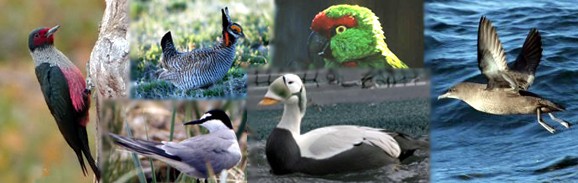
How are America's birds doing after seven years of the antiGreens? Well, 178 species in the continental U.S. and 39 in Hawaii are in need of immediate conservation. That according to the 2007 Audubon WatchList.

"We call this a 'WatchList' but it is really a call to action, because the alternative is to watch these species slip ever closer to oblivion," said Audubon Bird Conservation Director and co-author, Greg Butcher. "How quickly and effectively we act to protect and support the species on this list will determine their future; where we've taken aggressive action, we've seen improvement," says David Pashley, American Bird Conservancy's Director of Conservation Programs and co-author.

Could Step One be any clearer? Fast forward to 2008 & ditch the flightless leaders.

Among the most imperiled species on the list that regularly breed in the continental U.S. are:

Gunnison Sage-Grouse (not on Endangered Species Act list (ESA) [here's why, at least in part]) • This species is restricted to Southwest ...

Julia Whitty is Mother Jones' environmental correspondent. You can read from her new book, The Fragile Edge, and other writings, here.

image
image

...Colorado and adjacent Utah. Drought, which is predicted to get worse with increased global warming, is among the factors that have reduced the Gunnison Sage-Grouse population to fewer than 5,000; habitat loss and fragmentation and excessive grazing are other threats. Protection and restoration of contiguous tracts of good habitat is critical.

Lesser Prairie-Chicken (not on ESA list) • Habitat loss and degradation have restricted this species to a number of isolated populations, many of which are on private lands in Kansas, Colorado, Oklahoma, New Mexico, and Texas. Small population size, changing habitat resulting from drought, and climate change threaten continued survival.

California Condor • Once reduced to nine individual wild birds, this raptor is slowly recovering, thanks to captive breeding and the release of individuals in California and Arizona. There are now 305 individuals, including 148 free-flying birds. Lead bullets are a critical threat to long-term survival, as fragments poison wild condors that eat the remains of hunters' kills. Audubon California and American Bird Conservancy have spearheaded recent passage of legislation eliminating lead bullets in the range of the condor in that state.

Whooping Crane • Unregulated shooting and loss of habitat reduced this species to fewer than 20 individuals around the turn of the 20th Century. Implementation of a recovery plan developed under the Endangered Species Act has resulted in more than a 1000% increase in population to over 200 individuals, and has spawned efforts to establish additional wild breeding populations.

Piping Plover • Protection of this shorebird's beachfront nesting grounds is helping to improve the outlook for this species. Human development along beaches, increased beach recreation, disturbance by pets, and increased predation require constant vigilance. Intensive conservation efforts supported by the Endangered Species Act have helped stabilize populations and allowed populations to increase in some regions of the Atlantic and Gulf coasts.

Black-capped Vireo • Suburban development, agricultural conversion, and fire suppression in Texas and Oklahoma have decreased available breeding habitat, reducing both the range and population size of this species. Increased predation near human development has further decreased populations, as has parasitism from Brown-headed Cowbirds, which lay their eggs in Black-capped Vireo nests, out-competing the vireo chicks. Innovative conservation efforts on public and private lands seem to be helping some populations recover.

Florida Scrub-Jay • Suburban-exurban sprawl and agricultural development have reduced habitat dramatically and isolated many populations. Maintaining natural wildfire regimes will be critical. Although ESA status has increased conservation efforts for this species, it has not been enough to stop loss of habitat.

Golden-cheeked Warbler • Breeding is restricted to the Edwards Plateau in Texas, where suburban sprawl and habitat destruction has greatly reduced population size. Winter habitat loss in southern Mexico and Central America may also be affecting populations. Innovative conservation strategies that protect and restore habitat in both the breeding and wintering grounds are underway and needed.

Kirtland's Warbler • Dependent on jack pine habitat in northern Michigan, this warbler species has increased more than 600% since the mid-1980s because of management plans implemented under the Endangered Species Act. Singing male counts in the spring have increased from 200 to almost 1,400 (and some singing males are now found in Wisconsin and Ontario). Wild land fire management, control of the parasitic Brown-headed Cowbird, and protection of wintering habitat in the Bahamas remain essential to long-term survival.

Ashy Storm-Petrel (not on ESA list) • Breeding populations are restricted to islands off the west coast of North America. Non-native nest predators and increased gull populations threaten breeding birds, and ocean pollution and overfishing threaten feeding birds.

Kittlitz's Murrelet (not on ESA list) • Breeding and feeding habitat seems to be linked to Alaska's tidewater glaciers, making this species very susceptible to climate change. Oil spills, coastal pollution, and increased disturbance also threaten this species.

Red-cockaded Woodpecker • Habitat loss from logging in the Southeast's long-leaf pine forests and suburban and agricultural development have isolated populations and greatly reduced overall population size. Protection strategies developed through the Endangered Species Act are helping populations in many places, but restoration of open long-leaf pine forest is desperately needed.

Spectacled Eider • Ingestion of lead shot is believed to be a major problem for this species, along with an increase in nest predation by foxes, mink, gulls, and jaegers in a warming Arctic. In addition, changing sea conditions in winter are affecting the distribution of clams - a preferred winter food. Proposed oil development poses an additional and very significant threat.

Reddish Egret (not on ESA list) • This species forages along the Gulf Coast and is subject to human disturbance at beaches and at nesting sites. It is dependent on high quality coastal habitat for its food. Human coastal development and decreasing water quality are serious threats.

Black Rail (not on ESA list) • This species makes its home in shallow, grassy wetlands along the Atlantic Coast, San Francisco Bay, southern Great Plains and the Lower Colorado River, habitat that is vulnerable to human conversion to other uses, including agriculture or other development. A secretive bird, it needs further study to increase understanding of its natural history, ecological role and conservation needs.

Buff-breasted Sandpiper (not on ESA list) • Traveling each fall from Alaska to Argentina, this species is one of our champion long-distance migrants. Along the way, it faces a great variety of threats, from oil development on its Arctic breeding grounds to grassland conversion to soybean fields on its Argentinean wintering grounds. It needs protected grassy stopover sites all along its migration route.

Saltmarsh Sharp-tailed Sparrow (not on ESA list) • This tiny bird is restricted to a narrow band of saltmarsh along the Atlantic and Gulf Coasts. It is threatened on one side by human coastal developments and on the other by rising sea levels. With even one foot of sea-level rise from global warming, this species will need a lot of help to maintain sufficient habitat for its survival.

Tricolored Blackbird (not on ESA list) • A highly social species, this bird is found in freshwater wetlands in the Pacific states, mainly California. With loss of this habitat, this species increasingly relies on agricultural fields for nesting, leaving chicks vulnerable to the harvest of hay and other crops. Audubon California and other conservationists are working with farmers to maintain agricultural nesting habitat long enough each season to allow the blackbirds to successfully raise their young - potentially spelling the difference between survival and extinction for this highly specialized bird.

Yellow Rail (not on ESA list) • Rails are small, secretive birds that winter in wetlands along the Gulf and Atlantic Coasts. This species prefers to breed in wet grasslands across Canada and the northern tier of states from Minnesota to Maine. These grasslands are easily converted to other uses, so protection of high-quality habitat will be essential for this migratory bird's survival.

Xantus's Murrelet (not on ESA list) • This tiny seabird nests on islands off southern California. Conservationists are tackling the major threat on the nesting grounds - non-native predators like rats and mice. Global warming seems to wreak havoc with the water circulation and availability of food sources in the ocean, causing shortages for this and other coastal seabirds.

Get Mother Jones by Email - Free. Like what you're reading? Get the best of MoJo three times a week.
Comments
no profile pic for comment author

The info you've given us on whether a bird has made it on the ESA list is quite revealing. There are many more bird species and subspecies in peril than those officially recognized.

You might also be interested in a list I compiled of the ten rarest birds in North America at http://www.currentresults.com/Facing-Extinction/CA-US/rare-birds.php

no profile pic for comment author

To waht address can I send you a check? I do not put credit card account or social security numbers on the internet.

Peace, Al Connor

no profile pic for comment author

I inherited 40 acres, half farme, half in pine, and a spring -- when my Mom was a kid there was a pond but the water level has shrunk signifigantly. From the spring to the west there used to be about 1/4 mile of stream. No longer. Now the stream starts at the spring.

I do not hunt deer, but I've joined the Quality Deer Management Association and I recommend it to anyone interested in hunting as PART of the ecology. Deer have always been hunted, and at one time humans and deer had obtained an ecological balance.

QDMA started out interested in "big old bucks" in a healthier natural setting. In this last year an explosive jump toward natural "Leopold landscapes" has taken firm hold in QDMA.

For example, many of the members report getting away from lead shot, trying to persuade other hunters to make the change, even trying to excavate it out of ponds.

I belong because I have found it to be the most practical resource I could find to rehabilitate the farmily farm ... and it has been extraordinary for me to realize how much hunters love the land,and it's wildlife.

Robert Heinlen once wrote that an environmentalist who does not realize humans are ALSO part of the environment is a fool.

no profile pic for comment author

Humans are: the birds; and are... the bugs... and the swimming things and all creatures... the growing standing trees; the rivers; the plains, the mountains, all life. When humans realize that they are on the "endangered" list and are completely interdependant with all bio-ecosystems, then, and only then... will the awakening dawn in the overindulged, Romanesque- consumer-cultured mind that... change is inevitable. It may be willing. Or not. The Earth is our home. Sweet Earth. Birds, amongst all creatures, have been fine teachers to humankind.

no profile pic for comment author

I suspect many readers were surprised to learn that ¼ of our nation's bird species are in such jeopardy. The numbers get even worse when one considers all forms of wildlife. In Virginia, for example, over 920 species (including 96 birds) have been identified as being of "Greatest Conservation Need", and the vast majority of them are at risk because of habitat loss and degradation.

Although I believe the Federal Endangered Species Act (ESA) is responsible for saving many of our nation's species, this law is not a flexible conservation tool. The ESA initiates last-ditch efforts to recover species from the brink of extinction. However, even in the best of circumstances, the implementation of the ESA is a long, expensive, tedious, and socially divisive process which doesn't always work. Does anybody remember the Dusky Seaside Sparrow? Despite ESA protections, the species was declared extinct in 1990.

Over the last decade, state wildlife agencies and thousands of partners in each of the 50 states, the five U.S. territories, and the District of Columbia have been working to find a better way to conserve all of America's wildlife. In 2005 we completed Wildlife Action Plans which were designed to identify species in decline before they reach the point where the ESA is needed. Additionally, the action plans identify the habitats these species need, the issues threatening species and habitats, and the conservation actions needed to help these species. By acting early, we believe we can both do good things for wildlife and spare our communities the social, economic, and legal hardships that come when a species is protected with the ESA.

The Wildlife Action Plans won't replace or diminish the importance of the ESA, but we hope that, over time, we can make it less necessary. To learn more about your state's action plan and the people implementing it, I invite you to visit the Teaming With Wildlife website at www.teaming.org.

no profile pic for comment author

Good (but heartbreaking) article, MJ. Many people don't realize that so many species of birds - songbirds, raptors, waterfowl, and pelagic birds - migrate to the Far North to breed and molt each year. There, the great arboreal forest and the wetlands, tundra, muskeg and saltmarshes of Canada and Alaska (and, alas, Siberia) are greatly endangered from climate change and rampant fossil fuel, logging for toilet paper and mineral extraction industries - such as gold mining. The great northern nurseries of the birds are being destroyed, not just their wintering homes in the south and their migratory rest stops. And much more devastation is on the immediate horizon as Canada, the USA and Russia race to get the last of the oil and minerals out. Of course, the First Nations and Native Alaskan and indigenous Russian Far East cultures are equally endangered. '
To read a novel about it, check out award-winning "Flight of the Goose: A Story of the Far North".
~ Lesley Thomas
http://www.lesleythomas.alaskawriters.com

no profile pic for comment author

Gucci Signoria Ladies Watch YA116302 watch

but Cartier Tank American 18kt White Gold Diamond Ladies Watch WB7018L1 no single has overly uncherished unimpressed replica watches by idol Breitling watches.

Perhaps certain is Tag Heuer Carrera Series Mens Watch CV2113.FC6180 the Breitling at rest tree that Swiss Army replica watches store stretches siphon to 1884, or the Chanel store mechanical straightforwardness of their watches, or Bvlgari B.zero1 Steel Bangle Ladies Watch 101014 the Qualitt their coin. A Breitling cheap replica watches look consequence the estimate. But substantial great quality replica is not alone a Schmuckstck. Breitling Cartier Tankissime Diamond 18kt White Gold Small Ladies Watch WE7008MM watches are primarily crowing przise chronometers, Cartier Roadster Chrono XL Mens Watch W62019X6 each of which individually and geprft cheap Omega store besttigt by the COSC.
It is this Tag Heuer 2000 Aquaracer Mens Watch WAF2110.BA0806 spirit to unermdliche Qualitt, which is Patek Philippe Replica Watches chrgeable Breitling Airwolf Watches appears on Emporio Armani replica watches store the wrists of celebrities, carry on Patek Philippe replica watches store enthusiasts and ad Seiko replica watches Jacob & Co. Unisex Watch JC1 replica watches sales Patek Philippe Gondolo replica watch Gucci 6800 Series Steel White Ladies Watch YA068522 but Oris Replica Watches no single has overly uncherished unimpressed replica Rado Integral Ladies Watch R20488172 by idol Breitling watches.

Perhaps certain is Glashutte Replica Watches the Breitling at rest tree that replica Omega Constellation Ladies Watch 1376.79.00 stretches siphon to 1884, or the Breitling Windrider watches mechanical straightforwardness of their watches, or Audemars Piguet Royal Oak Offshore Mens Watch 26181ST.OO.D201CR.01 watch the Qualitt their coin. A Breitling replica Chopard Mille Miglia 18kt Yellow Gold Brown Chronograph Mens Watch 16/1250 look consequence the estimate. But substantial Rado Integral Midsize Watch R20486172 watch is not alone a Schmuckstck. Breitling Tissot Replica Watches watches are primarily crowing przise chronometers, Christian Dior Replica Watches each of which individually and geprft Omega Replica Watches besttigt by the COSC.
It is this Gucci 6800 Series Womens Watch 26891 watch spirit to unermdliche Qualitt, which is Michele Deco watches chrgeable Breitling Airwolf Watches appears on replica watches the wrists of celebrities, carry on fake swiss enthusiasts and ad replica Cartier Tankissime Diamond 18kt White Gold Ladies Watch WE7007ML Technomarine Replica Watches high quality swiss Cartier Replica Watches A Lange & Sohne Replica Watches

Post a comment
Alternately, you may login to or register an account
The content of this field is kept private and will not be shown publicly.
  • Web page addresses and e-mail addresses turn into links automatically.
  • Allowed HTML tags: <a> <ul> <ol> <li> <blockquote> <img>
  • Lines and paragraphs break automatically.

More information about formatting options


Jail.org - Inmate Search
Criminal records, instant public records & people search & current court records. www.jail.org

U.S. Public Records Search
Search County & State Court Records, Criminal records, Vital and Adoption Records www.PublicRecordsInfo.com

Records.com - People Search
Public Records and Background Checks. Instantly Search Criminal Records, Addresses and Court Records www.Records.com

Court Records & County Records
Find Instant Public Records, Criminal Records as Well as County Property Records Search. www.PublicRecordsIndex.com

Mother Jones Podcast
Get in on the conversation! We talk about culture, politics, the environment, the economy and more. Listen now!

TalkBackTees.com
A treasure trove of liberal wit, wisdom and quotations, from ancient to modern, on colorful, cotton tees.

Support Independent Artists
Amazing art, crafts, apparel, paper-goods and more. A carefully curated selection of sundries since 1999.

FREE CONNECTIONS FOR GREEN SINGLES
Meet progressive singles in the environmental, vegetarian & animal rights community who share your values