Storm Warning: The Unlearned Lessons of Katrina
New Orleans and its surrounding areas are a petri dish for global climate change. What's happening there will show up in your neighborhood sooner than you think. Part one of a three-part series.
Eroding coastline, sinking land, rising seas; failing levees, poor evacuation planning; a city that would fill like a soup bowl if its flood defenses were breached. In 2002, Pulitzer Prize-winning reporter John McQuaid coauthored a series in the New Orleans Times-Picayune, where he'd worked for more than 20 years, that predicted the fate that would befall New Orleans 3 years later. Now, in a three-part series for Mother Jones, McQuaid reports that the initial surge of attention to strengthening the Gulf Coast's defenses has ebbed, once again, to complacency. And residents of the Gulf Coast are not the only ones who should be worried. As McQuaid reports, it's not just the levees that are broken—it's the entire political system by which we create disaster defenses. Climate change will bring more storms, floods, fires, and tornadoes, but Washington has done very little to get us prepared. In part one of "Storm Warning," McQuaid visits a New Orleans landfill that is ground zero for understanding what we haven't learned from Katrina.
—The Editors
Recently, I hiked to the top of a hurricane levee along the Gulf Intracoastal Waterway, a shipping channel running through the east side of New Orleans. During Hurricane Katrina, this spot had been hard hit: Easterly winds drove the hurricane storm surge straight down the canal into the center of the city, overflowing levees and floodwalls all the way. Some washed out. Some breached. In the end, the neighborhoods they shielded were mostly destroyed.
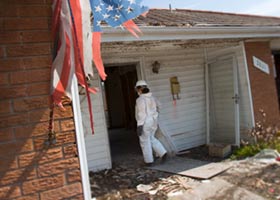
Guided by local lawyer Joel Waltzer, we walked about 50 yards, then turned and looked north, the water at our backs. In front of us was an enormous mound of construction debris, about 60 feet high and a football field long, covered with thick, gray-brown clay. Trucks rolled through a FEMA checkpoint on the far side and then up to the top of the mountain. There, attended by bulldozers and scoopers, they dumped their cargo, the remains of the New Orleans that used to be: the Sheetrock, wood, concrete, wire, plastic, and steel that once composed the city's wrecked buildings, which are still being torn down or gutted. Like many spots in New Orleans, the dump, called the Old Gentilly Landfill, is grimy and workaday on the one hand, elegiac on the other. "I'm thinking about how many homes are in there," Waltzer told me. "Mine's in there somewhere. I never did find it. I used to trudge up to the top of this son of a bitch and look."
The view was troubling for another reason: It doesn't take a geotechnical engineer to see that piling billions of pounds of debris next to a hurricane levee will affect its stability, which depends on a complex, poorly understood interplay between the extreme pressures of rising floodwaters and the cohesion of the squishy Mississippi delta soils. Miscalculate and your wall will breach. And even if the levee itself holds, a flood that overtops it will wash over the landfill, sending the remains of the city coursing through the streets—again.
When residents of nearby neighborhoods raised these questions in the months after the storm, the state dismissed their concerns at first. The agency that built the levee, the U.S. Army Corps of Engineers, was in the best position to gauge the safety issues, but it stayed out of the dispute—technically, it turns levees over to local authorities after construction is complete. Frustrated residents—members of a nearby Vietnamese community, among the few damaged neighborhoods to return in force—hired Waltzer to represent them in their attempts to shut down Old Gentilly and another nearby landfill. Robert Bea, an engineering professor at the University of California-Berkeley who had participated in a comprehensive review of the Katrina levee failures, volunteered to analyze the levee-dump relationship on behalf of the residents. He concluded that as the pile of debris grew, it would indeed cause mounting instability. The Corps still had ultimate responsibility for levee safety, so it agreed to upgrade the dump's safety standards—though not enough, in the view of Bea or the residents, who have continued to use every bureaucratic route available to try to close the dump.
The details of this fight won't be shocking news to anyone who has paid attention to the city's slog over the past two years; the entire reconstruction effort has been plagued by similar bureaucratic snarls and disputes. Basic safety—that is, what New Orleans needs more than anything else to survive—seems to have gotten lost amid the infighting between agencies of the city, state, and federal governments, and the myriad contractors doing the work. The unreliable political interests and bureaucracies that set the stage for the disaster are still in place, mostly unchanged, and now charged with planning for the city's future.
Catastrophes are supposed to nudge history in new directions. After the 1927 Mississippi River flood engulfed vast areas of the south, the Corps overhauled the river's basic flood-control architecture, building the foundation of the modern system we have now. Katrina's devastating blow to New Orleans raised some history-making issues: Can the damaged city be sustained—that is, can it survive not just the next few hurricane seasons, but the next 100? And as global climate change causes sea levels to rise and possibly fuels larger hurricanes, will other cities inevitably go under too? (See "A Hundred Katrinas: Climate Change and the Threat to the U.S. Coast.")
Instead of addressing those questions, though, the national debate has stressed the idiosyncrasies of New Orleans. Some have written that French explorer Bienville made a mistake when, in 1718, he founded New Orleans on the fringe of a low-lying swamp dangerously close to Hurricane Alley. Others take it a step further and say that three centuries has been a good run, but it's time to give up. There's some truth to these statements—New Orleans' location on a low-lying, sinking river delta has indeed put it in a terrible predicament. But the underlying message is that Katrina was a fluke: that New Orleans' problems are unique and its existential concerns mostly irrelevant to the rest of the country. That may be comforting to people outside Louisiana. But it's not realistic.
Thanks to centuries of man-made alterations to its fragile topography—levee construction, oil and gas drilling, suburbanization—New Orleans has become a place where environmental changes are accelerated, amped up. Year to year, sometimes day to day, the shape of the land is changing, and the life it supports is ever more exposed to danger, hurricanes being only the most dire on a long list of environmental threats. New Orleans and environs are a kind of petri dish for global climate change—what's happening there will be showing up elsewhere sooner than you think.
The rest of the nation already has plenty in common with New Orleans. For decades, government agencies at all levels have subsidized development in risky areas. Along coastlines and in river plains, this arrived in the form of flood defenses, federal flood insurance, and aid for businesses (in Louisiana, for example, oil and gas drilling and refining). Near fire-prone forestlands, road building and the marketability of nature itself drove construction of subdivisions. Katrina exposed this ad hoc approach as both lethal and unsustainable. The current wrangling over New Orleans is a preview of what will happen over the coming decades. As melting polar ice is projected to encroach on more and more coastal communities, larger hurricanes and powerful rainstorms will send floods rolling over outmoded flood defenses, and heat waves and ecological disruptions may make some now-comfortable locales unlivable. We don't yet have any idea how, or where, we'll draw the last lines of defense. As post-Katrina New Orleans is proving, it's not simply a matter of building levees; far more important is constructing the basic political architecture to decide who will be protected, and how.
Tomorrow, in part two of "Storm Warning," John McQuaid explores what the Dutch can teach us about protecting our coastline.

I don't understand why the people who have the power to get things moving toward solutions to slowing down or trying to stop global warming are dragging their feet. It's such a complex problem, we can't be sure that it's not already too late; in fact, it is too late, because the polar ice is melting...But of course the only things that concern Americans seeems to be their own precious hides...Never mind if dozens of species already suffering...what makes the news is the "treasure trove" beneath the ice.But it may not be too late to save some of the land and life, though, and--of course--our precious hides.I don't understand why more people are talking about diseal fuel, either...No, it's not more enviromentally safer than gasoline per se, but it does yeild an enormous advantage in how much is used to get from point A to B. Diseal cars, from what I understand, can already get about 50 miles to a gallon! And I find it hard to believe that we can put a man on the moon, but can't make a car that gets 100 miles to a gallon. And everyone needs to be continually reminded of the little steps they can take that add up to big decreases in carbon emissions--like turning one's computer all the way off, instead of putting it in stand-by mode..and this same thing holds true for a number of other electronic equipment as well..like the stereo, XBOX (or whatever)..making sure all lights are out unless absolutely needed, etc, etc. I wasn't very good about these sort of things myself until I saw a report that detailed exactly how much emissions come from the American home. I didn't realize that anytime I used electricity of any sort (except maybe batteries..I'm not sure about those)I was releasing emissions. Now, I'm a lot more cautious, and feel better that I'm doing a little something to help. It's not too late for anyone to start...but if we don't move forward strongly on all fronts, we will still face a world that we would not recognize today. Polititions with strong ties to the oil business is probably not a good idea. These super-rich, animal-killing, people--who consider, many of them, to be Christians!!---seem to believe they're going to take their billions with them...They are never rich enough. You would think that maybe they would have a little concern for their children and grand-children, but they don't seem able to think very far ahead. The Govt. has known for some time that oil wasn't going to last forever, and that we were getting close to the end days...but instead of thinking ahead, doing something before any species suffered, they were more concerned about their wallets. I have no doubt that patents have been submitted before for various devices that could help a car get more miles to the gallon; and I believe represenatives from the oil company showed up, offered an outrageous amount of money for the patent, so long as the payee signs a non-disclosure statement. And no one ever even hears about it. Now, I will admit that it's possible this is untrue, but I have no doubt that if such patents were developed, that's what would happen...and if the guy cared more about improving society than making money, or thought he'd make enough with his device, and said "no" to the oh-so powerful and Govt. connected Oil Industry, Mr. Patent maker would probably meet with an unfortunate accident.
The most ironic thing I find in politics is the Republicans manipulation of Americans' religion. No-one is as much a Christian as a Republican...yet, except possibly for the abortion issue, I think God--were he a man-like figure as many believe--would side with the Democrats on most issues. Republicans want to keep their money;they don't want to help anyone less fortunate than they are. Yes, some people do abuse the system just because they are lazy, but there are many people who truly need help simply because life threw them a curve-ball--like the residents of New Orleans received from Katrina. Christ emphasizes the UN-importance of money, and the IMportance of helping our fellow man. And when God said we are above the animals, and must look after them and the earth, he didn't mean going out and shooting cute little squirrels out of the trees!! Or dropping deer with a .3006. And going back to abortion--what sense does it make to shoot a doctor for performing abortions because you think that is murder? Abortion in early stages..well, we can't know if God considers that murder, since the soul is supposed to enter the body at first breath, and leave it at the last. But shooting the doctor--there's no question that's murder, in God's eyes, or in the eyes of our justice system. Haven't these lunatics ever heard that two wrongs do not make a right? Finally, there's "Judge not, lest you be judged yourself" (that not be perfect, but it's close) These matters are supposed to be left for God to determine guilt; yet the Republicans are the most judgmental of all groups, especially their religious right extremists. They want to set their religious beliefs up as law, for all to have to follow. This violates God's promise of free-will, and it certainly violates our Constitutions guarantee of freedom of religion, and seperation of Church& State. One would have to be very dense--blind--to think that the Christian God would support the selfishnes and greed of the Republican party. And I think he would really frown on them for using His Name to help them win elections!
Thanks for your time.....A.
Thank you, Mr. McQuaid for reminding the nation that the Gulf Coast is still deeply hurting from Katrina. People across the nation seem to be having a problem in relating to what has happened here in the long term, as if it could not, in the form of some storm, happen to them. As we have seen, other areas are suffering devastating storms and flooding; we know that levees and bridges across the nation are in deep need of repair. For whatever reason, although we know these things, we choose to ignore them until disaster strikes and then we hear a temporary, but collective "ouch, oh dear, how awful" before we go back to our couches and ball games.
It is time that we wake up not only to global warming but to the demise of our national infrastructure, and, indeed, manufacturing abyss. If we cannot get it together any other way, perhaps we need a new CCC and a new WPA to get things done.
And a heartfelt Thank You to all who came down to the Gulf Coast, sent money, and prayers - all efforts are deeply appreciated and will not be forgotten.
“The rest of the nation already has plenty in common with New Orleans. For decades, government agencies at all levels have subsidized development in risky areas”
At long last perhaps Mother Jones has struck, albeit inadvertently, on the main problem: federal government meddling in development and in all matters across the nation. Basically it comes to this, while there are no hard polling numbers that I am aware of, many people in the United States think it is catastrophically stupid to rebuild a city, or part of a city, below sea level. Many of us are tired of people building, often with government encouragement or assistance in the form of flood or other insurance, in known hazardous areas. Then, like clockwork, the sea, who no zoning board consults, takes back land in storms, fire rages though housing developments built in tinderboxes with a view, rivers reclaim flood planes, gravity votes last and houses built in areas prone to mudslides, well, slide, the earth quakes and idiots building on fault lines are stunned, stunned I say at the wreckage! Soon after will come the inevitable camera-in-the-face boo-hoo-a-thon, so as to catch every tear followed by pontificating blowhards demanding government ”do something” . We would all be better served if the poor in the known high risk areas were relocated at our collective expense, those who stay can buy what’s know as “insurance” and the ones who opt out of insurance are simply on their own.
To put it plainly stop insisting that government steal money out of my pocket, at the point of a gun if necessary, and continue funding or guaranteeing or in any way subsidizing people living foolishly in high risk areas.
check out Greg Palast: Hurricane George:How The White House Drowned New Orleans on Buzz Flash
whistleblower says White House knew the levees were breeched and told nobody
Ivanhoe, the government is not "stealing" money out of your pocket. Taxes are your contribution to living in a modern nation and you are just going to have to cope. It isn't like you don't personally benefit from them, anyway. The rest of your point is basically sound. We should never have built in marshlands in the first place. They act as a buffer against these storms, after all. Had we left them alone rather than drain them, we would have saved thousands of lives. And that's not even taking malaria into account!
This whole situation saddens me. I lived in Savannah, Georgia while in the Army and for part of my marriage afterward. I love that city, and knowing it will probably be wiped out--by rising sea levels, if nothing else--is depressing. And still our government sticks its head in the sand. OK, I misspeak. It isn't some nameless entity known as "the government." That entirely takes culpability away from the INDIVIDUALS in the government who believe stupid things and make stupid decisions. Can we please stop electing these idiots, already? Lives depend on it. Literally.
It must reaaly warm the hearts of terrorists everywhere to see that we cannot even respond to a natural disaster that we had several days warning about. The Cheney Administration(get real, Bush is just an alcoholic, dyslexic puppet) cares only about waging Operation Iraqi Liberation(that's right, the original cover name for the war spells OIL) and doesn't give a flying [deleted] about his own citizens. Cheney, of course, never stopped working for Halliburton and traded with Iraq until 2003, when he decide along with the WTO, Rothschilds, Bilderbergers and Rockefellers to just take over the country at gunpoint. But I am veering off on a tangent. My main point is the United Statesm if totally unprepared for any kind of disaster and will probably be taken over by China in about ten years. I hope I am wrong and would welcome any counteropinions. Send E-Mail to me at shastapenguin@yahoo.com.
Sadly, there is a lot of blame to go around.
Louisiana politics played a big roll in the levee's not being maintained/built properly.
Congress has steadfastly denied funds for the CE to work on them.
The local citizens continue to want to live below sea level in a city with direct river access to the Gulf.
Europeans have come up with effective barriers to prevent the North Sea storms from ravaging their port cities.
But that takes money and a Congress willing to do the right thing, rather than sit back and accept bribes.
The concept of peaking world oil extraction rates will probably play the biggest role in what gets rebuilt and where. As the costs of all building materials increases along with transportation many areas will by necessity be abandoned.
There seems to be a common misconception out there that New Orleans is completely below sea level. Not true! 51% of Orleans Parish is above sea level according to LIDAR surveys done in the last year. (LIDAR is like RADAR, except it uses laser instead of radio waves.)
Many of the areas flooded by Katrina are above sea level including the populated areas of St. Bernard Parish and big chunks of the Lower 9th Ward and Holy Cross. The levees protecting St. Bernard were NEVER built up to the height mandated by Congress. The floodwall bordering the 17th St canal was originally designed with sheet piling going down 35 ft. into the ground. The Corps of Engineers changed that somewhere along the way to only 17 ft., with now well known tragic results. These are just two examples of our government's failure in this area.
If the flood protection system had been built the way it was supposed to be, and the protective wetland barriers surrounding the area had not been so badly compromised by years of erosion accelerated by man's actions,the region would not be in the dire straits it is in now. The whole ecological situation in southern Louisiana requires looking at a multitude of complex conditions, processes and interactions, with similarly complex, intertwined solutions. Is it too much to ask that those in power get off their duffs, stop bickering and do something positive about this situation?
tiffany jewelry
of tiffany jewelry on ebay are cheaper than tiffany jewellery outlet store, why is that?
You will find the newest tiffany jewelry on sale fashion release on their official website.
I am planning to give my wife a big surprise with tiffany and co as a birthday gift, but I don’t know which one to choose, any ideas?
Welcome to our company, our
Welcome to our company, our company Huayi Trade Co.,LTD are good at selling the top quality designer bags (Balenciaga ,Chanel , Chloe' ,Christian Dior ,Dolce&Gabbana , Fendi , Gucci , Hermes , Galliera GM ,Miu Miu , Prada ), they are mirror image bags which are identical to the real onesLouis Vuitton Galliera GM . Our company locates inthe leather town in China, Speedy 25since 2003 we did this business we have won great trust and popularity from our customers from all over the world. We areexpanding our business, any inquiry for wholesale business is warmly welcome, Louis Vuitton Speedy 25just contact us, you can get our prompt reply.We have enlish speaking representative to answer phone call, or we can call you if convenient for you.
We are providing all kinds
-
tagged as:
- result
We are providing all kinds of louis vuitton handbags, wallets and purses in ourgucci Online Store, all items of which have the most popular styles and are the newest and at discounted prices.
We also provide helpful shopping guide tips for you to choose and compare our bags and other accessories. Get your sale of replica handbags today and you will never be disappointed with it.