Recycling? Fuhgeddaboudit
Are New Yorkers right to think recycling is a waste of time?
A COUPLE OF SUMMERS ago I was in Boulder, Colorado, where I grew up, for a visit. On a wildfire-dry Saturday morning, I went with my husband and son to the downtown farmers market. We got ice water from a drink stand, broccoli from Pachamama Organic Farm, and a muffin from an old favorite, the Brillig Works, where the guy was nice enough to say he remembered me from when I was 17. On the way out, we threw the remains of the muffin in a receptacle for compostables and the water cup in a bin for commingled containers. I wasn't sure what to do with the straw, so we took it with us, because the market is a "zero waste zone," where anything not compostable or recyclable must be "packed out." I thought of our regular Saturday Greenmarket back in Brooklyn, where there are no recycling bins—just dented metal drums overflowing with newspapers, water bottles, and dog poop. I said to my husband, "This would never work in New York." Then I wondered why.
What makes a city good at recycling? Is it just a cultural thing? Why is Boulder a city of recycling zealots and New York a city of recycling skeptics? Many New Yorkers see their recycling program as a total facade—or, at least, a total failure. Debates about our refuse burn in the massive incinerator online. "Is it true that New York and New Yorkers don't recycle their rubbish?" wonders an Australian on Answerbag. Closer to home: "[A] lawyer friend of ours who works for the City...said he was fairly certain that the City doesn't actually recycle—that it's all a charade," writes Brooklynite Carrie McLaren on Stay Free! Daily, a blog of consumer culture. McLaren herself doesn't "believe in such a massive conspiracy," but is struck by how many others do.
The origins of New York's recycling skepticism are murky, but many point to a notorious 1996 New York Times Magazine cover article by John Tierney titled "Recycling Is Garbage." According to Tierney, recycling neither made economic sense (cities lost money doing it) nor was good for the environment (he claimed, for instance, that recycling newsprint "creates more water pollution than making new paper"). Recycling cranks had been making these arguments for years, but the Times gave their reasoning a kind of counterintuitive cred. I remember reading the article the Sunday it appeared. Though I'd been a committed recycler since my teens—the girl who made a show of collecting the Coors Light cans after the beer bash—Tierney introduced an element of doubt. I actually agreed with him about some stuff—namely, that recycling served as "a rite of atonement for the sin of excess." Was it possible that he was right about other things, too? In the years that followed, I recalled the piece whenever I needed to rationalize a recycling misdemeanor such as tossing a shampoo bottle into the regular trash. The technique used to recycle plastic is actually worse for the environment—right? I found that others also retained their own Tierney "facts." One night when I asked my husband why he'd thrown the breaded-chicken box in the garbage, he cited the glut of recycled paper—a 12-year-old nugget from Tierney. Our memories of the story testified to its staying power. The National Resources Defense Council called Tierney's piece "the most prominent...attack on the nation's growing commitment to recycling," noting that the article was discussed in more than two dozen major newspapers and prompted New York's mayor, Rudolph Giuliani, to mock his city's recycling program as "absurd."
Our next mayor, Michael Bloomberg, went even further. He didn't just dis the program; he dismantled it. In 2002, Bloomberg suspended the recycling of plastic and glass. The city was facing a budget deficit, and Bloomberg said his measure would save $40 million. For the next two years, we left our Brooklyn Lager bottles on the stoop for the homeless or just threw them in the trash. "That lost the faith of a lot of people," says Elizabeth Royte (see "Meet the Zero-Waste Zealots"), who immersed herself in the city's waste stream for her book Garbage Land. Now even true believers began to wonder if the new policy just codified what had been happening all along: mobsters collecting your recyclables and, when you weren't looking, dumping them in with the regular trash. Bloomberg fully restored pickup two years later, in a contrite acknowledgment that recycling did the city both environmental and financial good. (According to the city comptroller, savings from the suspension were "minimal, if any.") At the time, recycling was finally starting to satisfy even the critics who cared only about the balance sheet. As the price of landfilling garbage was rising, recycling markets were improving. The costs of the two kinds of disposal had nearly reached parity when the world economy collapsed last fall. Today the recycling market is depressed. But New York's current contracts with buyers were structured to protect us from such fluctuations. That's good, because another hiatus would be a Sisyphean setback: New Yorkers are still recycling less than they were before the last interruption.
New York City residents—and we're just talking residents, not businesses, not schools, not construction sites—recycle 18 percent of their waste. This is what waste wonks call a "diversion rate," meaning that it measures, by weight, what portion of refuse is diverted from the regular trash. Weight, rather than volume, or rate of participation, is the established metric primarily because all over the world, people put garbage trucks on scales. It's an imperfect system: The number on the scale doesn't differentiate between a ton of glass and a ton of paper, or tell us how many lightweight yet toxic BlackBerrys we're tossing. But for better or worse, the diversion rate is the standard measure of a recycling program's success. Our diversion rate is better than Oklahoma City's, which, at 3 percent, is the lowest of any major city in the country, but not as high as San Francisco's, where residents reportedly recycle nearly half their garbage. (I say "reportedly" because laid-back California only estimates its diversion rates; type-A New York weighs every truck.)
How can we get New Yorkers—or Philadelphians (8.4 percent), or Denverites (13 percent)—to recycle more trash? Perhaps better marketing? The Czech Republic tries to sell citizens on recycling with sexy TV ads. In one, a mop-top boy and his huge-boobed neighbor reach their communal bins at the same time. The tagline: "Any reason is a good reason to recycle." Funny, but in America, it's our policies that require manipulation, not just our perceptions. Even if every New Yorker recycled everything perfectly all of the time, our residential diversion rate would only reach 35 percent. The city simply doesn't include enough materials in the program to do any better than that.
So what aren't we recycling that we could be? Let's start with yogurt cups. New Yorkers are obsessed with the fact that we can't recycle yogurt cups: Three times a month, some of my neighbors carry their rinsed-out cups to the Park Slope food co-op, which sends them to Recycline, a company that turns them into toothbrushes, razors, and other items. Yogurt cups aren't included in the city's recycling program because the resale market for the type of plastic they're made out of is limited. But yogurt cups don't weigh very much. Let's say we began collecting them, as well as all of the other kinds of plastics that are currently excluded from our program: Our residential diversion rate would increase by all of 0.4 percent. Still, Benjamin Miller, a former Sanitation Department policy planner and the author of Fat of the Land, a history of garbage in New York City, argues that we should collect all plastic containers, as they do in Dallas, San Jose, and San Francisco. The volatile yogurt-cup market—that's a headache for the waste wonks. The parsing between No. 1s and No. 2s—that's a task for sorting facilities. For residents, recycling should be as "simple as signs on the street that say, 'Pick up after your dog,' period," says Miller.
If one way to simplify recycling is to change what we collect, another is to change how we collect it. New Yorkers will tell you that they don't recycle because the city makes it too complicated. Sometimes they cite what turn out to be vestigial misunderstandings from an even more bewildering era. It's news to many people, for instance, that they no longer have to bind newspapers into stacks no higher than 18 inches (not since the mid-'90s), or separate out junk mail and cereal boxes (that ended in 1997), or sort different kinds of recyclables into clear or blue bags (2004, R.I.P.). These days, some cities are making recycling as mindless as possible by implementing "single stream" recycling, in which paper, metal, plastic, and glass are all mixed together in one bin. Should this be our standard nationwide? Proponents argue that it makes people more likely to recycle; others counter that the quality suffers. Miller is all for simplicity, but says single stream "degrades the material and reduces the amount that can be made into new products." A glass recycler told BusinessWeek that single-stream glass arrives mixed in with "slime, chicken bones, and needles."
Chicken bones: There's an idea. The most dramatic way to boost a city's diversion rate is to compost food scraps and yard waste, which in NYC are a weighty 39 percent of our household waste stream. At least 42 communities, mostly in California and Washington, have residential composting programs. Could it work in the five boroughs? Debatable. Sixty-three percent of our housing stock is made up of multi-unit buildings—many with exterminator sign-up sheets in the lobby. San Francisco's composting program is lauded, but it serves primarily single-family homes. (Plus, compost needs a place to go once it's collected, and you wouldn't believe the Not-In-My-Borough fights over siting such a facility.)
The issue of infrastructure is not easily overcome. A recent Sanitation Department report stresses, "It is well-known in the recycling evaluation literature that recycling in multi-unit apartment buildings is particularly difficult," citing discouraging studies from sources as varied as the Journal of Applied Social Psychology and the EPA. (High-rise fun fact: Having a trash chute diminishes the amount of materials a building recycles by almost 11 percent.) Our apartment buildings also prevent us from adopting the gold standard of garbage disposal, a pay-as-you-throw system, found in 7,000 communities, including San Francisco, where residents get a hefty discount for producing less garbage, but aren't charged for more recyclables or compost. A San Francisco recycling spokesman jeered in Chemical & Engineering News in 2007 that New York's current free-for-all system is an "incentive for people to create garbage."
"The benefits of pay-as-you-throw are clear," agrees David Hurd of the NYC recycling outreach office. "But how do you assess a fee in a big complex of 1,000 apartments?" Miller, however, compares it to water metering: a 19th-century technology New York resisted until the 1980s.
Before those San Franciscans get too smug, though, take note that among things both cities can currently recycle, like paper, the diversion disparity narrows to within a few percentage points. (And we don't "estimate.") The same high-density, trash-chute-addicted lifestyle that hampers our recycling impulses also has a preventative effect. New Yorkers produce much less waste than the average American: about 250 pounds less per household per year.
And isn't that the real point? While all Americans could do more to recycle, we also need to, contrarily, reduce our fixation on it. Recycling is like a rock star whose solo career has eclipsed the rest of the band. Reduce and reuse—where are they now? We obsess over recycling, demand that our cities make it cost neutral and effortless, yet at the same time, we discard "garbage" with impunity. Recycling gives us permission to consume. But putting a week's worth of plastic bottles into a clear bag instead of a black one doesn't address the real problem. From a literal perspective, John Tierney was right: Recycling is garbage.

4 Rs
I guess I could have chosen ReuseBill or ReduceBill as a handle but after rethinking I think I'll stick with RecycleBill...
Seriously, recycling is my business but reality is: recycling only treats the symptoms of excessive consumption and waste. It's time we took up the 4 Rs: Reduce, Reuse, Recycle and Rethink.
The systems have not
The systems have not changed much even in this day and age except that the rubbish is of a different nature, containing plastic bagging and materials which will never decompose when buried in the ground. One layer of garbage and plastic bottles and items topped off with one layer of dirt and continuing upward until a maximum height is reach by order of the environmentalist and city ordinances. After it reachs the height allowed it is covered over to a final layer of earth and they move on to another section. What to do when there is no more land left to cover up this rubbish and garbage is indeed a problem.
Whoever drew the little
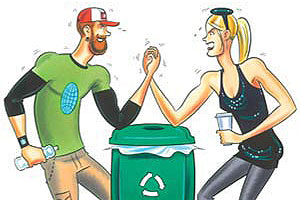
Whoever drew the little graphic for this piece got it wrong. Arm wrestling is done right hand to right hand, or left to left.
Aside from that important correction, I agree that recycling probably has a significantly lower impact than proponents believe. If you watch the Story of Stuff, there's a good explanation of the trash that is produced for every bag of stuff you buy (I think it was 65 bags of trash from manufacturing for every bag of trash you ultimately throw away). By that measure alone (if true), recycling has limited potential, at least at the comsumer level.
Dangle A Big Carrot On A Stick For Maximum Effectiveness
-
tagged as:
- solution
There is no cultural challenge that a good bribe can not fix. On an online green social network called Greenwala, members discuss infinite ways that people can become more motivated to recycle -- the common refrain uttered is that "every little bit DOES help." One article cites the successes of a recycling rewards program called RecycleBank which has in some east coast areas secured a community participation rate of 95%. Read all about what eager recycling beavers get in return for their admirable efforts here: http://tinyurl.com/qfgmho Ultimately, we have to remember that we're dealing with HUMAN NATURE and as such, people must feel that they are earning a little somethin'-somethin' for their hard work in order to justify the extra 20 seconds of effort. It's just how people are. Companies like RecycleBank are proving that human nature doesn't have to be a barrier to our waste reduction goals.
Don't create trash in the first place
Ultimately, the best way to reduce the amount of garbage is to not create it in the first place. This motto can also go a long way in solving a lot of other problems. For example, fresh vegetables do not create trash, especially if you compost. They also are healthier and require less energy to produce compared to processed and packaged foods. Daniel Quinn was right when he said recycling is just a program and programs won't save us from ourselves, there needs to be a complete paradigm shift.
Funny thing about the US is
Funny thing about the US is that our greatest destinations; our great hubs of commerce NY and LA are completely and totally unsustainable. Without illegal labor, organized crime, and mammoth levels of local tax evasion and under the table deals both would have withered on the vine long long ago.
Recycling means more than
Recycling means more than just sorting "trash." Sorted "waste" is of no greater value to anyone than unsorted, unless the materials are then re-manufactured for new use. This means that, if we want "recycling" to succeed, we need to create markets for recycled materials. Since manufacturing out of recycled materials takes less energy and water than making the same products from virgin materials (think pulping paper vs. pulping trees), this should result in less CO2 and lower social costs all around.
And JD is right. The first R is the most important: to the extent possible, don't make waste in the first place.
Funny thing about the US is
Funny thing about the US is that our greatest destinations; our great hubs of commerce NY and LA are completely and totally unsustainable. Without illegal labor, organized crime, and mammoth levels of local tax evasion and under the table deals both would have withered on the vine long long ago.
People are the secret of recycling
I run a small New England recycling transfer station. I receive scrap metal, appliances, tires , waste oil, batteries and such. The trash haulers have single or bistream recycling pickup that means I don't have to deal with paper or beverage containers. I have buyers for ferrous and nonferrous metals, but I still can't find a buyer for large plastic things, like kiddy pools or playhouse furniture or those broken resin lawn chairs. I started a Hippy Freestore to allow me to collect useful items and offer them to patrons gratis, it serves as a draw and allows me to collect a wider variety of items that people may want to get rid of. Due to the complete absense of a budget from my town I have turned the recycling center into a self supporting town department. I have made two things paramount, generosity and good will coupled with constantly seeking out the best price for my recyclables. I think that recycling is not really about the stuff, it is about people and how they relate to society. In the poorer parts of the world more is recycled because no one can afford to waste a thing. Americans are still more fixated on their own convenience than any sense of thrift but this is likely to change. I came to my own attitude by way of the hammer of homelessness on the anvil of poverty. I have property now but back in the day I was an unhoused scavenger on the streets of Metro Boston. The stuff people would throw out! I found gold, silver antiques, tools and more! I continue to honor the scavanging spirit with my recycling center, hiring fellow scavengers to help run the site. The Freestore also helps to channel Yankee thrift and I encourage local bodgers to come and pick materials for whatever crazy projects they might be working on (a la Junkyard wars). Recycling has certainly taken some hits in the past year, but it represents a way of life, and a choice of future for us all.
where everything is hermetically sealed in *oversided* &
redundant packaging, recycling is a major problem
Especially if you live in a small home.
We picked a small home in Toronto, simply because a McMansion seemed ridiculous for our family.
Toronto has a major garbage problem. When the GTA decided to deliver upon us...:
-a single massive, wheeled garbage can, (size matched to tax fee!),
-a *tiny* recycling bin,
(glass, paper, metal... washed, organized & separate?
...in THAT? really???),
-a largish, wheeled green-composting waste bin,
-& provide us with 5 'extra bag' stickers for which we must pay $$$ for extras (where do we buy more if necessary? Still a mystery to me!)
...those of us with small homes were bewildered. Where the hell do we put our recycling materials FOR TWO WEEKS until the next pickup?
...In the basement? that begs for bugs...
...In the dining room? that begs for bugs...
...In the kitchen? that begs for bugs...
...Outside? that begs for bugs...
...acquire a special hermetically-sealed *waste holder/organizer*? really?
You tell me: can you *really* clean a pizza box enough that it doesn't attract raccoons that tear up any organized stack outside so they may play with the cans & lick the paper...
or so that it doesn't draw cockroaches or earwigs? CAN YOU? I dare you.
I double-dog dare you to find a way to keep a pizza box neatly stacked so that raccoons don't festoon your yard with your recycling.
Hell, I understand that one can't *actually* recycle fat-impregnated paper. Which leaves me entirely suspicious that every neatly folded & compressed pizza box or leaked-upon Asian delivery paper bag that I see in a blue bin... is an exercise in comforting mass delusion.
"Oh" but you say, you shouldn't make ANY garbage!! if you're making garbage, its your problem!
"Oh screw you", say I. If I can't get magnificent Thai phad woon sen delivered or some fantastic Chinese chili chicken... then why the hell am I putting up with living in a crowded, urban setting? Maybe the answer is recycling the delivery containers? That starts getting very much like the Indian dabbawala economy... (now *that's a thought* for a food delivery complimentary industry!)
So now we sit, with our colour-coded quarterly calendars, accumulating the exceptionally hard-to-avoid recycling materials...
attending upon the next time we are deigned with a 'themed' pickup...
...downright suspicious that most of this shit isn't *actually* being recycled or appropriately...
...awaiting "The Great Canadian Cockroach Urban-Surge Invasion"...
~~~~~~~~~~
Spread Love,
BlueBerry Pick'n
The Jeff Farias Show: streams FREE & LIVE Mon-Fri, 6-9pmEDT
FREE podcast
~~~~~~~~~~
"We, two, form a Multitude" ~ Ovid.
"Violence can only be concealed by a Lie, & the Lie can only be maintained by Violence." ... "Any man, who has once proclaimed Violence as his Method, is inevitably forced to take the Lie as his Principle" – Aleksandr Solzhenitsyn
Those who can make you believe absurdities can make you commit atrocities." - Voltaire
~~~~~~~~~~
Obviously, recycling or not
Obviously, recycling or not is only one component of a huge problem. I have become quite conscious of my buying habits and have found it still quite difficult to get certain things not wrapped in the "dreaded" plastic. Even if you shop in natural stores, there will still be items w/packaging that cannot be recycled. What are we as consumers supposed to do when there are no other options(I'm mainly talking about grocery items). I really think that the government has the responsibility to protect our environment. Corporations should be responsible not only for the products they create, but the packaging and life cycle of the product. The only group powerful enough to demand this change for corporate responsibility is the govt, but I guess it's obvious who really running the show these days, and it's not our elected officials.
slobone
As for the economic value of recycling, check out a recent issue of the New Yorker for a profile of a Chinese woman, the richest person in China, worth $9 billion before the crash. Her entire fortune comes from buying recycled wastepaper in the US and making it into cardboard boxes, which are then shipped back to the US with Chinese goods in them.
In other words, that stuff is so valuable that even if you pay to have it shipped by barge all the way to China, you can still make enough of a profit to become a billionaire. So please don't tell me New York City can't find a way to make it pay.
Recycling? Fuhgeddaboudit
They made a song about it for heaven sake:
http://blogdredd.blogspot.com/2009/03/garbage-garbage-garbage.html
Nowadays, recycling is
Nowadays, recycling is important as it can help us to save money. With the economy that we have today we need to be wise on what buying the things that we really needed. Many people are now struggling hard just to meet their ends. Right now, recession dating has taken a financial turn, with online dating sites like CreditScoreDating.com. The importance of money can't be diminished, but as the sole focus of dating, it is crass, to say the least. Do not get a fast cash loan and sign up for Established Men, whatever you do.
#5 plastics (which many
-
tagged as:
- solution
#5 plastics (which many yogurt cups are) can be recycled at Whole Foods.
دردشة منتدى منت
This trash thing.
This is the first of comments by me, though I did make past comments on other threads. As a new subscriber I wish all to be well and acceptence is appreciated.
Cordially RF Callahan
This trash problem
This is the first of comments by me, though I did make past comments on other threads. As a new subscriber I wish all to be well and acceptence is appreciated.
I REMEMBER
Think we have a problem about trash in this country? I mean we have every day in most all households at least one container of trash composed of bottles and cans, cardboard containers of various foods, bread wrappers and plastics of all sorts. Once per week the truck comes rolling down from one household to other picking up containers and hauling off the trash. If you were a slob you placed in the food wastes also, and it was quite a stink after a week in those containers. The truck hauled it down to the waste facility to be burned for industrial factories or dumped into the local landfill.
Behind my home here in Stow Mass. Is a group of stone walls separating my property from other owners property. Along these walls can be dug up old refuse of decomposed trash, cans and bottles etc. That was how it was handled one hundred odd years ago at this colonial home. You dug a hole and dumped in the month’s supply of rubbish and covered it up, and it was out of sight, out of sound forever.
Weekly in the cities you went to the local dump across the river in Watertown Mass. That dump was not legal due to city ordinances not being developed then at the turn of the century.
Also was the garbage hole. This was a cast iron round swill top door you stepped on and it opened up to allow one to dump the food wastes. It was a haven for fly’s and maggots galore. Weekly the garbage truck came to empty by hand, pulling out the steel container of garbage weighing up to a hundred pounds which in some cities and towns was hauled off to the piggery. That was farmer Brown’s cheap food for his hogs.
The systems have not changed much even in this day and age except that the rubbish is of a different nature, containing plastic bagging and materials which will never decompose when buried in the ground. One layer of garbage and plastic bottles and items topped off with one layer of dirt and continuing upward until a maximum height is reach by order of the environmentalist and city ordinances. After it reachs the height allowed it is covered over to a final layer of earth and they move on to another section. What to do when there is no more land left to cover up this rubbish and garbage is indeed a problem.
Should it be mentioned that years ago Boston had its barges shipping it out over the continental shelf and dumping it into the ocean? I remember.
This trash problem
This is the first of comments by me, though I did make past comments on other threads. As a new subscriber I wish all to be well and acceptence is appreciated.
I REMEMBER
Think we have a problem about trash in this country? I mean we have every day in most all households at least one container of trash composed of bottles and cans, cardboard containers of various foods, bread wrappers and plastics of all sorts. Once per week the truck comes rolling down from one household to other picking up containers and hauling off the trash. If you were a slob you placed in the food wastes also, and it was quite a stink after a week in those containers. The truck hauled it down to the waste facility to be burned for industrial factories or dumped into the local landfill.
Behind my home here in Stow Mass. Is a group of stone walls separating my property from other owners property. Along these walls can be dug up old refuse of decomposed trash, cans and bottles etc. That was how it was handled one hundred odd years ago at this colonial home. You dug a hole and dumped in the month’s supply of rubbish and covered it up, and it was out of sight, out of sound forever.
Weekly in the cities you went to the local dump across the river in Watertown Mass. That dump was not legal due to city ordinances not being developed then at the turn of the century.
Also was the garbage hole. This was a cast iron round swill top door you stepped on and it opened up to allow one to dump the food wastes. It was a haven for fly’s and maggots galore. Weekly the garbage truck came to empty by hand, pulling out the steel container of garbage weighing up to a hundred pounds which in some cities and towns was hauled off to the piggery. That was farmer Brown’s cheap food for his hogs.
The systems have not changed much even in this day and age except that the rubbish is of a different nature, containing plastic bagging and materials which will never decompose when buried in the ground. One layer of garbage and plastic bottles and items topped off with one layer of dirt and continuing upward until a maximum height is reach by order of the environmentalist and city ordinances. After it reachs the height allowed it is covered over to a final layer of earth and they move on to another section. What to do when there is no more land left to cover up this rubbish and garbage is indeed a problem.
Should it be mentioned that years ago Boston had its barges shipping it out over the continental shelf and dumping it into the ocean? I remember.
RECYCLED AUTOMOBILES, AND THE PROBLEM
THIS MAY NOT BELONG IN THIS MEDIA, BUT NEVER THE LESS IT IS IN FACT RELATED TO THE PROBLEMS OF RUSTED OUT HULKS, FILLING AMERICA'S JUNKYARDS
Those of us who had worked in the automobile business in one capacity or another came to realize that the American system of the past in manufacturing automobiles became deficient in many facets of that system of manufacture.
With Detroit the very quite theorem not ever spoken of was to make a car that lasted three to five years, after which a detieriation of the bodies would begin to come about. Basically you ended up with a rust bucket eventually ending up in the junk yards. Being disgusted in this you kept the car for no more then three years, traded it in for a new one and that future rust bucket lasted its second owner a year or two. It went on and on for years. Detroit loved it because it kept them busy manufacturing the cars. They did well with car owners that continually traded in for a new car every to or three years.
At the time foreign south pacific Islands such as Taiwan brought forth the replacement panels that were welded onto the cars to extend the life in body. Even bogus replacement hoods and doors were made. They were made just a very little different from the factory originals so they could get by the patent laws against copying. It went on for several years that way and body shops were kept busy. Then we had the undercoating scam. They sprung up for around ten years also until the American public got wise to the fact that cars rust from the inside out. The real value of those undercoating systems was for sound deadening purposes. They quieted down metal vibration to make the car seem to run smother.
When Toyota entered the picture they basically made a car to last longer in body and go further between repairs. You made less visits to the repair shops. Honda and Nissan followed Toyota’s success, and America bought.
The above is just a few of the reasons for Detroit’s failures. No doubt there are other reasons also.
RECYCLED AUTOMOBILES, AND THE PROBLEM
THIS MAY NOT BELONG IN THIS MEDIA, BUT NEVER THE LESS IT IS IN FACT RELATED TO THE PROBLEMS OF RUSTED OUT HULKS, FILLING AMERICA'S JUNKYARDS
Those of us who had worked in the automobile business in one capacity or another came to realize that the American system of the past in manufacturing automobiles became deficient in many facets of that system of manufacture.
With Detroit the very quite theorem not ever spoken of was to make a car that lasted three to five years, after which a detieriation of the bodies would begin to come about. Basically you ended up with a rust bucket eventually ending up in the junk yards. Being disgusted in this you kept the car for no more then three years, traded it in for a new one and that future rust bucket lasted its second owner a year or two. It went on and on for years. Detroit loved it because it kept them busy manufacturing the cars. They did well with car owners that continually traded in for a new car every to or three years.
At the time foreign south pacific Islands such as Taiwan brought forth the replacement panels that were welded onto the cars to extend the life in body. Even bogus replacement hoods and doors were made. They were made just a very little different from the factory originals so they could get by the patent laws against copying. It went on for several years that way and body shops were kept busy. Then we had the undercoating scam. They sprung up for around ten years also until the American public got wise to the fact that cars rust from the inside out. The real value of those undercoating systems was for sound deadening purposes. They quieted down metal vibration to make the car seem to run smother.
When Toyota entered the picture they basically made a car to last longer in body and go further between repairs. You made less visits to the repair shops. Honda and Nissan followed Toyota’s success, and America bought.
The above is just a few of the reasons for Detroit’s failures. No doubt there are other reasons also.
tiffany jewelry
of tiffany jewelry on ebay are cheaper than tiffany jewellery outlet store, why is that?
You will find the newest tiffany jewelry on sale fashion release on their official website.
I am planning to give my wife a big surprise with tiffany and co as a birthday gift, but I don’t know which one to choose, any ideas?
According to stylists, Paris
According to stylists, Paris Hilton chooses an ideal pair of shoes for her outfits Eugenie Wallet. Like her dress, they're fun and carefree, without being sloppy Louis Vuitton Eugenie. Alongside her popular sportswear and fragrance lines,Neverfull MM handbagParisalso runs a footwear line. "Louis Vuitton Neverfull MM I have always loved shoes and after working on my recently launched sportswear and fragrance lines this seemed like a natural next step", commented the radical shoe princess on her much hyped Paris Hilton Footwear range.
We are providing all kinds
-
tagged as:
- result
We are providing all kinds of louis vuitton handbags, wallets and purses in ourgucci Online Store, all items of which have the most popular styles and are the newest and at discounted prices.
We also provide helpful shopping guide tips for you to choose and compare our bags and other accessories. Get your sale of replica handbags today and you will never be disappointed with it.
ugg sale
I would like to buy uggs,
ugg sale,
ugg boots uk,
ugg boots london,
ugg boots sale,
uggs,
ugg london,
ugg boots sale,
UGG Bailey Button boots,
bailey button ugg boots,
UGG Nightfal boots,
and so on.
ugg sale
I would like to buy uggs,
ugg sale,
ugg boots uk,
ugg boots london,
ugg boots sale,
uggs,
ugg london,
ugg boots sale,
UGG Bailey Button boots,
bailey button ugg boots,
UGG Nightfal boots,
and so on.