Photo used under a Creative Commons license by flickr user <a href="http://www.flickr.com/photos/granchius/">granchius</a>
UPDATE: Join us for an expert-led reader forum April 13-17 on MotherJones.com around the question: Is organic and local so 2008?
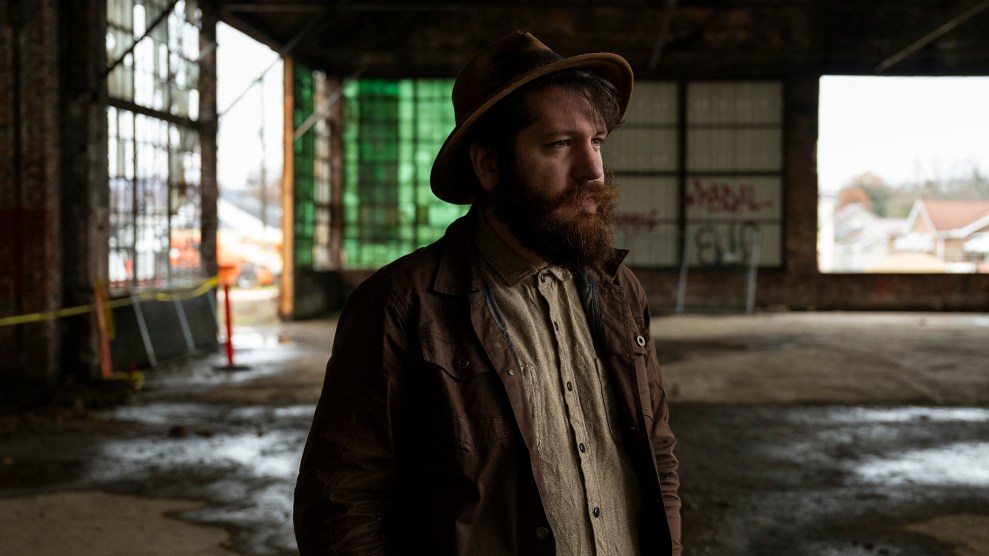
Both Alice Waters and Van Jones praise Bryant Terry‘s new cookbook, Vegan Soul Kitchen. And not just for the recipes. Terry, a food policy fellow for the Kellogg Foundation, has a history of whipping up recipes for change, not just food.
After founding a youth nonprofit and hosting the public television series The Endless Feast, Terry now travels across the country giving lectures on everything from the prevalence of diet-related diseases in the South to “food deserts” in Oakland. He joined Mother Jones on video to whip up his healthy version of a quintessential soul food recipe and talk about racism in the food system, faith-based food activism, and the Southern Organic Kitchen Project.
Mother Jones: Your new book is called Vegan Soul Kitchen. Why vegan? Is veganism going to save the world?
Bryant Terry: I don’t necessarily think veganism is going to save the world; I’ll start there. In fact, I don’t advocate any particular diet for anyone. I think that’s a very personal decision that people have to make. I will say this, however: There are more and more studies in terms of the health benefits of veganism; there are more and more studies that are showing that a properly executed vegan diet is highly beneficial for cleansing, for detoxing, in addition to lowering the risks for and even ameliorating chronic illness. We all have our own body constitutions and cultural food ways and personal tastes that determine what will work for us. All that being said, I think that if everyone did at least embrace a more plant-centered diet, it would improve public health. Given that it takes up to 16 pounds of grain to produce one pound of meat, I think we can also go a long way toward ending hunger and saving the environment as well.
I want [Vegan Soul Kitchen] to be a book for everyone. I wanted this book to be a book for people who identified themselves as vegetarian, people who identified themselves as vegan, and people who identified themselves as meat eaters. For me, the focus of this book is about the use of local, seasonal, and sustainable real food.
I also think that one of the most important parts of this project is moving away from this stereotype of what traditional African American food and cooking is and going back to what I know it as. Food historian Jessica B. Harris says African American cuisine is simply what black people ate. When I think about what my family ate, we ate what people think of as soul food on special occasions, on holidays, but our typical diet was leafy greens and nutrients and tubers—food that was as fresh as being harvested right before our meal. Whatever was in season, that’s what we were eating. It was being harvested right from our backyard.
MJ: You grew up in the South, and you were able to eat locally there then?
BT: I was. I grew up in Memphis, Tennessee; I went to college in New Orleans before moving to New York City for graduate school. Both sets of my grandparents grew up in rural Mississippi and brought a lot of agrarian knowledge to Memphis, which is an urban center in the South. Both sets had amazing backyard gardens. My paternal grandfather, practically every inch of available space was green.
MJ: What’s the best way to improve access to healthful foods in low-income communities?
BT: In California there are lots of great farmers markets, especially here in the Bay. But in West Oakland there are close to 35,000 residents and not one single grocery store. Yet there are over 50 liquor/convenience stores. I think that people deserve at least a supermarket in their community. But that’s not the only solution. All communities, and low-income communities especially because of food insecurity and lack of access to healthy foods, need more farmers markets, need more community gardens and urban farms. It would be great if people living in communities had the tools and resources to grow food in their own backyard—community-based food systems.
MJ: Is the current US food system a medium for racism?
BT: I think that the agriculture system in general is rooted in racism—consider that historically black labor on plantations was the backbone of the economy. These workers didn’t reap the benefit of that system. In terms of the contemporary food system we see a lot of racism currently. Obviously we have a large supply of food. A lot of people don’t examine why that is the case, but there are a number of nonwhite migrant workers being exploited every day. In restaurants across America we see Latino workers in the kitchen who are being paid substandard wages. The saddest thing to me is that if we think about these workers, these are the people with the least access to good food. Yet they’re often suffering from the highest rates of obesity and diet-related illnesses.
MJ: How can food activists best combat this?
BT: I think there needs to be a general consciousness raising among consumers. So many consumers aren’t aware of the backstory. They see the end product in the supermarket but don’t know all the steps that it took to get it there, who helped to get the food there.
MJ: What’s the future of farming? Will young, hip organic farmers save the world, or is it something else that will keep people motivated?
BT: I don’t necessarily think we need more hip farmers, but we do need more young people going into farming. I think the last time I read the statistic the average age of farmers was 55? So we do need more young farmers. And we need more immigrant farmers, more woman farmers, more farmers of colors, and we need more support so people can actually see it as a viable career option.
MJ: What one fact about food injustice do you think would most shock Americans?
BT: The thing that I think about most often is the loss of biodiversity. We talk about these food issues so often with concern to historically excluded communities, but I’m concerned with everyone having access to healthy foods. Consumers across the board are being robbed of biodiversity. I think it’s an injustice that most consumers going to the supermarket have so few options for fruit and vegetables to feed their families. There might be the appearance of abundance, but it’s an illusion.
MJ: What’s the Southern Organic Kitchen Project?
BT: I’m currently a [Kellogg Foundation] food and society policy fellow and the project that I developed as a part of the fellowship in the first year was what I called the Southern Organic Kitchen Project. Nine out of the ten states with the highest rates of obesity are in the Southern region of the United States. Given that I’m from the South, I wanted to do something to address that. I have been focusing more energy and resources on addressing those issues.
MJ: You talk about the South but you live in San Francisco. What’s unique or interesting about the Bay Area that keeps you here?
BT: Well, within an hour I can be at the ocean, the forest, the mountains…But really, I fell in love with the city the first time I came out here in 2003. In addition to the natural beauty, this is ground zero for the food justice movement. I trace my entrée into this work back to the Black Panthers and the work they were doing in Oakland in late 1960s at the intersection of poverty, malnutrition, food insecurity, and institutional racism, with their free breakfast program and their grocery giveaway and their projects in which they fed young people three times a day in schools in Oakland. I’m here because of the energy, the ideas, and the fact that this is a great place for me to land. When I’m traveling and working nationally, I love coming back here.
MJ: How can faith-based organizations or places of worship tie faith and food together?
BT: In terms of addressing some of the most impacted communities and historically excluded communities—often of color, often low income—there is this adage in specifically African American communities that on every corner in low income neighborhoods you’ll find a liquor store. I would add to that that across the street you’ll find a church. Because we’re becoming such an urban nation, we’re going to need to be producing so much more food in cities. These institutions have members, obviously. They have the resources to start projects like urban farms and gardens, teaching tools, and the ability to educate their members so that they can then go home and start their own urban gardens. I just really think that faith-based institutions can take the lead in creating community-based food systems, and I’d really like to see that happen.
MJ: The Fair Food Foundation was forced to close because of Bernard Madoff’s Ponzi scheme—how will this affect your work?
BT: It’s one thing to hear about these things in the media as abstract, far-off things, but I got a call one morning from Oran Hesterman, who was the president of the Fair Food Foundation, saying that the Fair Food Foundation was shutting down effectively as of that day, because they’d been caught up in the Madoff scandal. It affected me because the fellowship that I had was actually funded in part by the Fair Food Foundation. That meant that my fellowship was pretty much null and void. Thankfully the Kellogg Foundation picked up the funding for the second year of the fellowship.
Oran Hesterman is a brilliant philanthropist. He had so many progressive ideas about shifting the way that money is given out. He wanted to focus on the creation of healthy, community-based food systems in historically excluded communities and now an advocate, an ally, and obviously lots of capital won’t be able to go into these communities now.
MJ: Are there other groups ready to step in and provide funding for food activism?
BT: I think more and more foundations are putting resources into food activism. But I think that given the state of the economy, foundations won’t be giving as much in general. For me it’s about working with these existing institutions in communities that people already go to, that people trust, that they know, and determining how best they can play a role in the creation of local food systems and address the ills that are right around them in the community.
Video produced by Alexandra Bezdikian.