- ‹ previous
- 2297 of 2798
- next ›
Income vs. Consumption
INCOME vs. CONSUMPTION....In recent years, as it finally became impossible to deny that income inequality had risen to unnerving levels, conservatives began trying out a new argument: it's not income inequality that matters, they said, it's consumption inequality. If middle class people were buying 50% as much stuff as rich people two decades ago, and they're buying 48% as much as rich people today well that's not such a big deal, is it? Middle class lifestyles, contra liberal whining, are in pretty good shape.
This has always been a fairly desperate attempt to deny an obvious problem. At the low end of the income spectrum it mostly depended on the fact that government welfare programs boost the incomes of the poor, which, though true, is something that's happened only over many a dead conservative body. They never approved of most of these programs in the first place, but they were happy to use them as evidence that the economy was doing fine for poor people anyway.
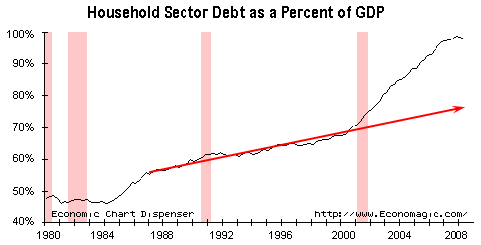
In the middle part of the income spectrum, the consumption argument relied on what? Well, it's obvious: if your income is flat or down, but your consumption is rising, that means you're borrowing. It means you're taking out home equity loans, or maxing out your Visa card, or paying usurious rates to your local payday loan outlet. And sure enough, broad statistics show that as median incomes stagnated over the past eight years, household debt exploded. Of the increase in consumer spending we've seen over that period, several trillion dollars of it has been fueled solely by increased borrowing. It turns out surprise! that income inequality mattered after all. This debt explosion couldn't keep up forever, which means that eventually middle class consumption was bound to plummet. And now it has.
As for what this means, Paul Krugman explains it all for you today:
The long-feared capitulation of American consumers has arrived. According to Thursday's G.D.P. report, real consumer spending fell at an annual rate of 3.1 percent in the third quarter; real spending on durable goods (stuff like cars and TVs) fell at an annual rate of 14 percent.
To appreciate the significance of these numbers, you need to know that American consumers almost never cut spending. Consumer demand kept rising right through the 2001 recession; the last time it fell even for a single quarter was in 1991, and there hasn't been a decline this steep since 1980, when the economy was suffering from a severe recession combined with double-digit inflation.
....It's true that American consumers have long been living beyond their means....Sooner or later, then, consumers were going to have to pull in their belts. But the timing of the new sobriety is deeply unfortunate. One is tempted to echo St. Augustine's plea: "Grant me chastity and continence, but not yet." For consumers are cutting back just as the U.S. economy has fallen into a liquidity trap a situation in which the Federal Reserve has lost its grip on the economy.
....The capitulation of the American consumer, then, is coming at a particularly bad time. But it's no use whining. What we need is a policy response.
The ongoing efforts to bail out the financial system, even if they work, won't do more than slightly mitigate the problem. Maybe some consumers will be able to keep their credit cards, but as we've seen, Americans were overextended even before banks started cutting them off.
No, what the economy needs now is something to take the place of retrenching consumers. That means a major fiscal stimulus. And this time the stimulus should take the form of actual government spending rather than rebate checks that consumers probably wouldn't spend.
Let's hope, then, that Congress gets to work on a package to rescue the economy as soon as the election is behind us. And let's also hope that the lame-duck Bush administration doesn't get in the way.


As usual, Krugman is right. The previous "stimulus program" helped out Walmart, but practically no one else. We need a massive public works program to rebuild the infrastructure that we've been neglecting (and neglecting to pay for) since the Reagan administration. A recession is no time to worry about the federal deficit, provided that once the economy is booming again, we'll have the wherewithal to pay the deficit down. This means that after the economy recovers, we'll have to raise taxes; the alternative would be to watch our infrastructure and our government crumble as did the former Soviet Union.
(A) major fiscal stimulus. And this time the stimulus should take the form of actual government spending rather than rebate checks that consumers probably wouldn't spend.
If we elect John McCain this will never happen.
Listening to Obama the other day, I think he gets the message.
The only power left to most Americans is to not borrow and consume more. Dr. Krugman thinks it is a bad time for consumers to finally exert their only economic power, but saving the current political economy with increased borrowing and consumption will not benefit the average American consumer in the short or long term. The current political economy can no longer provide average Americans an affluent lifestyle, so it is not worth saving. Dr. Krugman, like Reagan Republicans, wants the average American consumer to deny their best ineterests and save the wealthy by increasing their debts and consuming more. Americans should not follow Krugman's advice, but should withold their meager wages and force the end of America's capitalist dictatorship.
The mystery is, why don't the business interests recognize that a healthy, and relatively wealthy, middle class is their only hope? The American economy, consumer-based as it is, is a trickle-up economy. Isn't this obvious? Or am I missing something?
In what distant future will the consumer again live far beyond their ability to pay?
That is the problem--the US economy has depended upon the foolish expenditure of the consumer in order to "grow" the economy.
Where will all the nail salons, spas, resturants, specialty stores go?
What will replace their position in the economy?
A puffed up economy, with less than ever at the core.
I think there might be a direct correlation with intrade's future market on The Rapture.
The likelihood of a rapture was amazingly high during the first seven years of the bush administration. I can only suspect that fundamentalists were buying TV's and dealing in credit default swaps at an elevated rate in expectation that they would not have to deal with the consequences.
Over the last six months the bottom has dropped out on the futures market for the rapture. I'm not sure I understand it, but this might explain the drop in consumer confidence.
tpx: Dr. Krugman, like Reagan Republicans, wants the average American consumer to deny their best ineterests and save the wealthy by increasing their debts and consuming more
You might come to that conclusion if you hadn't read the article. Krugman fully acknowledges that excess consumer borrowing has to stop sometime. He doesn't suggest that people borrow more - he says that the appropriate response is fiscal stimulus in the form of increased gov't spending.
Like I asked before....
Kevin, I'm thinking about what you say and your recommendation against Prop. 1A in California while I'm reading Krugman and Brooks seeming to agree that we need serious government spending on something, preferably infrastructure to prevent the recession from deepening. Have you got any thoughts on this? Your prior: we. don't. have. the. money. stance seems pragmatic but it may hurt us in the short and long runs. What say you?
Today I saw a headline saying that the cost of bonds may be too high for California if 1A passes???
hollywood,
How about local train service or subway? Improving commuting options will do a lot more for the average person and a lot more for greenhouse gas emissions.
Payday loans are great alternatives to return check fee's and late payment fee's on bills.
Yes, Dr. Krugman did say, "That means a major fiscal stimulus. And this time the stimulus should take the form of actual government spending rather than rebate checks that consumers probably wouldn't spend."
But he also said:
"So this looks like the beginning of a very big change in consumer behavior. And it couldn't have come at a worse time."
"Sooner or later, then, consumers were going to have to pull in their belts. But the timing of the new sobriety is deeply unfortunate."
"The capitulation of the American consumer, then, is coming at a particularly bad time."
What Dr. Krugman did not mention is the American consumer should discontinue their consumption in order to eliminate wealthy corporate America's influence on the political economy. Dr. Krugman, instead of lamenting the American consumers' capitulation, should celebrate and encourage it.
tpx made the post at 4:46 PM.
The capitulation of the American consumer is not comming at a bad time for them, it is coming at a bad time for Dr. Krugman and his crony friends on Wall St.
Fred Zlotnick: The mystery is, why don't the business interests recognize that a healthy, and relatively wealthy, middle class is their only hope?
Because they're short sighted and ignorant of history.
They also weren't too quick to realize that that light at the end of the tunnel was an oncoming train representing the burst of the housing bubble.
The American economy, consumer-based as it is, is a trickle-up economy. Isn't this obvious?
It may be obvious to you, but you probably have the unfair advantages of not being short sighted, historically ignorant or utterly brainwashed.
B,
I agree. But that ain't on the ballot. When would it even be considered (we can hope)?
"The American economy, consumer-based as it is, is a trickle-up economy. Isn't this obvious? Or am I missing something?"
Posted by: Fred Zlotnick on 10/31/08
Think of it as a garden water feature. There's a pool of water being fed by a fountain (if it's a Republican pool it's bound to be a figuring of a little boy peeing into the pool) and there are statuettes and other water features (employee, employer, banks, etc.) and so the water meanders around before going back out of the pool, around to the system's engine and then spouts back out into the pool. The system's engine could be the Fed, but it's also the desire of people to fulfill their greed or other personal desires (home ownership, business ownership, building another room on the house, sending kids to school, etc.).
So, you could say it trickles down, around and out and around and back up and so on.
But, as activity grows you need a bigger pool and more water. Too much water (inflation) and it spills over everywhere. Too little water and the growth dies off.
What we've had recently was a lot of inflation (in housing and the financial markets) and then a collapse because there just wasn't enough real growth to support it. It was inflation we didn't see much in the real economy (the pool) because it was kept in the financial markets until it got into housing. When that all collapsed the market collapsed and money on paper disappeared (trillions). This by itself was probably good and didn't directly hurt the real economy.
Where we got into more serious trouble was when the credit markets seized because people couldn't evaluate mortgages and the derivatives. This began to shrink the water supply for the pool and activity began to die off. Now we're receding in a recession.
So, how to counteract it?
First we've got to get a handle on the toxic assets which are still there. The houses are fine, but the mortgages must be burned and replaced with something we all can evaluate.
Second, we have to do the usual sorts of things to reinvigorate the economy and bring it back. If there is still something there, but in stasis, then new capital flow will revive it. But, if activity has died completely, then we essentially have to start over and regrow new stuff. It's like stepping back in time.
I like the infrastructure plan as one to keep activity from dying off too quickly and giving us time to fix the mortgage problem. That we have the option, unlike last spring, of really building new stuff or fixing up old stuff makes it really terrific.
But, we've got to get rid of the big underlying problem of broken toxic mortgages and the derivatives related to them.
Up in the bay area we get to vote on a BART extension.
The problem with the argument that rising inequality had something to do with the explosion of debt is that the start of the rise in inequality greatly predates the explosion is debt that is depicted. Moreover it is not just the lowest quintiles that got into debt - uper middle class people also were living beyond their means. It's correct that the crisis has a lot to do with excessive household debt, but what the sources of the increase in that debt are is far from obvious.
Maybe now we will have a majority we will be able to pass the raise in the minimum wage.
That floats all other wages higher as well. It is common sense.
Henry Ford understood even in the 20's: You have to have customers. The greed economy just doesn't work.
So the middle class will be able to spend like it did in the 50's and 60's when wages were fairer, because back then unions were still strong.