- ‹ previous
- 2358 of 2746
- next ›
Playing Pattycake?***
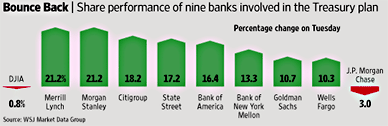
PLAYING PATTYCAKE?....The stock market was down today, but shares in banks that got capital infusions yesterday are up, up, up. The LA Times reports:
Investors' verdict on the Treasury's $250-billion plan to buy stakes in banks: They love it.
That may make taxpayers even more suspicious about these deals. If there was supposed to be some pain involved for shareholders in this partial nationalization, it's not showing up in the stocks. Of the nine big banks expected to get the largest cash infusions, most saw their shares surge today the third straight advance even as major market indexes slipped.
Sure, maybe this means less than meets the eye. Maybe the details don't matter, and investors just figure bailout = good and therefore it's time to buy. But check out this tick-tock from the Wall Street Journal about how yesterday's meeting at the Treasury Department went:
A final deal between regulators was hashed out in Mr. Paulson's office Sunday afternoon....The top bankers were then told to show up for a meeting Monday at 3 p.m., but were given few details. Expecting an uproar over the plan, government officials secretly planned to break off the first meeting, giving CEOs time to vent, talk to their boards, clear their heads, and reconvene at 6:30 p.m.
In Mr. Paulson's call with Morgan Stanley's Mr. Mack, the CEO asked the Treasury secretary the reason for the meeting, according to people familiar with the matter. Mr. Paulson responded, according to a person familiar with the matter: "Come on down, we'll tell everyone at the same time," adding, "I think you'll be pleased."
....U.S. officials argued the plan represented a good deal for the banks: The government would be buying preferred shares, and thus wouldn't dilute their common shareholders. And the banks would pay a relatively modest 5% in annual dividend payments.
The meeting ended at about 4 p.m. By 6:30 p.m., all of the [term sheets] had been turned in and signed by the CEOs. No second meeting was held.
It sure doesn't sound like the bankers put up much of a fight, does it? They've shown precious little willingness to sacrifice for the common good before now, so my guess is that they decided this was indeed a pretty good deal. Count me among those taxpayers who are more suspicious about this deal than I was yesterday.







If these guys write the bailout so the taxpayers are gamed and ripped off, they're asking to be put on the Benedict Arnold plane.
Kevin, what do you expect from meetings held between a few stinking rich guys in a smoke filled room? They are taking care of themselves with our money.
The whole bailout is a bad idea. There is plenty of private money around the world that would have, with terms such as those offered to Buffett, would have loved to participate in investing in US banks. I think the whole reason this was done in this secret manner is because these banks are insolvent and the banks, who have been hiding these details from the public, probably with Paulson's blessing, didn't want to be exposed. With Paulson/Bush's help they now managed to go from insolvent to somewhat normal using the taxpayer's dime and without having to admit they were insolvent.
Talk about Moral Hazard.
I think Paulson may have slightly blackmailed several bankers with something like: "if you don't participate, we'll let it leak that your not a good citizen or worse." Leaking stuff could be a powerful weapon to punish banks that opted out.
Yes sir, Kevin, as a firm supporter of recapitalization, this deal has looked like pure bullshit to me since last night. Exactly what hit are management and shareholders expected to take under this new Paulson plan? None that I can tell.
This is pure gift to these motherfuckers who got us into this situation. It lacks the following:
1. Dilution of existing shareholders. These jerks failed to their job -- make sure the businesses that they owned were run properly.
2. Suspension of dividend payments. What fucking profits? So the U.S. taxpayers provides capital that are redistributed as profits to shareholders? Give me a fucking break.
3. Management is held accountable. So the same assholes who got us into this mess are still there. Only the Bush administration would be happy with this outcome.
Give me a goddamn break. This deal is a crime. A gift to the shareholders and management via lower middle class taxpayers.
Kevin, as I tried to emphasize before the bailout bill passed, any wiggle room in interpretation was going to work for the financial sector actors and against the taxpayers.
The process should have been slowed so that we had commitments written into law about what the taxpayers were getting for our $700 billion.
Agree with g. powell, but would note also that investors are probably figuring here that any firm in which the Feds take a significant equity stake are regarded by the government as being in the 'too important to fail' category, and that therefore the nine firms (or whatever number it ends up being) are now the safest investments out there.
kevin,
now you are suspicious? are you joking? you have been an enthusiastic cheerleader of an immediate bailout with no discussion. now that it's done, you have buyer's remorse? cripes.
I agree with 'sc'. It's a bit late to boo-hoo now, Kevin Drum. You were so all over this bailout over the last few weeks I thought you were being paid privately by Bush and Co. Now you're SURPRISED that power is helping power? The ugliest thing of all is our money 'rescuing' them without us getting any profit from their recovery, if indeed they have one. Pathetic. Look twice before crossing the road, chicken little.
The banks have all had stern letters sent to them. What else do you want, that someone should abolish their compensation committees?
Oh, yes, God forbid if the teachers' unions should want some more money. They're putting personal profit before the public good.
This country is so fucked.
If the bankers want public funds, let them do the same thing they did in Japan. Apologize in front of a national audience and resign. And give back your freakin' bonuses.
The woolmarkets of the world must be awash with all the sheared sheep.
This is what Buffett got for his preferred shares:
* 10% dividend yield
* 10% premium to par upon call
* 100% of mkt cap of pfd stk in warrants to buy common stk.
This is what Paulson got for the taxpayers' preferred shares:
* 5% dividend yield (9% after 5 years but they'll most likely be called away after 3 years, so 5% is the effective rate)
* par call (0% premium)
* 15% of mkt cap of pfd stk in warrants to buy common stk
So the taxpayers get less current yield, less upon call scenario, and far less upside. And the terms are far more generous than what I've seen in the convertibles / pfd.shares+warrants mkt. Sure, the US govt has lower cost of capital than Buffett so Paulson could have had less onerous terms for the banks and still make the same expected profit, but this is bending over backwards. Very little surprise that the banks all took it without complaint (esp. since the terms didn't include covenants that were discusses as possibilities).
Kevin circa a week or two ago: Paulson's going f these guys over. Kevin today: Yeouch!
The biggest problem here is that Paulson has wasted our money on banks that were already well capitalized. When you recapitalize banks in this way, you ought to aim for those banks in the fat part of the curve; the 25% at the bottom will fail anyway, and the 25% at the top don't need our help. So Hank Paulson, incompetent as he is, aims squarely at the top. Heckuva job, Hank.
It could be argued that you need to recapitalize the healthiest banks so the weaker ones will follow along, but that's just not the case. The weaker banks will go along in any event, it's a simple matter of their survival.
The other problem with Paulson's recapitalization scheme is lack of board representation. Only a fool would put that much money on the line and not demand a seat on the board.
test post
That's weird. Any posts I've attempted lately that had actual content in them have been blocked.
OK, now let me try the comment I'd originally intended.
jerry - here's the link.
"It's worth noting that when Paulson submitted the initial 3-page bailout bill that gave him czarlike authority to do anything he wanted with his $700 billion, it was a huge tactical mistake. He was treating Congress the way he'd treat a Wall Street adversary, and that was a very bad move. But it doesn't mean that he wanted unfettered authority to make sweetheart deals. It's actually more likely that he wanted unfettered authority to rape and pillage."
-Kevin Drum, October 1, 2008
Oops.
What I got when I linked to and quoted Kevin's post from a couple weeks back, saying Paulson was going to give the Wall Street bankers no quarter:
"Thank you for commenting.
Your comment has been received and held for approval by the blog owner.
Return to the original entry"
This is getting spooky.
When the market crashed, I thought to myself, I though, "You know, godoggo, it's kind of a shame about you not having any money, because now would be a good time to buy some stocks, so you can sell'em real quick when they bounce up again." That's what happens after a crash. They bounce around for a while. Maybe the news triggers it. Maybe not. Who knows?
I don't know what the big surprise is about these stocks bouncing up. It is not like any of them (that I have looked at) came back up to anywhere near what they've been over the past couple of years. Sure, a 25% gain on ML is nice, but the stock has been hammered this year. This is not surprising at all.
And Re: comparisons to Buffet's GS deal... I'm sure they were feeling a lot more desperate at that moment than they are now.
rational >"...There is plenty of private money around the world that would have, with terms such as those offered to Buffett, would have loved to participate in investing in US banks...."
That is true but "the smartest people in banking" wouldn`t have been able to continue their top monkey high-roller game if they had to accept money from Abu Dubai, China, Saudi Arabia etc soverign wealth funds.
Wake up folks !
"Revolutions, before they happen, appear to be impossible and after they occur they appeared to have been inevitable." - Alexis de Tocqueville
Note that by contrast, the UK banks that are being bailed out have seen their share prices hammered - in large part because part of the deal is them cancelling their dividends until the government gets its money back. This looks a lot more like punishing bad risk taking while still avoiding damaging the system.
One never knows what happens in this elite club of CEOs and Paulsons.
I am trying to figure out why State Street and Bank of New York Mellon got a piece of the pie (albeit, a smaller billions chunk).
My understanding is that State Street and BNYM are not really banks (commercial or investment) but the processors for "the" banks transactions. I know much of the stock market to bank processes go through BNYM.
My question then is are we "pseudo" nationalizing "the" banks along with the processors too?
hmm, maybe these processors were actually dabbling in some mainstream banking too.
Presumably we will soon be hearing stories about large bonuses being paid to failed bankers that were enabled by the bailout.
I am a Citigroup shareholder, and what is to stop me from introducing a resolution at the next shareholders meeting to pay out a $25 billion special stock dividend?
I agree that the taxpayers did not get a very good deal, but some commenters' arguments here are just wrong.
First, the banks will not be able to pay out dividends using the government's money. Since the government stake is preferred stock, no dividends can be paid to common shareholders until the full preferred dividend is paid. The banks will need to invest the government money in order to avoid needlessly diluting common shareholders.
Second, existing shareholders are in fact diluted by this deal (just not much). Even without the warrants (which are obviously dilutive), the fact that some dividends that would have been payable to common now must go to the preferred shares is inherently dilutive, since the value of any stock is nothing more than the value of future dividends.
Finally, while I understand the sentiment that injecting capital into healthy banks is a waste of money, this too is incorrect. Healthy banks that have additional capital are in an immediate position to lend that money out at full leverage (~10x). By contrast, undercapitalized banks will have to keep some of the new capital in reserve to shore up their balance sheets. Since Paulsen and Bernanke's goal is to increase lending, what they did is the right way. Furthermore, as has been pointed out elsewhere, Treasury and the Fed had an interest in not stigmatizing banks that participated.
So, yes, the government did not get a good deal. This, however, is not surprising, since the government is not a profit-maximizing entity. Its goal was to increase lending, and since the government itself has a very low hurdle rate, it could afford to offer capital to lend at very attractive terms to the banks, and that's what they decided to do. Considering the desperate situation, that seems to be a decent course of action even if it fails to punish (and may well reward) those responsible for the crisis in the first place.
So, yes, the government did not get a good deal. This, however, is not surprising, since the government is not a profit-maximizing entity.
Nonetheless, Kevin Drum ("Quote of the Day," 10/1/08), echoing Brad DeLong, insisted that Paulson would in fact exact the full pound of flesh from the banks in return for keeping them solvent. Point is, they were quite wrong. Some acknowledgment of that fact would be appreciated.