- ‹ previous
- 1899 of 2798
- next ›
Bush and Katrina
BUSH AND KATRINA....In Vanity Fair this month, both Dan Bartlett and Matthew Dowd say that Hurricane Katrina was the event that finally, irrevocably, killed the Bush presidency. Here's Dowd:
Katrina to me was the tipping point. The president broke his bond with the public. Once that bond was broken, he no longer had the capacity to talk to the American public. State of the Union addresses? It didn't matter. Legislative initiatives? It didn't matter. P.R.? It didn't matter. Travel? It didn't matter. I knew when Katrina I was like, man, you know, this is it, man. We're done.
I think this is only half right. I've long believed that what really killed Bush was the contrast between his handling of Katrina and his handling of the Terri Schiavo case, which had come only a few months earlier. It was just too stark. What the American public saw was that when the religious right was up in arms, the president and the Republican Party acted. Bill Frist performed his famous long-distance diagnosis; Tom DeLay fulminated on the floor of the House; Republicans tried to subpoena both Terri and Michael Schiavo; and President Bush interrupted his vacation and made his famous midnight flight to Washington DC to sign a bill transferring the case to federal court. It was both a whirlwind and a political circus.
And it showed that Bush could be moved to action if the right constituency was at risk. It wasn't just that Bush was mostly MIA during the early stages of Katrina, but that he was plainly capable of being engaged in an emergency if it was the right kind of emergency. But apparently New Orleans wasn't it. And that was the final nail in the coffin of his presidency.


If Katrina was the final nail, what were the nails that preceded it, according to Bartlett? And what counsel did he offer at the time about those nails? Or did he just help with the hammering?
While I agree that Bush's Schiavo shenanigans didn't go down well with the USA public, I believe it was Katrina that was the Bush administration's undoing.
I remember watching NBC's Brian Williams fairly railing at the inept, inhumane Bush administration response to the disaster in New Orleans, and thinking, finally a media personality was reporting critically about the Bush administration.
I think Williams gave license to the rest of the echo chamber media herd to report critically, which it increasingly did. Public opinion followed.
I'm just some shmuck on the internets, but from where I'm sitting, his SS rollout right after he was reelected was the first time I saw pushback in any concerted way from his political opposition. There's a lot of symbolism in Schiavo and Katrina, but SS really galvanized and organized groups who had long been tolerant of him.
Katrina may have been a nail but the Iraq War was the coffin.
Bush was DOA before he ever got into office, having failed at pretty much everything he was involved in until bailed out by someone else. The public either didn't notice or didn't want to believe it.
I do not have the chart in front of me, but I recall that Bush's approval ratings had been in a steady decline from December 2004 until Katrina. My recollectionwas that he was at or near 40%, maybe less. In fact, his approval had been dropping prior to the 2004 election, until he got the SWIFT Boat bump. In August of 2005, the one-woman protest (her name escapes me for the moment) outside the Crawford Ranch was gaining much traction and visibility in the press.
You are also correct in that Katrina pushed him past a point of no return. Further, for the first time, it became acceptable to openly criticize Bush. My point is that Bush was already fading fast. Katrina was not the beginning of his downfall. It simply sealed the deal.
As Catfish points out, there is a very consistent tendency for Bush's ratings to go down almost no matter what is happrning. Remember that his ratings plummeted during a boom economy. Excluding events like 9/11, the start of the Iraq War, or the capture of Saddam, ordinary Bush governance results in fewer pleased citizens, almost as a matter of iron law. There is no sustained period in which regular Bush governance resulted in higher approval ratings.
Katrina, Iraq, DeLay/corruption, and Schiavo could not have undone this presidency if the foundation had not already been thoroughly rotten because of a strong indifference to quality governance (i.e. implementing effective programs to help people). Since the means were awful, the ends were just a matter of events playing out.
I have to agree with "A Different Matt" in his referencing the SS debacle. Remember, Bush had just gotten done with the destruction of Fallujah and things were kinda looking better. He announced that his election had given him a big load of political capital and he intended to spend it. On what? Something that was DOA from the start. Then the Terri Schiavo scandal heated up with the court decision to allow the disconnection of her feeding tubes on March 18 and her death on March 31. Both the SS mess and the Schiavo circus put the president and Republican Party on display for what they were -- ideological hypocrites who did not care about the old and the and tragic family matter.
I agree with other posters and with Kevin. Just don't forget the SS mess and how vital a role it played.
There were some severe hurricanes in Florida during the runup to the 2004 election. As I recall, Bush and FEMA acted promptly and effectively. Bush was highly motivated then because Florida was key to his reelection. Louisiana in 2005? Not so much.
I think that Bush's attack on Social Security is another element in his decline, but I'll agree with Kevin that the the disaster of mishandling both Katrina and the press as well as the contrast in his handling of Terry Schiavo for the religious right (something he cared about) really alienated the American people in general.
One big difference between Katrina and the earlier problems was that in and after Katrina Bush lost control of the media. The media has operated on a pack basis since about 1990, usually going where the Republicans lead them. But in the Katrina events, the media narrative very quickly built up against Bush to an extent that had not happened before and I don't think has happened again since.
The result was that the American people recognized that while the Bush administration could act strongly and quickly on subjects they were interested in (SS and Terry Schiavo), the welfare of the American people was not one of the things Bush and the Republican Party were interested in.
I think Katrina confirmed to the rest of the country what the left had been saying about Bush - that he's a liar, that he's insensitive to the plight of the common man, that he is out of touch, that he is incompetent.
The media couldn't really report these things about a war or about the economy. You can't say 'negative' things about the US during a war. It's hard to report economics in general, and especially when your bosses' bosses benefit from some onerous tax policies.
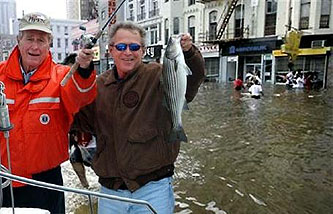
But with Katrina, it was right there on TV. Reporters would drive right up to the Superdome, tape their stand-ups, then head back to the hotel. But for some reason, the government couldn't get a cheese platter in to help those poor soles.
And there was George, peering meekly out of his airplane window . . . saying no one knew the storm would be so bad . . . saying Brownie was doing a heckuva job.
It confirmed all the negative things Bush's detractors had said. It proved he was as bad as advertised.
After that, everything he said or did was seen through the prism of Katrina.
Could Bush have done worse? Yes. He could have SUCCEEDED in privating Social Security. Think where his approval would be now.
Yeah, I don't think Schiavo had that much to do with it. I'm a blog-reading political junkie and I didn't pay that much attention to it so I have trouble imagining it was a big deal for the rest of the country.
I think the relevant comparison to Katrina was obviously Iraq. There were two explanations in circulation for why Iraq was such a mess: (1) Bush's line, that it was a difficult but crucial war against al Qaeda or (2) the left's line, that Bush is an incompetent ideologue. There were a chunk of people (many in the press) who were willing to give credence to #1 until Katrina. Then there was really no explanation left except #2.
I think the key epiphany I saw many TV news people going through was that in the past when Bush lied to them, they couldn't really prove he was lying because of secrecy or conditions in Iraq. But with Katrina, they were literally hip-deep in the evidence of his lying and incompetence.
Bush's entire administration has been a series of bad judgments followed by worse implementation. But the fundamental thing that destroyed him was his bankrupt ideology; you can't govern if you really, truly believe that government is the problem; if you believe that you can use the power invested in you by the people to gut the treasury for your cronies.
Bushco thought they could fool all of the people all of the time. But, over time, when the gap between accomplishment and claims were so great, people were unfooled. I'll agree that Katrina in 2005 was a big lesson for the slow learners, but half the country was already doubtful in 2004.
Bush in the role of President sends out competing vibes.
1) Is that of a uncaring semi-incompetent conservative idealogue whose policies are steered by cronyism, big business, and the wealthy. This president firmly holds his hands over his eyes and screams "nananananana" in the face of reality.
2) a strong Reagan conservative who's strong on defense, strong on individualism, strong on values. This president's principles concerning defense, evil doers, the size government, taxes, and economic growth are based on an almost spiritual insight.
The first picture is the accurate one -- but during this eight year saga several events (911, initial Afghanistan victory, initial Iraq victory, capture of Saddam, etc.) have led many americans to take up the second presidential view that we'll call "suspension of disbelief". Imbetween the events the bush governing style (to "use political capital") led to a steady attrition of believers largely dependant on how much they were paying attention. Katrina is just an example of more people paying attention to a particular example of the Bush governing style.
The perceived shrillness of political opposition was another element which prolonged the suspension of disbelief on the part of many americans and may be the only thing holding the 20% (backwash) together today.
The summer of 2005 into fall of 2005 was really the pivotal time when the curtain was finally pulled back. Cindy Sheehan's campaign outside Bush's ranch in August of 2005 legitimized the antiwar movement which up until then had been absent in the corporate media. Then Katrina, then in November Jack Murtha came out in favor of bringing the troops home.
Rick B and RZ nailed it better than Kevin did.
Before Katrina, Bush would say something and the press would agree with him. That became impossible for the press during Katrina because Bush was saying things that were so obviously wrong. The stuff Bush had been saying before that was obviously wrong to people with brains, but during Katrina it became obviously wrong even to people without brains.
Bush would go on TV and say that he responded slowly during the first 24 hours but that everything had been fixed since then, and then we would see video of a week-old baby without food. Then one of Bush's aides would go on TV and tell us not to worry because Bush was planning a totally awesome photo-op.
This didn't just change the coverage of Bush, it changed the coverage of everything Bush was associated with. Before Katrina, when Bush said that we were winning the Iraq War, many people thought that we were winning the Iraq War. After Katrina, when Bush said that we were winning the Iraq War, everybody realized that he lived in Opposite World.
Baloney. Name one piece of Bush administration legislation that got torpedoed after Katrina -- fact is that Rs & Dems colluded in keeping the worst of Bush operable, and to hell with the public. (One amazing exception, the plans to scuttle --ie privatize--social security.)
Bush never needed the public, he was the decider.
Thanks reino,
One suggestion though. I don't think the problem is "people without brains." It is in my opinion the TV generation who get their information from images instead of reading.
Things that are well written are designed to surface contradictions and inconsistencies as well as to show what elements are more important than others. It's part of the structure of good writing and it guides your thinking. People who read a lot are used to getting their information in this form.
Images are different. They are simply what they are. The structure is not logical in the way a written document is, so people who get their information from images think they are getting the facts - and they may be - but there is nothing in the presentation that automatically exposes contradictions, inconsistencies and the relative importance of the elements. There is structure in good images, but it is not the kind of structure that guides your thinking the way good written documents do.
We live now in the TV generation where people get their national and international "news" from images instead of newspapers and magazines. It's easier to fool someone with a picture than it is with written documents, and politicians of all stripes know that clearly.
By the way, in my opinion Power Point is a way of presenting written material to people used to images.
I think that Katrina just showed up a lot more clearly in images than Bush's earlier errors did. What's a TV image that clearly shows that Bush was out to destroy Social Security and that destroying SS would adversely effect a large majority of Americans? Bodies in the water in New Orleans, however, show up real clearly on TV.
I know a lot of very smart people who are image-oriented, but almost every effective Business School Professor I have known read at least one and usually two newspapers daily while cutting down on TV.
I really don't think the press EVER began going after Bush and his lies until, maybe, 2007 or 2008.
Hell, they're STILL not asking the questions they should have been since 2001. But now they're interested, fascinated, etc, by Obama's "part" in the Blago scandals.
I think Katrina confirmed to the rest of the country what the left had been saying about Bush - that he's a liar, that he's insensitive to the plight of the common man, that he is out of touch, that he is incompetent.
I knew the Republicans were in big trouble when one of my strongly conservative co-workers went off on a rant about how horrible and incompetent Bush was in the wake of Katrina.
This was someone who was very much a Reagan Republican and bought into a huge amount of the conservative bullshit, but the sight of American citizens being herded into the Superdome like animals and denied food and water horrified him.
I think Schiavo made a good contrast, but Katrina really was the death blow for Bush. He (rightly) was never able to recover from it.
While both events (Schiavo and Katrina) reflected negatively on Bush, linking them as Kevin does seems too clever by half. How many Americans, watching the Katrina fiasco unfold, thought, 'hey, he stayed home for this, but flew to D.C. for the Schiavo bill'?
I agree that Schiavo doesn't pair well with Katrina. It was already known that Bush reliably pandered to his base. Rather, I believe that when the public perceived how clueless and careless Bush was in the face of a gen-u-wine national emergency, they realized he could not deliver on his fundamental promise that he knew how to "keep the country safe," whether from terrorists or some other cause. When he didn't step up to the plate, people perceived the Emperor was inadequately attired, and the game was over.
Kevin -
I happen to respect you more than almost anyone in the Blogosphere, but I HAVE to ask this question:
Katrina was a bigger failure than 9/11?
With all due respect, I have to disagree.
You talk about Bush being MIA on Katrina, but all that did was remind me of the "The Pet Goat" episode and Bush's absence all that day. And that is only on TOP of the fact that the attacks on the WTC happened ON HIS WATCH.
On a scale of 1 to 10, if 9/11 was a 10, Katrina is an 8.0 at best.
Any Prez who has both on his record is s total f___up, of course. But how can you talk about screw ups without mentioning 9/11?
...AND:
I have to totally agree with A Different Matt about Social Security. I've been saying that all along; it scared the bejeezus out of people who thought Bush was on their side. They started abandoning him after that - even before the Downing Street Memo and Joe Wilson's "What I Did Not Find In Africa". Bush's intention to use his "political capital" was the tipping point, when it all started to go wrong. Ohh, the ubers on the right wanted to do away with FDR's biggest success (while enriching their Wall Street cronies, of course), and they thought their moment had come. They had a GOP Congress, a re-elected President and a coopted, infiltrated judicial system. But they just did not know how many Americans REALLY count on SS as their one and true pension plan, no matter what else. Bush scared people into abandoning him, and the rest is freaking history.
.
I think the first nail in the Bush presidency's coffin was allowing Cheney to anoint himself, V.P. It was all down-hill from there. Cheney was calling all the shots and Bush was just parading around like a puffed up pigeon, playing president.
When you say this in terms of nails he has a nail gun bungeed to his wrist shooting everything.Some stuck in his coffin, more than enough to seal it before he came into view.
The media events that catch the attention are only a place to park the blame.Has he ever been prepared to perform?
Hope that isn't a newsflash.
At least reagunz could read the scripts and play the part.Imagine reagunz at katrina?High drama on the wetlands.
Let's make 09 erase all 8
I agree with RZ. Schiavo and Katrina were two instances where it was much easier for the public to fact check the Bush administration against reality. Many families have had or do have loved ones in end of life situations, and people affected by Katrina were so numerous that the administration couldn't keep a lid on the reporting of the real conditions and failures there.
What I don't see addressed here is the people who actually suggested the Katrina debacle as the cause: Republican operatives.
As far as today's TRUE Republican base is concerned; that makes a lot of sense. By claiming Katrina did Bush in, is like agreeing that anything before that was acceptable.
As far as the base is concerned; the Katrina debacle was exaggerated by the media, and the 'black' people 'deserved' what they had coming... So... in their mind, Bush did act appropriately, and the rest of the country "just doesn't understand"
Of course I understand that those thoughts are deplorable, but have you ever tried to make sense of someone who still considers Bush to be a good President who will be vindicated by history? Yeah those 25% of the population.
Republicans have to keep playing to base because the don't know any better.
msn nick
I agree that Schiavo doesn't pair well with Katrina. It was already known that Bush reliably pandered to his base. Rather, I believe that when the public perceived how clueless and careless Bush was in the face of a gen-u-wine national emergency, they realized he could not deliver on his fundamental promise that he knew how to "keep the country safe," whether from terrorists or some other cause. When he didn't step up to the plate, people perceived the Emperor was inadequately attired, and the game was over.