
- ‹ previous
- 1894 of 2716
- next ›
Taxes of the Rich and Famous
TAXES OF THE RICH AND FAMOUS....Ezra Klein is doing tax wonkery over at his place, and I can't let him have all the fun. So just for the record, here's a look at effective federal tax rates in general:
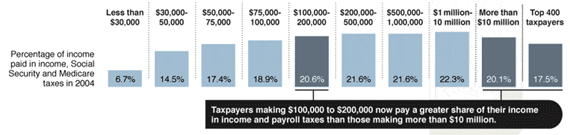
Not very progressive! Add in state and local taxes and it would look flatter still. And just to remind everyone of exactly what that "Top 400 Taxpayers" segment at the far right looks like, here are the pinkos over at the Wall Street Journal to explain it to you:
The top 400 taxpayers have greatly increased their share of individuals' income since the mid-1990s. The group accounted for 1.15% of total income in 2005....more than twice as large as its 0.49% share a decade earlier.
....The average federal income-tax rate for the group was 18.23%....well below the average income-tax rate of nearly 30% back in 1995, when Bill Clinton was in the White House.
So there you have it. The top 400 taxpayers, a group so rich and elite that I'd need scientific notation to properly represent their proportion of the population, have doubled their share of income in the past decade or two but have decreased their tax burden by nearly half. Nice work! As you can see, Warren Buffett wasn't exaggerating when he said his secretary paid a higher tax rate than he does. If she pays more than 18% not exactly a tough hurdle when you figure that payroll taxes already account for about 8% of that she probably does.
UPDATE: So how do the rich do it? Jonathan Stein interviews David Cay Johnston here to find out.














This is so hypocritical, including income taxes and FICA taxes mixed together.
On May 2, 2005 you wrote:
"when his aides presented him with their initial Social Security proposals 70 years ago, FDR balked: "No dole," he said, "mustn't have a dole" ? because he knew instinctively that welfare programs are both fundamentally unpopular as well as corrosive to the human spirit. Conservatives understand this better than liberals, and know perfectly well that the best way to kill something is to convince the public that it's actually a welfare program.
But that's not what Social Security is. It's a modestly progressive social insurance program that's paid for by everyone and that benefits everyone. If it ever stops being that, if it ever stops being universal, it will eventually cease to exist. Don't let anyone fool you into thinking otherwise."
So, to meet your own goals, the SS system is only moderately progressive, such that benefits generally are loosely tied to contributions. As you said, it must be insurance, not welfare. Since benefits are capped, taxes are capped, so wealthier earners do not pay, just as they also get no benefits credit for those higher earnings.
We can argue about this approach, but purposely using a tax rate number that includes social security taxes is wildly disingenuous. The tax structure of the income tax rate and social security are wildly different, and someone who combines the numbers is only attempting to obfuscate.
You think the upper bracket person derives 50 to 100 times as much benefit from the infrastructure?
Yes, of course, since in the extraction of his riches from the society, the rich person relies far more heavily on the infrastructure than does an ordinary wage earner. That is:
[T]he services one gets from the government increase with one's assets. But these services increase more and more rapidly as one's assets increase. (With protection ? the more wealth you have, the more of that wealth is in intangible form or, if physical, not something to whose defense one can contribute.) In a fair and capitalist system, therefore, taxes should increase with wealth, and they should be progressive, increasing proportionally to the services provided by the government. Now, we don't tax based on wealth, but rather on income that is a proxy (however poor) for wealth.
I note that the Bible of capitalism, Adam Smith's Wealth of Nations, says the same thing: "It is not very unreasonable that the rich should contribute to the public expense, not only in proportion to their revenue, but something more than in that proportion." In other words? Smith felt that the tax system should be progressive. http://angrybear.blogspot.com/2006/12/in-defense-of-progressive-tax-syst...
The United States in its best days after the Second World War had a system of taxation that was far more progressive than it is now. It may well be that the decline of progressive taxation since the Presidency of Ronald Reagan has undermined our social stability, and those who thought they had accumulated wealth, as well as the rest of us, may accordingly suffer.
I've used the term ultra-rich to refer to these people. It is short but still conveys where they are on the continuum.
I'm pretty sure the Republican term for them is 'small business.'
I'm not ultra-rich, I'm a small business with one employee and obscene amounts of cash.
Hey, you're not supposed to talk about things like this, it's class warfare, don't you know. Just concentrate on clawing your way into the top 400.
The sad thing is that the Dems really aren't much better than the GOP on this issue. They are suggesting very modest increases on the marginal rates for the higher brackets.
Here in NY, gov. Paterson is suggesting higher state U tution, a sales tax on lower priced clothing, etc., all regressive revenue moves. But not a higher state income tax surcharge on the wealthy, except a modest move on deductions. This is from a so-called liberal.
g. powell,
Yup. That is not surprising either. That is why my revolution predictometer is set on 2021.
If you add in the self employment tax of the self employed, the numbers are worse for those in the lower income brackets. I gave up on trying to convince anyone about the unfairness of this, but it is still a bite to me.
Why do you say it would still look flatter if you add in state and local? I would guess that those people in the $100K to $500K range live disproportionally in places like New York which have the highest local income taxes (which is why they get killed by the AMT). I think if you adjusted further for cost of living you would find that those people pay a much higher percentage of income in taxes than anyone else.
I like the conceit about needing scientific notation to express the relative size of the group of ultra-rich. How about using scientific notation to express the humongousness of their wealth, ego and lack of public spirit (voir Cheney et al.)
And people say George Bush hasn't been a successful president.
Don't you people remember how dreadful the economy was before Bush's tax cuts?
the Dems really aren't much better than the GOP on this issue
Worse, in some cases, to wit, Charles Schumer. He single-handedly assured that hedge-fund managers (and employees, I think) would have their earnings taxed at the capital gains rate of 15% rather than their marginal rate of 35%. This is notwithstanding the fact that under any realistic view of the matter, their earnings are ordinary income and not capital gains.
This means that hedge-fund managers are taxed at the same rates as people making about $32,000 a year. Talk about a flat tax -- it's here!
I have often said kill the rich, which irritates others. Since the irritation was so intense I have changed the slogan to destroy the rich. The slogan was never intended as a rallying cry to eliminate individuals or a class, but to make a concise statement about eliminating the political influence of the wealthy. Wealth is used to effect the political economy to favor the already wealthy at the expense of everyone else. It is this effect of wealth, not its buying power, that needs to be limited and mitigated through progressive taxation. Eisenhower era taxes were about right and need to be reintroduced.
"The group accounted for 1.15% of total income in 2005"
So increasing their taxes would have a negligible effect upon state revenues.
So the only reason to increase their taxes is ideological.
To use the coercive power of the state to exproptiate certain individuals' posessions because you, Kevin Drum, prefer that those individuals not retain them.
What does that make you?
Capital has its own coercive power, and the only power that can confront it, and mitigate it, is state power. The power of capital is manmade as is the power of the state. Accumulated capital is not a development of nature, but a development of mankind. Nature cannot solve the problem of huge capital accumulation, unless there is a return to the natural state, which is not in anyone's best interests. The proper, and least violent, way to deal with the misallocation of a society's wealth is through progressive taxation.
It's obscene that the federal government gets 20% of my paycheck. 20 fucking percent.
17.5% is too low. I think 95% is too high. Something between 40-50% sounds about fair.
Dear Brad...try substituting for "the federal government", "me and my fellow citizens". Is it still obscene? Or would you rather not have roads, bridges, courts, etc. If not, tell us what you, and the rest of us, are willing to give up. By the way, how do you earn that paycheck? I'm sure it has nothing to do with a stable, functioning society.
Kevin,
If you want a controversial appointment, how about David Cay Johnston for IRS Comissoner?
The top marginal rate was about 90% in the 1950s, the economy did fine then. And the middle class was born.
The top rate is now 35%, and the middle class is dying.
You're still missing about 7.5% paid to medicare & SS by the employer, which is part of the cost of hiring you. If your employer didn't have to pay that 7.5% to the Feds, he could pay it to you. So it is part of your tax burden. It's just a nice job of disguising the payer. Put that 7.5% in and it's not flat, but regressive, especially when you consider capital gains and deductions.
a: "The group accounted for 1.15% of total income in 2005" So increasing their taxes would have a negligible effect upon state revenues.
Good point. While we're at it, engineer's salaries account for less than 1.15% of total income. Why not drop tax rates for engineers down to 18%. I'm all for it (and you get one guess at what I do for a living).
not exactly a tough hurdle when you figure that payroll taxes already account for about 8% of that
Do these numbers count both employee and employer contributions to the payroll tax, or just the employee part? As Rick mentions, both parts are a tax on compensation and should be counted as part of the tax rate.
If the numbers don't include both halves, the situation is much worse than it looks.
So the only reason to increase their taxes is ideological.
And thus with the little word 'only' you dismiss the entire ideological concepts of fairness and justice.
Poof. There they go - wave to them as they fly away.
Listen, anonymous 'a,' the ultra-rich get the most from society so it is fair and just that they also contribute the most to it.
Can you understand that concept?
Maybe I was too touchy-feely with my ideas of fairness and justice for Mr a above.
Set those aside for a minute and consider this:
It is in the ultra-rich's self interest to keep the peasants from revolting. This is not a threat. It is an acknowledgment of human history and psychology and a statement of how these things go and where this road leads.
But we aren't there yet. That is why my prediction is for 2021. We are headed there, and we could change our path, but the choice is with the ultra-rich. It always has been with them, since they have the real power to change things. The ultra-rich are playing chicken with the hoi poilloi and they are seeing how hard they can squeeze before things break. That is a very old and a very dangerous game.
To: alex the engineer
Thanks for answering the numbskull. Saved me the time.
The person in the $100-$200K bracket pays 20%, or $20K to $40K in dollars. The person in the $10M bracket pays $2M in dollars. This is 50 to 100 times as many dollars as the lower tax payer. You think the upper bracket person derives 50 to 100 times as much benefit from the infrastructure? Or are you just pissed off that the upper bracket person has $8M after taxes?
Hom Lee,
Yes. I do.
Not only do I state that the ultra-rich should pay the same proportion as the poor, I state that the rich should pay a greater proportion of their income as taxes. Taxes should be progressive.
The ultra-rich are able to make their money because of the stable society we have. They also get to be the ultra-rich in a stable society. What is the value of that? Pretty high I'd say. Pretty high.
Even if you don't buy into the 'fairness' idea and somehow think the ultra-rich deserve what they have and even more, consider this.
A totally free and fair market will have, by chance alone, an early winner who's winnings will give him an advantage and as trading continues ultimately you will be left with a single winner and all the rest are losers and the market trading stops.
To keep the market going there MUST be a way to take some of the wealth from the winner and give it to the losers.
So even if you don't give a damn about the poor you'd better distribute some of your wealth or the whole thing will collapse and we'll be back to being hunters and gatherers and not traders.
Taxes should be progressive.
I second that.
People who claim the only motivation for a progressive tax is "jealousy" are people whose lives revolve around greed, and find it impossible to imagine any other human motivation. It's almost pathetic.
This is so hypocritical, including income taxes and FICA taxes mixed together.
On May 2, 2005 you wrote:
"when his aides presented him with their initial Social Security proposals 70 years ago, FDR balked: "No dole," he said, "mustn't have a dole" because he knew instinctively that welfare programs are both fundamentally unpopular as well as corrosive to the human spirit. Conservatives understand this better than liberals, and know perfectly well that the best way to kill something is to convince the public that it's actually a welfare program.
But that's not what Social Security is. It's a modestly progressive social insurance program that's paid for by everyone and that benefits everyone. If it ever stops being that, if it ever stops being universal, it will eventually cease to exist. Don't let anyone fool you into thinking otherwise."
So, to meet your own goals, the SS system is only moderately progressive, such that benefits generally are loosely tied to contributions. As you said, it must be insurance, not welfare. Since benefits are capped, taxes are capped, so wealthier earners do not pay, just as they also get no benefits credit for those higher earnings.
We can argue about this approach, but purposely using a tax rate number that includes social security taxes is wildly disingenuous. The tax structure of the income tax rate and social security are wildly different, and someone who combines the numbers is only attempting to obfuscate.
You think the upper bracket person derives 50 to 100 times as much benefit from the infrastructure?
Yes, of course, since in the extraction of his riches from the society, the rich person relies far more heavily on the infrastructure than does an ordinary wage earner. That is:
[T]he services one gets from the government increase with one's assets. But these services increase more and more rapidly as one's assets increase. (With protection the more wealth you have, the more of that wealth is in intangible form or, if physical, not something to whose defense one can contribute.) In a fair and capitalist system, therefore, taxes should increase with wealth, and they should be progressive, increasing proportionally to the services provided by the government. Now, we don't tax based on wealth, but rather on income that is a proxy (however poor) for wealth.
I note that the Bible of capitalism, Adam Smith's Wealth of Nations, says the same thing: "It is not very unreasonable that the rich should contribute to the public expense, not only in proportion to their revenue, but something more than in that proportion." In other words Smith felt that the tax system should be progressive. http://angrybear.blogspot.com/2006/12/in-defense-of-progressive-tax-syst...
The United States in its best days after the Second World War had a system of taxation that was far more progressive than it is now. It may well be that the decline of progressive taxation since the Presidency of Ronald Reagan has undermined our social stability, and those who thought they had accumulated wealth, as well as the rest of us, may accordingly suffer.
Government spends much protecting property rights. The upper income brackets have the most property to protect.
The tax structure of the income tax rate and social security are wildly different, and someone who combines the numbers is only attempting to obfuscate.
Coyote, you don't understand. It's perfectly fair to consider both. The poor person is required to pay a social security tax and so is the rich person. The same with income taxes, except that with income taxes there is a progressive rate and with payroll taxes, there is not. That's just a fact. The person who makes $10,000 a year pays the same payroll rate as the person who makes $1 billion per year; the person who makes $100,000 per year pays the same rate and the same tax as the person who makes $1 billion per year. It is hardly unfair to take note of this and to include both in the total tax burden.
Hom Lee, Brad and other of their ilk somehow believe that any success they achieve is due entirely to their own efforts. The entire apparatus of the state, the hospitals, the schools, the courts, the markets, the armed forces; none of that played any part in their achievements. So, why should they fork over any of their hard and entirely self-created dough? In Leona Helmsley's words, "Taxes are for little people".
The top 400 taxpayers, a group so rich and elite that I'd need scientific notation to properly represent their proportion of the population...
Brilliant.
"The tax structure of the income tax rate and social security are wildly different, and someone who combines the numbers is only attempting to obfuscate."
If we had a social security trust fund that was dedicated only to Social Security, you might begin to have an argument. But instead the money has been used in the general budget to pay for anything and everything. Those who want to pretend that it's separate are obfuscating.
One other point. Look at the history of the world and in most societies a few powerful individuals dominated the masses and used them for their own personal aggrandizement, like building pyramids and the Taj Mahal, while the average guy struggled to survive. After WWII, this country built the greatest society in the history of man-kind for the average guy based on a very progressive tax system, which the right wing has been tearing down ever since. Basically, they have been transferring power, in the form of money, taxes, tort reform, deregulation of environmental, osha, corporate and other types of laws to benefit the rich. And it's worked. We now have an unregulated society where greed wins. However, one of the results of the deregulation is a society where no one trusts anyone and the result is the collapse of our financial system. Greed is painfully self-regulating.
ultimately you will be left with a single winner and all the rest are losers and the market trading stops
The best explanation of what is now happening to the economy.
It's obscene that the federal government gets 20% of my paycheck. 20 fucking percent.
Posted by: Brad on 12/16/08
Is it "obscene" that policemen and firefighters would give their lives to protect you, your family AND your property?
Ingrate!
If my state could receive only 1% of all the Wall Street Ponzi schemes we'd be doing great!
I thought S.S. and Medicare were insurance programs? If you want them to be wealth redistribution programs you have to state it. But last time I checked payroll taxes were regressive, because the benefits are regressive (i.e. low income people receive a larger share of their income in retirement from S.S. than the rich). Also this calculation completely ignores corporate taxes. Warren Buffet owns X% of Berkshire Hathaway. When Berkshire pays corporate taxes of $Y Buffet pays income tax of $Y * X%.
payroll taxes already account for about 8%
It is a simple fact that payroll taxes are about 14%. The fiction that the "employer's half" of that tax is somehow different or should not count is just that -- fiction.
It's ironic that I jumped from this discussion to a Bloomberg item that noted>
"The company's effective income tax rate dropped to 1 percent from 34.1 percent, New York-based Goldman Sachs said today in a statement. The firm reported a $2.3 billion profit for the year after paying $10.9 billion in employee compensation and benefits."
I know, corporate tax rates vs. individual tax rates; apples and oranges right? But does anyone out there really believe that that the uber-rich pay anything close to the published tax rates? ANYWHERE close? Just like GS, their wealth buys them the privilege of avoiding taxes wholesale. And their participation in these tax avoidance schemes often generates even more wealth.
The older I get the more I realize Libertarianism is simply an effort to elevate selfishness to a virtue and a philosophy. The only way for a rational mind to embrace it is to ignore the entire infrastructure a society provides.
It is a way to say "I want all the benefits of a stable society, including a working monetary system, with none of the costs."
As stated brilliantly above, Libertarians ignore the fact that without a society their money is worthless and their material possessions will be stolen.
Similar to religious authoritarian followers who claim to follow the Bible and are ignorant of what it actually says, Libertarians claim to follow Adam Smith and are ignorant of what he actually said.
Libertarians really get pissed when you point out how immature their philosophy is, and they especially get pissed when you point out that invariably their viewpoint causes them to be a failure with "the laydees."
I suspect that their failure with "the laydees" may come first and then they turn to Libertarianism for cold comfort, which ironically makes them even bigger failures.
Kevin's post is of course misleading because he is combining payroll (social security and medicare) taxes with income taxes. As Democrats have been telling us for years, social security is not a welfare program, taxing the rich to subsidize the poor, but an insurance program, where there is some correlation between premiums paid and benefits received.
Now if you all want to change that and turn social security into a more transparent welfare program, well, OK. Here's my suggestion. Abolish payroll taxes altogether. Removing a tax on employment will boost employment rates, something that is surely desireable. In their place, have a simplified, mildly progressive income tax, with no credits or deductions of any kind: X% on income up to, say, $50,000, and Y% on all income over $50,000. I'm not an economist so I don't know what X and Y would have to be to generate the same revenues with approximately the same distributional impact as today.
The best reason to do this, apart from ending the illusion that social security is anything other than just another income transfer program, is that it would put all workers on the same playing field as taxpayers. Today, we have a tiny percentage of taxpayers paying most of the income taxes; that leads all the others to think that Government is free. This is unsustainable. Everyone should bear the burden of supporting the Government and all of its activities.
Maybe "Eat the rich" would be a better slogan?
lou mentioned including self-employment taxes in the calculation and rick, et al mentioned combining the employer's contribution in the total. Just wanted to point out that everyone pays at the same rate as the self-employed, the only difference is accounting: the self-employed calculate their tax and then deduct half from their Adjusted Gross Income, people on payroll avoid this by having their deduction calculated at half the rate. Comes out to the same thing.
coyote talks about the cap in taxes. Capping the salary on which payroll taxes are collected is not the only way to limit the amount deducted, we could as easily tax everyone at the same rate and then stop withholding when the amount received by the trust fund was deemed sufficient for that year. Much larger monthly benefits could be paid to the very rich out of fairness but I think the net result would be a lot more fair for everyone.
don
There are small businesses and there are small businesses. The "main street" ones ... the Sam's Club ones ... are the tenants.
The big ones are the landlords who collect rent from them -- triple net leases, usually -- and the landlord businesses seldom struggle much. Land requires little if any maintenance, and the tenant must pay for the rest. The landlord need only maintain a drop-box to receive his checks, against which he can net "depreciation" -- often on an old building which has been fully depreciated by the previous "small businessmen."
And yet we honor the landlords as "self-made men".
We do the same with those who own the earth from which natural resources -- the non-renewable type -- are taken.
We treat the labor involved as if it were trivial. And their wages are kept to a minimum by the way we treat the landlords.
Easy to fix, once enough of us see that cat, but few of us bother to study the matter. (Search on wealthandwant or lvtfan to learn where to look.)
DBL,
I'm not an economist so I don't know what X and Y would have to be to generate the same revenues with approximately the same distributional impact as today.
True dat.
You are focusing on wages and ignoring other forms of income. You are also building a fantasy-land and trying to tell us everyone should come and play in it.
Give it up.
The regressive/progressive conversation is nice, but it ignores the more important question: what ought we to tax, and what ought we not to tax? The answers to those questions are important. They respond to issues of efficiency, administrability, economic justice, and general fairness. Do we want to leave in private pockets that which the community as a whole creates? Do we think it right to collect for common purposes that which the individual creates, even if we are NOT collecting the economic value which the community creates? Do we want to use taxes which are efficient? Do we want to use taxes whose application creates jobs, or do we prefer the kind which depresses the economy?
So far, our answers to these questions are rather uninformed, and most of us think inside a box that keeps us debating the details of the income tax.
It's the wrong tax!
There is an awesome amount of value in what the classical economists called land, even if some of its manifestations wouldn't show up for 100 years after they were writing. Urban land value, of course. But also the broadcast spectrum, geosynchronous orbits, LaGuardia landing rights, water rights, "rights" to pollute the air and water on which all of us (and all of "them," too) depend ... the list is long and we close our eyes to our current treatment of it at our mutual peril.
By correcting our current ignorant state, we could be well on the way to solving not just one problem, but a number of our most pressing -- and supposedly intractable -- problems:
wealth concentration
income concentration
low wages
housing unaffordability
sprawl and its concomitants, pollution, long commutes, energy use, time waste
poverty
Which of these would you prefer we studiously avoid solving?
"Land value taxation" is the generic name for the reform to which I refer. You might look for Fred Foldvary's paper, "The Ultimate Tax Reform," at wealthandwant.com and elsewhere.