
- ‹ previous
- 1794 of 2735
- next ›
Dennis Blair
DENNIS BLAIR....Last month Gary Farber noted that Adm. Dennis Blair, who is Barack Obama's choice to become our new Director of National Intelligence, has a gray spot on his record: in 1999, when he was Commander in Chief of the Pacific, he apparently cozied up with the Indonesian military at a time when they were
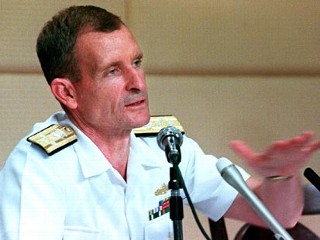
supporting terrorist militias in East Timor and he did it in spite of instructions to tell them it was time to shut down the militias. Here's a contemporaneous report from The Nation:
Officials say that this past April, as militia terror escalated, a top US officer was dispatched to give a message to Jakarta. Adm. Dennis Blair, the US Commander in Chief of the Pacific, leader of all US military forces in the Pacific region, was sent to meet with General Wiranto, the Indonesian armed forces commander, on April 8. Blair's mission, as one senior US official told me, was to tell Wiranto that the time had come to shut the militia operation down....But Admiral Blair, fully briefed on [a recent massacre at] Liquiça, quickly made clear at the meeting with Wiranto that he was there to reassure the TNI chief. According to a classified cable on the meeting, circulating at Pacific Command headquarters in Hawaii, Blair, rather than telling Wiranto to shut the militias down, instead offered him a series of promises of new US assistance.
Last night Gary emailed to ask why nobody seemed to care about this. My response, essentially, was "I dunno."
And I really don't. In fairness, Blair doesn't seem to have disobeyed a direct order from the president or anything. The Nation piece uses the passive voice ("was dispatched to") in its description and a later admonition to Blair came from the State Department via the U.S. embassy in Jakarta. Blair, however, apparently felt that you catch more flies with honey than with vinegar, and chose to engage with General Wiranto in hopes of gaining his trust, rather than delivering a sharp rebuke that might have seriously damaged U.S.-Indonesian relations. In an update, for example, Gary quotes a line from a Dana Priest article in the Washington Post:
Robert Gelbard, a former U.S. ambassador to Indonesia, opposed Blair's push to work with that country's military in 2000, but he endorses Blair as director of national intelligence. "We had a legitimate policy disagreement. But he has a tremendous analytic mind and commands a lot of respect in Washington. His appointment comes at a time when there needs to be a critical reassessment of what the ODNI does," Gelbard said.
These kinds of intra-government disagreements happen all the time, so it's hard to say how big a deal this really was. And Gelbard certainly doesn't seem to hold it against Blair. Still, it seems worth making sure Blair's actions in Indonesia are at least on the table. So: is this a red herring or a legitimate beef? Anyone who happens to know more about what really happened here is invited to chime in in comments.









While Blair might have been exercising his personal judgment in the interests of the US Navy in Pacific environs of Indonesia by supporting/turning a blind eye to the massive killings in East Timor, since when does a military commander counteract an order by his civilian elected president? If there was a moral, strategic/policy decision to be made (the choice between "honey and vinegar") involving consequent risk of death of Indonesian civilians, it was for Clinton to make, not Blair, and Clinton made it -- late but he made it -- and per Allan Nairn on Amy's show two days ago, Clinton said he was not aware Blair countermanded his orders. This needs further exploration but on its face, if it's true, I'm disturbed by Blair's actions as a pattern when he takes over as Obama's DNI as a certified loose cannon in the literal sense of the word.
Also disturbed that this story is getting almost no mainstream newsplay. There's a good moral debate here, not only as to the direct issues historically but as to Blair and his style of taking orders -- or not. The event in the late 90s was not about whether Blair's policy/strategy was right or wrong. The policy/strategy was not his to make. It was about following orders.
When I Googled around, this site is one of the few places (MyDD another, referencing content of this site) where I found the other side of the story coming from Allan Nairn (via Amy Goodman and The Nation), including former Indonesian ambassador Robert Gelbard without opposed Blair's actions at the time but supports him for DNI now. It's a vivid debate ? or could be -- and I'd like to see further fleshing out of Blair's position, not just from Blair but reasonable others high up in govt (Congress, Clinton admin, military) who supported Blair's actions at the time, if anyone did. How much respect will Blair have for Obama if he got away with thumbing his nose at a president previously if that in fact happened? Too bad the rest of the country is being left out. I expect vague references to these events to pop up in Blair's confirmation hearing without much prep from newsmedia for viewers to make sense of it all. I expect the whole affair will slide by on C-SPAN like a ship passing an iceberg in the night.
The Navy has vital interests in the waters surrounding Indonesia. The Admiral may have judged these trumped whatever limited effect U.S. hand-wringing might have achieved.
Disobeying or at least working around the Bush Admin was not in itself such a bad idea.
This attitude - that keeping the Indonesian military happy was more important than saving the East Timorese - was very common amongst western diplomats dealing with Indonesia back in 1999 and earlier.
It was a pretty slimy piece of realpolitik, but understandable; relations between Indonesia and western countries (particularly Australia, the closest, who took the major role in the peacekeeping operation that ovesaw the transition to independence) did take a beating after East Timor's independence.
And Indonesia is an important country, if one routinely ignored in the USA. It has a population of 200-odd million people with a Muslim majority, a growing economy, and sits on some very important sea lanes.
Disobeying or at least working around the Bush Admin was not in itself such a bad idea.
True, but we're talking about the Clinton administration. Not saying that the conclusion is necessarily different, but we should at least assess the facts.
Thanks for the correction.
yes - we must be careful. The needs of the Indonesian dictatorship had to be carefully weighed against the Timorese people. After all, although we are discussing great numbers of deaths in relative terms - more than 10 per cent of their population, it was a small number in absolute terms - only 1-2 hundred thousand deaths. When you look at this you realize why realpolitik reasons would triumph.
But think about the many compromises Ike had to make with odious Vichyite French in North Africa in 42-43 to gain their longer term cooperation that saved lives. Blair too seems to have had his eye on the bigger picture
I'm not comforted because Gelbard doesn't seem to have any sort of grudge. Why should he? He and Blair probably have a lot more in common than either of them have with some murdered Timorese person. They're alive, for one thing, and they wield a certain amount of power, and neither of them was or is ever likely to be the victim of an Indonesian-sponsored pogrom.
Just to make clear, I think the approach that the West took to Indonesia's actions in Timor, from 1975 through 1999, was appalling.
But the policy - keep the Indonesians sweet, and bugger the East Timorese - was pretty much a consensus one. Sad, but that's the way it was.
Global Voices are talking about A Dark Past in East Timor for Obama's CIA Nominee, and some comments here are quoted.
Thanks!
While Blair might have been exercising his personal judgment in the interests of the US Navy in Pacific environs of Indonesia by supporting/turning a blind eye to the massive killings in East Timor, since when does a military commander counteract an order by his civilian elected president? If there was a moral, strategic/policy decision to be made (the choice between "honey and vinegar") involving consequent risk of death of Indonesian civilians, it was for Clinton to make, not Blair, and Clinton made it -- late but he made it -- and per Allan Nairn on Amy's show two days ago, Clinton said he was not aware Blair countermanded his orders. This needs further exploration but on its face, if it's true, I'm disturbed by Blair's actions as a pattern when he takes over as Obama's DNI as a certified loose cannon in the literal sense of the word.
Also disturbed that this story is getting almost no mainstream newsplay. There's a good moral debate here, not only as to the direct issues historically but as to Blair and his style of taking orders -- or not. The event in the late 90s was not about whether Blair's policy/strategy was right or wrong. The policy/strategy was not his to make. It was about following orders.
When I Googled around, this site is one of the few places (MyDD another, referencing content of this site) where I found the other side of the story coming from Allan Nairn (via Amy Goodman and The Nation), including former Indonesian ambassador Robert Gelbard without opposed Blair's actions at the time but supports him for DNI now. It's a vivid debate or could be -- and I'd like to see further fleshing out of Blair's position, not just from Blair but reasonable others high up in govt (Congress, Clinton admin, military) who supported Blair's actions at the time, if anyone did. How much respect will Blair have for Obama if he got away with thumbing his nose at a president previously if that in fact happened? Too bad the rest of the country is being left out. I expect vague references to these events to pop up in Blair's confirmation hearing without much prep from newsmedia for viewers to make sense of it all. I expect the whole affair will slide by on C-SPAN like a ship passing an iceberg in the night.
This Blair fellow is a lose cannon who has been directly involved in some very heinous activity in Indonesia. He should not be appointed to anything, let alone the Director of National Intelligence. I am extremely disappointed in Obama.
Umm, it was not the Bush administration at the time. It was the Clinton administration.
Still feel it was a good idea to work around it?
Dennis Blair
Dennis Blair, seems to be a cool calculating bastard -brainy but cold as ice. It is perhaps what it takes to be a master spy, not given to emotion but given to achieving overriding objectives. As the saying goes you need a thief to catch a thief. However you would not want him as your friend.
Anyhow East Timur did not matter to anybody let alone the US. Dennis 'hardcase' Blair knew that. He knew that better than Clinton. What if a few natives were killed ? All credit to Clinton who changed his mind at the last minute not perhaps due to conscience but real politik. In Indonesia a blind president had replaced dictator Suharto and he was ready to give Timur a referendum.