In The Blogs

How to Think About Taxes

—Photo from flickr user RogueSun Media.

Here's my contribution to today's tax day festivities: an effort to get you to think about federal taxes a little bit differently than usual.  Normally, when we talk about taxes, we end up talking about percentages of people: the top 1% pay a certain amount, the bottom third pay a different amount, etc.  But this is the wrong way to look at things.  What we ought to be looking at is percentages of income.

Have your eyes glazed over yet?  Just wait!  It's going to get worse.  But first a caveat: the numbers that follow aren't exact.  I don't think they're way off the mark, but they're the result of some rough interpolation from several different data sources.  Anyone with access to more detailed data is welcome to correct this, but in the meantime it should be close enough to give you an idea of how to look at this stuff.

So: percentages of income.  What I mean by this is that you'd expect a group of people with, say, one-fifth of the nation's total income to pay one-fifth of total federal taxes.  (Note: one-fifth = 20%, or one quintile in tax-speak.)  It doesn't really matter if that group has one-fifth of the people or not, just that it has one-fifth of the money.  Like this:

But hold on.  That's a flat tax, and I want to appeal to your native sense of fairness here.  Even most conservatives agree that taxation ought to be at least mildly progressive, so let's make this mildly progressive.  First, let's say that the middle quintile, almost by definition, ought to pay 20% of total taxes.  Like so:

The next quintile up ought to pay a higher share, and the quintile above that even more.  The slope of the increase doesn't need to look like a hockey stick, but it should trend clearly upward.  Let's say it should be 8% more for each quintile:

Likewise, the quintile below the middle ought to pay a lower share, and the poorest quintile ought to pay even less.  Something like this:

Question: does this seem roughly fair to you?  If you're a die-hard flat-taxer, it won't, but for most people, even conservatives, it ought to seem reasonable.  It's progressive, but the slope is moderate and consistent.  So now let's take a look at the income cutoffs that produce our five quintiles.  Here they are:

Most people are surprised at how high the income cutoffs are.  But that's how it works out.  If you add up the incomes of every single household that makes less than $50,000 — all 50 million of them — they earn only a fifth of the total income.  If you add up the tiny number of people who make more than $300,000, they also earn a fifth of total income.  So now, instead of looking at our theoretical progressive system, let's see the actual numbers.  Here they are:
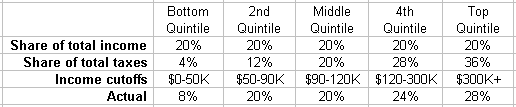
As you can see, when you add up all federal taxes and compare it to where the money is, our system is only barely progressive at all.  The bottom quintile doesn't do too badly, though they're probably paying a little more than they should, but CEOs and bankers are paying only slightly more than teachers and engineers.  And if you add in state and local taxes, even this small amount of progressivity goes away.  You can come at this from a lot of different angles, but you always end up with the same answer: taken as a whole, our tax system is close to flat.  Does this seem fair to you?  It shouldn't.

NOTE: As I said above, these numbers are rough interpolations from several sources.  The high-end income data is from Piketty and Saez, here.  The middle income aggregates and cutoffs are from Census figures, here and here.  Tax shares are from the CBO, here.
image
image

Get Mother Jones by Email - Free. Like what you're reading? Get the best of MoJo three times a week.
Comments
no profile pic for comment author

based on those numbers, it

based on those numbers, it appears the bottom two quintiles
are being theoretically screwed

no profile pic for comment author

Brilliant!!

I've been saying for years that this is the way we ought to look at it. I'm delighted to see someone with a wider readership actually pull up the numbers and do it!

no profile pic for comment author

Kevin's tax analysis

This is a really great post. It really clarifies the issue of distribution of taxation. This kind of explanation is why I followed Kevin from WashingtonMonthly to MJ.

no profile pic for comment author

CBO

Very interesting, and on target.

The CBO numbers appear to have a variety of methodological issues that make the distribution of federal taxes look more progressive than it is. The CBO study counts the following as income: Medicare, Medicaid, employer-paid health insurance premiums, food stamps, school lunches and breakfasts, housing
assistance, and energy assistance. They also count your employer's FICA payments on your behalf as income for you, rather than as taxes paid by you.

In other words, the income of the lower quintiles is inflated to include money they never actually received. That makes their tax rates look lower.

In addition, the taxes paid predominately by the upper quintiles (on dividends and capital gains) is inflated to include taxes they never actually paid (corporate taxes). That makes their tax rates look higher.

no profile pic for comment author

Income tax analysis

This is a very revealing analysis. You really should do it with payroll taxes included as well. Leaving them out fails to represent the real federal tax burden, and my friends on the right seem to never consider these taxes when discussing the tax burdens of the better off, i.e. themselves. I suspect that this will noticeably change the progressiveness of the result.

no profile pic for comment author

all federal taxes

Great post. You state, "As you can see, when you add up all federal taxes and compare it to where the money is, our system is only barely progressive at all."

What's in "all federal taxes" again?

no profile pic for comment author

I agree - brilliant.

Kevin,

If they're giving out an award for "smart blog post of the year" somewhere, it's all yours, man.

You've just put the lie to a million conservative talking points.

Congratulations! Very smart.

no profile pic for comment author

A post worth logging in to commend!

Well done, Kevin Drum! I have always loved your wonky analyses, and this one is marvelous. It's nicely analytical AND reasonable, and I hope gets wide distribution in the blogosphere. It's an antidote to the "tea-party" craziness out there today!

It seems to me that the folks who are getting really screwed are the 2nd quintile, those earning $50-90K. That is, leaping into the conversation, your step values of 8% per quintile are arbitrary, so one could as easily start from the actuals of 8% for the 1st quintile and 20% for the 3rd quintile, and propose progressivity of 6% per quintile. Then the hypothetical values, starting from the reality, would be 8%, 14%, 20%, 26%, 32%. The top two quintiles would pay a little less than in your model, but more than they are paying now. But at progressivity of 8% or 6%, the second quintile is being screwed.

So I wonder what percentage of those second quintilers are participating in the teaparties today?

no profile pic for comment author

Teaparty participants

I would venture that a significant percentage of the recent teaparty participants were in fact in the second quintile. Why? Because for reasons that are a mystery to me, people in that tax bracket seem to be attracted to the Republican party, despite the fact that the Republican party offers little or nothing to benefit them. I have even known people in the lowest quintile who are die-hard Republicans more or less because that party advocates less strict gun laws.

no profile pic for comment author

Bottom quintile

Nice post, and really clear and crisp how you laid it out. However, when you note that the bottom quintile isn't treated quite as badly as the system might otherwise lead one to expect, don't forget that this quintile contains people who don't pay taxes because they earn little or no money. Thus, it's not much of a compliment to the system that it's somewhat progressive at the lower end; it can hardly help it.

no profile pic for comment author

Genius!

This deserves wide distribution--through all quintiles.

no profile pic for comment author

Depends on what you mean by Share of taxes

To me your numbers are way off, at least if you define the terms as I do. When you say "Share of Total Taxes" I think percentage of Federal Tax Revenue paid. In that sense the top Quintile pays about 70% of the taxes not the 28% you list. But you must mean "Effective Tax Rate" which would make more sense. Using "Tax Share" is how Republicans like to talk about taxes. They conveniently don't mention "Income Share". Ezra Klein has a good post on this here: http://www.prospect.org/csnc/blogs/ezraklein_archive?month=04&year=2009&base_name=day_of_1000_tax_graphs

no profile pic for comment author

Tax Day Tea Parties

As many on the political right prepare for tax day tea parties, it may be worth noting that the first such tea party was NOT in Boston, but in Norfolk. Just like every good Virginian knows that the first Thanksgiving was in Jamestown in 1619, a full two years before the Plymouth feast, Virginia scooped Massachusetts again with the June Norfolk Sweet-Tea Party a full six months before the December Boston Tea Party.

The little known Norfolk Sweet-Tea Party of June 1773 started when Southern colonists poured both tea and sugar into the Hampton Roads in protest of the Sugar Act (1764) and Tea Act (1773). Colonists were egged on by Patrick Henry whose words still echo today: " Is tea so dear, or sugar so sweet, as to be purchased at the price of chains and slavery? Forbid it, Almighty God! I know not what course others may take; but as for me, give me coffee, or give me death!" However, the Sweet-Tea Party took an unexpected twist when a small ship carrying rebellious colonists struck a barge carrying ice from New York causing its contents to spill into the water. The resulting cool, sweet brew started a Southern tradition that continues to this day.

no profile pic for comment author

Bobreply, if you are in the

Bobreply, if you are in the Norfolk area I'd love nothing more than to buy you a beverage of your choice.

no profile pic for comment author

Lorenz Curve

If you want to get even wonkier, Drum, use the Lorenz curve to illustrate your results. It was one of the most popular classes I used to teach -- Econ 107 -- in the old days when I was a member of an economics department in the top 20, but not in the top 19.

Little di I know then that, 20 years later, I would trade it all for a new pickup truck.

no profile pic for comment author

Note To KJ

The difference between your numbers and Kevin's numbers come from the fact that you are classifying the top quintile as one-fifth of the population. Kevin is classifying the top quintile as one-fifth of the income. This makes a very big difference, especially at the top. Kevin is not referring to Effective Tax Rate, as you suggested. He is referring to tax share, just as you are.

I agree with most of the commenters--this is a great post by Kevin.

no profile pic for comment author

to reino regarding kj's post

Still KJ's point is well taken.
Progressive taxation has to consider the effective tax rate.
For the purpose of populist illustration assume that the poorest quintile would not pay taxes whatsoever and the rest four would pick up the tab at roughly the 'progressive' quoted rates:
0 12.5% 20.85% 29.15% 37.5%
In what way would this make 50 million people happier compared to the burden of the contributors to the revenue?

no profile pic for comment author

It would be nice to collect

It would be nice to collect the data so that the statistics are more granular (say, increments of 5% instead of 20% as you have) and show the results in a graph.

Excellent post.

no profile pic for comment author

Follow Up Questions

Here are my two follow up questions:
1) How much has Barack Obama changed these numbers already assuming that some of the stimulus stays in effect and that his budget is passed?
2) What is the best way to help the 2nd Quintile? A lot of their taxes are for Social Security, and they would get hit by a carbon tax. If you exempt the first $75,000 or so in income to help out that 2nd quintile, what would the top rate have to be?

no profile pic for comment author

Thanks Reino

Ahhhhh. Thanks Reino. Kevin never makes errors like this so I should have known it was my misreading. Never mind.

thersites

migraine

Man, these numbers and stuff make my head hurt. It's much simpler to read the big pie chart on Rusty Limbo's site proving that he pays all the taxes.
I'll have Lipton's, thank you.

no profile pic for comment author

Are the income figures gross

Are the income figures gross income, or after various deductions made in calculating taxes (dependent children, mortgage interest, home office, health expenses above 2% or whatever it is, etc.)? The reason I ask is that it makes a difference for which quintile I fall in. I imagine this is true for others as well.

no profile pic for comment author

median income

Median household income in the US is under $50,000/yr. (was $44,000 in 2005).
So, over half of the households in the US are in the bottom quintile - making less than 20% of the total US income.

80% of US households make less than $90,000, and so are in the second quintile - all 80% make less than 40% of US income.

no profile pic for comment author

Great Post

Ditto everyone else. A great post, Kevin! Pretty much explains my eureka tax moment from a previous thread. Thanks.

no profile pic for comment author

The big picture

The fact remains that two-income earner households on the high end (by no means wealth) who live in high tax states pay about half of their income in various taxes - and the majority of that money is completely wasted on boondoggles that benefit the super wealthy and their paid bureaucrats.

f that's the intent of "progressive" taxation then progressives are fools. But I knew that already.

no profile pic for comment author

Marginal tax rates?

Great post, Kevin. Really great. Could you extend the math a bit further to say what marginal tax rates we would need to get the distribution you propose?

no profile pic for comment author

Additional numbers...

How about adding a line with the actual population breakdown? Since your top 20% falls above the magical $250,000 cut off we heard about throughout last year, does that mean that the top 1% pays 20% or is it even lower...Not that I am complaining since they are still paying less than I think I did this year.

no profile pic for comment author

Too bad we can't all be in the top quintile

I think the term "flat tax" has been misused enough to require some clearer treatment. Most proposals include a few demarcations of tax brackets to achieve some progressive increases;14,17, and 20% are typical. The key idea is to remove all the insane tweaks for mortgages, health care, 401ks, AMTs, babies, etc that are intended to improve people's behavior. All they do is serve to drive people into the arms of tax attorneys and open loopholes for cheaters.

Very nice article all in all.

no profile pic for comment author

taxes

.What you are saying is the same as everyone else -.- Washington takes care of Washington and those who contribute to their campaign funds....
Taxation without real representation -.- elect me and I will do as I damn well please.
Smoke & Mirrors with one hand washing the other..... One Party Pretending To Be Two -.- TWO FACED
REPEAL THE SECRECY ACT -.- and see who runs the fastest
LET THERE BE LIGHT -.- REPEAL THE SECRECY ACT

no profile pic for comment author

Kevin, your charts need tweaking!

"Share of taxes" is not correct. You need to gather all taxes on "income", if that is where you are going. It is not just FIT. Add Fica and Med, and how about the consumption taxes? That is where the Rethuglicans have gone to get their goodies.

no profile pic for comment author

new Republicans

Now I understand why even old hippies turn Republican once they get decent jobs. All of a sudden they are hit with a new tax burden and the only party offering to ameliorate their suffering are the very people ripping them off, shipping their jobs overseas, and duping them into a false sense of "freedom."
I agree that we really MUST consider Social Security and Medicare taxes. Too many of us, myself included, find that the only way we can pursue out profession is as an, "independent subcontractor," responsible for our entire tax burden.

God bless America, land of the fraud, home of the scam.

no profile pic for comment author

off the mark

You obviously write well Kevin, but your basic premise--that those who make more should pay a higher rate--has never made any real sense to me. I realize that not everyone in a given society is born equal, and that there are some in every population that will always require assistance. I am as generous and compationate as anyone and am just as irritated as the rest of the working class when the rich get richer on the backs of those that aren't rich, but I just don't get the point. We live in a free country and exist in a capitalistic society where virtually everyone has a chance to improve their status...why should successful people be required to pay a higher tax RATE simply because they're successful? Why should people on the lower end of the scale be rewarded with a lower rate simply because they aren't successful? In my simple opinion, a comsumption (sales) tax is about as fair as one can get in the way of taxes. If you have a lot, you consume more and pay more taxes; if you have little, you spend little beyond the basics and pay few taxes. It's not a perfect system, but it's simple, self-leveling and much cheaper to administer than our present system or many of the other ideas I've heard tossed around. You can juggle numbers all you want to and you will never eliminate the natural animosity that exists between the "haves" and "have nots."

no profile pic for comment author

Larry's idea of a fair,

Larry's idea of a fair, consumption based tax is ridiculous. If you are making $30,000 a year and spending it all on food, clothing, housing, etc... you are consuming a far higher proportion of your income than those who make more. That is why consumptive taxes are regressive!

MarkH

Excellent post!

Way to go Kevin.

Consumption taxes tax consumption and that tends to be regressive since the poor have to spend everything they have to stay afloat while the rich have a lot left over to not spend...unless you want to tax when someone buys a share of stock. No, they could still sock it in a bank and it would go untaxed.

I think it's the growing gap in wealth which poses a greater danger. Thus, I say we tax all income (whether earned, rent or stolen) equally and offer one deduction for the Cost of Living -- call everything above that a profit if you like.

What exactly *does* it cost to live in America today?

no profile pic for comment author

flat or progressive

At this point, I won't dispute your data indicating our tax system is relatively flat. However, I believe this doesn't take into account a number of factors.

Having said that, I"m curious as to why you mad the comment, "You can come at this from a lot of different angles, but you always end up with the same answer: taken as a whole, our tax system is close to flat. Does this seem fair to you? It shouldn't."

I do not understand how you can scientifically define fair otherwise. A flat tax is by it's very definition fair. Please shed some logic, (no I didn't say emotion) on this statement.

skippy

thx

thx for pointing out what i think is obvious but what the hardly-ever-right ever bothers to mention, that we tax incomes and not people. so the over-used trope that 10% of the people pay 50% of the taxes is meaningless, imo. what they fail to point out is that the upper 10% on the economic ladder own 90% of the wealth (and income) in this country.

and wbinmd, i don't know how anyone could "scientifically" define a qualitive state like fair, but regardless of that, a "flat" tax is not fair by it's very definition. what's fair is those who have benefitted most from the country pay a tax proportional to their income.

paying a tax isn't like buying a car. it's not like the rich are "buying" the same thing the poor are "buying" with their taxes.

the idea that rich people by definition are more productive is laughable, as any perusal of any trust fund baby can reveal.

interest is not by definition "productive." and dividends from stock investing is much closer to winnings from gambling than actual production.

(note: the above is not a scientific statement; merely my two cents)

thersites

between pure logic and pure emotion, consider...

I do not understand how you can scientifically define fair otherwise.

Scientifically it's hard to do. But somewhere between logic and emotion, consider these propositions.
Some people work very hard, are successful, and are well rewarded by our economic system. I won't quarrel with that. But it seems to me that some individuals reach a level of income where it becomes absurd to claim that the reward is proportional to the amount of work that they do. If someone is paid, say, a million dollars a year, and then another 10 million in bonuses, etc. it seems that the work/reward ratio becomes grotesquely disproportionate.
How exactly is it not fair to tax these people at a higher rate?

I'll have Tetley's, thank you.

no profile pic for comment author

Marginal Value of a Dollar

-that those who make more should pay a higher rate--has never made any real sense to me.

The leftist/progressive answer to your question is what right-wingers object to: income redistribution. Most Europeans, including the vast majority who aren't Socialists, support progressive taxation on this basis. It's a social justice argument.

However, there's a more centrist, liberal rationale for progressive taxation: the marginal value of the dollar. Essentially, the argument is that a dollar in the pocket of a man who makes $10,000 a year is worth a lot more to him than a dollar in the pocket of a man who makes $100,000 a year. As wealth increases, the marginal value of a dollar decreases. Therefore, taxing 10% of income for a low-income person is effectively a higher level of taxation than taxing 10% of income for a high-income person. Thus, progressive taxation can account for the differing marginal values of a dollar and "evens out" the effective tax rates for all income levels.

Right-wingers will object to the latter argument. But I think they're just being ideological. My own personal experience is that the few years that I made mid-six-figures income during the dotcom era, a hundred dollars was worth much less to me than it is now, when I'm quite poor. It's obvious that the marginal value of a dollar changes depending upon total income.

The combination of the two arguments produces a significantly progressive tax system.

Incidentally, I suspect that lots of people don't comprehend how our tax system is progressive with regard to marginal income brackets, not total income.

no profile pic for comment author

A flatter path to progressiveness

Why not have a constant marginal tax rate for all taxable incomes, but give fixed-size household (or individual, if you prefer) exemptions when computing taxable income from gross income.

Think of this as exempting survival costs from taxation, and it seems pretty fair. But it is also pretty progressive at the lower end of the income ladder, where the progressiveness matters most. Thus its overall feel is more like helping the less well-off than hurting the more well-off.

For example using the simplest case - say a fixed household exemption of $30,000 and a universal marginal rate of 25% - the effective tax rates are:

   Gross income    Tax      Effective Rate

         30,000            0        00.0%
         60,000      7,500        12.5
         90,000     15,000       16.7
       120,000     22,500       18.8
       150,000     30,000       20.0
            ...            ...             ...

P-)

no profile pic for comment author

A good and useful analysis, but we're barking up the wrong tree!

I am intrigued with your analysis, and think it is a useful addition to the discussion of the income tax. I agree with those who point out that it needs to include the FICA and other withholding, including the employer's portion.

But those who believe that tax reform is necessary might want to get outside of the income tax box. And I don't mean that they should climb into the consumption tax box. It is just as bad, and arguably worse, particularly for the bottom 95% of us.

But there is a better alternative, which most of us overlook because our economics professors overlooked it, and they because they weren't taught it either. This despite the fact that 100 to 125 years ago, everyone knew about it. I refer to the collection of taxes called land value taxation. The classical economists -- taught far too infrequently and briefly today -- would recognize as land things that they'd never heard of: not just urban land value, but electromagnetic spectrum (those airwaves we say belong to the American people); geosynchronous orbits (so satellites don't bump into each other); landing rights at LaGuardia and other busy airports (which Mary Peters said belonged to the American people, not the airlines); natural resources; rights to pollute; water rights, and a long list of other things that are created by nature or by public spending on infrastructure and services.

The economic value of these things goes largely untaxed. This means that the economic value gets privatized by whoever has title. Finders keepers; losers out of luck. (Finders get to strut as "self made men.") As Michael Kinsley wrote recently in the WaPo,

"Perusing the Forbes 400 list of America's richest people, it's striking how few of them made the list by building the proverbial better mousetrap. The most common route to gargantuan wealth, like the route to smaller piles, remains inheritance. The ability to pass money along to your kids may motivate many a successful executive or investor to work harder, but it can't possibly motivate those kids to inherit harder in order to pass it along once again.

"Dozens of Forbes 400 fortunes derive from the rising value of land or other natural resources. These businesses are fundamentally different from mousetrap building. Land does not need to become "better" to increase in value, and that value increase doesn't produce more land."

We fail to tax land value. We permit it to accumulate in private pockets. That raises the cost of living for all of us, and we end up providing public revenue through taxes on that which we create, instead of getting those who have claimed that which no one CAN create to pay us for the privilege of privatizing the commons.

Let go of your focus on tweaking the income tax. You're just rearranging deck chairs for a better view or finer acoustics. Focus on the iceberg. We can obliterate it, and leave a safer ocean, a sailable ocean, an ocean on which all can thrive.

Read Henry George. Start with his speeches at wealthandwant.com, or read "Progress & Poverty," or "Social Problems." Look for Mason Gaffney's website (.org). Read lvtfan.typepad.com. We can do much better than an income tax, and NOT by shifting to a tax on consumption. That's no improvement.

Land Value Taxation would put us well on the road to solving problems you currently think are intractable.

(And if wealth distribution data is your thing, check out the SCF 2004 data at wealthandwant ... an eye opener ... and a bit of 2007 SCF data at lvtfan.typepad.com -- both wealth and income distribution data which no one seems to have picked up on yet.)

no profile pic for comment author

It's all so clear!

I love chicanery and obfuscation! The fact is that anyone who argues against equal taxation is either promoting victimization (life's unfair!) or class warfare. The fact is that by telling people that they have the "right" to other people's money is the first step in a larger lie that doesn't help them - it excuses them from society and self respect. Anyone who works should pay the same percentage in taxes. Period. We are equal, right? Otherwise you condemn them to be second class citizens with permanent wealth envy, and legitimize theft from others because "they deserve it". I envied (and still do) successful people, not because of where they live or what they drive, but because being successful gives you freedom! Free to choose how to live your life, how to play, gives you time with those you love, and yes, who to help. We have divorced ourselves from each other by giving at the office, or legitimizing taxable mugging. Hey! Increase taxes on successful hard workers! Let's pretend that as they earn more their taxes stay at the same dollar amount instead of growing as they earn more. It's easier to sneer and be smug if you think that they were lucky or didn't deserve it or it's because they are part of some secret society class - not that they worked for it. Make the government steal it! That will make not having to think about people's inherent responsibility to others really easy! And we can blame the rich for my being not as successful or not working harder so I too can help my fellow man! Duh.

No matter how you cut it, the top 10% pay 70%+ of all taxes. The bottom 50% pay less than 3%. That's the unvarnished truth. How is that fair? What is the message here? As a person who started off life with no money, no job, but willing to take what I could get, I resent those that somehow romanticize this bandit mentality. This is the same group running the ads about the wicked credit card companies - "you can buy all you want - and we'll make sure you don't have to take any responsibility!"

The breaking point was when I realized that I donated more money to charity than Obama, Gore, and Kerry combined! And that's not a reflection on me - it's one on them. Oddly enough, they seem to only donate when they move further into the public eye and it might be embarrassing. What was it that Biden donated? Something in the neighborhood of $300 or some embarrassing amount? God, we are such chumps!

Don't feed the beast people, they have completely snowed you into class warfare. On the other hand, just keep watching the monkeys - they'll keep you entertained for years while they rob your future and keep you at each other's throat. If you call yourself a Democrat or a Republican you can be sure that there are more leeches out there telling you not to think, but watch out for those mean other guys! And avoid the salt!

The end of this tale is in 2004 I worked with a woman who was as ardent a liberal Democrat as could be. She literally cried for three days after Kerry lost. Recently I reconnected with her and her husband. Through hard work she has been successful, and now she realizes how she was duped. She wants to control her money, and realizes what a scam taxes are. There is no fury like a woman tricked. She is still an ardent progressive, but realizes that there is no freedom of choice for her. Nor will there be for anyone who continues to swallow the wrong pill.

no profile pic for comment author

This shows who is *not* getting screwed

Since the Middle Class (which the President apparenly wants to pay less in taxes) needs to pay more in this model, the only apparent solution is a massive cut in the size of government.

no profile pic for comment author

Very Flawed Marxist Logic

Well written but very deceptive-- 38% of income earners pay no federal income tax whatsoever---is there any doubt they receive a disproportionate share of federal largesse ? With Obama's scheduled tax rebate to those who pay very little in federal income tax this percentage is expected to rise to 50% which will become the tipping point to the slow dissolution of the union as the majority will support spending at any level as they will not have to pay for it. Only in the fantasy world of the Socialist does someone receive an income tax cut when they pay no income tax. The only fair solution is a flat tax where everyone pays the same percentage or a "fair tax" where everybody pays the same rate at the till. Face it anything else is discrimination and says one person should be punished to reward another. The idea that one who earns more owes more because they received disproportionate advantage from the government is really reflective of the Socialist / Communist mindset. The creation of wealth happens despite the federal government conducting activities not outlined in the Constitution not because of it. "The problem with Socialism is you eventually run out of other People's money." Margaret Thatcher

no profile pic for comment author

Very Flawed Marxist Logic

Well written but very deceptive-- 38% of income earners pay no federal income tax whatsoever---is there any doubt they receive a disproportionate share of federal largesse ? With Obama's scheduled tax rebate to those who pay very little in federal income tax this percentage is expected to rise to 50% which will become the tipping point to the slow dissolution of the union as the majority will support spending at any level as they will not have to pay for it. Only in the fantasy world of the Socialist does someone receive an income tax cut when they pay no income tax. The only fair solution is a flat tax where everyone pays the same percentage or a "fair tax" where everybody pays the same rate at the till. Face it anything else is discrimination and says one person should be punished to reward another. The idea that one who earns more owes more because they received disproportionate advantage from the government is really reflective of the Socialist / Communist mindset. The creation of wealth happens despite the federal government conducting activities not outlined in the Constitution not because of it. "The problem with Socialism is you eventually run out of other People's money." Margaret Thatcher

no profile pic for comment author

tax rates

I'm not sure how you managed to spin the data to make your point, but here's mine: the CBO figures show that the top two quintiles pay 16.5% and 69.3% of all federal taxes. The top 1% of earners pay 28% of all federal taxes. A lot of your readers probably think that's OK. I'm not so sure. Yeah, you guessed it, I'm in the top quintile, but not the top 1%. There is a lot of room for debate. Should taxes be progressive? Up to a point, it's the only realistic way to pay for things. It gets dicey when the progressiveness turns into emptying the pockets of the wealthy to pay everyone else for...what? One thing seems certain to me: the people getting the skim are not motivated to pressure the government to spend its money wisely. After all, they are on the receiving end of the food chain. Ironically, those folks do get hit harder with sin taxes like the tobacco and gasoline taxes, but pay them without registering any protest. I spent tax day working, as usual, and did not attend any tea parties. My days of marching in mass protests ended in the 70s when I realized that the leaders of the movements were as self-serving and venal as the people on top we were trying to oust.

no profile pic for comment author

Taxes

All of this blather is akin to debating how many angels can dance on the head of a pin.

The level of govt. spending and benefits that you support is not consistent with a tax base where the bottom 50pct of the population pays almost nothing (net of benefits).

Rather than debating fanciful concepts, why not look at real life examples?

1) there are dozens of social democratic states that offer the benefits Americans (on this website) dream of

2) it is politically popular to impose high taxes on a very few in order to buy the votes of the many with "free" benefits

Hence, if it were possible for the states in category (1) to pay for their benefits using policy (2), we should find dozens of real life examples of this. Where are they? I've lived in both the UK and Canada and they tax the hell out of the middle quintiles. For instance, the 40pct income tax bracket starts at about $50k in income in the UK and everyone pays 17.5% VAT in addition to high energy and sin taxes.

There is no country that has built a social democratic "paradise" off the backs of the rich.

I can't find any major developed country where the bottom 50pct of the population (in income terms) pays less taxes.

no profile pic for comment author

I don't get it.

When you buy a loaf of bread, the store doesn't demand to know your income and charge you a percentage of that. Everyone pays exactly the same price.

So why is it somehow considered acceptable for governments to charge some people more than others for exactly the same government? Aren't we all "equal under the law?" It's not like people who pay more taxes get better government.

No tax is fair that discriminates against people on the basis of income.

no profile pic for comment author

There is no country that has

There is no country that has built a social democratic "paradise" off the backs of the rich.

I am a patriot who firmly believes in American exceptionalism. We are after all, the city on the hill and the last best hope of earth.

no profile pic for comment author

Most of these countries in

Most of these countries in Europe did try this (squeezing the rich) and it failed.

We even did it in the US (back in the 60s and 70s when we taxed both the rich and the poor at higher rates than we do now) and we couldn't pay for European-style benefits.

American exceptionalism or no, there are dozens of examples of failure (to pay for Social Democracy off the backs of the rich alone) and no successes.

Then again, it depends on how you classify rich. I call rich anyone who is "above average" in income. If you tax that half of the population heavily than we can pay for benefits. I think a system that allows the first $40k of income tax free and then takes 75% of everything above that would work great. The very, very rich would pay average tax rates of close to 75%. Someone making $80k would pay about 37.5% (probably close to 50% including state, local and soc sec), which sounds about right.

Social Democracy isn't free- it is time for everyone to step up and pay. No vacations, smaller houses, no eating out- hey, but health care will be free until about age 80 (when treatment stops). All in all a very nice tradeoff.

no profile pic for comment author

comments on Drum's tax article

The most imortant factors I learned from Drum's article were gleaned from the various comments, all of which are intelligent and no doubt sincere. My conclusion is that there is no easy solution. I was almost swayed by the higher income respondents who stated that a progressive tax is unfair, until I pondered on the comment that stated that a dollar to a poor man is not equal to the dollar of the rich man. This means to me that while the rich are paying a higher ratio of the overall tax burden, they are paying it with "cheaper" dollars. Thank you for this article as well as poresenting all the pros and cons.

Post a comment
Alternately, you may login to or register an account
The content of this field is kept private and will not be shown publicly.
  • Web page addresses and e-mail addresses turn into links automatically.
  • Allowed HTML tags: <a> <ul> <ol> <li> <blockquote> <img>
  • Lines and paragraphs break automatically.

More information about formatting options


Jail.org - Inmate Search
Criminal records, instant public records & people search & current court records. www.jail.org

U.S. Public Records Search
Search County & State Court Records, Criminal records, Vital and Adoption Records www.PublicRecordsInfo.com

Records.com - People Search
Public Records and Background Checks. Instantly Search Criminal Records, Addresses and Court Records www.Records.com

Court Records & County Records
Find Instant Public Records, Criminal Records as Well as County Property Records Search. www.PublicRecordsIndex.com

Mother Jones Podcast
Get in on the conversation! We talk about culture, politics, the environment, the economy and more. Listen now!

TalkBackTees.com
A treasure trove of liberal wit, wisdom and quotations, from ancient to modern, on colorful, cotton tees.

Support Independent Artists
Amazing art, crafts, apparel, paper-goods and more. A carefully curated selection of sundries since 1999.

FREE CONNECTIONS FOR GREEN SINGLES
Meet progressive singles in the environmental, vegetarian & animal rights community who share your values