- ‹ previous
- 1139 of 2794
- next ›
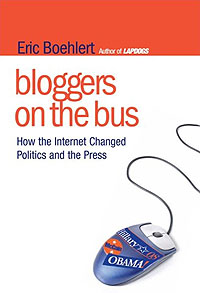
Bloggers on the Bus
If you're interested in the political blogosphere and the netroots in general, Eric Boehlert's Bloggers on the Bus is a great read. It's built around potted sketches
of some of the best known liberal bloggers (Atrios, Digby, Jane Hamsher, John Amato, Arianna Huffington, Glenn Greenwald, and others) and some of the blogosphere's greatest campaign hits during 2008 (the Obama MySpace debacle, the John Hagee meltdown, the Sarah Palin eruption, the great sexism debate), and Boehlert really does a terrific job of diving in and explaining how everything unfolded. I followed almost all of this stuff pretty obsessively in real time, but I still learned lots of details I'd never heard of before.
It's a very fast, entertaining read, and since it focuses (almost) exclusively on the liberal blogosphere it mostly avoids the sense of triumphalism you might get in a more partisan book. Which is a good thing since it ends with this:
The bad news for liberal bloggers was that as the Obama campaign unfolded, as his new commuhity-based coalition was being built and celebrated, it became obvious that bloggers were never really invited to the party. Liberal bloggers simply never became active partners with Obama in the way they had been with the Dean insurgency four years earlier, and the way they had been with scores of Democratic politicians in skirmishes throughout the Bush years. Why? Mostly because Obama didn't seem to want the bloggers around.
That's true, isn't it? For all the hype, the liberal blogosphere in 2008 had its biggest impact in state and local races, just as it did in 2004. It's true that it was much more successful in pushing stories into the mainstream media than it was four years ago, but in terms of being active in the Obama campaign itself, it wasn't. And that was primarily a choice made by Obama himself, who apparently felt that the raw partisanship of the blogosphere was something he wanted to keep at arm's length.
There were a couple of things missing from the book that struck me. The first is specific: the Jeremiah Wright firestorm, which begged to be included in any book about the 2008 campaign, but which Boehlert inexplicably never mentions. The second is more general: Boehlert does a good job of showing how the blogosphere managed to gain attention for stories that might otherwise have gone unnoticed, but at times his account feels too blinkered. The mainstream media played a pretty big role in all this too, and even in a book about the blogosphere this deserves a little more attention. At the very least, there should have been a chapter devoted to the relationship between blogs and the MSM.
But these are nits. If you're looking for a blog's eye view of Campaign '08, Bloggers on the Bus is a terrifically readable and carefully reported book. Highly recommended.








the Golden Age of blogging is over
The Golden Age of blogging is over. Censorship, registration and greed have ended it. Censorship prevents flame wars, the reason blogs became popular. Registration restricts access, reducing the amount of comments. Greed has motivated many Golden Age bloggers to be co-opted by the MSM, or its wannabes, where the big money and audiences are, and made censorship and registration ubiquitous.
All of those bloggers are
All of those bloggers are most likely, guilty of felony cyberbullying if Rep. Linda Sanchez' bill passes.
[Eugene Volokh, April 30, 2009 at 4:07pm] Trackbacks
Federal Felony To Use Blogs, the Web, Etc. To Cause Substantial Emotional Distress Through "Severe, Repeated, and Hostile" Speech?
"That's what a House of Representatives bill, proposed by Rep. Linda T. Sanchez and 14 others, would do. Here's the relevant text:
Whoever transmits in interstate or foreign commerce any communication, with the intent to coerce, intimidate, harass, or cause substantial emotional distress to a person, using electronic means to support severe, repeated, and hostile behavior, shall be fined under this title or imprisoned not more than two years, or both....
["Communication"] means the electronic transmission, between or among points specified by the user, of information of the user's choosing, without change in the form or content of the information as sent and received; ...
["Electronic means"] means any equipment dependent on electrical power to access an information service, including email, instant messaging, blogs, websites, telephones, and text messages.
1. I try to coerce a politician into voting a particular way, by repeatedly blogging (using a hostile tone) about what a hypocrite / campaign promise breaker / fool / etc. he would be if he voted the other way. I am transmitting in interstate commerce a communication with the intent to coerce using electronic means (a blog) "to support severe, repeated, and hostile behavior" -- unless, of course, my statements aren't seen as "severe," a term that is entirely undefined and unclear. Result: I am a felon, unless somehow my "behavior" isn't "severe."
2. A newspaper reporter or editorialist tries to do the same, in columns that are posted on the newspaper's Web site. Result: Felony, unless somehow my "behavior" isn't severe.
3. The politician votes the wrong way. I think that's an evil, tyrannical vote, so I repeatedly and harshly condemn the politician on my blog, hoping that he'll get very upset (and rightly so, since I think he deserves to feel ashamed of himself, and loathed by others). I am transmitting a communication with the the intent to cause substantial emotional distress, using electronic means (a blog) "to support severe, repeated, and hostile behavior." (I might also be said to be intending to "harass" -- who knows, given how vague the term is? -- but the result is the same even if we set that aside.) Result: I am a felon, subject to the usual utter uncertainty about what "severe" means.
4. A company delivers me shoddy goods, and refuses to refund my money. I e-mail it several times, threatening to sue if they don't give me a refund, and I use "hostile" language. I am transmitting a communication with the intent to coerce, using electronic means "to support severe, repeated, and hostile behavior." Result: I am a felon, if my behavior is "severe."
5. Several people use blogs or Web-based newspaper articles to organize a boycott of a company, hoping to get it to change some policy they disapprove of. They are transmitting communications with the intent to coerce, using electronic means "to support severe, repeated, and hostile behavior." Result: Those people are a felon. (Isn't threatening a company with possible massive losses "severe"? But again, who knows?)
6. John cheats on Mary. Mary wants John to feel like the scumbag that he is, so she sends him two hostile messages telling him how much he's hurt her, how much she now hates him, and how bad he should feel. She doesn't threaten him with violence (there are separate laws barring that, and this law would apply even in the absence of a threat). She is transmitting communications with the intent to cause substantial emotional distress, using electronic means "to support severe, repeated, and hostile behavior." Result: Mary is a felon, again if her behavior is "severe."
The examples could be multiplied pretty much indefinitely. The law, if enacted, would clearly be facially overbroad (and probably unconstitutionally vague), and would thus be struck down on its face under the First Amendment. But beyond that, surely even the law's supporters don't really want to cover all this speech.
What are Rep. Linda Sanchez and the others thinking here? Are they just taking the view that "criminalize it all, let the prosecutors sort it out"? Even if that's so, won't their work amount to nothing, if the law is struck down as facially overbroad -- as I'm pretty certain it would be? Or are they just trying to score political points here with their constituents, with little regard to whether the law will actually do any good? I try to focus my posts mostly on what people do, not on their motives, but here the drafting is so shoddy that I just wonder why this happened.
"
I vaguely recall there was
I vaguely recall there was some sort of blogging scandal early in Obama's campaign that necessitated repudiation. Some campaign workers going overboard....
The dumbest thing about Sanchez's bill
It's in response to the suicide of Megan Meier, the 13-year-old girl in MO who was bullied and humiliated towards suicide by Lori Drew, a friend's mother. Posing online as a local teenage boy she invented Drew led this poor kid on and then pushed her over the edge with some really cruel comments. The odd part is there wasn't anything "interstate" about it, they lived in the same town.
What's the Obama MySpace
What's the Obama MySpace debacle?
Re: Obama Myspace Debacle
Techpresident.com had the best coverage (google "joe anthony" obama); or
http://blogs.myspace.com/index.cfm?fuseaction=blog.view&friendId=159248288&blogId=353068555
It's over?
The Golden Age of Blogging is over? I must have slept through it.
No Kevin Drum?
Was Kevin Drum not included in "some of the best known liberal bloggers"?
So is he really a moderate? A conservative even, at times? Hmmmm.
professional advancement probably better describes the ambition
The word greed is too loaded with criticism and should not have been used to describe one of the reasons for the end of the Golden Age of blogs. Professional advancement probably better describes the ambitions of bloggers who have transitioned from their seminal websites to the websites of media companies and magazines to reach a wider audience. Trying to reach a wider audience leads to censorship and registration. Censorship is implemented in order to not offend some readers and registration is used as an attempt to lock the readers into the community of the media company.
thnks for your post. it's
thnks for your post. it's wonderful.....