In The Blogs

Media

Paying for the Times

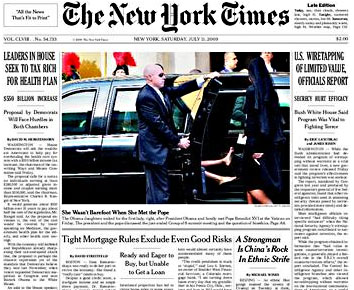
The New York Times is considering charging half a sawbuck per month for online access, and Michael Crowley approves:

Given that some people spend $5 per day on coffee, paying that much per month for online access the best newspaper in the world strikes me as an absolute no-brainer. I myself would pay twice as much. I hope the idea catches on, and I hope this marks a shift from the days of newspapers panicking to the start of successful new business models.

I'm a little torn here.  I don't have any problem with paying for the Times.  I already pay for the Wall Street Journal online, for example, and I figure that's just part of the job.  But if the Times does go this route, I hope they provide some mechanism for providing short-term public links to individual articles.  I generally try not to link to pieces that readers can't click through to read themselves, partly as bloggy courtesy and partly because it's one of the things that keeps bloggers honest.  If the Times blocked off online access completely to nonsubscribers, I'd link to them way less and would therefore find them way less useful.

As for the broader question of whether this will work, it's hard to say.  On the one thand, we're rapidly entering an era in which the Times is almost literally the only top notch general purpose newspaper in the country, now that the LA Times and Washington Post seem to be in death spirals.  That means less competition, which in turn means that if you really care about serious news, you don't have much choice except to pony up.

On the other hand — well, the Post and the LAT aren't that bad, and McClatchy and AP and the Guardian and the BBC and NPR and all the cable nets are still around.  The Times has them beat on a number of scores, but you still have to be a real news junkie before you're going to be unsatisfied with the flood of news from other outlets.  And I'm just not sure how many serious news junkies there are out there who don't already subscribe to the print edition.

But on the third hand, online advertising seems to have collapsed so completely that it's hard to see the downside of charging for access.  Even if it only brought in a few million dollars a year, that's probably more than they make from online ads these days.  So what's the harm in trying?

image
image

Get Mother Jones by Email - Free. Like what you're reading? Get the best of MoJo three times a week.
Comments
no profile pic for comment author

I dont want to buy papers

If things go down this route, I would like to pay a general fee to read many different newspapers. Its not as if i read the whole edition of anyone. I generally look at the front pages of the post, the guardian and the ny times. Then I check this page, the corner, tpm, kos, aaandrew sillivan and drudge. That is to say I check to see what the general consensus of news is.

I think I should just send the NY Times a check every year in general support, perhaps. I want to support it but I dont read newspapers, I read articles and columns that are diffusely spread out through a number of portals.

Ideally, a little popup would come up when I moved my mouse over a link asking if I wanted to spend 10 cents or a nickle for an article. Microretaling. They certainly have the volumne for that kind of model. I suppose someone just has to invent the software.

no profile pic for comment author

pay per click

I'm waiting for the day when major newspapers and commentary sites form a common credit-card-based system (I'm thinking something like my EZ-Pass account) in which I can pay a very small amount to read each article, perhaps a penny or two or so, and get billed as I go along. I would surf around as usual to my favorite sites and end up with a bill around a dollar or two a day at most. Unless the online audience is a lot smaller than the market that used to reliably shell out for daily papers, it's hard for me to see why the profits would not sustain the online newspaper industry.

no profile pic for comment author

My opinion as to how far they've fallen

Is that I would be happy to pay $5 a month to shut them down! They used to be a great paper, but recently they've simply sold out to the forces of disinformation.

no profile pic for comment author

2nd verse same as the 1st?

They tried to charge for access to their columnists. The blogosphere promptly forgot they existed, they lost influence, and the NYT caved after a year or so.

Anyone giving odds that the NYT wil repeat their own history?

no profile pic for comment author

If they want to make drastic

If they want to make drastic cuts to their audience and influence, why should we stop them?

I use the NYT archives frequently to source Wikipedia articles. If they become pay-only, I'm likely to stop, not just because I wouldn't have personal access but also because pay-only links aren't useful to most other Wikipedia readers. Net effect: fewer NYT links in Wikipedia, no additional revenue for the NYT. But it is their intellectual property and they have the right to be stupid about controlling it.

jimBOB

Maybe they could be

Maybe they could be tax-supported, like PBS used to be before it was sold off to corporate underwriters. Or you could do what the U.K. does with TV and have a mandatory internet user fee that went to support various online news outlets.

no profile pic for comment author

They sincerely have my best

They sincerely have my best wishes, but it ain't going to work. But I'll tell you what I would pay for.

I'd pay for some access.

I'd pay for a Web 3.0 newspaper that provided me and others (who pay) with the ability to discuss articles that came with some amount of guaranteed access to reporters, editors, and ombudsman.

Blogs provide me the ability to shout at people who really have very little say. (Fuck you by the way.)

Newspapers are still at Web 0.5 where they provide comment discussions that no one at the paper reads and so devolve into sites that just attack the newspaper until the newspaper shuts them down.

I'd pay for access to a forum that would guarantee every reporter had to spend 30 minutes each day responding to some amount of the letters generated by an article. A forum in which the ombudsman had to send 60 minutes each day responding to readers. A forum in which the editors has to spend 60 minutes each week responding to readers.

This would be a value add newspaper forum in which readers were actually respected and not just taken for granted.

I'd pay for that, but just to read the Times and be treated to Judy Miller? Not so much.

no profile pic for comment author

That's an interesting idea

That's an interesting idea but those times you mention are waaaaay too little, especially if a reporter ends up having to do research to answer someone's good question. Essentially, the reporters who write the high-profile stories would have to spend hours (yes, plural) each day to do a decent job answering web comments, which means the paper would have to hire more reporters to do the work the other reporters are not doing, which means the paper would be even deeper in the red. I guess each paper could hire an ombud to answer questions, but even at full-time, the ombud would answer very few comments per day. (as a side note, knowing that there was even a possibility that reporters or an ombud was answering questions would increase the trolls greatly. My local newspaper's website comment areas are already almost run by the trolls as it is.) .... Still, there must be some way something like this would work.

no profile pic for comment author

Interaction? By the people

Interaction? By the people who know what they are talking about? Hmm, I see a business model here that it appears there is a demand for.

no profile pic for comment author

what's a sawbuck? oh well,

what's a sawbuck? oh well, i don't care cuz i'll pay whatever they charge. only good newspaper left.

Brian

A sawbuck...

...is a ten dollar bill. You're thinking of a fin.

g. powell

iTunes

I'm surprised no online paper has tried charging a very modest fee per story using the iTunes model. They might haul in more revenue that way than they would charging a monthly flat rate.

no profile pic for comment author

the problem seems to lie in

the problem seems to lie in that no one has come up with a convenient way to make micropayments. Once that is seamless, and transparent, so you don't have to make an effort for each payment, it may be more successful, and may point to how to capitalize the intertrons.

no profile pic for comment author

After Whitewater, Monica, War on Gore, pre-Iraq, Bipartisanship?

After Whitewater, Monica, War on Gore, pre-Iraq, Bipartisanship-boosting, Micheal Jackson coverage, so what?

The main stream media has disgraced itself over the past two decades. And it shows no sign, none, of mending its ways. I'll just post the following quote from Atrios, and say i'm tired of this malarky:

With this small tax bump for the relatively wealthy being proposed, look forward to the following bad press coverage:

Confusion between total and marginal tax rates.

Confusion between small business revenue and small business profits.

Stories about how in some places $350,000 isn't all that wealth.

The various news organizations show no signs of ending this and thereforre, as they exit the stage, I say good riddance.

no profile pic for comment author

What's a sawbuck?

I wouldn't pay for the Times because I had NPR, the BBC, the WaPost for free. I wouldn't pay for NPR because I had the BBC and the WaPost for free. I wouldn't pay for the BBC because I had the WaPost. I wouldn't pay for the WaPost because of Charles Krauthammer......

and I had Fox News for free.

Information may want to be free, but those who gather information and write about it have to eat and pay rent.

no profile pic for comment author

Paid press

Remember that part of what gives the Times it's stature is impact outside of the US where the print edition is seldom easily available and certainly where it is not home delivered. In the previous and original Times online access regime, domestic US users were permitted online access while non-domestic users were in theory barred from unpaid access. This regime broke down almost immediately with the registration and wide publication of userid/pswd pairs. The Times gave this arrangement up in defeat, restricting access only to oped pieces, then dropping the barriers altogether. I confidently expect that if access is once more a matter of money, workarounds will appear, much as they have for the Wall Street Journal, almost all of which is now available to anyone for free with a special spoofing Firefox plugin (Refspoof). For me the conclusion is inescapable that the editorial functions of the quality press will have to be subsidized in some fashion, either from government revenues or from private philanthropy, and also that paper as a delivery medium cannot survive much longer. The latter conclusion would apply to the book industry as well, especially in low volume graphics-heavy textbooks which are revised regularly, though it may take a bit longer to peter out in that context.

Over the long run, I would expect the quality press in London will be central to world news dissemination. That would be The Times, The Guardian, The Independent and the Telegraph. One or more of these will likely also cease publication and currently the leading candidate for cessation is the The Independent. Already, The Times is carrying more and more US news, perhaps because the rest of the world no longer has faith in the integrity of the NYTimes, WashPost, etc. to publish the truth about US government abuses, a faith which was probably misplaced in the first instance. In other western countries, there would typically be one major "paper" and lots and lots of free local rags supported entirely by any mass advertising such as remains in the altered commercial context, except in countries in which there is more than one official language and thus more than one "national" stream.

Arrangements for a public subsidy for a single national news organ would be challenging. I suggest an endowed trust with resources drawn both from private and public sources and with a completely independent board of directors drawn from all the important constituencies. Essentially the Beeb has operated in much this manner for generations and although there have been abusive pressures brought to bear from time to time, in the main it has remained a commendable independence and is widely trusted throughout the literate world.

LarryB

It had better include the crossword!

Their last experiment - pay for opinion content only - was a massive flop. I managed to suvive without Paul Krugman and was happy to be free of Maureen Dowd.

I probably would fork over a nominal fee for the Times, but if I do, the crossword had better be included, and not an optional, extra fee subscription.

no profile pic for comment author

Kevin Drum sez If the Times

Kevin Drum sez

If the Times blocked off online access completely to nonsubscribers, I'd link to them way less and would therefore find them way less useful.

I suppose it depends upon whether you consider "useful" simply being an informed citizen or whether "useful" means the appropriation of another's work for your own purposes.

no profile pic for comment author

NYT Charge for Access

LarryB said it. Throw in the crossword puzzle for free and I'll gladly pay $5. And don't try bank-like chiseling such as charging an extra 50 cents to read the Sunday Magazine.

no profile pic for comment author

par4 They should have to

par4 They should have to fire Bobo & Douthat or offer a rebate.

no profile pic for comment author

the limits of "free"

my computer/monitor wasn't free. my isp isn't free (and those of you who are leeching off others' wireless access points aren't actually getting "free" service, either), and I'm not sure why the news should be free... I still get the paper on paper, partly because I think that through the print version I am exposed to more that I didn't know I wanted to read and because it is easier to skim pages of print spread across the dining room table than it is to point and click and scroll etc. (And because I'm addicted to doing the crossword in ink. )
And I do wonder if in fact "everyone" wants to be on line all the time, for every activity in life. Should early adopters and power users be the driving force for the dismantling of a good technology? the history of information technology has been additive, not replacement (radio didn't replace print, television didn't replace radio or films...), why should this change now?
elisabeth

no profile pic for comment author

Too much competition

Kevin,

If the New York Times (and the other main American papers) chooses to firewall their service, and force readers to pay a subscription, it will drive people like me into the hands of foreign English news sources like the BBC and Al Jazeera, both of which provide top notch journalism for free.

serial catowner

Why Bother?

Ok, give the NYT one more chance. Let's see how well they can explain cap-and-trade, or "robust public option".

If they fail (and I'm sure they will), the hell with 'em.

thersites

what xtalguy said

xtalguy:

Information may want to be free, but those who gather information and write about it have to eat and pay rent.

Bingo.

no profile pic for comment author

Unfortunately, those who own

Unfortunately, those who own the gathering and disseminating of the 'news' want to earn more than just enough for eating and paying the rent. They are not satisfied with the median wage, but the market no longer values journalism's inputs as highly as it once did. If the NYT said they will stop taking corporate advertising and would return to investigative journalism of government and business, instead of being a propaganda arm of government and business, then perhaps that would be a business model subscribers would want to support. Subscribing to the NYT, as it stands now, would be subsidizing a pro Wall St and war slanted propaganda rag. If the NYT wants to increase its net profits, it should fire Brooks and its finance propagandists.

no profile pic for comment author

Half a sawbuck is a fin

>>Submitted by Brian on July 11, 2009 - 2:16pm.

>>...is a ten dollar bill. You're thinking of a fin.

This is what happens when you let children loose on the Internets...

no profile pic for comment author

the LA Times and Washington Post seem to be in death spirals

I live in L.A., and I stopped reading my city's paper of record when they fired war critic Robert Scheer, and replaced him with neocon troglodyte Jonah "Liberal Fascism" Goldberg. Same for the Washington Post, which just fired Dan Froomkin, and added Ross Douhat to its disproportionately neoconservative editorial staff, all at a time when the rest of the country has moved to the left. I'm not interested in hearing a "me too" chorus of liberal opinion, but having an editorial page that is so far from the mainstream that they can't even see the water makes me distrust the entirety of those newspapers.

By way of backing up my opinion on this, check out Glenn Greenwald's article from last month on the WaPo devolving editorial page, Persecution of the Right and the Washington Post Op-Ed Page.

Greg in FL

Channeling Reb Tevye

Hmm.
He's beginning to talk like a man.
On the other hand,
what kind of a match would that be
with a poor tailor?
On the other hand,
he is an honest, hard worker.
But on the other hand,
he has absolutely nothing.
On the other hand,
things could never get worse for him, only better.

Have a good Saturday night, Kevin...Tradition!!!

no profile pic for comment author

They tried that, Kevin

Kevin, the pricing model you're suggesting (free access to the current, pay to get archive access) was one of the first fee structures they tried. They were never that public about why they abandoned it.

But times change, and an abandoned model could work now.

But me, I'll gladly pay the fiver.

no profile pic for comment author

Me too, I will gladly pay

Me too, I will gladly pay it. Although I find the paper on the whole to be to the right of where I would prefer it to be on many issues (and despite Judy Miller's and Bill Kristol's tenures there), it's still a breath of fresh air compared to Fox, WaPo, WSJ, etc. Articles that appear in major newspapers often significantly affect (or drive) debates in congress, and a good deal of what appears in the liberal blogosphere is commentary on NYT articles. Its demise would be a major blow to liberalism in this country and would consolidate the domination of right-wing media at all levels. Supporting it is a worthy cause.

no profile pic for comment author

What I envision: an analog

What I envision: an analog of PayPal (or a new feature of PayPal) for the world of newspapers--one that specializes in prepaid micropayments. So you can put $20 or whatever in your micropayments account and pay for whatever odd articles you want to view at different publications, or use it to pay for monthly subscriptions to publications you read the most often. This both makes it simpler to subscribe to multiple publications (so you don't have to keep track of account and payment info for each one individually) and allows for micropayments to be made so easily that the barrier to the viability of micropayments will be largely eliminated. If all that stands between you and buying a ten cent article from a publication you don't read regularly is a "Buy Me" button, then you're more inclined to buy the article than if you have to register for access just to view that single article, and it will be more profitable to the publication in aggregate than if it just gave away a certain number of articles to new users. Prepaid is better than charging someone's credit or debit card every time they make a purchase, but people are not likely to be willing to buy prepaid credits for a publication they don't read often. If instead they can buy credits from a single provider that can be used at many publications, they are a lot more likely both to buy and to spend credits.

no profile pic for comment author

BBC does cost....

"foreign English news sources like the BBC and Al Jazeera, both of which provide top notch journalism for free."

Well free at the point of delivery anyway...
As a licence payer, i don't see the BBC as being free.
At 39p (60 cents) a day it's worth it but it's not free...

no profile pic for comment author

Free news

When all the reputable news outlets are out of business because their business models no longer pay for them unless the include crosswords or mandatory reporter responses to user comments, we'll have Fox News and the New York Post for free because Rupert Murdoch IS willing to pay for them.

One of the reasons Obama won was that the mainstream (I mean liberals) caught on to the fact that reactionaries had been financing campaigns for decades, while liberals wouldn't pay for anyone less pure than themselves.

You get what you pay for. If you're not willing to pay, you get what the Murdochs of the world ARE willing to pay for.

no profile pic for comment author

Opinions Only

I don't know the solution to saving The Times or any other paper, in print or online. But one thing strikes me about the 30 comments so far: how many write off the major papers for their OpEd columnists. If columnists vanished, I do understand that the papers would be less entertaining and would sell less. If they vanished, I also understand that the world would carry on. I've no doubt that bloggers can bloviate as well, or at least agree with me as often. I can bloviate myself.

But the comments suggest that a lot of people have already lost track of the difference between that and news. I worry that this is the future. Papers won't in fact survive, we'll have an extremely partisan age, with opinions based on little but the public record. Partisanship itself isn't a bad thing. I wish we had a more partisan Democratic party. But what if right now we were all shouting that torture and surveillance were ordered from the highest places, while conservatives could as easily shout back, and no one could be proved wrong?

Sure, the papers have let us down on checking government (e.g., Judith Miller). But follow TPM's obsessive (and, to me, annoying) links from its headines, which always point to its own articles, as if it were doing the reporting. Then another click takes you to the real papers. They're the only ones doing the work. It also takes more than one for that to continue, since competition between them drives the scoop as much as an editor's sense of responsibility. In the long run, it is what gives us editors with a sense of responsibility.

"Information wants to be free" is nonsense on the face of it, as if information wanted anything, as if NY Times t-shirts (as one alternative revenue source) had any more claim to cost money, as if supply and demand went out the window, or as if it didn't cost money to have a paper online or off. Still, I suspect that none of these schemes will preserve a free press, and the future is with the commentators who think the Times is the sum of David Brooks and Maureen Dowd.

no profile pic for comment author

Newspapers shrinking

Satirist, comedian, and writer Harry Shearer pointed out in this morning's (7/12/09) "Le Show" broadcast (not heard in your area) that while American newspapers seem to be dying on the vine, British newspapers are thriving -- the Saturday and Sunday editions are all fat, bulging with extra sections and (it would seem) ad revenue.

One wonders what the Brits know that we don't.

no profile pic for comment author

Times charging for what?

Yes, yes, I agree with all this. But then I think...Judith Miller. Wiliam Kristol. And suddenly I lose interest.

no profile pic for comment author

"The Times has them beat on

"The Times has them beat on a number of scores, but you still have to be a real news junkie before you're going to be unsatisfied with the flood of news from other outlets."

One important exception is what might broadly be called cultural news: arts, lifestyle features, ideas/letters, etc. Sometimes the Times falls into self-parody, but in general it's the only American paper that seriously competes on these beats. That's true whether one's reading in one's specialization (I can't imagine life with Dave Kehr), catching up with other arts (for me, the architectural reviews) or engaging in lifestyle voyeurism (the Dining section).

Another interesting point is that the bloggers seem to have missed this angle because they consume hard news far more than cultural news.

no profile pic for comment author

internet access already costs money

Internet access already costs money. It will be difficult for the NY Times to grow subscribers when people are discontinuing their wide band and dial up services.

no profile pic for comment author

When the Times restricted

When the Times restricted access to the editorial page behind a firewall, I accessed the print version through a free database provided by my local library. It was a pain- you get an index list of article title, page, by-line, and no ability to scroll through the "front" page, but it was always available and always free.

jrw

Weird

So, you'd pay for the NYT if they got rid of all the columnists you disagree with? God forbid that such sensitive souls should have to put up with something so onerous. I can't believe people would not pay $5 a month for the NYT...why should it be free? Apparently because the idiots that set up early web "business" models were naive enough to believe their own nonsense, and we swallowed that nonsense because it was great to get for free what cost a lot to produce. Now everybody has this firmly held belief that everything on the web should be free. That's gonna change.

no profile pic for comment author

I would never pay for news

I would never pay for news as long as there are hundreds and hundreds of free sources. Early Internet experience showed that for every site that wanted to charge for information, there were others that would put information out on the Internet for free. Seems a bit old hat subscribing to a few new sources when there are aggregators like drudgereport from which you can link to many sources and the most interesting stories from dozens and hundreds of sources.

I would say the newspapers have been rather unimaginative in financing their online editions. They could perhaps copy the Craigslist business model. The Chicago reader, an alternative newspaper with a fairly large circulation, used the same model -- free noncommercial ads, paid for commercial ads -- to print their paper for several decades, although they are now struggling.

It might be in the end that investigative journalism would have to be supported by a foundation model or something, but then does anyone care anymore? Political correctness has supplanted patriotism and integrity as our highest national value.

jrw

Are you kidding me?

"I would never pay for news as long as there are hundreds and hundreds of free sources." There it is in a nutshell, the thought-free position...everything should just be free. Well, I say nothing is free; somebody is paying for the news you read, just not you, I guess. Way to suck value from the world. And newspapers should copy the Craigslist model? Craigslist is, in large part, what has killed newspapers by eliminating classified advertising revenue. And Craigslist is explicitly aiming to be non-profit. But then if you're getting all your information from Drudge, there's no reason why you'd be thinking about anything, anyway.

no profile pic for comment author

If the NYT discontinued its

If the NYT discontinued its advertising, then charging a subscription might make business sense. What the NYT should do is become an internet service provider if it wants to collect fees for internet usage.

no profile pic for comment author

...

If they're going to charge, I don't want to be paying a large lump sum for a paper I might not come back to for months, and find my time is already up.

Also, they don't seem to have the right idea of what ads to suppress if you pay or how to get access to the ads after they've been shown: Haven't you ever wanted to go back to an ad you saw, only to not have its link there when you refresh the screen?

Maybe if national papers banded together and ran promotions to get people to pay to a central payment tool - which would then give monies back to the papers based upon which one got people to sign up.

no profile pic for comment author

paying for news I read, paying for news I want others to read

I used to read the NYT almost every day. Now, in addition to having so many web-available outlets for decent coverage and niche coverage heaven, there are just too many subjects that the NYTimes doesn't cover well or covers in ways that perturb me (politics, industry, environment, technology).
I'd rather pay the money to Mother Jones, etc.. In fact, that should be your sales pitch, to us partisans. If you'd support the NYT for x dollars a month, why not help your friends at MotherJones, WashMonthly, etc.., for the same, or instead? Or, consider targeted giving -- I'd rather pay for investigative journalism targeted at things I care deeply about, rather than pay and hope that the NYT does the right thing.

Post a comment
Alternately, you may login to or register an account
The content of this field is kept private and will not be shown publicly.
  • Web page addresses and e-mail addresses turn into links automatically.
  • Allowed HTML tags: <a> <ul> <ol> <li> <blockquote> <img>
  • Lines and paragraphs break automatically.

More information about formatting options


Jail.org - Inmate Search
Criminal records, instant public records & people search & current court records. www.jail.org

U.S. Public Records Search
Search County & State Court Records, Criminal records, Vital and Adoption Records www.PublicRecordsInfo.com

Records.com - People Search
Public Records and Background Checks. Instantly Search Criminal Records, Addresses and Court Records www.Records.com

Court Records & County Records
Find Instant Public Records, Criminal Records as Well as County Property Records Search. www.PublicRecordsIndex.com

Mother Jones Podcast
Get in on the conversation! We talk about culture, politics, the environment, the economy and more. Listen now!

TalkBackTees.com
A treasure trove of liberal wit, wisdom and quotations, from ancient to modern, on colorful, cotton tees.

Support Independent Artists
Amazing art, crafts, apparel, paper-goods and more. A carefully curated selection of sundries since 1999.

FREE CONNECTIONS FOR GREEN SINGLES
Meet progressive singles in the environmental, vegetarian & animal rights community who share your values