
- ‹ previous
- 72 of 2794
- next ›
Hungary and the Iron Curtain
This isn't exactly a forgotten part of history, but still, it's nice to see reporter Mitchell Koss reminding us today that although the fall of the Berlin Wall was the most dramatic aspect of the end of Soviet domination of Eastern Europe, it wasn't the original trigger. In the LA Times today, he writes about the changes in Hungary between a visit in 1987, "when it seemed as if the Soviet presence in Eastern Europe would last for a thousand years," and a visit two years later:
By 1989, when I returned, everything had changed. When I visited that same embassy the first week of March, a U.S. official talked openly to us — and presumably to the KGB eavesdroppers — about how, as the impending March 15 demonstration seemed to get bigger, Soviet leader Mikhail Gorbachev was not responding to pleas for instruction from Hungary's communist rulers. "We don't know what to make of it," he said.
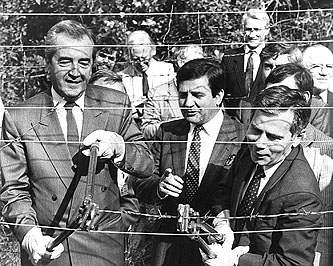
....It all began to come into clearer focus two months later, when Hungary removed the barbed-wire fence along its border with Austria and told guards not to shoot those who wanted to cross. Months after that, the Berlin Wall fell, and two years later the Soviet Union dissolved, albeit with fewer memorable images. Before the decade was out, Viktor Orban, one of the mildly rebellious students whom we'd interviewed in 1986, had become prime minister of Hungary.
In retrospect, some things that seemed puzzling at the time now seem so clear. The embassy wondered why Gorbachev was ignoring the Hungarian leaders' plea for assistance. But as it turned out, his not responding was central to all that happened next. Months later, he also didn't take the calls from panicky East Germans seeking guidance for how to react when the wall was breached. He had decided to disengage, and that made all the difference.
By 1989, the Soviet Union was so far in hock to western banks that they basically had Gorbachev by the balls. He couldn't afford a repeat of 1956 or 1968, and when that became clear the jig was up. Hungary went first, Berlin followed, and within a few months the Iron Curtain was on the ash heap of history. In the end, it was hard currency, not ICBMs, that brought down the empire.









Or as A. Whitney Brown once said,
"Who would have thought that the fatal flaw of communism was, that there was no money in it."
stupid question
I confess to being a dunce in these matters of international high finance, but I have a question that someone might be able to answer:
Who were these Western banks financing a global superpower whose stated goal was the destruction of these same Western banks, and was presumably applying some of this money to the construction of weapons of mass destruction capable of wiping us off the face of the planet?
I don't pay as much attention as I should to the news. Maybe I missed the treason trials.
do-overs
Timothy Garton Ash has a fascinating piece, in which he considers a wide variety of contributors to the events of 11/9/89, in the 11/5 of the NYRB. For anyone interested, it's available online:
http://www.nybooks.com/articles/23232
Among the books reviewed, one of the authors suggests that Gorbachev may have gotten more than he bargained for. When asked, years later, if he would make the same decision today that he did back then, he replied, "Probably not."
Kevin Drum: "By 1989, the
Kevin Drum: "By 1989, the Soviet Union was so far in hock to western banks that they basically had Gorbachev by the balls."
And now the US banks are so far in hock to the US government that they've got us by the balls. Huh? Would someone please explain the logic of that, or is it as simple as the banks always win?
Hungary does deserve the
Hungary does deserve the credit for the fall of the Berlin Wall. East Germans were traveling to Hungary en masse after they cut the fence with Austria. The Germans would abandon their Trabis near the border, dash for Austria, and take the train to West Germany. The Berlin Wall was in effect leaking like a sieve and undermining Honecker's government before the wall physically came down.
Thanks Junebug
I enjoyed Timothy Ash's piece in the NYRB.
By the way, Ash is adamant that it was nothing as simple as banks having the Soviet Union by the balls that caused the fall of Communism...
I have trouble believing the
I have trouble believing the finance story.
It has two odd premises. First, that western creditors would care if the Soviet Union cracked down in eastern Europe. Would they? Only if a crackdown made it less likely that the Warsaw Pact regimes would repay --- and I'm not sure why that would be the case.
Second, that western creditors held leverage over the Soviet Union. Considering the frequency of sovereign default, and the willingness to restart lending afterwards, I have trouble understanding what exactly that leverage would be.
The "hard currency brought down the empire" story seems highly unlikely. Of course, I may be missing something, some reason why the Warsaw Pact's western creditors would both want to punish a crackdown and have the means to do so. I'd very much like to know what it is.
I have trouble believing the
I have trouble believing the finance story.
It has two odd premises. First, that western creditors would care if the Soviet Union cracked down in eastern Europe. Would they? Only if a crackdown made it less likely that the Warsaw Pact regimes would repay --- and I'm not sure why that would be the case.
Second, that western creditors held leverage over the Soviet Union. Considering the frequency of sovereign default, and the willingness to restart lending afterwards, I have trouble understanding what exactly that leverage would be.
"Bliss it was to be
"Bliss it was to be alive,
but to be young was very heaven."
Don't forget
Poland is there is the mix as well. The Poles kicked out the commie government in the summer of 1989.
Really? The whole trajectory
Really? The whole trajectory of Gorbachev's decision to surrender the notion of a totalitarian, Soviet empire - his decision to disengage from Eastern Europe which was so central to his reform project, doomed as it was, of the communist state - reduced to it just being because he was "in hock to Western banks"? That was really all perestroika was all about?
I think a number of the above commenters have it right on this simplification - and a good NYRB link too.