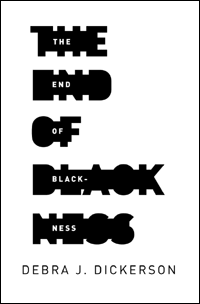
It’s characteristic of this blunt and bracing book on being black in America
that author Debra Dickerson says, “Get over it.” She’s speaking to blacks who are still holding
out for white admissions of guilt for slavery and racist oppression, but it’s as if she were speaking
to a self-defeated friend who blames adult woes on a miserable childhood. Many grown-ups
had unhappy childhoods, she is saying, and they have accepted that they can’t go back in time and
fix it. So, “get over it.” Look to the future.
Dickerson’s ambitious aim in this book is to clear the ground for fresh
thinking about race in America. She argues persuasively that while America is no racial utopia,
it has become, in the long aftermath of the civil rights movement, a place where racism no longer
blocks blacks from “playing the game.” Indeed, she believes that “no one can stop the American,
black or blind, who is determined to succeed.” She also highlights such social dysfunctions
in black communities as low scholastic achieve- ment, crime, and “family breakdown” that have
not improved in the two full generations since the passage of the Civil Rights Act. “There is work
to do,” she writes, “and it must be done by black people, regardless of how whites behave.”
The End of Blackness is a solidly researched account of the evolution
of black identity in America (her “prologue” is about as concise and direct an account of slavery
and its long-standing effects as you are likely to find). Dickerson is issuing a tough-minded challenge
to her fellow blacks “to shoulder the adult’s full responsibility as a member of the polity.” “Crime
is crime,” she writes. “Sloth is sloth. Merit is mostly measurable,” and it is debasing to believe
and act otherwise, regardless of race. In this turned-off age when so few eligible adults are even
bothering to vote, let alone assume other vitally important responsibilities of citizenship,
Dickerson’s is a message for all Amer- icans, not only those who are confused about how to think about
race.