After the Bomb Dropped
On the 62nd anniversary of the atomic bombing of Hiroshima, HBO's White Light/Black Rain tells the stories of those who survivedand those who triggered the nuclear age.
For more than 25 years, Steven Okazaki has been making movies about the 1945 atomic bombing of Japan. His latest film on the subject, White Light/Black Rain, which will air on HBO starting August 6, is the film he's "been wanting to make for 25 years." In it, he tells the stories of more than a dozen bombing survivors plus those of the Americans directly involved in creating and dropping Fat Man and Little Boy on Nagasaki and Hiroshima, respectively. The personal narratives are fascinating, but they're awkwardly woven with a chaotic mix of historical footage, personal interviews, and present-day sit-ins and public art exhibitions inspired by the bombings. The mix is disorienting and confusing, perhaps an intentional reference to how the survivors recall feeling immediately after the bombs first dropped. Ultimately, White Light/Black Rain provides memorable, personal experiences and a little insight into life in post-WWII Japan, but little in way of a cohesive vision.
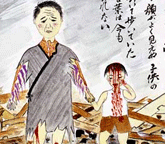
In his interviews with survivors, Okazaki spares no details, no matter how personal or gory. The survivors' scars have nearly disappeared beneath their wrinkles (most were children at the time of the blast) but their stories retain a horror-movie quality that doesn't fade. Sakue Shimohira, 10 years old when her hometown of Hiroshima was bombed, identified her dead mother by her gold tooth: when she touched her, the body crumbled to ashes. The girl's sister, the only other family survivor, later committed suicide by jumping in front of a train. A celebrated graphic novelist recalls how, as a boy, he listened helplessly as his little brother spent hours dying beneath the rubble of their Hiroshima house. He later turned the tragic events into a dynamic manga comic called "Barefoot Gen" that was adapted into anime and live-action movies.
Understandably, some survivors believed that dying was much easier than living with the guilt and pain. One survivor recalls how all the patients in his burn unit, cried and begged for the doctors to kill them whenever they saw a white coat. Suicide was, and remains, an "honorable" way out of life's problems in Japan. That, combined with the mindset that any physical abnormalities should be hidden or ignored, made suicide a tempting and face-saving way out for people who might have otherwise survived their wounds. Those who had the "courage to live," as Shimohira puts it, chose a difficult path because the people marked by scars or lost limbs as bomb survivors were deemed "untouchables." Many couldn't get jobs or find spouses; it was as if they had murdered someone. Even those who looked physically fine, but later came down with "atomic bomb sickness," were shunned because others feared their disease might be contagious.
Many of the Hiroshima and Nagasaki survivors express anger that the Japanese government did not take responsibility for the victims of the bomb, and refused to tell the people what was really happening in the war, which would have allowed them to make arrangements for their own safety. "Though the government kept saying we were winning, we were winning, the Japanese people realized we couldn't win," says Shintaro Hida, who was a military doctor at the time of the war. Sadly, this disconnect between government rhetoric and the reality of an "unwinnable" war could be applied to any number of conflicts, including those in present day United States.
The American flight navigators and weapons technicians interviewed said that winning war was really the only reason they felt alright dropping the bomb. Like the Japanese, they also were told by the government that they could win the war, but they weren't told about the bomb's true power because no one really knew. It was only after the photographs came back—Hiroshima leveled, scattered with carbonized bodies and skulls and spines—that they realized the enormity of the weapon. "From now on, the world will live with the possibility of nuclear war," says former Los Alamos manager Lawrence Johnston, who developed Fat Man's detonator. "We've opened Pandora's box and the genie can't be stuffed back in the bottle."
The focus of the film, though, is really the survivors. They're living testimony to the damage of war, both physical and psychological, and testament to human resiliency, so it's distracting when Okazaki breaks up their stories with present-day tangents like a punk band playing songs about the bombings in downtown Tokyo, or an artist creating a finger-painting of a mushroom cloud near a Hiroshima memorial. The juxtaposition of costumed Harajuku kids and drably dressed survivors is marked, but it doesn't really add anything to the discussion. It's easier, and more meaningful, to simply let the survivors tell the story of the bomb.

I've seen many of the films previously dealing with Hiroshima and Nagasaki, and I have to say that "White Light/Black Rain" seems to have done the best job of truly bringing the story to life. Whereas in other films the testimonies seemed to be used merely as a way to buttress the political agenda of the filmmakers, "White Light" really lets the people just tell their story. The paintings, photos and archival footage were, I felt, effectively woven in to help illustrate the stories. It really added power to the stories that I hadn't felt in the other films.
Also, correct me if I'm wrong, but the scenes of present-day Tokyo mainly appear in the beginning and end, instead of "breaking up" the survivors' stories. For me, they help frame the stories so that it makes me think of this historical event in a certain context. It made me think about the incredible sacrifices that Japan's peace today is built on, and about how all that could be blown to smithereens in an instant. The bookend was a frightening reminder that this isn't just a story about the past; it has everything to do with the present.
My father was with the 7th Fleet until 1947. He was already in the Navy when Pearl Harbor was attacked. I didn't see him until 1947 - and, yes, his ship came in for repairs and mommie dearest was there. The Japanese got what they deserved.
I'm sorry about whatever happened to your father -- he didn't deserve it either. No one deserves to be killed or wounded in a war.
I watch this show, and it made me cry. People don't fight wars, Govt's do, theoretically.
This Pandora's Box should be a deterent to ALL nuclear enabled nations on what will happen to life as we know it, ERASED.
Peace!
This was a powerful documentary done in the best tradition of HBO. I'm disappointed that the reviewer did not get closer editorial supervision in the writing of the story.
For instance, the writer mentions the girl's sister who, "later committed suicide by jumping in front of a train." It was important to the story to mention that these were both children and the suicide happened only a short time after the bombing. These children were completely alone and surrounded by death.
The writer also comments that “suicide was and is an ‘honorable’ way out of life’s problems in Japan. One learns this is clearly untrue in the course of the film. One of the two bombs wad dropped on what was the largest Christian church in Asia and for these Christian survivors, suicide was not an option.
The discussion of the “courage to live” was part of a discussion with the surviving sister who lost her sister to suicide. She told of attempting suicide herself at the same spot on the tracks, only to jump to safety at the last moment. She saw two kinds of courage in the experience, one who had the courage to live and one who had the courage to die.
There were many other examples that could be cited here.
The writer continues to not “get it” through the end of the piece commenting, “so it's distracting when Okazaki breaks up their stories.” It’s disheartening that an author could make it on to the pages of Mother Jones with such a story that is so poorly written about a film that was poorly experienced. I think this reviewer probably fell asleep on the couch or was otherwise AWOL.
In 1956 my father, a veteran of WWII in Europe, was caught in the web of lies surrounding the nuclear bomb. He helped build the test site for Bravo (hydrogen bomb), still recognized as the most devastating nuclear disaster in history, and was on a boat, fifty miles from the blast site with a pair of black out goggles when the bomb went off. Less than a year later he was dead, and nobody has taken responsibility, not the government, not the company that held the contract. Trusting in your government is a fool's work nomatter what piece of real estate you inhabit.
I have long suffered with the bombing of Nagasaki and Hiroshima. I am a veteran of the Phillipine campaign and the terrible destruction of Manila. However none of wanted to go to Japan so we accepted the bombings as legitimate.
As, I believe, R E Lee said, It is good that war is terrible, lest we grow too fond of it.
A sentiment unknown to the Shrub, 'cause he gets others to do his fighting.
Folks tend to forget that Japan was not about to surrender, until those bombs opened their eyes.
As always, a select group of individuals felt that Japan had a major role to play in ruling their part of the world. And that role was worth the lives and property of others.
America "forced" Japan to go to war because we would not accede to their demands.
Japan paid a dear price for the beliefs of a few individuals.
Just as America and Iraq are paying a heavy price for the beliefs of a few individuals.
Side note: Mr. Stossel of 20/20 wrote a book and pointed out that 'radiation sickness' was one of the Big Myths. Why? After WWII, Japan and the known nuclear leaks, never had any cases of individuals suffering from or dying from, radiation!!! Even this article points out the horrific loss of limbs and other effects from surviving the bom b, but no mention of any hospitalized cases of radiation sickness, leading to death!! Yes, many burn victims, etc. but not radiation. Again, will this further understanding of the question: is their radiation sickness or not?! Stossel says no.
It seems that the excuses that the US has offered to avoid being termed a barbaric nation such as "Japan was not about to surrender" or "The bombs saved (hundreds of) thousands of lives" are basically myths. New research shows that the Japanese asked for terms of surrender more than once. The Americans just ignored them. Moreover, several generals -Einsenhower incliuded- disagreed with the political decision to drop the bombs. In their view, there was no strategic relevance, except maybe to show the Russians that the Yankees meant business. Or, even more disturbing, America was still thirsty for blood. What else can one conclude when one hears comments like "The Japanese got what they deserved" This makes the rest of the world wonder whether the idea of America being a basically decent nation is also a myth.
As a 9 year old American child living near Nagasaki, I remember visiting the city of Nagasaki and visiting the museum and Peace statue that had been recently built as memorial to the event and a symbol of peace on earth. The pictures that were displayed at the museum of the devastation are still very fresh in my mind. I saw the scars from the radiation burns on many then adult residents and the looks they gave me as my parents and I passed by them. The looks these wounded people gave me were angry and painful-I have never forgotten those expressions. The time was 1961, and the dreadful event of the bombs of murder and devastation was still fresh on the Japanese mind. As I have written, I have never forgotten those impressional interactions of 1961 while visiting beautiful Nagasaki. Still deeply engrained is the message of that Peace Statue with one finger pointing to the sky showing where the destruction came from. With that experience as a child, I deeply fear that this same horrid event will happen to us here in the United States soon. I carry the same innocence that the citizens of Nagasaki carry, the few seconds before the bomb was detonated; Those men, women, children and elderly, who were not fighting but living their day to day life, misled by their government whose engrained innocence and angry rebuttal carried to their grave and passed on from one generation to the next. I pray that, although my experience of Nagasaki was a displaced one, this dreadful devastation never happens again. Ever.
It would be nice for Mr. Okazaki to make some revealing films about the Rape of Nanking, human experimentation in Korea, and forced recruitment of "comfort women" carried out by Japanese forces in WW2. I'd watch those.
Right or wrong (I say very wrong), nuclear weapons kill innocent people in horrible, prolonged ways. Right or wrong on Aug. 6, 1945 (I say horribly wrong), this should never happen again. Does the death of some young boy's beloved soldier-father in Iraq mean your entire town deserves total destruction? Your children, your grandmothers? The people of Hiroshima and Nagasaki did not "deserve it" anymore than the child living next door to me deserves to die for the mistakes of our government!
This just further goes to show that the entire World needs to totally and utterly destroy this horrible nation once and for all, for the sake of World Peace! The USA and Americans do not deserve to be on this Earth alive any longer. My family came off the Mayflower and signed the Constitution and if I had to power to push a button to totally vaporize all Americans from this Earth forever, I would push that button in a heartbeat! We are the scum of the Earth these days!
Unlike Mr. Mitton, I do not believe we (the US) is the scum of the Earth and deserves to be vaporize. No nation or people is without sin. The threat of nuclear war is real and another nuclear attack somewhere on this planet is possible. We do not learn from history's lessons. Some men cry "Peace, Peace" but there is no Peace. Some do not believe there is "EVIL" and stick their heads in sand.
what america did was the worst event of the century.
i am doing my history day project on this and i am really said and my grandma was in this so she will never forget it and will there forever!!!
these peapole did not do anything wrong and they did not deserve this people are very sad there relatives and close friends might have died and they should have never dropped the a bomb on hiroshima and nagasaki!!!!!!!!!!!