In The Blogs

Why Bank Rage Is Not Populism

Does the widespread public fury over AIG bonuses constitute a populist rebellion, and signal a major shift in American political culture? That's what the mainstream media seems to be pondering this week. The Newsweek cover that hit the stands yesterday reads “The Thinking Man’s Guide to Populist Rage.” Eye-catching hyperbole is the stuff of newsweekly covers. (Six weeks ago, Newsweek’s cover line was “We Are All Socialists Now.”) But the issue is filled with serious essays on the subject, by Michael Kazin, Eliot Spitzer, and others. And in yesterday's New York Times, John Harwood makes similar claims, painting people’s anger at Wall Street as part of a populist resurgence. Harwood’s most prominent source is, of all people, Ed Rollins, the Republican strategist whose credentials on the subject consist of working on the campaign of faux-populist Ross Perot.

One person not quoted in these pieces is the original, and still unequaled, historian of populism, Lawrence Goodwyn. He identified the first populist movement—-the agrarian revolt of the 1890s—as the greatest mass movement in American history. It posed a genuine challenge to the dominant power structures, especially the banking system. It was also largely an unfulfilled dream. Goodwyn’s 1978 book The Populist Moment is still in print and well worth reading, both for its stirring history and its insights into what is going on today—-and what isn’t going on.

Goodwyn traces the Populist Movement to its origins in the rural depression after the Civil War, when Southern and Western farmers formed clubs that fought the monopolistic railroad rates. By the 1870s these clubs had grown in number and size, forming themselves into Farmers Alliances, which engaged in all sorts of cooperative action, from catching horse thieves to buying supplies. By the 1890s, the alliances had a combined membership of more than one million people and were in the thick of politics. Georgia populist leader Tom Watson accused the Democrats of sacrificing “the liberty and prosperity of the country…to Plutocratic greed,” and the Republicans of serving the interests of “monopolists, gamblers, gigantic corporations, bondholders, [and] bankers.” He said that big business didn’t care about ordinary Americans “except as raw material served up for the twin gods of production and profit.”

Most significantly, in relation to today’s economic crisis, they demanded paper money and an end to the gold standard---changes they believed would help wrest control of credit, and of the money supply in general, from the hands of bankers and other blood-sucking plutocrats, and place it in the hands of the farmers and laborers who were the real producers of wealth. As an alternative, the populists proposed what they called the “sub-treasury plan,” under which a new monetary system would be created and operated “in the name of the whole people,” and credit would be freely extended to farmers, small producers, and other ordinary citizens.

image
image

In the election of 1890 the movement emerged with substantial blocs—52 congressmen, state legislatures, a handful of senators and governors–-and by 1892, the alliance leaders had created the foundations of a new People’s Party. They got more than one million votes in the elections that year. Cleveland won, and in 1893, rural America fell into deep depression. The populists gained favor, and in 1896, the Democratic Party’s nomination of William Jennings Bryan (who also opposed the gold standard) represented an effort to pull in the People’s Party. 
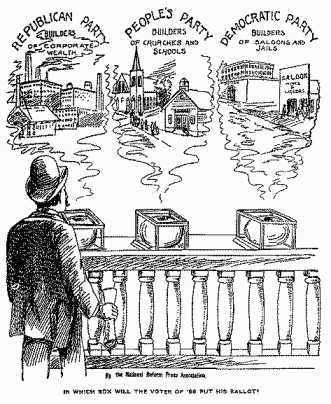
Kingfisher Reformer (Oklahoma), November 29, 1894

Kingfisher Reformer (Oklahoma), November 29, 1894

But the revolt collapsed, for a myriad of reasons: It failed in its efforts to build alliances with industrial labor unions and with black farmers in the South. And it was deprived of its driving force when economic conditions improved. Some rebellious farmers went home to the Republican Party; others splintered off into generally futile local movements. Certain populist ideas were gradually worked into the overall economy-—railroad regulation, some banking reform, direct election of senators, postal savings banks, initiatives and referendums, and an expanded concept of currency.

But in fact, the movement’s co-optation into the mainstream politics of the Progressive Era was what cemented its demise. Goodwyn sees these reforms as “skin-deep parodies of the original ideals.” As he puts it, what happened was “a consolidation of our current political culture, framed by the narrow aspirations of ‘reform,’—-falling within the labels of ‘progressive’ or `liberal.’ No one would ever again challenge the basic structures of the political economy.” As for the farmers, “the noose tightened, with smallholders being swallowed by big enterprises.” It marked the beginning of the movement toward agribusiness, as well as an affirmation of the power of the industrialists, the insurance companies, and above all the banks. The public would push back at that power structure in bad financial times such as the Great Depression, but would never again pose it any serious threat.

What’s going on today bears little resemblance to the great surge of political organizing that began in and spread through the South and West in the 1890s. To begin with, it isn’t now, nor is it likely to become, part of any larger mass movement. It’s directed at the worst excesses of the system, not at the system itself. And it doesn’t offer an alternative vision, beyond a few more progressive “reforms.” (Contrary to what Rush Limbaugh and Newsweek may say, we are definitely not all socialists now.)

Some reforms are being earnestly pursued by the Obama Administration and some members of Congress. But it is clear that they have no intention of taking the change any deeper. And even some of the less tepid reforms may fail. As Robert Reich wrote on his blog last week:

When the public isn't looking, Congress reverts to its old ways. The Obama-supported plan to allow distressed homeowners to renegotiate their mortgages under the protection of bankruptcy has run into a Wall Street wall....Obama's plan to limit itemized deductions for the richest 1.2 percent of taxpayers (including the top 1.9 percent of small business owners) to 28 percent, starting in 2011, is also in trouble on the Hill. Wealthy contributors and friends of congressional leaders involved in setting tax policy have balked. So Congress is telling the White House to look elsewhere for the $320 billion it needs over ten years to finance half of the tab for health care reform. Congressional leaders have also informed the White House that they don't have the votes to pass Obama's proposal for treating the earnings of hedge-fund and private-equity managers as income rather than capital gains.

Angry populism thrives on stories about the rich and privileged who use their influence to get cushy deals for themselves at the expense of the rest of us....It's too bad the same populist outrage doesn't extend to issues involving far more money, affecting many more people, and entailing far more insidious abuses of power.

Even if its worst abuses are reined in, the system will survive largely intact and the society it dominates will remain wildly unequal---a far cry from the dreams of those farmers who gathered in barns and grange halls when the nation was much younger than it is today.
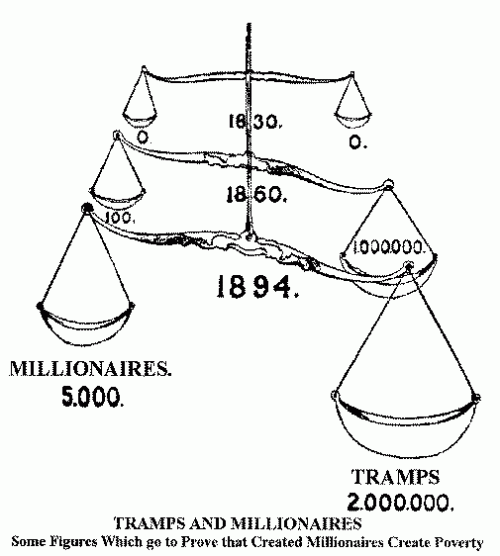
Anthony Weekly Bulletin (Kansa), May 4, 1894. Cartoons from web site on Populism created by Worth Robert Miller, Department of History, Missouri State University

Anthony Weekly Bulletin (Kansas), May 4, 1894. Cartoons from web site on Populism created by Worth Robert Miller, Department of History, Missouri State University.

Get Mother Jones by Email - Free. Like what you're reading? Get the best of MoJo three times a week.
Comments
no profile pic for comment author

The two overbearing topics

The two overbearing topics in this article are, the lack of proper citation of sources to verify or deny a populist movement. And the other is the comparison to something that happened over 100 years ago.

Basically I agree that it isnt anything like 1890 because the circumstances are different, we got exactly what the populist movement of that time wanted, a fiat currency that allowed for the infinite expansion of credit which is one of the factors that caused this depression we are in. Also if you are trying to relate the organizational factors and not seeing it, that is because you are looking in the wrong place. Obama is the Populist movement. The man who supports the people and not the elite (redistribution of wealth, etc). So just because a third party isnt significantly present doesnt mean a populist movement hasnt begun or is there.

However, my problem with this article says is that just because of lack or proper citation and not a very large observable third party populist candidate that the populist movement doesnt exist. Which isnt true. Obama is the populist movement, plain and simple. It tends to be better to see if the situation fits the definition of a word than looking at past occurrences to see if the current situation fits into the pasts situation.

The problem that is now faced by the current populist movement is that, is there enough people who have been voted to congress, or currently in congress, that march in step with Obama? Not sure, we will have to wait and see.

Just as a side note: "It’s directed at the worst excesses of the system, not at the system itself. And it doesn’t offer an alternative vision, beyond a few more progressive “reforms.”" I agree with this mostly in the fact that they are just vote pandering in the sense that when congress elections come around they will wave these little things they did when it comes election time. But it is also a sign of making sure Obama can get things passed. If he pulls out some ridiculous liberal thing he will alienate himself and is plans. Doing that is the absolute worst thing to do politically. He hasnt even been in for a year yet. Wait about 2-3 more years and we will see if your opinion still holds true. If you want big handed movements and fast action, I think you are living in the wrong political system.

Interesting read none the less.

no profile pic for comment author

Please, Obama is no better

Please, Obama is no better than the rest of the politicos. If you want true reform let's get someone like Ron Paul in office. Ron's plans to get back to running this country with the Constitution as our guide is brilliant.
The government is currently over-involved in the daily lives of it's citizens. I won't dispute that regulations are needed for banking, and that the greed of those at the top of these institutions needs to be controlled. I am at odds with Obama's continued plan to mortgage the country to save it. This puts the whole country in the same boat as the mortgage industry, and this is just plain reckless!

no profile pic for comment author

I agree with the commenter

I agree with the commenter above, that Ron Paul's ideas are actual populist reform. Most of Paul's ideas are against mega-corporations, so in effect it's carrying on where the previous populist movement left off.

CrakeWasRight

Rep. Paul

Ron Paul's laissez faire approach would likely result in business running rampant over the consumer and the worker.

no profile pic for comment author

Not Ron Paul, but Ralph

Not Ron Paul, but Ralph Nader.

no profile pic for comment author

Obama is hardly populist

With regard to Obama, he talks a good talk but the actual policies he is implementing leave a great deal to be desired and fall seriously short of campaign promises to a fault. I would love to see a Kucinich/Paul ticket, but don't think it likely. When it comes to Laissez Faire economics, if the world economy were a boat it would be like unfurling the sails, removing the rudder, and hoping for the best - there will be lots of variability, chances for high profits, but the most likely outcome is a devastating crash.

no profile pic for comment author

Branches of government

Even if a 'true populist' president were elected into office, people seem to forget that Congress in essence controls all legislation. Until the populace as a whole starts caring about their elected officials and voting with a conscience, special interests will continue to control Congress; and thus, the legislation.

rimchamp77

Ron versus Ralph

There isn't a whole lot of difference between Ron Paul and Ralph Nader - if you consider all corporations as being wholly creatures of big government. If you see government regulation as a tackle clearing the way for corporations to subdue independent businesses you will see Ralph Nader a font of meaningful reform that circumvents the inherently corrupt regulatory process. We don't need government watchdogs [an oxymoron]. We need citizen watchdogs. We need a corporate death penalty for corporations that don't serve community interests. We give them limited liability so they can improve our economic well being. They failed today and they have always failed.
We won't need no stinking welfare if we had real free markets that actually competed for good labor and access to natural God given resources. Jesus had a tizzy fit when money changers corrupted God's temple. If our environment isn't a temple of God, I don't know what is? When someone uses money as leverage to steal God's resources from God's people, religious people should emulate Jesus and grab those whips and drive them out!

May God's will be done on earth and let it begin - and end - with myself. If it happens any other way it's not God's will.

no profile pic for comment author

Populism

When I read an acticle of this nature I have to scratch my head in total baffelment since given the course of the last 8 years and now at the birth of the truly populist Obama slogan ”change” that American rage has nothing to do with ”populism”. Populism is something along the lines of ”Reaganism”. I have no idea what ”Reaganism” means since I never read anything written by Ronald Reagan that could in anyway lay claim to something even remotely resembling an ”ism”. When it comes to the pen it is obvious that Reagan certainly was no Lennin, or no Churchill or even a Fidel Castro though he did leave us his dairy. Shall we say that this diary is the great doctrine of ”Reaganism” or should we conclude that Reaganism is a populist term used to invoke some vague notion of political ideology (hence the cludy mysticism that often surrounds the concept of populism itself) whose foundation builds from the rhetoric of ”anything done by the government is less effective than anything done by private business.” This ”mythodogy” of private efficiency has just been dealt a death blow for the second time in less than a century and yet the power of this provably false populism still clings to the seat of American Power—in spite of the fact that is has been private efficiency running amuck that has created the second world wide depression in less than a century.
Our present situation demands that the American people avail themselves of the 2nd Amendment to the constitution and together with this right to bear arms forms a nation wide militia and armed with this and the declaration of independence marches on Washington with a list of demands of their own—especially the notion that the people are going to speak!
When something so thoroughly corrupt as the housing scam, the creation of toilet paper assets which are going to be purchased on false grounds with American tax payers money since these assets cannot be purchased for the simple reason that they are all illegal—they fraudulant since they were given AAA credit ratings when the creator of the asset knew that the debt involved was incured by indiviudals who were not capable of repaying the debt. To buy these assets is to make legitimate the felony of fraud. It simply cannot be done without at the same time admitting we live in a 100% Banana Republic.
When I look at Geithner I see Chiquita written all over his face (that vision of mine I would call ”populist” but the state of our union and the rage that is felt is not populist but rather it is the very spirit from which revolutions are forged.

no profile pic for comment author

this site is the best place

this site is the best place to comparison shop for
Cheap Gucci Handbag
Gucci Handbag , Gucci Handbag and Gucci Handbags,we have many of Gucci
including bag
Gucci Classics handbag
Gucci Cruise handbag
Gucci Fall Winter handbag
Gucci’s designs are recognizable because of certain signature trademarks. Two of these trademarks are the double G logo and the red striped webbing that appears on many of the pieces. Another trademark of the label, the Gucci horsebit can be found on anything from shoes to watches and bags. As a symbol for the label, the horsebit refers back to the company’s early beginnings.
Gucci Bags
Gucci Wallet

no profile pic for comment author

The savings rate of the

The savings rate of the Americans has risen markedly as a result of this economic chaos, showing that people are taking back control of their finances, focusing on their needs (not wants), and getting a little less dependent on bank credit. I would consider this a type of movement - hopefully it can be sustained indefinitely.

Post a comment
Alternately, you may login to or register an account
The content of this field is kept private and will not be shown publicly.
  • Web page addresses and e-mail addresses turn into links automatically.
  • Allowed HTML tags: <a> <ul> <ol> <li> <blockquote> <img>
  • Lines and paragraphs break automatically.

More information about formatting options


Jail.org - Inmate Search
Criminal records, instant public records & people search & current court records. www.jail.org

U.S. Public Records Search
Search County & State Court Records, Criminal records, Vital and Adoption Records www.PublicRecordsInfo.com

Records.com - People Search
Public Records and Background Checks. Instantly Search Criminal Records, Addresses and Court Records www.Records.com

Court Records & County Records
Find Instant Public Records, Criminal Records as Well as County Property Records Search. www.PublicRecordsIndex.com

Mother Jones Podcast
Get in on the conversation! We talk about culture, politics, the environment, the economy and more. Listen now!

TalkBackTees.com
A treasure trove of liberal wit, wisdom and quotations, from ancient to modern, on colorful, cotton tees.

Support Independent Artists
Amazing art, crafts, apparel, paper-goods and more. A carefully curated selection of sundries since 1999.

FREE CONNECTIONS FOR GREEN SINGLES
Meet progressive singles in the environmental, vegetarian & animal rights community who share your values