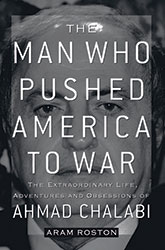
 Emmy award-winning investigative journalist Aram Roston, a producer with the NBC Nightly News, has just published a biography of long time Iraqi exile leader Ahmad Chalabi, The Man Who Pushed America to War: The Extraordinary Adventures, Life and Obsessions of Ahmad Chalabi, reviewed by Bruce Falconer in the current issue of Mother Jones. I asked Roston about allegations that Chalabi had such a close relationship with elements of the Iranian security services, that the FBI reportedly investigated him for passing highly classified U.S. intelligence to Iranian intelligence.
Roston’s conclusion: “In the end, I came away thinking that the key question, from a U.S. perspective, was not whether or not Chalabi was an Iranian agent, but whether he was more useful to Iran’s intelligence services and government, or to America’s intelligence services and government,” Roston told me. “Here I think it was indisputable that he was far more useful to Iran.” Go read the rest.
Mother Jones: What is the conclusion you drew about Chalabi’s relationship with Iran?
Roston: Actually, I really didn’t find evidence that Chalabi was or is an “Iranian agent,” as some have speculated. In other words, I found no evidence that he was controlled or directed by Iranian intelligence. I also did not come across evidence that Chalabi was paid by Iran, or that he received funding from them. (Some Iraqis close to him claim he is but I really didn’t find hard corroboration.) Maybe Iran preferred funding other groups, or maybe he preferred simply getting his money from the Americans.
Some former intelligence officers who know him well believe that he was in part an “agent of influence” for Iran, rather than a controlled agent. And a lot of Iraqis who know him well say that he has bolstered his ties to Iran’s government to give him more leverage in his work in Iraq.
What is true is that he had a quite strong relationship with Iran and its security services that goes back a long way. The Iranian revolution in 1979 was a very important event for many Shiites in the region and for him. I quoted one friend of his in the book saying “For Chalabi, Iran is the place where power and Shiism have come together in the form of the Islamic revolution. He is very loyal to Iran.”
And of course during the Iran-Iraq war, Chalabi, who was an exile banker opposed to Saddam Hussein, rooted quite vocally, for Iran instead of for his own country.
During the early 1990s, when everyone knew he was getting funding from the American CIA, Iran continued to work with him. They allowed him to pass in and out of the country. And there isn’t any doubt that over the years he did meet and have contacts with both MOIS and the Revolutionary Guards on a long term basis.
One of the things I say in the book is that Chalabi met several years before before the war and also after the invasion with an Iranian Revolutionary Guards General named Ahmed Frouzanda. (The U.S. Government calls the General “Ahmed Foruzandeh”– a different spelling.) Just this January, the U.S. government “designated” the general, accusing him of sponsoring terrorism in Iraq. “Iran-based Ahmed Foruzandeh, a Brigadier General in the IRGC-QF, leads terrorist operations against Coalition Forces and Iraqi Security Forces, and directs assassinations of Iraqi figures.”
U.S. and Middle Eastern intelligence sources say Frouzanda is a key figure and one of the most effective leaders of the Revolutionary Guards Qods Forces. I thought it was interesting that Chalabi apparently met with him in early 2004 — and according to one very good source it was a secret meeting — was that at that point Chalabi’s Iraqi National Congress was still getting funding from the US Department of Defense at the time.
In the end I came away thinking the key question, from a U.S. perspective, was not whether or not Chalabi was an Iranian agent, but whether he was more useful to Iran’s intelligence services and government, or to America’s intelligence services and government. Here I think it was indisputable that he was far more useful to Iran.
There is no indications he really shared anything with American intelligence officials about Iran. He did not provide information about Tehran’s intentions, capabilities or personnel, as far as I could tell, to American intelligence.
There’s one other important thing: Iran is key for him geographically. Without Iran he could barely get in and out of Iraq. He’s convicted in Jordan, and so he’s got to be careful where he travels. He doesn’t want to travel somewhere he could be arrested. So his public travel has really taken him mainly to Iraq, Iran, the U.K. and the U.S.. He has to keep a good relationship with Iran, or his world will get even smaller.
MJ: And did you ever figure out if any of his (anti-Tehran) supporters in Washington fully understood that relationship? What is their relationship with Chalabi’s relationship with Iran?
Roston: That’s the key: how could his neoconservative supporters, all of whom condemn the leadership in Tehran, countenance Chalabi’s close ties to that leadership? And even more: how could they countenance his ties to Iran’s Revolutionary Guards, which spearhead Iran’s aggressive efforts worldwide?
Chalabi’s Washington D.C. supporters resolve this contradiction in a few ways:
1) Chalabi HAD to deal with Iran, they shrug.
2) They believe he outwitted the Iranians, managing to negotiate with its government, intelligence services and the rest, all without doing anything that could impact America, or Iraq itself, in a negative way. Richard Perle expressed it best, way back in a NY Times interview, when he told the Times: “I think Chalabi has been very shrewd in getting the things he has needed over the years out of the Iranians without giving anything anything in return.”
Finally, there is a very strange phenomenon: some of these supporters and friends in Washington seem unable to absorb the idea that Chalabi could, or would, ever do anything wrong. They are incredibly loyal to him. I really tried to work through it with them and I think it may be possible that their personal attachment to him, and loyalty, just lets them overlook his ties to Iran.
Falconer’s book review echoes the observation about what the Chalabi phenomenon says about Washington. “More than just a biography of a chameleon, Roston’s book is a fascinating, if dispiriting, look at the mechanics of power in Washington,” Falconer writes. “Time and again, Chalabi, ‘an extraordinary dining companion,’ wins the loyalties of key political players by sheer force of personality.” Chalabi continually wins Washington loyalties too, as Roston notes, by his undeniable competence.
You can also listen to Roston’s Monday interview with NPR’s “Fresh Air with Terry Gross.”