Sarah Stanton, a Pahyways social worker, helps clients spend $1,200 that the program proveds as move-in money.Erika Larson/Redux
When Andre hears something that strikes him as crazy, he’ll lean in, almost uncomfortably close, cock his head to the side, and fix his one good eye on you, bugging it a bit for dramatic effect. Sarah Stanton is getting one of these looks right now, as she and Andre sit side by side on a low brick wall, outside one of Washington, D.C.’s busy soup kitchens. Stanton has just finished telling him that her Pathways program, brand new to the city, offers apartments to homeless people—right away and with virtually no conditions. After a long silence, Andre grins. “Can you get me a mansion?”
Stanton laughs. “Oh, today!”
Andre leans back and laughs louder. “Only the best!” he says. “All chrome furniture!”
Stanton is still smiling, but as she pulls a stack of paperwork out of her messenger bag, Andre realizes her offer is real. He turns serious and stares out at the street. He has no job and no income—he lost his veteran’s benefits a while ago and isn’t sure how to get them back. He doesn’t really remember the last time he lived indoors, unless you count jail.
Stanton asks if he would like to visit her office. He’ll need to see a doctor. “A psychiatrist?” Andre asks. She nods; Pathways wants to determine whether Andre has a mental illness serious enough that, left on his own, he would be unlikely to find and keep a home or a regular job. He seems wary. But when she returns to the soup kitchen a week later, he is waiting for her, his possessions packed tight into a small duffel. “So, do I need to act crazy?” he asks, screwing up his face. “It makes you this way, you know?”
“What does?” she asks.
“Living in the street,” he says. “It makes you crazy.”
Mental illness can make it hard to hold down a job, stick to a budget, and stay in the good graces of a landlord. But homelessness can be part of the cause of psychiatric problems as well as an effect: A life without privacy or shelter can turn even a manageable mental illness into full-blown madness. It is that vicious circle of illness and homelessness that drives the work of Pathways to Housing—Stanton’s employer and, at the moment, perhaps the most radical program for the homeless anywhere in the country.
For years, homeless people had only two options: sleep outside or hope for a space in a shelter. During the 1990s, so-called “permanent supportive housing” introduced a third option: a permanent, private room or apartment in a nonprofit building with psychiatrists, social workers, and nurses on site. Trouble was, these programs tended to be difficult to get into, particularly for the long- term homeless who are often mentally (and physically) ill, addicted to drugs, fearful of shelters, and distrustful of social workers. Supportive housing programs usually involve a long list of preconditions, such as six months or a year in a “transitional” group home, mandatory counseling and medications, a record of responsible behavior, and sobriety.
Pathways, by contrast, sweeps homeless clients into an apartment within two weeks. And it never threatens to take that home away. Although Pathways offers clients medical and psychiatric services, as well as substance-abuse and job counseling, it doesn’t require anyone to use them; the group maintains that housing is therapeutic in itself. It should come first, and fast, as the foundation for ongoing treatment. “You’re curing the housing problem first,” Pathways founder Sam Tsemberis explains. “You cure the person later.”
This idea can be jarring to anyone who expects work to come first and reward to follow. But the chronically homeless are seldom able to make that leap. Faced with a bunch of strict conditions for housing, and lots of ways to get kicked out, many assume they will fail, so they reject help. And the costs of these refusals are steep. On any given night, this group occupies half of the nation’s emergency shelter beds, even though they make up only about 10 percent of the homeless population. By living, and often dying, on the street they also run up enormous bills for federal and local law enforcement agencies, social service providers, prisons, and hospitals. In 1997, the University of California at San Diego Hospital followed 15 chronically homeless residents for 18 months and tallied 417 emergency room visits between them, at a cost of more than $1 million.
Pathways relies on this fundamental calculation—that reversing the order of services to put housing first produces much better results with no greater costs. Launched in New York City with a handful of employees in 1992, the program has grown to 85 caseworkers, psychiatrists, and nurses, plus 35 mostly part-time positions held by its clients, and has moved hundreds of mentally ill and homeless New Yorkers into apartments. Today Pathways works with nearly 500 clients—a small number compared to New York’s nearly 40,000 homeless, but considerable for a young organization.
This unorthodox success has made the program a target of criticism from others in the field. A common view is that the chronically mentally ill and homeless aren’t “ready” for housing. “The hell I took from my colleagues!” says Alexa Whoriskey, the program’s New York director of psychiatry, who came to Pathways through a fellowship at Columbia University. “In the beginning, they laid into me for what poor care this was.” Whoriskey’s colleagues thought Pathways clients needed hospital beds and constant supervision. Instead, the organization was taking highly unstable people, giving them the keys to an apartment, and leaving them there alone.
Improbably, Pathways has been a favorite of the Bush administration, which has chosen to focus its homelessness efforts on long-term cases and shift aid from shelters to permanent housing. But if the program is so profligate that even some liberals object, why in the world would conservatives be gung-ho about it? Bush homelessness czar Philip Mangano, a crusading Bostonian respected by liberals and conservatives alike, admits Pathways is “a tough political sell.” But, he notes, it is also research-driven, cost-conscious, and accountable—and those are traits that appeal to anyone.
During the 1990s, when the Clinton administration tripled spending on the homeless to about $1 billion a year, most of the new money went to the “continuum of care,” a funding initiative based on the idea that although shelters alone would not make homelessness go away, “wraparound services”—from rehab programs to job training—might. Despite the surge in funding, the number of homeless people nationwide continued to grow. Even in the booming ’90s, according to the Urban Institute, 2.3 million people were homeless at some point in the course of a year. Today, according to the U.S. Department of Health and Human Services, roughly 600,000 people are homeless on any given day, and New York City is facing the largest numbers of homeless people it has seen since 1990.
Pathways has demonstrated that it can shrink those numbers. Between the years 1993 and 1997, research showed that 88 percent of Pathways clients, all of them extreme cases, remained in housing, compared to just 47 percent who went through New York City’s treatment system. Another study, funded by the Substance Abuse and Mental Health Services Administration, randomly assigned 225 mentally ill New Yorkers to either Pathways or a traditional program. After 12 months, Pathways clients were homeless 3 percent of the time, compared with 28 percent for those in the city’s system.
And the approach costs no more (in fact, probably less) than conventional programs. In a five-year study, Dennis Culhane, a professor at the University of Pennsylvania, showed that New York City could give each of its mentally ill homeless residents their own apartment or room plus access to support services for roughly the same amount the city was already spending on ER care, prison time, shelters, and other services. Culhane found that someone mentally ill and on the streets costs government about $40,500 each year. (Homelessness czar Mangano believes Culhane’s accounting is too conservative, because it leaves out the costs of police and court time, care at private hospitals, soup kitchens and other street outreach.) Pathways, on the other hand, spends only about $22,000 a year on each of its clients, and a good portion of that is money already allotted to them through government benefits programs.
Pathways’ newfound national prominence, however, has yet to completely erase doubts that it gives away too much, too fast—or, at the very least, that its success is unique to New York. Which is why founder Tsemberis has set out to prove his program can work elsewhere. By the middle of 2005, Stanton and the rest of Pathways’ Washington team plan to move 75 mentally ill homeless into apartments around the city. So far, they’ve offered apartments to Bob, a fragile, elderly man who has slept in the same grassy stretch along Wisconsin Avenue for most of the last 30 years; to Muriel, a strikingly childlike Lebanese immigrant who lost custody of her kids, and then her home, when the onset of mental illness alienated her husband and her mother; to Michael, who is battling delusions, rage, and HIV; to Dolores, an elderly African American woman who has struggled with drugs. And today, to Andre.
When Andre reaches the Pathways minivan, he opens the door and stops. “Are these for mentally ill people?” he asks, pointing at the seat belts. “Like, restraints?”
Stanton shakes her head. “No, Andre,” she says. “You can get out whenever you want.”
It took about three weeks to win Muriel over to the idea of moving indoors. Mostly, the whole thing just seemed unreal to her. Once she signed up, though, everything happened in a rush. She loved the first apartment she saw, a one-bedroom with light lavender carpeting and a brand-new kitchen with gleaming white tile. She wanted to move in that afternoon. But there were errands to take care of first. Like a shopping trip to Target, out in the suburbs.
As the wide glass doors whoosh open, Muriel draws a few stares. She has on a metallic gold jacket, a bra, and jeans, with two silver-studded black leather belts slung low around her hips. Her prematurely gray hair is cropped short and topped by a pair of metallic blue wraparound sunglasses, the UV-protection sticker still covering one lens.
The scene that ensues is like something out of a social conservative’s welfare nightmare. Stanton steers Muriel toward the cheaper sheets and blankets, but talks only about colors, advising her like a girlfriend. Muriel has a thing for purple, so purple it is—purple sheets, purple towels, purple dish soap. “Do you want two pillows or four?” Stanton asks. “Four!” Muriel says. Four it is, each one thick and squishy. New dishes and glasses in Mardi Gras colors, new pots and pans, a television, a microwave, ice cube trays: Housewares pile precariously high in two shopping carts.
The financial model that makes all this possible is ingeniously simple. Raise what you can from foundations and government grants (in Washington, D.C., a $750,000 start-up grant from the Department of Mental Health). Then draw the rest from the federal and state benefits the disabled and the desperately poor are eligible to claim but don’t—because they can’t navigate the system, for instance, don’t have an ID or mailing address, or don’t know the benefits exist. Andre is entitled to more than $1,500 a month in veterans’ benefits, disability benefits, Section 8 rent assistance, food stamps, transportation and local telephone discounts, and a range of handouts from the city’s informal network of churches and nonprofits. All he is collecting when Stanton meets him is an occasional free breakfast. When homeless clients accept Pathways’ offer of an apartment, the program collects their benefits and puts them in a bank account. Each month, rent money is withdrawn, while other spending, on food or clothes or cable TV, is left to the client’s discretion. Pathways staffers offer ample, friendly budgeting advice.
Pathways also fills in a number of gaps, like providing $1,200 to set up house. That’s what has made Muriel’s shopping spree at Target possible. It’s what will pay for the pillows and a fish-shaped toothbrush holder—though eventually Stanton steers Muriel away from a beach towel and a Nickelodeon kiddie cup with a big plastic Dora the Explorer figure perched on the lid. She also vetoes a car. “I think you’ll have to wait on that,” Stanton says with a laugh. “Today is just the essentials, to get you started.”
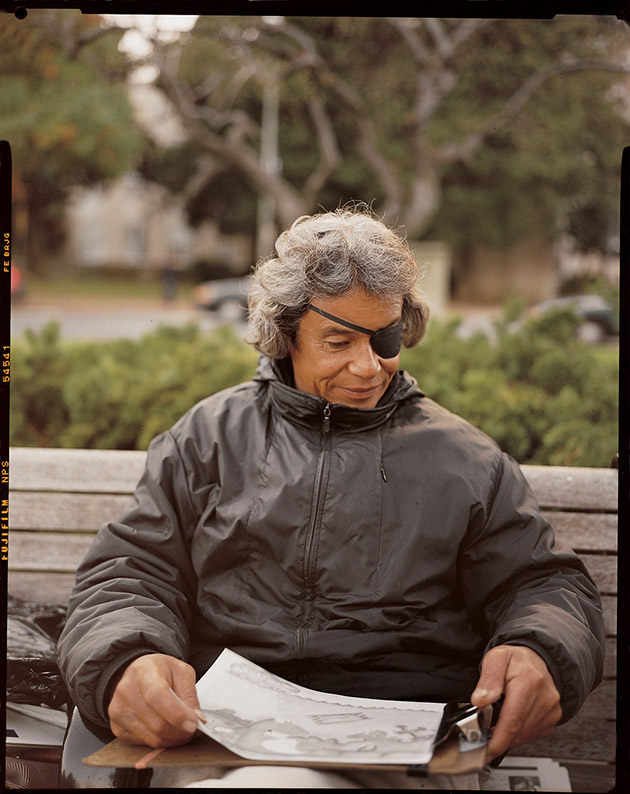
Andre has wild gray hair, like a pompadour undone by a fierce wind, and a black patch over one eye (the result of an accident he refuses to talk about). He and Stanton are huddled over a map. “One of the apartments is here,” she says, pointing to a stretch of Georgia Avenue near the Maryland state line. “Another one is over here, near Catholic University. We’ll take a look at a couple today, see if you like them,” she says. “If you don’t, we’ll keep looking.”
“This means they’re going to put me in an apartment?” he asks me quietly, when Stanton walks ahead to the car. Even now, after an appointment with Pathways’ psychiatrist and several meetings with Stanton to plan for a move, Andre is skeptical. “I’ve talked to other programs,” he says. “They’ve said there’s a waiting list, you have to wait a year, a year and a half, and do all these things.”
Normally an incessant talker, Andre is quiet as we drive to the first apartment. Stanton pulls to the curb in a pretty, leafy neighborhood. “This is the suburbs!” he says approvingly. It is not the suburbs, but it is a good deal more peaceful than the traffic circle where Andre usually sleeps.
The building manager, Kenya Brown, welcomes Andre and Stanton warmly. She leads them up to an airy, one-bedroom apartment on the second floor, with big windows overlooking a school yard and a small park. The rent is $850 a month—for Andre, with Section 8 help, it will cost a third of his $989 veteran’s benefit. Brown doesn’t know that Andre suffers from severe mental illness—that, for instance, before he was last arrested, got out, and met Stanton, he wandered around Rock Creek Park with a big Japanese sword. All she knows is that he is extremely poor. But even when landlords know that a Pathways client is mentally ill and homeless, they are far less resistant than they would be if the same person walked in on their own. Pathways guarantees the rent, a bigger issue for many landlords than a resident who might act erratically. The owners’ most common fear is utterly mundane: that tenants will stay home all day and run up high utility bills.
Sometimes landlords do kick Pathways clients out, but Tsemberis considers that a normal part of their recovery from homelessness. Once, at a conference, somebody challenged him: “How many apartments do you give people if they lose them? How are they going to learn?” He was standing with one of his first clients, a guy named Jerome. “I said, ‘Jerome, how many apartments do you think a person deserves?’ He said, ‘I don’t know, but it took me three before I got my act together.'”
Stanton has another apartment lined up for Andre to see, but he is done looking. He wants to move in. “If you’re not sure, we can find some other places for you to look at,” she offers. He is sure.
Andre appears to survive on less than a panhandler’s cup of change; Muriel gets an array of benefits, but always seems desperately broke. Andre is a tough guy, fiercely protective of his independence; Muriel is lonely and needy. But they both share a desire to get off the streets, out of dangerous, depressing shelters, and into a home. Pathways delivers immediately; later, when staffers help with budgeting or encourage them to get counseling, Andre and Muriel will have reason to trust them. Outreach workers will stop by twice a month at a minimum. Ostensibly, they come by to chat—living indoors can be lonely at first—or to help out with errands. But subtly, they help clients wrestle with the issues in their lives and in their heads, keep an eye on their health and hygiene, and encourage them to take their psychiatric meds. They also teach living skills, like how to cook. “Fried rice? You can make fried rice?” Andre exclaims, when Stanton suggests that he could buy a wok for his new apartment. For now, he gets his favorite dish only on the nights when he finds takeout boxes in the trash.
It may be a while until Andre has his own kitchen, though. A few days before he’s set to move into his apartment, Stanton takes him to the Veterans Affairs office, to help restore his benefits. (Andre enlisted in the Marines at 17 and served a tour in Vietnam.) There he meets James Street, an outreach coordinator for homeless veterans.
After filling out some paperwork, Street tells Andre his first check should arrive in the mail soon. But there is more. Street wants Andre to participate in an all-day counseling and activity program for homeless veterans. “I want to see you in that program every day,” he says. “It will give you something to do, and keep you out of trouble.” Andre withdraws. He says he needs to keep his days free, to work on his sketches and his martial arts, but Street is insistent. When it is time to leave, Andre looks distant and a bit sullen. Although Street cannot enforce his attendance, Andre is convinced he’ll have to give up his freedom. The next day, he drops out of Pathways.
“Not for good,” Tsemberis stresses. An offer of housing is just the first step in winning over the hardest cases, who tend to distrust those trying to help.
Muriel, for her part, moves right in. She piles her pillows high on her new bed, fluffs the comforter, and positions her cheery toothbrush holder thoughtfully on the bathroom counter. But when her next benefits check arrives, she immediately spends money she needs for food on three pairs of shoes and two brightly colored purses, before Stanton has a chance to help her plan a budget. She has trouble thinking an hour ahead, much less keeping the end of the month in mind. What she wants more than anything else is to reunite with the children she lost when her husband left, but that still seems like a fantasy.
Five months later, Muriel’s progress is striking. Once deathly afraid of public transportation, she now gets around on the bus and metro by herself with her disability discount pass. “She’s on medication, and doing counseling,” Stanton adds. “She keeps her apartment immaculate.” She’s also learning to manage her money. At first, she asked Pathways to issue her benefits payment as a weekly allowance; now, she’s getting her benefits twice a month and talking about looking for a job—a long shot, Stanton says, given her limitations, but something she wouldn’t have aspired to before.
Meanwhile, Pathways client Dolores is taking her medications, and stops by the office frequently to visit. Michael, who joined Pathways around the same time as Dolores, is going through a rougher adjustment. He has done some damage to his apartment and remains very suspicious of anyone who tries to help him, including Pathways staff. “It’s going to be a long journey with him,” Stanton says. By early November, Pathways’ Washington branch has placed 22 homeless people in D.C. apartments and is increasing that number at a rate of two a week. None are back on the street.
Half a year passes, and nobody has seen Andre. Then, finally, on a warm fall evening, Stanton spots him in the traffic circle where he used to sleep. They talk, and soon Andre is weighing a move indoors once again.
With the country’s worst homelessness rate (about 3 percent of the city’s residents, according to the Community Partnership for the Prevention of Homelessness), Washington, D.C., seems overdue for a new approach—and city officials believe Pathways is onto something. Already, they’ve asked Tsemberis to move 375 more of the city’s homeless residents into apartments within the next five years, if they can line up the funding. “Pathways is doing the best work in the country for people who are chronically homeless,” says Martha Knisley, director of Washington’s Department of Mental Health.
Tsemberis figures Pathways will stick to New York and Washington for a while. But with homelessness czar Mangano’s support, he is advising a half-dozen different cities, from Hartford to Fort Lauderdale, that intend to launch similar programs. “In a perfect homeless services world, I think we’d do away with ‘transitional’ services altogether,” Tsemberis says. “There’s no need for them.” Homeless people have all lived in homes at one point, he says; they don’t need years of training to do it again.