It’s estimated that one quarter of the world’s untapped oil and gas reserves lie in the Arctic. And while politicians bicker loud and long over Iraqi oil, and oil executives lay plans for bringing natural gas and oil from West Africa, most know that the Arctic is the real prize in the ongoing international struggle to control dwindling energy resources. That’s especially true now, as global warming causes Arctic ice to melt, exposing virgin territory and even, perhaps, opening for shipping the fabled
Northwest Passage, which connects the Atlantic and Pacific oceans.
The region has become the center of an international skirmish, with Russian interests going so far as to plant an underwater flag in order to at least symbolically claim reserves presumed to exist beneath the North Pole’s Lomonosov Ridge (which, they say, is connected to Russian territory by a submerged shelf). Even the U.S. government, which for decades has resisted signing an international treaty called the U.N. Convention on the Law of the Sea—which establishes rules for national sovereignty over portions of the earth’s oceans and seas, along with the resources beneath them—suddenly supports ratifying the treaty. The Senate’s Foreign Relations Committee began hearings in late September to get the process rolling.
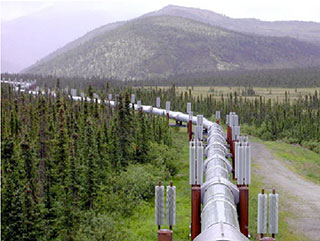
Oil executives have discussed the “Arctic play” for well over 30 years. But so far, U.S. exploitation of the area’s petroleum resources has been limited largely to the rigs in Prudhoe Bay off the Beaufort Sea on Alaska’s north coast, which pump oil into the Alyeska pipeline that runs south through the state to the port of Valdez, where it is loaded onto tankers. Now, the industry is seeking to move forward on a number of grand schemes to fully exploit what the former president of Shell Oil called the “stranded” reserves of the Arctic region—such as Shell’s planned drilling in the Beaufort Sea off the coast of the Arctic National Wildlife Refuge, which has been delayed by a court challenge by Native Alaskan and environmental groups.
Making profitable use of these abundant fossil fuels depends not only on drilling rights, but on creating a mode of transportation—a way to bring the oil and gas south to energy-hungry consumers. And here, the path to the industry’s goals both short-term and long runs through one thousand miles of pristine Canadian wilderness, following the course of the mighty Mackenzie River. Now, decades-old plans are again moving forward to build a pipeline through the Mackenzie River Valley that would carry natural gas directly to southern Canada and the lower forty-eight. If current proposals succeed, they will lay the groundwork for what will become North America’s greatest ever industrial development plan—bigger than the Colorado dams or the Tennessee Valley Authority. They also will disrupt the native cultures of a vast, virtually untouched region and wreak widespread destruction on one of the last best places on earth. “This is the environmental frontier,” Kert Davies of Greenpeace told Mother Jones. “It will be a giant fight over the next 20 years.”
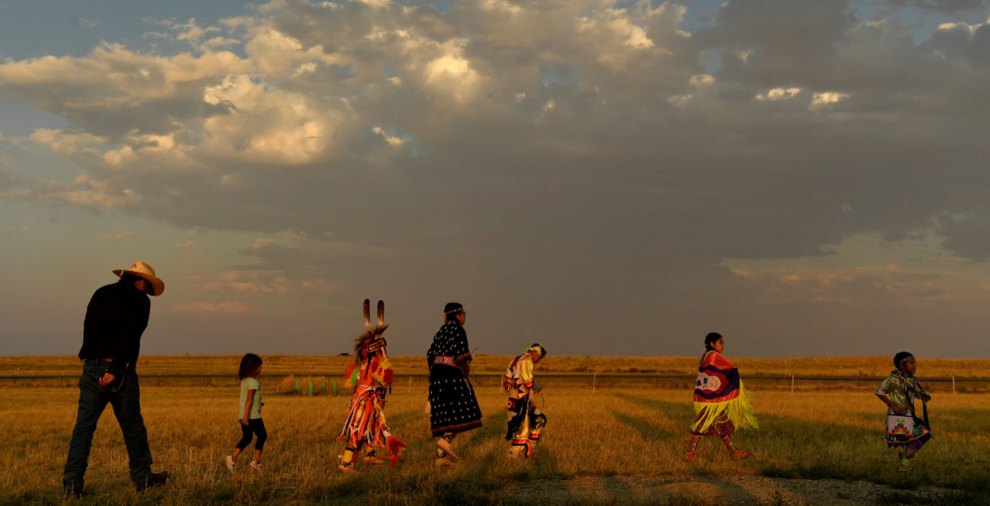
The Mackenzie River begins in the Canadian Rockies, gathers force as it pours into one lake after another, and grows into a powerful river before emptying through a wide delta into the Beaufort Sea, and from there into the Arctic Ocean itself. The longest river in North America after the Mississippi, its watershed covers hundreds of thousands of miles and encompasses one-fifth of Canada. For the most part, it is still undeveloped wilderness, containing lakes, wetlands, smaller rivers, and the largest intact forest remaining on the planet; it is free of roads, buildings, electricity, and cell phone coverage. Canada’s Northwest Territories, through which the river runs, is home to moose, caribou, wolves, bear, and thousands upon thousands of birds that travel this flyway. The entire human population numbers only about 40,000. Most of these are First Nations people—primarily the Dene and Metis, Inuit and Inuvialuit—whose livelihood and identity are inseparable from the river the Dene call Deh Cho, variously translated as “big river” or “much moving water.” “Our homeland is comprised of the ancestral territories and waters of the Dehcho Dene,” says their “declaration of rights.” “We were put here by the Creator as keepers of our waters and lands.” Canada’s European colonizers named it for 18th century fur trader and explorer Alexander Mackenzie, but Mackenzie had his own name for these waters: He followed the river hoping to find a route to the Pacific, the fabled Northwest Passage; when he emerged in the Arctic Ocean instead, he called it Disappointment River.
The Mackenzie Valley pipeline project takes its place in a long history of the United States exploiting the fossil fuel supplies of its northern neighbor. While Canada receives little of the attention afforded the Middle East or even Latin America, it is in fact the largest foreign source of oil for the United States. From the beginning, the nation’s oil industry was owned largely by U.S.-based companies. We have always looked to the Canadians—who have been referred to as “the blue-eyed Arabs”—as the guardians of a cheap energy reservoir while disregarding the country’s own interests. “We get all the shit, you get all the benefits,” says one Canadian environmentalist, who wished to remain off the record. Sue Libenson of the International Boreal Conservation Campaign, which seeks to protect northern Canada’s old-growth forests, puts it this way: “Contamination flows north. Fuel flows south.”
The current Mackenzie River Valley plan, advanced by Imperial Oil (Canada’s largest oil company, in which the U.S.’s ExxonMobil has a controlling interest along with ConocoPhillips and Shell), involves building a gas pipeline that follows the river’s course upstream—that is, south—through the Northwest Territories into Canada’s Alberta province. The Mackenzie delta is a rich source of gas and there are three known gas fields along the river, according to Susan Casey-Lefkowitz, who runs the Canada program for the Natural Resources Defense Council, one of a group of environmental organizations fighting the project.
If you ask the project’s supporters, the pipeline would actually benefit the environment by delivering “clean” natural gas to points south. After a visit to Boston at the end of September by the Northwest Territories’ industry minister Brendan Bell, who is a pipeline booster, a Boston Globe editorial entitled “Greener Policy in the Pipeline” declared the region “a potential Klondike of this clean-burning fuel, which could greatly reduce U.S. and Canadian reliance on coal, the biggest fuel emitter of greenhouse gases.” But environmental groups aren’t buying this argument—in part because, they say, most of the gas in the pipeline would never reach cities and industries to replace other energy sources. Instead, it would be piped only as far as Alberta, where it would be used to produce other fossil fuels with a net result that would add to, not reduce, the emissions that spur climate change.
Alberta contains huge deposits of tar sands—also called oil sands or heavy oil—which can be strip-mined and drained of the oil they hold. The tar sands amount to a reservoir of oil that could rival Saudi Arabia’s—some 300 billion barrels currently, and much more if new extractive methods are developed. But the process requires large amounts of natural gas or other energy sources, as well as huge quantities of water. It is extremely polluting, and some worry that increased production could go so far as to drain the Athabasca River. According to Elizabeth May, executive director of Sierra Club of Canada, “Tar sands oil is to conventional oil what crack cocaine is to ordinary cocaine powder. [It creates] more harm to the global climate through increased greenhouse gas emissions, more destruction of boreal forests, more toxic tailings, and more air and water pollution.”
Currently, Canada produces one million barrels of tar sands oil per day; a pipeline could increase that fivefold. The largest producer is the Canadian company Syncrude, which is partially owned by the pipeline’s leading promoter, Imperial Oil. The tar sands oil now goes by pipeline to Chicago-area refineries, where BP and ConocoPhillips want to expand their operations. An increased flow of tar sands oil, facilitated by a fresh supply of Arctic natural gas, likely would be shunted south to the Great Plains area via yet another planned pipeline called the Keystone.
If built, the Mackenzie pipeline would cause environmental damage far beyond its use in boosting the oil sands industry. In the late 1970s, Canadian judge Thomas Berger, who was appointed to study an earlier Mackenzie proposal—billed then, too, as “the biggest project in the history of free enterprise”—warned of the project’s far-reaching environmental impact. He predicted that the gas pipeline would inevitably be followed by an oil pipeline, and that the pristine river valley would become a vast “energy corridor” laden with feeder pipelines, roads, airports, and electric utilities, creating a sort of urban sprawl just below the Arctic Circle. Berger concluded that any pipeline project should be postponed for no less than ten years, and then pursued only after a serious discussion and agreement with the First Nations people whose homeland it would transform.
The risks of running pipelines through the frozen Arctic have been confirmed again and again by experiences with the trans-Alaskan Alyeska pipeline, which has been fraught with leaks and ruptures—some caused by structural problems, some caused by sabotage. In fact, in 1999 six anonymous pipeline workers wrote to warn the federal government of what they saw as an inevitable disaster: “It won’t be a single gasket, or valve, or wire, or procedure, or person that will cause the catastrophe,” explained the employees, who said they all had at least 10 years of experience with the pipeline. “It will be a combination of small, perhaps seemingly inconsequential events and conditions that will lead to the accident that we’re all dreading and powerless to prevent.” More recently, in early 2006 a rupture in a BP feeder pipeline near Prudhoe Bay produced a huge spill of crude oil that flowed onto the tundra and into the Arctic Ocean and was estimated to be the second largest in Alaska’s history, after the Exxon Valdez. BP subsequently acknowledged widespread corrosion and shut down and replaced miles of pipeline.
The risks and costs associated with building a new pipeline through the Mackenzie River Valley are enormous. Since the gas pipeline was first proposed in the late 1970s, the estimated price has reached $16.2 billion. The actual construction of the pipeline also would be no easy task, as it would run through areas of permafrost where shifting conditions can result in pipes bursting. Besides that, workers would face hundreds of miles of wilderness with no roads and ice that is solid for only six weeks out of the year.
The energy industry also must contend with the fact that, as with any overland transport of fuel directly from the Arctic to the lower forty-eight, the proposed pipeline must run through Canada, where serving oil interests is not always the government’s top priority. Since the Mackenzie lies within the Northwest Territories, its fate is governed not by one province or another, but rather by Canada’s central government. This means that public opinion throughout the country could influence the government’s decisions regarding the pipeline—on balance, sentiment may run against the project. Provinces such as Alberta historically support the extractive industries, which form the base of their economies, but the federal government is more responsive to centers of population on the coasts, where residents are concerned with conserving natural resources.
The Canadian government also has made it a policy—at least on paper—to consider the views of First Peoples, as indigenous populations are called in Canada. Up and down the Mackenzie River, various First Peoples have taken differing stands on the project. While in the 1970s, they were united in their opposition to a pipeline, three out of four groups now have signed on, provided they get something in exchange for their support. “If managed properly [the pipeline is] something we could live with,” Stephen Kakfwi, a member of the Sahtu Nation and former premier of the Northwest Territories, told Mother Jones. “Right now we don’t get any revenue. The federal government gets the revenue—billions of dollars [from the] diamonds, oil, and gas coming out of the land. We are destitute, and don’t get a penny of it.” Kakfwi goes on to describe the lack of housing, poor health, and high suicide rates in native communities and the failure of the central Canadian government to do much about it. “All we do is live on grants, handouts, and contributions from governments,” he says. “We are entitled to govern ourselves.”
The lone holdout among First Peoples is the Dehcho, a Dene group that owns around 40 percent of the land over which the pipeline would pass. In questioning the project, they stress conservation as a goal and are anxious to make sure outstanding land claims are settled before anything moves forward. Environmental concerns are foremost among other First Peoples and white residents as well. A September 24, 2007, poll of Northwest Territories residents, conducted by McAllister Opinion Research, found that two-thirds of respondents said they want to see conservation measures put in place before development begins, with 90 percent giving a high priority to protecting lands, water, and natural ecosystems. These figures are noteworthy when one considers the poverty of many of these communities, especially those in the far north.
Whether the Canadian government satisfies these criteria remains to be seen. In 2004, in a report for the World Wildlife Fund Canada, Kakfwi accused the federal government of failing to implement a protective scheme. He called for “responsible economic development within a sound environmental management framework,” with conservation plans clearly laid out before any major industrial development begins. More than three years later, he told Mother Jones, the situation “hasn’t changed.” The matter now has become entangled in a long-term planning process called the Northwest Protected Areas Strategy, which typifies the perhaps well-intentioned but famously obstinate Canadian bureaucracy.
Later this year, a joint review panel—appointed to study the pipeline scheme and made up of members from the different affected regions and governments—will file its report with the National Energy Board, and its recommendation will be forwarded to the central Canadian government in Ottawa, where Minister of Industry Jim Prentice will play the key role in deciding what to do. Prentice previously shepherded the project as Minister of Indian Affairs and Northern Development, and is widely considered an advocate of the pipeline. As for the Canadian Prime Minister Stephen Harper, Kafkwi gives this opinion: “Harper is more in line with Bush than most Canadians would like. He follows the direction Bush takes, like on Afghanistan and Kyoto. He’s seen as kissing up to Bush more than anything.”
At a May 2007 annual meeting of ExxonMobil in Dallas, CEO Rex Tillerson sounded decidedly glum about the Mackenzie project, which is tentatively slated to get underway in 2014. “We are now in a situation where it’s not economic at the current costs,” he said. This declaration may have been a strategic ploy, since ExxonMobil wants the Canadian government to subsidize the building of the pipeline’s infrastructure, a prospect that infuriates Canadians. As the Toronto Sun recently pointed out, Exxon netted a 2006 profit of $39.5 billion (with Tillerson himself receiving $1.75 million in base pay, plus a $2.8 million bonus).
By September, Tillerson was more upbeat, reporting that there had been “satisfactory progress” on the pipeline project, which he promised was not “on the shelf.” And last week, Pius Rolheiser, Imperial Oil’s public affairs spokesperson for the Mackenzie pipeline project, told Mother Jones, “Imperial remains committed to the project. We are continuing work on a number of fronts.” The company is focusing, Rolheiser said, on regulatory matters and on working with both regional groups and the federal government.
Outgoing Shell Canada CEO Clive Mather also remains bullish on the Mackenzie play, according to the Toronto Sun. “The fundamentals are strong—I mean the fundamentals associated with bringing that stranded gas to market, the fundamentals associated with opening up a potential new [supply] basin in the North,” he said. That potential new supply basin, of course, reaches beyond the Mackenzie delta gas fields to encompass the entire Arctic region and its untapped energy reserves. Over the long term, the vastness of this treasure stands to make almost any investment in a pipeline worthwhile. And the more the price of oil and gas rise, the more the Mackenzie River Valley will seem like the road to riches.