Image: Larry Fink
Plus: Faith Healing Hoax.
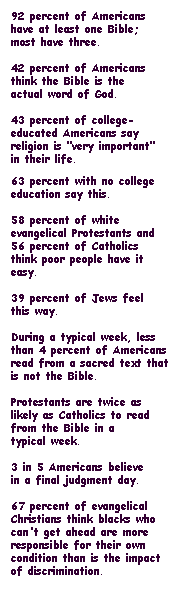
America is in the grip of a biblical frenzy. Books claiming to contain divine instructions fill bookstore shelves (one popular set is actually called the God’s Little Instruction Book series). Athletes, who used to just play ball while fundamentalists in the crowd held up signs pointing television viewers to John 3:16, are now shouting biblical slogans themselves. Boxer Evander Holyfield even credited Jesus Christ with his world heavyweight victory. Forty-two percent of Americans believe the Bible is the literal word of God, up almost 5 percent since 1987.
Some of this Bible-thumping gets a bit goofy. A former country music promoter is building an amusement park, God’s Wonderful World, featuring a visit to hell complete with blasts of heated air from below. And some of it’s scary, because religious fundamentalists are not just preaching their version of biblical values, they’re beating the rest of the country over the head with them. Ending welfare, praying in public schools, teaching creationism, eliminating “special treatment” for gays—the whole gamut of politically conservative rallying cries comes wrapped in a biblical halo: It’s God’s will, and here’s the big black book to prove it.
Mainstream religious folk have tried to fight back. Organizations such as the National Council of Churches and the National Council of Jewish Women attack conservative policies. But whatever the political success of these organizations (lately, it’s been depressingly low), on the biblical front they’ve lost the battle. Americans may love the Bible or loathe it. But for the most part, they read it the same way (when they read it at all): as the manifesto of a God who has a lot of laws and a definite inclination to punish those who don’t follow them.
Even nonbelievers see it that way. Take New Yorker John Hart, who joined a church Bible study in part to understand the enemy. “One of the big problems is this sense of moral certitude,” he says. “There is a God, and God makes rules, and this is what happens when the rules don’t get obeyed.”
Fundamentalists argue smugly that liberals are losers when it comes to the Bible because they’re just plain wrong. But there’s an eclectic mix of scholars and writers who don’t buy that explanation. Liberals have lost the biblical battle, these scholars say, because, even while they reject conservative interpretations of the Bible, they’ve been unable to shake free of conservative assumptions about the Bible.
Americans—and not just conservatives—are by nature fundamentalists, says Bruce Bawer, a poet, literary critic, and author of the forthcoming book Stealing Jesus: How Fundamentalism Betrays Christianity. “Anything that’s not useful is without meaning,” he says. “The whole country was settled by people who had to be very pragmatic. When we read the Bible, if a statement has a noun and a verb, we want to believe it’s literally true and use it in some way.”
That makes the Bible a prickly document. Most of the stories in the Bible—God’s creation of the world in six days, Moses’ bringing the Israelites out of Egypt by parting the Red Sea, and of course all of Jesus’ miracles—are, to a scientific worldview, highly improbable. And a lot of what God is described as doing, from demanding that Abraham sacrifice his only son to striking a pair of early Christians dead because they wanted to hang on to some of their own property, seems downright nasty.
With so much in the Bible to be disliked or discounted, there seems to be little left for liberals to do but engage in the same kind of moral prescriptiveness the religious right has made so unattractive. “Fundamentalists buy into truth as factuality, but Christian liberals have also tended to accept the idea that factuality and truthfulness are the same,” says author and biblical scholar Marcus Borg. “The mainline Protestant tendency is to ask what we can pluck from the fire, and extract these rather banal ethical teachings.”
The result is a war of “proof-texts.” Conservatives “prove” they’re right by quoting one biblical passage, and liberals “prove” they’re not by quoting another back at them. Take welfare. “Anyone unwilling to work should not eat,” thunders the apostle Paul in 2 Thessalonians 3:10. “Give to everyone who begs from you,” says Jesus in Matthew 5:42.
And in a war of competing texts, religious conservatives will always be able to make the clearer, and louder, case. Seeking refuge from modern science and a contemporary moral view that allows for abortion, premarital sex, and homosexuality, they find in the Bible facts and rules that give them comfort. Religious liberals have a much more difficult time of it. Faced with an ancient text like the Bible, they feel stuck with either taking it literally and hating it, or wrestling some usefulness out of it by contextualization and extrapolation.
On the vexed subject of homosexuality, for example, conservatives have it easy: Every sentence on the subject in the Bible (all four or five of them) disapproves. On the other hand, seminary professor William Countryman makes a convincing—and thoroughly biblical—case that the teachings of Jesus make homosexuality an irrelevant issue. But it takes him a whole book, Dirt, Greed, and Sex, to do it. In the sound-bite competition that is today’s political debate, it’s not too hard to figure out who wins.
In the end, “proof-texting” says a lot more about us than it does about the Bible. “We get our behavioral codes from our communities,” says Countryman, and then we go to the Bible to prove them. Used that way, the Bible is as malleable as those inkblots in a Rorschach test.
 There is another way to read the bible, however, a way that is both ancient and modern, a way that has nothing to do with facts, rules, and proof-texting. It’s the way of story and conversation, of imagination and engagement. Mostly lost in American mainline churches, it is the way of reading that has inspired many of the great progressive social movements. When Martin Luther King Jr. said he had been to the mountain, he was not using the Bible to prove that segregation was wrong. He was appropriating its story. As God, through Moses, had led his people out of captivity and taken Moses onto the mountain to show him the promised land they were to enter, so King, too, had been shown the promised land into which his followers were being led.
“When I was a child,” says Verna Dozier, a popular and respected Bible instructor in Washington, D.C., “the only two books we had were the Bible and Mother Goose, and my mother would read them both to us. That was my blessing. I learned the Bible as a story, and I never had it chopped up into little verses until I went to school.”
When the integrity of biblical stories is kept intact, rather than being chopped up into sound bites as both evangelizers and mainstream preachers tend to do, it’s easier to grasp that biblical truth is much less about facts than about relationships—both within the text and between the reader and the Scripture. “If I can get people to think of themselves as being in a relationship with Scripture,” says Roger Ferlo, a former Yale English professor who is now an Episcopal priest and author of Opening the Bible, “then there is a chance they can recognize a relationship with God when they meet one.”
To read this way is to follow the example of the Bible, which is itself a conversation. After all, it’s not a single book, with a single point of view. It’s a collection of books (24 to 73 of them, depending on which version—Jewish, Protestant, or Roman Catholic—you’re reading), written and rewritten over a thousand-year period by a wildly diverse collection of writers. Modern biblical scholars have traced multiple layers of authorship within the Good Book as writer after writer reshaped the material at hand to reflect new perspectives.
A case in point is the story in 1 Samuel of the beginning of Israel’s monarchy. The earliest stories of the rise of the monarchy were written as tributes to David, Israel’s great king. But after David, the monarchy fell on evil days, and later writers reshaped those stories to reflect their misgivings and apprehensions. The result is an almost schizophrenic God who anoints a king in one breath and, in the next, rails against the Israelites for wanting one.
The biggest such reinterpretation came when Christian writers laid claim to the Hebrew Scriptures. Known to the Jewish community as Tanakh, an acronym for the Hebrew names of the Scriptures’ three sections, these writings became, in the Christian Bible, simply an Old Testament, or precursor, to the Christian writers’ New Testament. The early Christians didn’t rewrite the Hebrew Scriptures, but they reimagined them, finding them filled with allusions to Christ—predictions that would have seemed as bizarre to those books’ original authors as they do to modern Jews.
But biblical writers do more than reinterpret each other; they also just plain argue with each other. The Book of Job is a scathing attack on the simplistic God-rewards-the-righteous theology of much of Psalms and Proverbs; at one point, in fact, Job quotes Psalm 8, turning it on its head in bitter parody. The Bible, in other words, is an open book, not a closed system.
Such an approach to the bible does not mean, however, that contemporary readers can interpret the Bible any old way they like. “The word ‘interpretation’ gives the wrong impression,” argues Stanley Hauerwas, author of Unleashing the Scripture: Freeing the Bible From Captivity to America. Fundamentalists, who pride themselves on going straight to the source, wrongly disregard the centuries of reading that have gone before them, he adds.
“Now that the Bible is open for everyone to read, the danger is that people will decouple from the traditional interpretations in their own communities,” agrees Burton Visotzky, whose study groups on Genesis inspired a Bill Moyers TV series on the book. Visotzky, a professor at the Jewish Theological Seminary, specializes in midrash, the great Jewish Bible-reading tradition of the first through sixth centuries. Just to look at a page of midrash is to know that you are in the midst of a conversation. Down the center of the page runs a narrow line of Scripture, the margins packed with rabbis’ comments on both the text and each other’s comments on the text.
One of Visotzky’s favorite episodes is Abraham’s visit to Egypt, a detour from the promised land. Afraid the pharaoh would kill him to steal his gorgeous wife, Sarah, Abraham pretended she was his sister; the pharaoh then took her. “There was a great deal of umbrage among the rabbis at the moral ambiguity of that,” says Visotzky, grinning. One rabbi imagined Abraham trying to bring Sarah into Egypt in a crate, so no one would see her beauty, but being foiled at customs. Another imagined him auctioning her off.
For centuries, Christians followed the example of their Jewish forebears and vigorously debated the Bible. St. Jerome, who translated the Bible from Hebrew into the Latin Vulgate, even studied with rabbis. “The debate in the Middle Ages between the Dominicans and Franciscans over whether Jesus’ disciples owned possessions makes our current controversies look trivial,” Hauerwas says. “Their arguments were about what the Bible was about. Our arguments are about what the Bible is, since we don’t think it tells us about the way things are.”
Over time, the Bible increasingly came to be set in stone (at least for Christians). And the past century of complex and often arcane scholarship—intended to open the book up again—has scared people off as often as it has brought them to it. “[People] believe they don’t understand the Bible and can’t understand it, that it takes scholarly and very brilliant people,” Dozier says.
As a result, biblical scholarship and biblical belief are pretty far apart. Phyllis Tickle, editor at large of Publishers Weekly and author of God Talk in America, quotes a recent poll showing that while 51 percent of Americans believe Jesus existed (as he almost certainly did), almost as many (47 percent) believe the virgin birth is a factual account (as it almost certainly is not). “The fruits of scholarship,” she says dryly, “have not filtered down.”
Now, though, even some academics are beginning to feel like Humpty-Dumpty: They’ve taken the Bible apart and don’t know how to put it together again. In the seminary, says Borg, students preparing for the clergy “experience a taking apart of their natural literalism, but they’re given very little help in the reconstruction of Scripture, in the positive task of saying, What does it mean?”
A small narrativist school of academics, battling a long-standing academic suspicion of anything that ventures beyond rigorous textual criticism, is trying out literary and imaginative approaches to Scripture, latching onto the idea that the Bible is a conversation modern readers ought to join.
So, if this handful of scholars and pastors is right that the Bible is a conversation, how do we join it? By allowing the Bible to be what it is, and not what we want it to be, argues Sharon Ringe, a professor of the New Testament at Wesley Theological Seminary and an adjunct professor at Latin American Biblical University in Costa Rica. “This is the document of a community struggling—as we struggle—to understand what it means to be in a relationship. We’re privileged to read over [the writers’] shoulders as they try to know what life with God is about. Sometimes they get it right, and sometimes they mess up badly, just as we do. But we have to take them seriously enough to grant them their own claims.”
This radical notion—that the Bible not only isn’t factual, it’s not always right, either—may be frightening to many religious Christians, but it’s what lets readers and participants join this ancient and ongoing conversation. We do not have to buy everything the Bible says. We just have to listen to it and to each other. “It’s an extraordinarily difficult thing to actually hear someone else,” Visotzky says. “Most of the time we’re pretending to be listening when what we’re really hearing is confirmation or denial of ourselves. But if we’re really listening, there is no ‘I,’ or if there is an ‘I,’ there is a ‘thou’ too, and something alien is worth considering because it’s alien. It takes courage, skill, and safety.”
Such conversations are taking hold. At New York City’s Church of St. Luke in the Fields, rector Roger Ferlo leads about 30 people, not all parishioners or even Christians, in a weekly Bible study. Over and over, he urges the participants to bracket their assumptions about what the text says and see it fresh.
“The writer has a strategy—an agenda that is often very shrewd and sometimes deceptive—that you’re being invited to participate in,” Ferlo says. “Being fooled is part of the contract and part of the pleasure. [Poet Samuel Taylor] Coleridge called it willful suspension of disbelief. But if people think the Bible is all about belief, they have a hard time with that. I’m asking them for a willing suspension, not of disbelief, but of belief. That’s a hard thing in a religious setting.”
The group is getting there. “The Bible is like an accordion now to me when I read it,” says Marion Lane, a regular participant. “There’s an opening up between the words on the page, leaving space for the Holy Ghost and also for human intellect. In my early education, the hand of God was supposed to be writing this down. Now I find there were other emotions, other needs involved, and there’s room for me to have my own feelings and understand other people’s feelings.”
The group studied the Book of Job recently, prompted by writer and group member Janet Malcolm. Job is profound poetry framed by an ancient and primitive folktale about a good man whom God allows to be tormented to test his faith. Surrounded by friends who insist he must have done something to deserve his misery, Job proclaims his righteousness and demands an accounting from God. Then God speaks, a voice out of a whirlwind, in majestic poetry that seems, on the surface, utterly irrelevant. “Where were you,” God demands of Job, “when I planned the earth? Tell me, if you are so wise…. Were you there…when I wrapped the ocean in clouds and swaddled the sea in shadows?”
Stephen Mitchell, the poet and scholar whose translation of Job the group used, makes note of the book’s complexity. “You have Job and his friends, God and Job, and then God and the poet in another kind of conversation—and all of these are in play,” he says. “If you approach the text as the ‘truth,’ you can’t possibly get to a deeper place of intimacy with it. With only one pole, there’s no place to go.
“Conversation,” he adds, “is one of the deepest and subtlest ways of play and growth and intimacy, and it’s a bipolar experience.”
The group’s conversation about the voice from the whirlwind was impassioned. God’s refusal to provide answers infuriated some. To others, the passage revealed the God who can be encountered but never grasped.
“What if God appeared out of a whirlwind,” asks group member John Merz, “and told us, ‘You’re all fighting over this book, and you think you’re going to control me—but where were you when I did all these things?'”
Malcolm, who says she is not a religious person, was amazed by the passage. “All those great verses about nature, about rain falling and nobody knowing about it, were very, very powerful,” she says. “It told us: This is what happens, in nature and to people.”
To read the Bible as a conversation is to read it as a question, not an answer, a starting point, not a final declaration. It’s not easy; it takes energy to suspend our own assumptions and welcome surprise.
But it also offers a way out of the dead end of sound-bite debate into genuine dialogue. “What makes the Bible come alive,” says Ferlo, “is acceptance of the possibility of edges, and not a fear of them.” To a political arena paralyzed by that fear, maybe the Bible actually does have something to say.
Ann Monroe is a Mother Jones contributing writer. Her story on the Christian Coalition’s effort to attract African Americans appeared in the May/June issue.