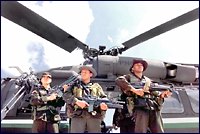
In the biggest step-up in US military aid to Latin America since the Reagan era, the Clinton administration is preparing to provide Colombia with $1.6 billion in helicopters, communications gear, combat training, and other forms of assistance.
All this aid is supposed to strengthen Colombia’s capacity to fight narcotics traffickers and the leftist guerrillas who protect them. But there is another, hidden objective — to protect US access to the largest untapped pool of petroleum in the Western Hemisphere.
US interest in Colombia’s drug production is well known. Government sources claim that Colombian traffickers supply as much as 90 percent of the cocaine flowing into the United States, plus a large proportion of the heroin sold in the eastern third of the country.
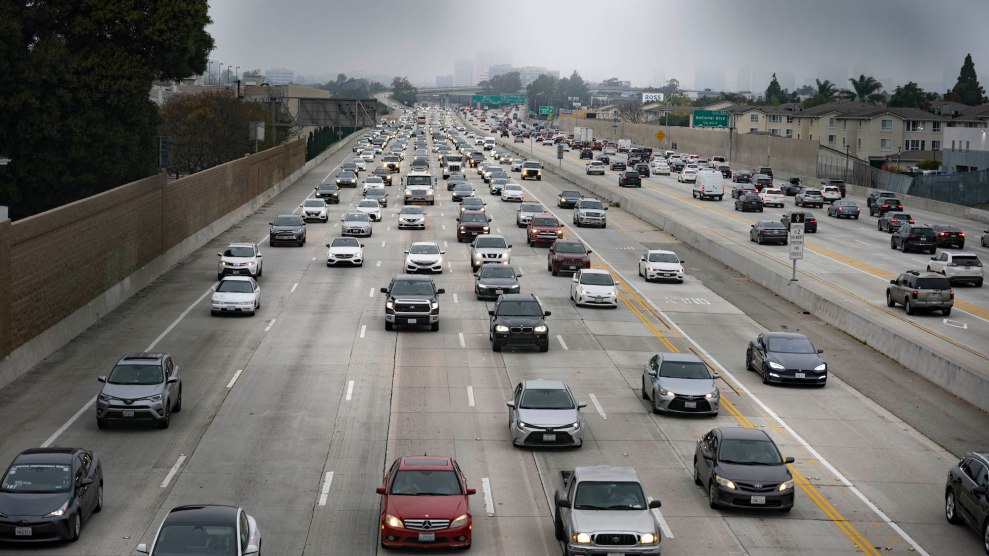
Far less known is Colombia’s role in satisfying America’s vast and growing petroleum habit. According to the US Department of Energy, US oil consumption rose by 15 percent between 1990 and 1999, rising from 17 million to 19.5 million barrels per day. During the same period, Colombia’s oil production rose by about 78 percent, with most of the added amount going to the United States, making it, today, the nation’s seventh largest supplier of oil.
But US strategic calculations are more concerned with the future. US consumption is expected to rise by another five million barrels per day over the next 20 years, and most of this oil will have to come from foreign sources. These quantities could easily be provided by the Persian Gulf countries, especially such petro giants as Iran, Iraq, and Saudi Arabia. However, US strategists are reluctant to increase America’s dependence on the unstable (and increasingly unfriendly) states of the Middle East — and so seek more accessible suppliers. This is where Colombia and neighboring Venezuela enter the picture.
Although Colombia’s current production is dwarfed by the petro giants, the country is believed to possess 2.6 billion barrels of untapped petroleum and perhaps ten times this amount in possible reserves. Venezuela is even more richly endowed, with 73 billion barrels in proven reserves.
Since the Gulf War of 1991, US leaders have moved to increase the importance of Western Hemisphere oil. “We are undergoing a fundamental shift in our reliance on imported oil away from the Middle East,” the White House noted in a May 1997 report on national security policy. Noting that Venezuela is the number one foreign supplier and that ” … Venezuela and Colombia are each undertaking new oil production ventures,” the report called access to these supplies a “vital interest” of the United States. This has significant security implications. Once a source of oil is designated a “vital interest,” it becomes incumbent on Washington to assure the long-term safety of these supplies. In the past, this has often entailed direct intervention by US forces or providing military aid to friendly governments.
In calling for stepped-up aid to the Colombian military, US officials have stressed the need to go after leftist guerrillas said to provide protection for drug traffickers. Rarely mentioned, however, is the fact that the guerrillas are also attacking US oil interests in Colombia, especially pipelines. In 1999, for example, the pipeline from the Cano Limon field — operated by US-based Occidental Petroleum Co. and Royal Dutch/Shell — was bombed 79 times. In fact, a key element of the guerrillas’ stated program is to expel foreign interests and use future oil profits to improve the lot of Colombia’s impoverished masses.
All this raises important questions about the aims of the aid program. The $1.6 billion is described as a one-time “emergency” measure, intended to tip the scales on the narcotics battlefield in the government’s favor. But it is very doubtful that this amount — five times the size of previous allotments — will make a lasting difference, and additional infusions of US aid will be needed in the future. When we add Colombian oil supplies to the strategic equation, it is apparent that we are talking about a very extended future indeed.
Given the risk that this military aid package will lead to protracted and expanding involvement in Colombia’s messy conflicts, it is essential that the administration and the various pro-aid factions in Congress be more forthcoming about America’s long-term interests in Colombia. If increasing our dependence on Colombian oil means expanding our involvement in that country’s internal wars, we may be better off looking elsewhere for our future oil requirements.