Courtesy of Prison Fellowship
Pastor Don Raymond isn’t trained in corrections and is not employed by the government, but he runs a new 140-person wing of the Ellsworth, Kansas, medium-security prison that draws inmates from throughout the state system.
In the phylum of prison staff, Raymond defies classification. He is not a tight-lipped warden, vindictive guard, or burnt-out social worker. In an industry that thrives on invisibility and resents the media, Raymond drives 140 miles, past newly seeded wheat fields and the rhythmically bowing heads of oil-well pumps, to pick me up from the airport, where he offers prayers of thanksgiving for my visit and “for the ministries of writing He has blessed Samantha with.” In a building that hums with hostility, Raymond is attentive, unguarded, gentle. Prison staff are not permitted to share personal information with inmates, address them by their first names, or socialize in any way; if an inmate wants to speak privately with a counselor, he has to fill out a Form-9. But these restrictions do not apply to Raymond, who often puts in 14-hour days working the cellblocks of the state’s prisons, recruiting men to transfer to his wing. In inmates’ marked bodies, averted eyes, and bristling rage, Raymond sees the debts and wounds, not of poverty or addiction, but of sin alone. He believes there is only one cure—Jesus Christ—and that it is a perfect and complete cure.
Once at the Ellsworth prison, Raymond and I quickly pass through the general population area, avoiding the acid attention of men slouched in front of bolted-down TVs, fingering the buttons of their state-issue work shirts. “I seeeeee you,” an inmate coos at me through his window grate as we pass. “Don’t think I can’t see you.” “I got to talk to you, girl! I got to talk to you right now!” another barks.
Raymond’s wing, the faith-based InnerChange Freedom Initiative, is identical to the rest of the prison but feels like an entirely different place, an excessively well-lit church basement perhaps. Inmates have arranged their desks, stacked with Bibles and workbooks, in a tidy circle. One rushes to pull a chair out for me; others reach out for a double-handed shake or a shoulder clap poised to morph into a full-body hug. These inmates see plenty of women; Raymond keeps a steady flow of church volunteers, mentors, and teachers circulating throughout the wing. They don’t behave toxicly, because the InnerChange staff doesn’t treat them like they are murderers or rapists, even though some are.
Before Bible study starts, they want to ask me some questions: “Where are you from?” “Have you been saved?” “Do you know Jesus?” After class, perhaps unsatisfied with my answers—I’m Jewish—Raymond presents me with a pocket-size New Testament, “a gift from the guys.” He then invites me to spend time alone with an inmate in his cell to peruse his extensive Scripture library more closely. A passing guard catches a glimpse of us crouched on the inmate’s cot and turns purple. “Don’t you know that no one is allowed in cells?” he bellows at Raymond. “Not even me, and I am a guard!”
Raymond is undeterred. Later that evening, after most prison staff have left, he leads InnerChange inmates across grounds off-limits to them because they are outside the view of security cameras. They set up amplifiers and a drum kit for an evening revival in the mess hall. With a backup band of inmates chanting, “You are the air I breathe,” Raymond preaches until the sun sets and goldfinches circle the indigo sky outside. By the end of the revival, Raymond has achieved his desired effect: The room is still with prayer; inmates are holding each other; some are crying. At 9:30, Raymond can be found in a cellblock, bent at the waist, his face pressed into the food slot of an inmate on lockdown. When he finally leaves the prison to eat a Dairy Queen dinner in the front seat of his pickup, the night is speckled with stars.
Aided by friends in high places—such as the White House—legislators in Kansas, Iowa, Texas, and Minnesota have, in the last six years, turned over portions of their prisons, and corrections budgets, to the politically powerful evangelical Christian group, Prison Fellowship Ministries, which pays Raymond’s salary. The largest prison ministry in the world, PFM sends more than 50,000 volunteers into prisons in every state with the goal of “declaring the good news of Jesus Christ to those impacted by crime.” The Ministries’ “Angel Tree” program has presented more than 4 million children of inmates with Christmas presents and evangelistic materials. The goal is clear. As Mark Earley, who was attorney general of Virginia before becoming president of PFM in 2002, writes on its website, “I believe God is going to raise up the next generation of leaders for His Church from men and women now behind bars, and from their children.”
In 1997, as part of a larger effort to increase funding for faith-based services in Texas, then-Governor George W. Bush gave PFM the chance to do more than just visit prisons; he allowed it to run a 24-hour “immersion” program in collaboration with the Department of Corrections. Three other states have since followed suit, and PFM plans to be in five more states by 2005 — “God does amazing things!” enthuses InnerChange executive director Jerry Wilger. In June, President Bush held a press conference with InnerChange officials and inmates, touting a University of Pennsylvania study that he, Majority Leader Tom DeLay, and the Wall Street Journal all claimed showed that InnerChange lowered recidivism. Critics later pointed out that the study actually indicated the opposite was true. In any case, InnerChange represents the cutting edge of Pres-ident Bush’s faith-based initiatives, which seek to have religious groups take over social services once provided by state and federal agencies and, in so doing, fulfill two goals dear to many conservatives: bringing more people to Christ and shrinking government.
In Kansas, most inmates two years away from possible parole are eligible to join InnerChange. Inmates who choose to live on its wing rise at 5 a.m. for morning prayers and bustle purposefully through a day packed with studying Scripture, practicing gospel music, learning life skills, and undergoing “biblically based” therapy designed to transform them through an “instantaneous miracle.” Their study regimen includes les-sons in creationism and an option to “convert” out of homosexuality. When I asked Alexander Curls, on work release after three years of InnerChange, what he was taught about other faiths, he said emphatically, “I found out that a lot of good people are going straight to hell!”
Many inmates, however, don’t join for the ideology. They do it to transfer from other parts of the prison system, and because completing InnerChange amounts to a get-out-of-jail-free card with the Parole Board: “We have a very positive relationship with the board. Sometimes they just give our inmates a green light and say, ‘See you at work release,'” said Larry Furnish, InnerChange program manager at Ellsworth. Kansas has only 298 coveted work-release positions for about 9,000 total inmates; InnerChange graduates are all but guaranteed a space as well as help finding a job and housing after they get out.
Meanwhile, joining InnerChange brings about a radical change in lifestyle. The movements of the general population are highly restricted. Those who share a snack or a book will likely be written up for “dealing and trading”; during visiting hours, hugs with family members are timed. But InnerChange “members” have good prison jobs and electric guitars. They are called by their first names, hugged and told they’re loved, and, because the program emphasizes reconciliation with family members, are provided much greater visitation rights—their wives can join them for Bible study and picnics.
And then there is the pizza. When a new class of inmates joins InnerChange, the staff orders 100 large pies, a fact that all 800-plus inmates at Ellsworth appear to be intimately, obsessively, aware of. “We are stretching the local Pizza Hut to its absolute capacity,” InnerChange office administrator Gale Soukup told me with a worried look, “and they’re the only game in town.”
Paid for in part by fees charged to the general population, InnerChange also offers substance-abuse treatment and free computer training, hot commodities in a time of budgetary woes. This year, the GED program Ellsworth offers regular prisoners was cut in half, the substance-abuse program eliminated. General-population inmates are still offered a computer class through the local community college, but as it costs $150, and men who are lucky enough to land a prison job make an average of 60 cents a day, the general population’s six computers sit under dust covers most days. As Issac Jarowitz, an Ellsworth inmate who isn’t in InnerChange, noted grudgingly, “The Christians do lots of stuff the state used to do, like vocational programs, but now they’re only for believers.”
“I tell them this is their ticket,” Raymond said, gesturing to the InnerChange ID card that inmates wear on a “What Would Jesus Do?” neck chain, “to everything they need.”
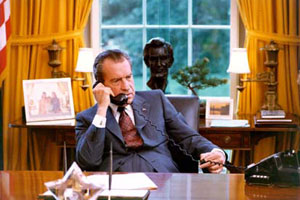
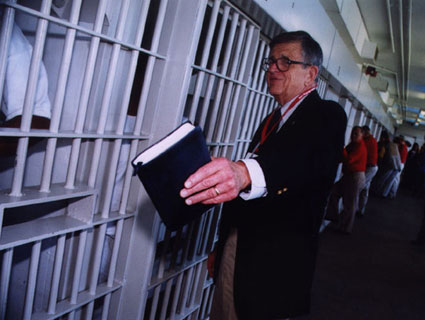
PRISON FELLOWSHIP MINISTRIES, the group that runs InnerChange, was founded in 1976 by Charles Colson, the “evil genius” of the Nix- on administration; one of his unrealized dirty tricks was a proposal to firebomb the Brookings Institution. For his Watergate crimes, Colson served seven months. After being released, he remade himself as a poster boy for the redemptive power Christ can have on criminals and the government, and has since become one of “America’s most powerful Christian conservatives,” according to the Weekly Standard. Still chairman of PFM, Colson is also a prolific writer. In his column for Christianity Today or his daily radio address, Colson can be found criticizing PBS for “promoting” evolution, hawking a brochure called “Rick Santorum Is Right,” or claiming that the real weapons of mass destruction “are not in Baghdad” but in “the hands of the sexual liberationist lobby.” In Colson’s first novel, Gideon’s Torch, the National Institutes of Health plans to harvest brain tissue from partial-birth abortions to treat AIDS patients, a scheme funded by Hollywood galas. Colson even has his anti-abortionist heroes firebomb the NIH. Gideon’s Torch, like much of Colson’s writings, ultimately argues that government without faith is doomed to destruction and corruption
Colson also drums on the clash between Christianity and Islam, a religion, he told Fox TV, “dedicated toward hatred,” but that can be defeated by aggressive evangelizing. Last year, he wrote several op-eds warning that Muslim inmates present a terrorist threat, a message that’s trickled down to InnerChange. Raymond refused to participate in an interfaith conference at Ellsworth last year because he thought the Muslim organizers were trying “to recruit guys.” Texas InnerChange inmates told me they watched an evangelical documentary on a Christian woman who’d been raped by Muslims.
At Ellsworth, Muslim inmates like Michael Patterson say that their practices have been restricted since InnerChange arrived. While InnerChange inmates and their families are treated to a Christmas dinner shared with prison staff, this year the Ramadan feast (which Muslim inmates must pay for and their families can’t attend) was denied. InnerChange inmates engage in spontaneous prayer throughout the day, but Lakota, Muslim, and other inmates in the general population need approval to pray together. “If anyone but the Christians gets together for a prayer, security hits the panic button,” Patterson said, adding that the prison’s chaplain would not order Islamic texts and that an inmate who started studying Arabic was called into the warden’s office. (The warden denies these reports.) To Patterson, this pattern suggests that “through a variety of avenues, the prison is trying to pressure inmates to join InnerChange to turn the whole prison into a Christian place.”
That sounds paranoid, and Warden Ray Roberts (who’s since become warden of another Kansas prison) said inmates are not pressured, implicitly or explicitly, to join InnerChange. But Roberts, his deputy warden, and the prison’s security chief all told me they would like the entire prison turned over to InnerChange. While walking with Raymond, an inmate suggested airbrushing a giant mural of Jesus on the side of the prison. “The state won’t let that fly,” Raymond said ruefully. “Wait until we take the place over.”
WARDEN ROBERTS previously served as director of the InnerChange unit in Texas, and he did his best to welcome the ministry to Ellsworth. Inmates in the program repair wheelchairs for an evangelical group that distributes them, and the gos- pel, in the Third World. When budget cuts affected state funding for InnerChange, Roberts allowed its inmates to hawk BBQ bacon cheeseburgers to the general population.
The prison’s chapel is small, so Roberts raised money for a large “Spiritual Life Center” that he said will make it easier to put on “wholesome entertainment, like gospel concerts.” Fundraising efforts included the sales of his wife’s “mop angels” (don’t laugh — that’s $23,000) and inmate art, a staff softball tournament, and a civilian-attended prison slumber party. Roberts said he didn’t plan to undertake similar efforts to restore the drug-abuse or education programs cut this year or to subsidize the $150 that regular inmates must pay for computer training.
Cheeseburgers aren’t the most substantial way Kansas’ inmates fund perks for their born-again brethren. Although some state legislatures allocate money for InnerChange (Texas recently set aside $1.5 million), Kansas provides it with only about $200,000 out of the Inmate Benefit Fund (profits from prison canteens and exorbitant phone rates). Kansas’ $4.3 million Inmate Benefit Fund typically buys library books and sports equipment, but Roger Werholtz, secretary of the Department of Corrections, said InnerChange is a fair allocation because it is voluntary and open to everyone. “Not everyone uses the basketball hoops,” he added.
In Kansas, the Inmate Benefit Fund covers only about 40 percent of InnerChange’s cost; PFM pays the rest, making it attractive to government officials not swayed by the promise of kingdom-building alone. Kansas pays up to $4,000 for each inmate who participates in a regular group-therapy program; InnerChange therapy costs the state only $1,086 per inmate. What’s more, the state saves money when inmates fulfill their requirements for vocational training or substance-abuse counseling through Inner- Change. “I know we don’t have any good long-term numbers on recidivism with the program,” said Werholtz, “but I was willing to suspend judgment because it follows the form, if not the content, of a therapeutic program. I’m interested in any kind of resources we can employ that will be effective on a low-cost or no-cost basis.”
Werholtz says, “If you turn down the volume, InnerChange looks like a therapeutic community program.” He is right. In their biblically based therapy sessions, InnerChange inmates break into tears and hugs with a frequency that would exhaust Oprah. These aren’t crocodile tears. Many men are reconciled with estranged family members; all can talk about whatever suffering, neglect, or poverty landed them in prison.
But lest anyone mistake an InnerChange session for group therapy, the program enumerates the differences in a handy page-long chart. For instance, while standard therapy “seeks gradual change of self,” the transformation that InnerChange promises “happens through an instantaneous miracle.”
InnerChange’s substance-abuse program is state accredited, although unlike in the regular state program, addiction isn’t presented as a disease to be struggled with for life, but as a sin that can be permanently “cured” through Jesus. This is typical of the faith-based substance-abuse programs, like Teen Challenge, that President Bush ardently supports. As governor, Bush defended Teen Challenge against charges that it violated state and health-department codes, saying, “I believe that conversion to religion, in this case Christianity, by its very na- ture promotes sobriety.”
At Ellsworth, InnerChange staff use Teen Challenge materials whether or not inmates have a substance-abuse problem. “It’s all about discipleship,” program manager Larry Furnish explains. “The addiction part is just one component of the materials.”
InnerChange is also eager to provide its own faith-based alternative to Kansas’ sex-offender treatment program. Pastor Raymond doesn’t think it would be that hard to develop. “It’s all sin,” he said, shrugging. Jerry Wilger, head of InnerChange, said the idea is currently under consideration.
I GOT A TASTE OF WHAT a faith-based sex-offender program might look like when I attended an InnerChange support group that Furnish said was “a little like AA for homosexuals.” The group was led by Clint Price, 28, who Furnish said “had a reputation across the state for being a flaming homosexual,” while the other two members were “former cross-dressers.”
Serving out a sentence for burglary, Price showed me pictures of his pre-InnerChange days when he plucked his eyebrows and had long hair. “At one point, I had the Bloods and the Crips fighting over me,” he said with a trace of pride.
Price joined InnerChange because he had “some bad relationships and got let down and hurt so much. I was sick of competing with other queens in the system. In the pris- on environment, people are just not faithful and I was taking a lot of abuse.” At InnerChange, Price was encouraged to grow out his facial hair, lift weights, stop shaving his legs, and abandon “the lifestyle.” The group Price leads—InnerChange plans to have him minister to those “in the lifestyle” when he’s released—is supposed to affect a similar change in the others.
I entered the InnerChange library unattended by any guard or staff. Sitting in the darkened room with Price’s group as he read evangelical texts on homosexuality off a slide projector in a Ben Stein monotone—”Start your life moving.” Click. “In a new direction towards complete manhood.” Click—was a profoundly unsettling experience. It quickly became clear that the other members, Terry Hoffman and James Gavin, were not simply “cross-dressers” but serious sex offenders; Hoffman said he’d attempted to sodomize a blind man, and Gavin had sodomized his four-year-old daughter. Hoffman attended InnerChange because he’d been thrown out of the state-run sex-offender program, which Gavin had completed. As Price shared the trials of growing up gay, Asian, and uncoordinated in “a town smaller than Ellsworth, where sports are everything,” it was clear he was out of his depth.
Privately, Price acknowledged that he’s “really not for sure on how to deal with someone who has a sex crime. Some of the things they bring up from their past—real, real dysfunctional things—go beyond my experience,” he said uneasily. “I don’t know what to say, so I just have us pray together.”
Letting Christ-based programs “cure” sex offenders—exempting them from state programs that employ aversion therapy and normative counseling, and releasing them into society armed primarily with polemics about sin—seems risky, to say the least, but Furnish is confident the state will go for it. “We already offer GED, substance-abuse, and pre-release programs. If we get sex-offender treatment, we’ll have the whole ball of wax for the state at a bargain-basement price,” he said.
INNERCHANGE is the sort of program President Bush is promoting with faith-based initiatives, appointments, exec-utive orders, and (so far failed) legislative attempts. The director of the White House Office for Faith-Based Initiatives says Bush has asked Attorney General John Ashcroft to investigate using InnerChange in federal prisons. Former PFM officials also lead Dare Mighty Things, which, thanks to a $2.2 million grant by the Department of Health and Human Services, now serves as a clearinghouse for faith-based and community groups applying for federal money.
It was already possible for faith groups to receive government funding to work in prisons; they simply have to separate their charity from their sermons and are forbidden to proselytize. But Bush’s faith-based initiatives promote a very different theology of social action—one that he and Colson have personally experienced—that claims religion itself is the cure for social ills. PFM can receive state funds because InnerChange members enroll voluntarily, though it’s hard to see the program as entirely voluntary when lifestyle and parole benefits serve as both carrot and stick. Furthermore, lifers who graduate from the InnerChange “God pod” return to cellblocks as “disciples” and are encouraged to proselytize.
Bush’s faith-based initiatives are also part of a larger effort to privatize social services. As Robert Boston, a spokesman for Americans United for Separation of Church and State, says, “This is really about making dramatic changes in the structure of the social safety net.” Boston’s group is suing InnerChange in an effort to challenge faith-based initiatives on constitutional grounds.
Colson, in a recent radio address, said, “What’s at stake [in the suit] is not just a prison program, but how we deal with social problems in our country. Do we do it through grassroots organizations or big government? We know what works.”
In fact, there’s no conclusive research about whether the treatments InnerChange is experimenting with do work. The Texas Freedom Network recently reported on how Bush’s faith-based initiatives have fared in that state, where they’ve existed the longest. It documents rampant safety violations at deregulated faith-based child-care centers and alcohol-treatment programs. Data compiled by Texas’ Criminal Justice Policy Council suggests InnerChange graduates have lower rates of recidivism. But as University of Arizona sociologist Mark Chaves notes, “Prison Fellowship claims amazing success rates, but in prisons where it exists, it’s often the only rehab program. We don’t have comparisons between PFM and secular programs; we have comparisons between PFM and nothing.”
Faith-based programs have a synergetic relationship with government cutbacks; InnerChange derives its transformational force from the stark neediness of inmates. It’s hard—even for Muslim inmates like Patterson — to be overly critical of InnerChange, because the services its inmates receive are such an improvement on what is offered in regular prison. Amy Fettig of the ACLU National Prison Project says InnerChange is “potentially problematic,” but “we haven’t had any complaints from inmates. It may be that folks are just desperate to get any services with states cutting back their budgets so much.” Meanwhile, she adds, “we have to focus on other conditions, like deprivation of food, crowding, and violence.”
THOSE ARE SOME of the conditions that Rodney Woods, 31, said drove him to enroll in InnerChange. Previously, Woods was serving time in the Hutchinson, Kansas, maximum-security prison, where he shared a cell with four other men and was let out to exercise for an hour a day.
Woods, who has wide almond eyes and rows of neat braids knotted behind his ears, said he was angry all the time, frustrated, and scared of what he might do. “My homeboy got jumped and I knew when he got out of the hole we were going to take care of it. I was going to end up fighting, kill the guy if need be. I was going to do something I was gonna regret.” When Raymond came to speak at Hutchinson about the faith-based prison wing, Woods said, “I was attracted to the aspect of change. I wanted to be around positive people with a message of love.”