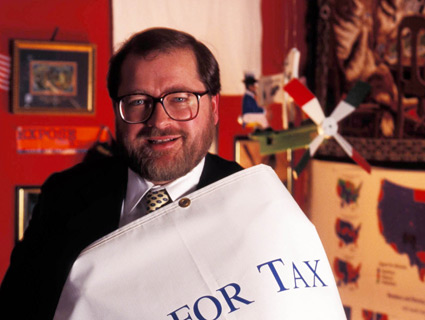
Grover Norquist.Rick Kozak/ZUMA
Editors’ note: Michael Scherer wrote this profile over half a decade ago, but with America’s debt just downgraded—and some blaming the GOP’s anti-tax stance—there’s never been a better time to read about Grover Norquist, the unquestioned leader of the nation’s anti-tax movement.
Grover G. Norquist is in fine form as he warms up the crowd at his Wednesday morning meeting. The conference room at Americans for Tax Reform headquarters is packed on this cool October day, and Norquist, ATR’s president, jokes about the “fun-filled, star-studded” agenda in store. Why wouldn’t he be in good spirits? The invitation-only meetings Norquist hosts have become a hot ticket for Washington’s conservative in crowd, the place for GOP players to brainstorm, swap intelligence, and see and be seen. The 100-plus people who come each week are the powers who run the federal government—congressmen, lobbyists, senior White House and Senate staffers, industry-group leaders, and right-wing policy wonks. “Everybody there has some sort of entrée,” says conservative activist Peter Ferrara, a longtime attendee. “When the White House sits down and says, ‘We want to get the word out on something,’ the top of the list is Grover.”
Norquist, the master of ceremonies, sits in the middle of the room, a microphone pinned to his tie. Stout and bearded, with rosy cheeks, he calls on speakers in his eager, nasal voice, cutting off ramblers and keeping the proceedings on track. There is no time for canned political rhetoric. The focus is on winning. Here, strategy is honed. Talking points are refined. Discipline is imposed. “It’s the most powerful, nihilistic movement in Washington today,” says Ralph Nader, who recently attended one of Norquist’s meetings to give his views on corporate welfare. “It is such a cold-blooded atmosphere it would sustain icicles.”
The same spirit that chills Nader warms the heart of Norquist. When he founded his weekly Wednesday meeting in 1993, its numbers rarely brooked a dozen. “It was like a conservative version of Seinfeld,” says an attendee of those early meetings, “with people double-dipping into the bagels and cream cheese.” But conservatives, with Norquist as one of their pre-eminent strategists, have since overtaken the capital. Once a consigliere to Newt Gingrich, Norquist now has the ear of Karl Rove, the president’s top political adviser, who has been known to stop in at the Wednesday meetings. In turn, Norquist plays the role of national ward boss, delivering the coalition that has rallied around the president’s policy agenda.
Norquist calls it the “Leave-Us-Alone Coalition,” a grouping of gun owners, the Christian right, homeschoolers, libertarians, and business leaders that he has almost single-handedly managed to unite. The common vision: an America in which the rich will be taxed at the same rates as the poor, where capital is freed from government constraints, where government services are turned over to the free market, where the minimum wage is repealed, unions are made irrelevant, and law-abiding citizens can pack handguns in every state and town. “My ideal citizen is the self-employed, homeschooling, IRA-owning guy with a concealed-carry permit,” says Norquist. “Because that person doesn’t need the goddamn government for anything.”
Few in American politics are as blunt about their plans. “If the American people really want to know what George W. Bush is up to, the best place to look is the candor of Grover Norquist,” says Ralph G. Neas, president of People for the American Way. Norquist is not above equating tax collection with a street mugging, or suggesting that arguments for higher taxes on rich people echo the ones Nazis used to justify their targeting of Jews. “Bipartisanship is another name for date rape,” he told a reporter in May, borrowing a phrase from former House Majority Leader Dick Armey. He likes to say he wants to shrink the size of government in half over the next 25 years “to get it down to the size where we can drown it in the bathtub.”
These are not the musings of an ideological fringe. Norquist has already secured written promises never to raise taxes from a majority of federally elected Republicans: 217 House members, 42 senators, and the sitting president of the United States. In 36 state capitals across the country, he is organizing weekly meetings modeled on his Washington coalition, and more than 1,200 state legislators and 10 governors have taken his anti-tax pledge.
Norquist has also helped found a raft of Republican recruitment efforts in immigrant communities, attempting to attract Muslims, South Asians, and religious Jews to the GOP. Norquist’s goal is nothing less than a well-oiled national, state, and local political machine that can roll over and crush the last few bastions of Democratic Party support. “We plan to pick up another five seats in the Senate and hold the House through redistricting through 2012,” he says. “And rather than negotiate with the teachers’ unions and the trial lawyers and the various leftist interest groups, we intend to break them.”
It’s hard to imagine what would be left if you took the politics out of him. In his office one evening, after all but one of ATR’s staff had headed home or off to a bar, Norquist considered the question of how many hours a week he spent doing something other than politics. “Mostly, it is what I do,” he said, after a pause. “I read murder mysteries. I exercise 40 minutes a day. I watch videotapes while I exercise. I listen to audiotapes when I am in my car. And I try to stay in three different centuries.” At the time, the book was a Philip Marlowe mystery, the audiotape was Shakespeare’s Henry V, and the videotape an educational offering from the Teaching Company about Alexander the Great. Did he ever watch CNN? “Too boring,” he said. “And I’m not learning anything.”
As early as the sixth grade, Norquist, now 47, remembers arguing with classmates over the Vietnam War. “Suzy somebody thought Nixon was a fascist and [Alger] Hiss was a good guy,” he says. Thanks to a fire sale at his local public library in Weston, Massachusetts, he picked up several books by J. Edgar Hoover and Whittaker Chambers on the communist threat. At 12, he was volunteering for Richard Nixon’s 1968 presidential campaign. After church, his father would buy him and his three younger siblings ice-cream cones and then steal bites, announcing with each chomp, “Oops, income tax. Oops, sales tax.”
These are the anecdotes Norquist offers up to explain how his obsession took hold. Politics hit him like puberty, and he has never looked back. “From the moment he gets up to the moment he gets to bed, he thinks, ‘How am I going to hurt the other team?'” says Stephen Moore, the president of the anti-tax group, the Club for Growth. “One time I was telling Grover about this woman I met. Most guys would say, ‘Oh, is she really good-looking?’ or something like that. Grover said, ‘Is she good on guns?’ He was being totally serious.”
Until last year, when he bought his own place on Capitol Hill, Norquist had lived with roommates in a rented house. His new four-bedroom home seems too large for one person. The walls and bookcases are decorated with the mementos of three decades of conservative crusading: a statue of Lenin he got in Bulgaria; a billy club from the tiny African nation of Lesotho, where he once went to promote private-property rights; and a Nixon campaign poster, circa 1972, hanging next to his bed.
Norquist first made a name for himself in Washington in the early 1980s as a leader of the College Republicans. From there, he signed on as president of Americans for Tax Reform, whose original mission was to push for the Reagan administration’s 1986 tax plan. Once the tax bill passed, Norquist turned the group into a platform from which he could build the ranks of the GOP while moving the party further to the right.
At the same time, he was working internationally, intent on helping to win the Cold War. “I’d ride to where there weren’t any guns and capture the high ground,” he says jokingly of his think-tank-sponsored forays to Afghanistan, Angola, and Mozambique to organize anti-communist rebels. In those places, he usually made time to get photographed with a large piece of artillery, pens sticking out of his shirt pocket, the serious look of a warrior on his face—”armed nerd,” he now calls the pose.
He says he plans to start a family someday, but it’s not clear how he could swing it. “It’s hard to believe that anybody can take as many plane flights as he takes,” marvels his father, Warren Norquist, a retired Polaroid executive. In one two-week period last fall, Grover squeezed in an Arab American conference in Michigan; anti-tax meetings in Georgia, Missouri, and New York; and a speech at a Texas think tank. At nearly every other point, he was in Washington, dining with journalists, conferring with senators, exchanging emails with the White House, arranging press conferences, hosting meetings, or working the phones. “A lot of power in this town comes from who you know,” says Jonathan Collegio, Norquist’s spokesman. “The guy is out every night talking to people.”
In 1998, as the Bush camp was plotting its run for the White House, Karl Rove sought out Norquist’s support. At Rove’s request, Norquist traveled to Austin for a private meeting with the then Texas governor and presented the agenda he wanted George W. Bush to back: broad income-tax cuts, school choice, the privatization of Social Security, tort reform, and free trade. Bush won Norquist over, and with Norquist’s endorsement, the Republican base soon got on board. “The president and Rove understood the coalition and deliberately placed themselves inside it,” Norquist says now. “That’s why they won and McCain lost.”
With Bush in the White House and Republican leaders in charge of both houses of Congress, Norquist’s dream of a withered, tax-starved federal government should be closer than ever to coming true. But so far, the Bush presidency has brought mixed results. Rollbacks in labor laws, environmental regulations, and social programs have cheered Norquist’s corporate and conservative supporters, as have tax cuts that could top $1 trillion in the next 10 years. But at the same time, the federal deficit under Bush is set to grow to $480 billion. All told, Bush and the GOP-controlled Congress have overseen an estimated $381 billion expansion in federal spending, including the military campaigns in Iraq and Afghanistan that have already required appropriations of more than $150 billion and are likely to cost tens of billions more before they’re through. “We have succeeded in making Republicans anti-tax, but we haven’t succeeded in making them anti-big-government,” says Moore, of the Club for Growth, voicing the frustration of movement conservatives. “He [Bush] is worse than any president since Johnson on spending.”
Norquist is far more circumspect, but he too has viewed the runaway budget and the Bush administration’s costly foreign policy with growing unease. “Wars are expensive and dangerous,” he says. “They’re not political winners.” He’s been even more outspoken about the Bush Justice Department’s all-out domestic anti-terror campaign, especially the Patriot Act, which he views as a potentially dangerous expansion of federal police power.
One Sunday last October, Norquist spent the afternoon of his 47th birthday doling out political advice to civil-liberties activists who had gathered near Washington to plot a rollback of the Patriot Act. “I don’t care if we eliminate four provisions or five provisions,” said Norquist, sitting on a panel between a ponytailed activist in a Hawaiian shirt and a goateed Green Party organizer. “What we need is to draw blood.”
Whatever his differences with the administration on specific policies, Norquist stops short of criticizing the president directly. “At some point,” Norquist says of the massive government spending, “it becomes a deal breaker.” But for now, he’s clearly decided that Bush has accomplished enough on tax cuts and other fronts that he’s willing to cut him some slack—even as he works to keep the conservative agenda on course. “My job is to make the movement and the party leader ready to lead,” Norquist says. “If Bush doesn’t feel he can do something [for political reasons], it’s not Bush’s fault. It’s my job.”
In building his coalition, Norquist has made a conscious strategic decision to go with a big-tent approach. At his weekly meetings, social issues like gay rights and abortion, which can divide the electoral base of conservatives and libertarians, are played down in favor of issues like tax cuts, tort reform, and the rollback of federal regulations and rules. These are the broad-appeal political winners on which Norquist is pinning the movement’s future. And they’re a strong lure for the corporate community, some of whose members—Philip Morris, Pfizer, and Time Warner, for instance—also happen to supply funding for Americans for Tax Reform. Roughly 20 percent of the group’s $6.7 million budget last year came from corporate contributions, according to Norquist, with foundations and individual donors providing the rest. But Norquist, who says he currently makes $120,000 a year as ATR’s president, isn’t making any apologies. “We are talking about getting the business community in sync with the Leave-Us-Alone Coalition,” he says.
That approach hasn’t played well with everybody in Norquist’s camp. Some of his oldest allies on the right fear that teaming up with corporate interests could lead to too many compromises of core conservative principles. In the late 1990s, Norquist signed on to a multimillion-dollar campaign for state utilities, called Citizens for State Power, that opposed federal deregulation of electric power, enraging several Republican members of Congress. “There is no ideological principle involved in these groups,” Oklahoma Rep. Steve Largent, a member of Congress at the time, complained. (Norquist defended his actions by saying deregulation was still possible on the state level.) Recently, ATR joined with major media companies lobbying for higher caps on newspaper and television ownership, even as the National Rifle Association and other conservative groups warned the proposed changes would give media conglomerates too much power. “Rightie Grover Norquist is too close to Rupert Murdoch,” kvetched William Safire, the conservative New York Times columnist. Despite his commitment to free trade, Norquist has also lobbied against imports of cheaper prescription drugs from Canada, a matter of critical importance to the pharmaceutical industry, which is a major donor to the GOP. Norquist’s take on the issue, in fact, is the same as the drug companies’, which claim that allowing reimports would hurt their ability to bankroll research on the next generation of drugs. “There was some division [within the movement] at one point,” he says, dismissively. “But I don’t think there is anymore.”
Norquist has had far less trouble uniting conservatives and corporations around his master plan for taking down the Democratic Party. By design, each of the prongs in that strategy is a win-win. Tort reform, for example, attracts millions in campaign lucre from corporate leaders while undermining trial lawyers, a major Democratic support base. School choice divides largely Democratic inner-city communities desperate for better education and undermines the authority of teachers’ unions. Social Security privatization could one day provide a windfall to Wall Street brokers, who increasingly favor Republicans with campaign donations, while eliminating one of the most successful Democratic government programs in history. Tax cuts for rich investors give a Republican voting bloc even more money to send to campaigns. There is nothing accidental about this. “You want to make your team bigger and their team shorter,” Norquist explains. “And the trial lawyers fund their team, labor unions fund their team, city tax collectors fund their team.”
Closer to home, Norquist has been working to purge the corporate-lobbying community of Democratic supporters, a plan he calls the K Street Project. He has circulated a list of Democratic lobbyists, while getting out the word that lobby shops that employ them can expect less cooperation from the GOP-controlled Congress. Vic Fazio, a former Democratic member of Congress who now lobbies at Clark and Weinstock, says some of K Street’s corporate clients have tried to resist these pressures with only mixed success. “They feel at times that they have to go along,” says Fazio, whose clients include AT&T, Microsoft, and the pharmaceutical industry, noting that some Democrats “feel this makes them unmarketable.”
It’s not the first time Democrats have complained that Norquist doesn’t fight fair. Though both parties regularly push the limits on campaign-finance rules, Democratic leaders claim that Norquist’s group has gone over the edge. For the 1996 election, the Republican National Committee gave ATR $4.6 million for direct-mail and attack ads. Democratic Senate investigators later claimed the shuffling of money appeared to violate ATR’s tax-exempt status. More recently, Oregon Department of Justice investigators found ATR had served as a conduit in what authorities said was a “laundering scheme,” through which Norquist collected money from Oregon business leaders and trade groups that was then rerouted into the coffers of Oregon Taxpayers United, an anti-tax organization working to limit state spending. Though the group was found guilty of violating Oregon election laws, Oregon officials never pursued a case against Norquist. “It was both legal and proper,” he says.
For the 2004 election, Norquist says he hopes to become a funnel for rich Bush supporters, who, because of campaign-finance reform, can no longer write unlimited checks to the GOP. “I am aggressively letting people who might want to be involved in soft-money contributions know what we do,” he says.
Hours after one of his Wednesday meetings, Norquist appears at a Washington think-tank forum with former Clinton adviser Matthew Miller. The subject is Miller’s new book, The 2 Percent Solution: Fixing America’s Problems in Ways Liberals and Conservatives Can Love. Miller argues that by adopting some conservative free-market approaches, all Americans could be provided with universal health care, stabilized Social Security, a livable minimum wage, and quality public education in inner cities. The cost: an increase in government spending by only 2 percent of the gross domestic product, which would still leave the government smaller than it was under Ronald Reagan. But Norquist is having none of it. “This offer of a trade reminds me of a deal the Soviet Union was offering as it left Eastern Europe,” Norquist says dismissively, when given the chance to comment. “And every time we didn’t give them an answer they kept asking for less.”
Visibly rattled by the blunt force of Norquist’s rejection, Miller tries to engage him in an argument. “I understand that rhetoric as a matter of politics. I don’t understand it as a matter of intellectually engaging with the ideas I am trying to put out,” he says. “I know from the National Journal that you are the most powerful man in Washington, so I have to take these arguments very seriously. But intellectually, aren’t you the product of suburban public schools?”
It’s an invitation to a policy debate, but Norquist isn’t interested. By the age of 12, he already knew that government was bad, that the Soviet Union must be eliminated, that public monopolies were worse than the private sector, that social freedom was more important than social fairness. He isn’t about to change his mind now. “We are deadly serious,” he declares. “We do intend to have a smaller and less intrusive government, and every time the government gets smaller there are fewer Democratic precinct workers in the world.” It is, he says, a virtuous cycle. “We can create our own majorities. We’ve been doing that for the last 20 years. And I’m cheerful because my team is winning.”
For the moment, nothing could be clearer.