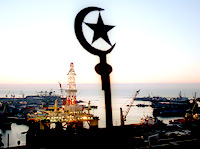
It’s a sunny Sunday afternoon in early spring, and fashionably dressed Baku
residents are strolling along the city’s Caspian Sea coast. Others are sipping tea in the outdoor
cafés that line the pedestrian esplanade downtown, amid 19th-century sandstone buildings
whose exquisite facades — European in structure, Asian in style — evoke the storied
past of this small, oil-rich land, coveted and conquered for centuries by Russian czars and Persian
Shahs.
But when I arrive at the headquarters of the Azerbaijan Democratic Party,
one of the country’s leading opposition groups, I find Natiq Jabiyev and other senior party brass
at work, oblivious to the fine weekend weather. They shake my hand firmly and give me a tour of their
office — a modest space, sparsely furnished, with worn Asian rugs covering parquet floors.
Last autumn, during Azerbaijan’s presidential campaign, enthusiastic campaign workers packed
these rooms. But they are long gone. Left behind are the pictures on the walls — pictures that
suggest obstacles inconceivable for politicians in the West.
In the meeting hall is a floor-to-ceiling painting depicting Rasul
Guliyev in front of a billowing flag. Guliyev, a former speaker of the Azerbaijani Parliament,
is the party’s chairman and would-be presidential candidate, and it’s in this room that he rallies
his supporters — by phone from New York, where he lives. He hasn’t actually been to Baku for
nearly a decade. The powerful regime that has ruled Azerbaijan for 10 years accuses him of embezzling
millions from state coffers. The party says the charges are false, pointing out that the regime
failed in its attempts to convince Western officials to extradite him. Yet if Guliyev did return
to Azerbaijan, he’d almost certainly be imprisoned. The country’s courts, like most of Azerbaijan’s
institutions, take their orders from the regime.
In another room is a photo gallery of some 70 smartly dressed party supporters.
“These are people who’ve been beaten, detained, or tortured,” Jabiyev explains. “We put a gold
star on the photos for each incident.” Jabiyev — soft-spoken, thoughtful, and wearing a
pinstriped suit — hardly fits the profile of a repeat offender. On his photo I count
five stars.
Next, we head for the office of party Secretary General Sardar Jalaloglu,
who leads the party while Guliyev is in exile. On the wall is a black-and-white poster of his face
with the words “Free Sardar Jalaloglu.” Since a few days after the election last October 15, Jalaloglu
has been spending his time with other opposition politicians: in prison.
The party officials are eager to talk to an American journalist, and
they do so for the next seven hours. They want their colleagues released. They also want the world
to know about the October election, in which Azerbaijan’s strongman, Heydar Aliyev, passed the
reins to his son Ilham, in what some have called the former Soviet Union’s first dynastic
suc- cession. In the months preceding the election, the international community had touted the
vote as a crucial test for Azerbaijan, particularly important as the country — a key ally
in the war on terrorism and a major emerging oil producer — becomes more closely involved
with the West.
The former Soviet republics surrounding the Caspian Sea sit on oil reserves
totaling as much as 200 billion barrels, or $4 trillion worth (Saudi Arabia, by comparison, has
roughly 250 billion barrels). Azerbaijan is the bottleneck through which the United States has
insisted the region’s oil must flow, skirting shorter, riskier routes crossing Russia or Iran.
BP, the largest investor in Azerbaijan, is building a 1,000-mile pipeline from Azerbaijan’s Caspian
coast to the Turkish port of Ceyhan; at the time of the October election, hundreds of millions of
dollars in public financing for the project — from the World Bank and the U.S. government’s
Export-Import Bank and Overseas Private Investment Corporation (OPIC) — were awaiting
final approval.
The election was an opportunity for the Aliyev regime, whose previous
polls had been marred by cheating, to show the world that it could behave like a mature democracy.
The balloting was also an early test for the “forward strategy of freedom” that President Bush was
then rolling out for the Muslim world. “Sixty years of Western nations excusing and accommodating
the lack of freedom in the Middle East did nothing to make us safe,” Bush declared last fall, “because
in the long run, stability cannot be purchased at the expense of liberty.”
Yet in the Azerbaijan election, stability ultimately trumped
liberty. International monitors condemned the election as a sham, replete with voter intimidation,
violence, ballot box stuffing, and brutal repression. U.S. officials had promised that vote cheaters
would be punished. But the administration — and particularly Deputy Secretary of State
Richard Armitage, who before taking his post in the Bush administration served as a consultant
for U.S. companies doing business in Azerbaijan — has continued to support its friends in
Baku, embracing the regime even as it stole the election and jailed and tortured its critics.
At the Azerbaijan Democratic Party headquarters, my hosts wanted me
to watch news footage of the election — especially the events that night outside the downtown
headquarters of the Musavat Party, the leading opposition group. Rather than a typical election-night
scene, the images resemble medieval warfare.
In most democracies, party supporters gather at their headquarters
after an election. “But here this was looked upon as, at best, suspicious and, at worst, as some attempt
to start a coup d’etat,” says a European diplomat. The rally morphed into a protest, growing tense
as Musavat supporters learned how rampant the election fraud had been. After midnight, the video
shows police in riot gear storming the peaceful crowd, breaking through a cordon of European
election observers bravely attempting to keep the peace. To a soundtrack of panicked screaming,
the police chase unarmed women and men down the street, knocking them down and battering them with
truncheons. In one scene, police clobber dozens of downed Musavat sup- porters at the front door
of the party headquarters. Their shirts stained crimson, their bodies curled in fetal position,
the protesters beg for mercy.
Even before the election, 2003 had been an odd year for Azerbaijan. In
April, President Heydar Aliyev, then 80, collapsed while delivering a speech, and by mid-July
he had disappeared from public view. This was a monumental development: Aliyev essentially was
the government. A former KGB general ruthless enough to have been regularly promoted under Stalin,
he rescued Azerbaijan from mayhem in 1993, seizing control of a failed government that was losing
the five-year war with the Armenians over the province of Nagorno-Karabakh. Within a year he had
negotiated a cease-fire. He installed friends and family members in positions of power
and marginalized or imprisoned his rivals. Throughout his 10-year rule, Aliyev’s subjects were
constantly reminded of his omnipotence through billboards featuring his image, bearing
slogans such as “Heydar is the nation, the nation is Heydar.”
Early on, Aliyev began negotiating with oil companies interested in
exploiting the country’s estimated reserves of 7 to 13 billion barrels. In 1994 he signed the $7.4
billion “contract of the century” with 10 companies, including BP, Unocal, and Pennzoil. He showed
he meant business by having Parliament ratify the contract as national law, since the post-communist
republic lacked an adequate commercial code. Contracts with other oil companies, including ExxonMobil
and Chevron, followed. To date, Western oil companies have poured nearly $4 billion into the Maine-size
country — an amount equivalent to two-thirds of Azerbaijan’s 2002 gross domestic product.
At least $10 billion more is expected in the next few years, and by 2008 the country is scheduled to
triple its output to 1 million barrels per day (ranking it just below Libya).
To improve his position in the United States, Aliyev also adopted a West-friendly
patina — appearing to tolerate opposition parties, for example, while simul- taneously
undermining them. At first, his efforts to curry favor in Washington were hamstrung by the powerful
Armenian lobby, but it didn’t take long for Aliyev to learn the Beltway game. Amoco helped him score
his first meeting with President Clinton, and oil companies pushed for a resumption of U.S. aid
to his government (which Congress had cut off during the war with Armenia). A pantheon of U.S. policymakers-turned-consultants
also chipped in on behalf of the regime — men such as Brent Scowcroft, James Baker, and Zbigniew
Brzezinski, as well as then-Halliburton CEO Dick Cheney and Armitage, whose clients at the time
included several Western companies looking to profit from the oil rush.
The war on terrorism helped the Aliyevs gain even better standing in
Washington. Azerbaijan has granted overflight rights to U.S. warplanes en route to Central Asian
bases, and it is one of the few Muslim nations to support the Iraq invasion. In return, the administration
has resumed military aid to Azerbaijan.
Even Aliyev’s critics laud his strategic triumphs. His economic record,
however, has been more controversial. The non-oil economy shrank dramatically through the late
1990s, and half the population lives on less than $26 per month. Pervasive official extortion preys
on the forgotten rural poor, among them nearly a million refugees from the Karabakh war, some of
whom have spent the past decade living in railroad cars or holes in the ground. The watchdog group
Transparency International calls Azerbaijan one of the world’s most crooked countries; the Aliyev
government is implicated in a major bribery scandal. It is this corruption and desperation that
fuels support for opposition parties such as Musavat.
Last August, a month after Heydar Aliyev vanished from public view,
a letter from him instructed Parliament to elevate his son to prime minister. Ilham, 41 at the time,
was known until recent years as a playboy with a weakness for women, gambling, and expensive cars.
Yet over the past decade it had become clear that Aliyev père intended to groom Ilham as his
successor. The son assumed a series of high-profile positions, including one as a senior executive
at the state oil company. To bolster his gravitas, he jetted around, camera crew in tow, to tête-à-têtes
with oil-industry-friendly pol-iticians such as Cheney and French president Jacques Chirac.
Both Aliyevs remained candidates for president until only a couple of weeks before the October
election, when the father dropped out, endorsing his son. Heydar died two months after the election.
Despite the election-night violence, thousands mobilized
the next day to protest. The re- gime had reported a preliminary victory for Ilham Aliyev, claiming
80 percent of the vote. Tempers flared, and the demonstra- tion soon turned into a riot, with protesters
beating police officers and the security forces retaliating ferociously. News footage shows
soldiers pummeling bloodied victims. Fleeing protesters run a gauntlet of swinging truncheons.
Security forces grin, pump fists in the air, and, like latter-day gladiators, drum their plastic
shields in celebration. The violence left at least one protester dead, according to Human Rights
Watch and the U.S. State Department, and more than 300 others seriously wounded.
Robbed of the opportunity to have their voices heard via the ballot box,
Azerbaijan’s democracy advocates pinned their hopes on pressure from the international community.
From several quarters, it came. One group of 188 observers, fielded by the Institute for Democracy
in Eastern Europe, expressed “outrage at the election fraud, intimidation, and political repression,”
adding that “if the word ‘elections’ is to retain its meaning, the events of October 15 in Azerbaijan
must be described by a different term.”
The United States had spent more than $2 million to support fair elections
in Azerbaijan. It hung posters throughout the country, bearing the U.S. Embassy seal and depicting
ballot cheaters behind prison bars. But the American response to the violence was muted at best.
The day after the protest, in a phone call to Ilham Aliyev, U.S. Deputy Secretary of State Richard
Armitage noted Ilham’s “strong performance at the polls and reiterated [America’s] desire
to work closely with him and with Azerbaijan in the future,” according to a statement. The call was
widely reported by Azerbaijan’s government-dominated media as a congratulatory handshake from
the regime’s patrons in Washington.
The State Department, in response to bad press, later issued a clarification
indicating that “the bulk of the conversation consisted of Mr. Armitage reminding Mr. Aliyev of
the importance of government restraint.” But if Armitage’s call included any such tough love,
the dose wasn’t strong enough. In the days that followed, the government arrested, beat, and tortured
dozens of opposition figures, including the Azerbaijan Democratic Party’s Sardar Jalaloglu
and Natiq Jabiyev. Close to 1,000 people were jailed, among them not only opposition politicians,
but also journalists and even election officials who refused to go along with the vote fraud. Nearly
all of the Musavat Party’s top deputies were imprisoned. One Musavat supporter told Human Rights
Watch that he had been strapped into an electric chair: “I felt the current going through me — my
artificial teeth fell out. My tongue came out and my nose started bleeding.” Testimony gathered
by Human Rights Watch suggests that many other opposition figures were tortured.
Yet the Bush administration quickly resumed business as usual. During
a December visit to Baku, Secretary of Defense Donald Rumsfeld congratulated Ilham Aliyev on winning
the presidency. At a press conference, Rumsfeld dodged questions about the election. In November,
with U.S. backing, the World Bank approved the loan for the BP pipeline through Azerbaijan. Financing
from the U.S. government’s Export-Import Bank and OPIC came through a few months later.
The Bush administration contends that it has worked hard to promote
democracy and human rights in Azerbaijan, routinely bringing these issues up with senior officials.
But “building a democracy is not like pulling down a Lenin statue,” embassy spokesman Tristram
Perry told me; rather, he said, it takes time and energy to overturn the legacy of the Soviet Union.
As examples of the progress that the Aliyev regime has made, he pointed out that “there are at least
10 new buildings in the capital since I arrived a year ago” and volunteered that as an observer during
the October elections, he was impressed by the lack of cheating at his particular polling station.
“It’s not a question of us being interested in Azerbaijan only because
of oil or its strategic interests,” a State Department spokes- woman adds. “We’re very eager to
see the country become democratic and West-leaning, and to make sure that it follows international
practices of human rights and democracy. That’s not to say that reform is an easy thing. It’s going
to take a long time.” She argues that the United States is not soft-pedaling the regime’s abuses,
pointing out that they were detailed in the State Department’s most recent human rights report,
issued in February.
During a visit to Baku in March, Armitage finally seemed to show concern
about the repression by holding a meeting with opposition leaders. Yet in a press conference, he
downplayed the postelection crisis. The human rights situation is “not as good as it could be or
should be,” he said. But “we have no doubt that it will change and will change for the better.”
Key members of Parliament from Ilham Aliyev’s party, for their part,
deny that anyone was tortured or wrongly arrested, or that the elections were falsified. They label
opposition officials “fascists” and dismiss the Human Rights Watch report as the work of
a small, insignificant organization working on behalf of Azerbaijan’s archenemy, the Armenians.
When I visited Azerbaijan this spring, Sardar Jalaloglu was still in
prison, pending an investigation into his involvement in the October 16 protests. (Jalaloglu
says that he had no involvement, nor did he attend.) He and scores of others still detained face possible
prison terms of up to 12 years.
“I think the U.S. government has played a great role in this turmoil,”
Jalaloglu’s wife, Fatma, told me, after describing how government thugs bearing Kalashnikovs
beat her husband and dragged him from their home. “They have been the foundation of the Aliyevs’
power in Azerbaijan. Before the elections, we were led to have great expectations from the United
States. But they have smothered our democracy, and now we know we can’t rely on them.”
When Armitage made his congratulatory call on October 17, it is likely
that Ilham Aliyev would have recognized his voice. For much of the 1990s, Armitage had cultivated
close ties with the Aliyev family. Business in Azerbaijan follows a schoolyard logic: A close relationship
with the ruling clique brings lavish rewards, which is why multinational companies pay top dollar
for well-connected consultants.
Armitage, Colin Powell’s best friend and second in command at Foggy
Bottom, is no stranger to the murky world of American overseas adventurism. “Big, bald, brassy,
built like an anvil, he looked as if he could step into the ring next Saturday at the World Federation
of Wrestling,” Powell wrote of him in his memoirs. It’s an image that Armitage appears to
cultivate: During the 2000 presidential campaign, he described his role on Bush’s foreign policy
team as “the guy with the mud, the blood, and the beer.” Armitage was a Pentagon adviser to the Shah
of Iran in the 1970s, and he held senior foreign policy and defense posts under presidents Reagan
and Bush. The elder Bush chose him as secretary of the Army, but he withdrew his nomination, reportedly
to avoid answering questions about the Iran-contra affair. Armitage declined to be interviewed
for this article.
When Clinton took office, Armitage did what political appointees typically
do when their party loses the White House: He set up a consultancy, Armitage Associates, to cash
in on his name and Rolodex. As the former head of the U.S. government’s aid effort for the region,
he had already won favor with Central Asian heads of state, putting him a step ahead of the swashbuckling
American oilmen who smelled money in the former Soviet Union. He seized the opportunity. His clients
included Unocal, Texaco, and Japan Petroleum Exploration Co., according to financial disclosure
forms submitted when he was appointed deputy secretary. All of these companies invested in Azerbaijan
in the 1990s.
From 1995 until he took his post in the Bush administration, Armitage
served on the board of — and for a time co-chaired — the U.S.-Azerbaijan Chamber of
Commerce, an oil-industry-dominated group that promotes economic ties between the two countries.
Ilham Aliyev has been a regular guest at its events.
The chamber’s roster of advisers attests to the Aliyevs’ ability to
attract name-brand in-fluence in Washington. It includes former secretaries of State Henry Kissinger
and James Baker as well as former Treasury Secretary Lloyd Bentsen and George Bush Sr.’s chief of
staff, John Sununu. Among its trustees are former Assistant Secretary of Defense Richard Perle
and Senator Sam Brownback (R-Kan.), a member of the Foreign Relations Committee. Cheney also formerly
served as an adviser to the chamber.
Heydar Aliyev was known to like flattery, and under Armitage’s stewardship
in the 1990s, the chamber put a premium on caressing his ego, granting him awards three times for
such accomplishments as “outstanding leadership.” (Another prominent honoree was Cheney, who
won the group’s Freedom Support Award for his lobbying in the mid-1990s when Halliburton was negotiating
several multimillion-dollar contracts in Azerbaijan.) Armitage also played into the Aliyevs’
hands when he was invited to testify before Congress in 1995 and 1996, warning about potential Kremlin
destabilization in Azerbaijan and urging a more robust American diplomatic role there. The advice
was heeded both times.
Armitage maintained his friendly relationship with the Aliyevs after
he assumed his duties at the State Department. In a speech to the chamber in 2002, he declared, “For
a long time, it was the U.S.-Azerbaijan Chamber of Commerce that was the real link between our two
nations. I think now we’ve got a pretty solid government-to-government link.”
Indeed, not only did Ilham Aliyev get the U.S. support he needed after
the disputed October elections, but the Bush adminis-tration has implemented the policies that
Cheney, Armitage, and other Aliyev allies were advocating during the 1990s: restoring
foreign assistance, supporting public financing for the pipeline, and tightening military and
diplomatic ties with the regime, despite its record on human rights and democracy. Bush hosted
Heydar Aliyev in the Oval Office in 2003.
In Baku, the American most vociferously criticized by Azerbaijani
opposition politicians and human rights monitors — besides Armitage — is Stanley
Escudero, a career diplomat who served as U.S. ambassador to the country from 1997 to 2000. These
days, Escudero wears many hats in Azerbaijan. As an entrepreneur (he imports Heineken, among other
ventures), as a consultant for multinationals (his clients include Texas-based Moncrief Oil
and British American Tobacco), and as president of the Baku chapter of the American Chamber of Commerce,
he trades in a commodity even more valuable than oil: close ties with the Aliyevs. He’s even hunted
wild boar and pheasant with Ilham.
“We welcome foreign businessmen,” Isa Gambar, the Musavat Party’s
presidential candidate, told me. But Escudero’s case, he said, raises questions about whether
the former ambassador had used his position to develop connections with the regime that he is now
using for business.
Over baklava and tea at his Baku villa, Escudero says he’s been careful
to abide by government ethics regulations since retiring in 2000. He does, however, admit to being
an unabashed supporter of the regime. “Ilham Aliyev is pursuing what is precisely the right
course for the country,” he says. “When Heydar Aliyev returned to power in 1993, this country was
engaged in a war with Armenia, in which it was losing territory on a daily basis. There were three
separate civil insurrections in addition to the war. Inflation was running at 1,642 percent
per year. There were no contracts signed with foreign oil companies. In the United States and elsewhere,
pundits were writing off Azerbaijan as a failed state which would soon be divided between Russia,
Armenia, and Iran. Heydar Aliyev brought this country back to existence.”
He points out that many of the people who ran the country into the ground
are the same ones who currently lead the Musavat Party. If they were to rise to power, he argues, the
country would risk returning to chaos. While he insists that Aliyev is not a tyrant, he notes that
“I really don’t follow this sort of thing,” when I ask about imprisoned opposition members.
As for the stolen election, he says, give democracy a generation to ripen: “The fabric of societies
like this one are inherently fragile, and if one tries to push change too fast, you run the very strong
risk of rending that fabric.”
Escudero knows the region — he was a diplomat for more than three
decades, serving in Pakistan, India, Egypt, and Iran before becoming ambassador to Tajikistan,
Uzbekistan, and finally Azerbaijan — and his views are vintage State Department. They reflect
the commitment to stability that often steers American diplomacy — the fear of just how bad
things could get, or how radical the opposition could be, that persuades Washington to embrace
“our SOB,” which at various times has included rulers such as Saddam Hussein, the Saudi royal family,
Iran’s Shahs, and Indonesia’s Suharto.
There is one diplomat who wins unanimous praise from opposition activists
in Baku: Norwegian ambassador Steinar Gil. Last October, anticipating violence following the
election, the gray-haired Gil and his wife, along with Norwegian Embassy staff, spread out around
Baku to monitor the situation. “When one sees a lack of basic rights, it is our opinion that
we should speak openly about that,” Gil told me in an interview in his office in Baku’s cobblestoned
old city. “What I saw personally was quite excessive police violence,” he continued. “But so far
I haven’t heard of any policemen brought to account.”
I asked him about Deputy Secretary Armitage congratulating Ilham Aliyev
the day after the violence in Baku. He drew his lips into a narrow smile and paused for a moment. “I
wouldn’t like to comment on that,” he said. “We didn’t make any statements congratulating anyone.
We made it clear from the beginning that the election was falsified.
“The government’s argument has been that ‘you must give us time.’ But
the principle of one man, one vote has to be respected. You don’t need 30 years to learn that.” During
the postelection wave of arrests, Gil used his official residence to provide sanctuary to a journalist
and a respected local imam; they left when the regime agreed to refrain from mistreating them, though
both were eventually arrested.
Mubariz Qurbanly, a prominent member of Parliament from Ilham Aliyev’s
party, says the government doesn’t worry too much about Ambassador Gil, as Norway is “only a small
country, like Azerbaijan.” However, he says, “if the U.S. ambassador had done the same thing, we
would have likely paid more attention, since the United States is big and powerful.”
Ironically, Gil has even closer ties with oil executives than his American
counterpart: The Norwegian state oil company is the second-largest investor in Azerbaijan. “When
you have great economic interests, of course you are interested in stability,” he says. “You can
keep [stability] by force or repression, but if you want a predictable situation, you should work
hard to create a truly democratic society. There’s no contradiction between human rights and oil
interests. Our oil company stands for the same values as the government of Norway.”