Photo By: AFP Imageforum
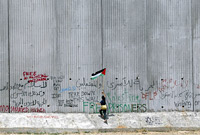
There is a 25-foot-high concrete wall in Nahayla Auynaf’s front yard. The gray mass, punctuated by cylindrical guard towers with narrow window slits for Israeli soldiers, looks from her steps like the side of an ocean liner. It is massive, cold, and alien. The shrubs, bushes, and stunted fruit trees seem to bow before it in supplication. On this August day, I struggle to make sense of it, the way I struggle to make sense of the pit that was the World Trade Center.
We do not speak. Auynaf lives with the wall. She is as drawn to it as she is repelled by it. It absorbs something deep within her. In the morning she goes out on her second-floor balcony and looks at it. Her eyes seem to implore it for answers, as if it were a Sphinx that could answer the riddle of her existence. “My old life ended with the wall,” she says in Arabic.
The wall, built by Israel in 2002, blocks her from the neighboring Israeli town of Kfar Saba, where she used to shop. It cuts her off from Israel. It makes it too hard to reach the rest of the West Bank. The lone Israeli checkpoint’s guard towers, floodlights, concrete barriers, dust, stench, crowds, special pass cards, intrusive searches, and rude remarks by border police are more than she can bear. She tried to pass through once. “I could not stand the humiliation,” she says. “I turned back. I went home. Now I never leave.”
The wall reduced her world to its ugly perimeter. Her five boys beg to go to the seaside. The wall makes this impossible. No one goes to the sea anymore. There are days when the checkpoint is sealed, days after suicide bombings or days when the Israeli soldiers shut it down abruptly without explanation. On those days, she sometimes gathers her children and walks the empty streets. Other families do the same. It gives a sense of movement. Families pass each other two, three, four times in an afternoon. All are thinking the same thoughts. “The town would rent buses to go to the sea,” she says, sadness in her eyes. “We would go for the day. We would stand in the water. We would look at the rocks and the waves. This was before.”
The Auynafs’ house is pleasant. It was fin-ished at the start of the uprising four years ago, when business was good and peace for a while seemed possible. The floors are marble. The kitchen has a counter and white appliances. The sofa and chairs have muted blue-and-beige-striped fabric. We sit in the living room. A large window fan, set on the floor in front of the open door, provides a weak breeze. The door frame is filled with the blank gray face of the wall. It draws our eyes to it, the way a muted television screen can distract a person during conversations. Sometimes we turn to look at it as if it were a presence in the room, someone who should be offered sweet tea or a glass of water — or asked to leave.
Auynaf’s son Ibrahim, six, sits on her lap. He has a scar on his leg, where he was shot two years ago. It happened at dusk. Israeli soldiers were firing at a group of Palestinian workers who were trying to slip into or out of Israel without proper work permits. He was watching from the front yard when a bullet went astray. He stays close to his mother now, especially when he hears gunshots. He does not like to leave home. The world frightens him.
The Auynaf family was one of the wealthiest in Qalqiliya before the wall ruined them. They spent $200,000 on their home with its sloping terra-cotta-tiled roof, its well-tended garden. It looks like the homes in Tel Aviv’s middle-class suburbs. Once the wall went up, the family’s car-parts business was wiped out. Her husband makes less than 10 percent of what he once earned. He has trouble shipping car parts into the walled enclosure and often cannot reach suppliers. Customers, those in Israel and in other areas of the West Bank, can no longer get to his store. He does not have a permit to drive the family car through the checkpoint. He must stand in line, often for several hours, to go in or out. He is away now. He is desperately trying to salvage his business. She hopes he will be home tonight, but she does not know. The lines at the checkpoint are long. Sometimes the soldiers get tired or bored or surly and turn people away until the next morning. “We talk and talk about how we are going to survive, what we are going to do,” she says.
On the second floor of the house is a balcony. She hangs laundry there. Her only view is the wall. The other morning she was hanging laundry to dry, and she heard singing. The song was by Fadl Shaker, a popular Arab singer. The singer had a sweet voice. “You who are far away,” the words go, “do not forget me. When I fall asleep I think only of your eyes. I think only of you.”
Her five boys were in the yard. They began to sing along. There was a chorus of voices, the sweet voice and the voices of the children. She looked into the glaring sunlight to find the singer and saw an Israeli soldier in his green uniform standing on the earthen mound on the Israeli side of the wall, the mound onto which the army drives jeeps in order to peer down on those below. He looked like an Olympian god. She thinks he was a Druze, one of the tiny, nominally Islamic sect whose members live near the Syrian border and serve in the Israeli army and border police. “He waved when the song finished,” she says. “The children waved back. Then he disappeared behind the wall.”
A few days later she was on the balcony again, pinning up clothes. She looked up and saw a soldier watching her from the top of the mound. There was no singing. His raspy voice crackled over the megaphone mounted on the jeep, ordering her to go inside and close the shutters. She obeyed. Her wet laundry lay behind in the basket. “I live in a zoo,” she says. “They come and watch me. I am a caged animal. They have the freedom to come and go, to look or not look, to be kind or cruel. I have no freedom.”
She fears madness. She points to the battered wreck of an elderly woman 200 feet away under a fig tree. “The wall was the end,” Auynaf says. “When it was finished, she went mad.”
We watch the woman, who is on her knees, keening slightly. I walk down the road and kneel in the shade beside her. She is missing many teeth. Her plaited hair is thick and white. Her name is Fatme Khalil al-Bas. She is 72. Her husband died a few years ago. Next to us are the shattered walls of an old stone house. It was her house. She was born in it and lived there until Israeli tanks blew it up in the 1967 war. She and her family continued to work the fields around the wreck of their home, never rebuilding. When the Israelis built the wall, they seized her land, and she was left with a small garden lot. Her fields, the ones where she worked as a young girl, as a mother, and as a grandmother, are inaccessible, now overgrown and untended. She left her small apartment in town to sleep under the fig tree. She has built an improvised shelter, little more than old boards placed across the branches. In the small patch of land, she grows tomatoes and cucumbers.
Much of what she says is incoherent. She rails against her husband’s second wife and then says softly, “He was a good man.” She spits out the names of Ariel Sharon and George W. Bush and Yasser Arafat, hissing with anger. She vows to protect her little plot with her life, even though she says she is afraid at night, “afraid as a woman to sleep alone on the ground, afraid for my honor.”
I stand to leave. She looks at me with plaintive eyes. I turn and see Auynaf watching us. “I am a bird in a net,” the elderly wo- man tells me.
Qalqiliya IS a ghetto. It is completely surrounded by the wall, with one small Israeli manned checkpoint to let its residents pass into the West Bank or return home. Only those with special Israeli-issued permits can enter the town. It is not the Lodz ghetto or the Warsaw ghetto, but it is a ghetto that would be recognizable to the 16th-century Jews in Rome who were herded into a walled enclave by Pope Paul IV in 1555 and stranded there for generations. Qalqiliya, like all ghettos cut off from the outside world, is dying. And dozens of ringed ghettos like it are being created as the serpentine barrier snaking its way through the length of the West Bank lays down nooses around Palestinian cities, towns, villages, and fields.
I walk down the main street. There is little traffic. Shop after shop is shuttered and closed, the huge metal doors secured to the ground with thick padlocks. There are signs in Hebrew and Arabic, fading reminders of a time when commerce was possible. Before the wall was built, 42,000 people lived here. Mayor Marouf Zahran says at least 6,000 have left since the Intifada. The unemployment rate is close to 70 percent. Beyond the wall, in the distance, I can see the tops of sky- scrapers in Tel Aviv. Qalqiliya feels like a plague town, quarantined, which may not be far from the truth. After suicide bombers slipped into Israel from here, Israeli offi-cials reportedly began to refer to it as a “hotel for terrorists.”
There are hundreds of acres of farmland on the other side of the wall, some of the best in the West Bank, and that land now is harder and harder to reach given the gates, checkpoints, and closures. The 32 farming villages on the outskirts of Qalqiliya are cut off from their land. Olive groves, with trees hundreds of years old, have been bulldozed into the ground. The barrier is wiping out the middle class in the West Bank, the last bulwark here against Islamic fundamentalism. It is plunging the West Bank into the squalor that defines life in the Gaza Strip, where Palestinians are struggling to survive on less than $2 a day. It will create perhaps 80 ghettos.
A U.N. report projects that when the barrier is finished in 2005, as many as 95,000 people will be held within such enclaves. Israel will administer little Palestinian Ban-tustans. It is ethnic cleansing, less overtly violent than the kind that I, as a journalist, saw carried out by the Serbs in Bosnia, but as effective. Israeli fanatics, some of whom serve in Ariel Sharon’s government, use the term “transfer.” Palestinians say that this is the true intent behind the construction of the barrier: to seize and depopulate swaths of their land. Thousands of Palestinians are leaving, never to return.