The phrase “Homeland Security” has become a political football, kicked around in policy debates and treated more as a platform issue than a comprehensive plan or a national imperative. George Bush has staked his political future on the perception that he, and not John Kerry, is the right man to guide the nation in an age of terror. But look beyond the rhetoric and you see a very different reality.
As Matthew Brzezinski notes in his Mother Jones cover story this month, Exhibit A in the case against the president is the Department of Homeland Security, the government mega-agency set up in the wake of 9/11 to guard against future terrorist attacks. For the past two years, Brzezinski has studied U.S. efforts to recalibrate the nation’s defenses against international terrorism. He offers his findings in the forthcoming Fortress America: On the Front Lines of Homeland Security: An Inside Look at the Coming Surveillance State, a hard-hitting and important perspective on post-9/11 changes in the security equation and what may portend for our culture and democracy.
Brzezinski gained access to officers in the Coast Guard, Customs, Immigration, Science and Technology, and Critical Infrastructure directorates. He found a disturbing combination of underachievement — 95 percent of cargo container’s entering through our nation’s ports aren’t screened for nuclear or biochemical devices; more than 15,000 chemical plants are just as vulnerable to attack as they were on 9/11 due to the lobbying efforts of the Petrochemical industry; and the war on Iraq has diverted resources away from first responders (who represent the first line of homeland defense) — and overreach -– in the form of technologies and laws, both prospective and actual, that in the name of security threaten the freedoms that define who we are as a nation.
Brzezinski recently spoke by phone with Motherjones.com about homeland security, terrorism, and the politics of fear in an election year.
Motherjones.com: Three years after 9/11 are we safer?
Matthew Brzezinski: No, absolutely not. It’s safer to fly today than it was before 9/11, but there are so many combinations and permutations of terrorist plots out there that it’s simply impossible to cover them all. A lot of the security we have is just smoke and mirrors — talk rather than action. More importantly, there are more people around the world that want to do America harm today than there were three years ago — as a result of our unilaterally going into Iraq.
MJ.com: Is genuine homeland security achievable?
MB: I think there are two forces at work here. One is elected officials, who of course want to be seen, for electoral purposes, to be doing everything they can. And the other is security professionals, who know that it is impossible to have a zero-terrorist environment, and who realize that you have to focus your energies and resources in certain areas. Elected officials and the general public have to come to understand that in some areas we’re going to have to concede that we can’t do everything. There are areas where we’re going to have to leave ourselves exposed.
MJ.com: Can you give an example?
MB: After 9/11 we said clearly aviation is a threat, so we plunked a lot of resources in there, and made it a whole bunch safer — not as safe as it can be, but safer. But then we have scenarios arise like shooting down an airplane with portable surface-to-air missiles. There’s this movement afoot in Congress calling for anti-missile devices installed on every airplane that flies. You’re looking at a proposition that will cost upwards of 30 billion dollars, which is two-thirds of the annual budget for all homeland security spending in the United States. Statistically you’re about as likely to win the lottery 2 or 3 times over and get struck by lighting than get shot down by one of these missiles, but the government has put aside $120 million to study it and may end up spending 20 to 25 billion on this.
MJ.com: What did you think about the latest Orange Alert in early August? Was there a real threat?
MB: I think the main issue here is that it was based on information that’s three years old. It’s ancient, and homeland security officials even admitted that there was no imminent threat. I think it’s a step in the right direction to start selectively going to Code Orange. Don’t put the whole country on Code Orange because you’ve got intelligence that one particular target has been selected by al Qaeda or some other extremist group. I think the election is really muddying the waters when it comes to homeland security right now. When bad news comes out about poor job growth, then all of a sudden it’s, ‘Lets talk about terrorism instead.’
MJ.com: On that note, you compare the U.S. “war on terror” to the Israeli-Palestinian conflict, in that both sides seem to have an interest in a “perennial state of emergency.”
MB: With this latest Code Orange some of the cynics like [Howard] Dean have come out and said that every time Bush has some kind of political setback, they pull out this “Let’s scare the hell out of America” trump card. I think that Senator Lieberman rightly said that Dean may have been going too far, but clearly the White House has used the fear of terrorism to its advantages to push through a certain political agendas. I don’t think they go as far as raising a terror alert just to score some political points right before an election, that may be too cynical.
But there is a parallel between the U.S. and Israel. You would never have a Prime Minister like Ariel Sharon if you didn’t have an Arafat. Sharon would not survive politically if he couldn’t convince the Israelis that there wasn’t a life-and-death threat out there from the Palestinian suicide bombers. Politicians use these situations – it’s been happening forever. And it’s a real danger that we face.
MJ.com: A related danger, you write, is that we’ll become a “surveillance state.”
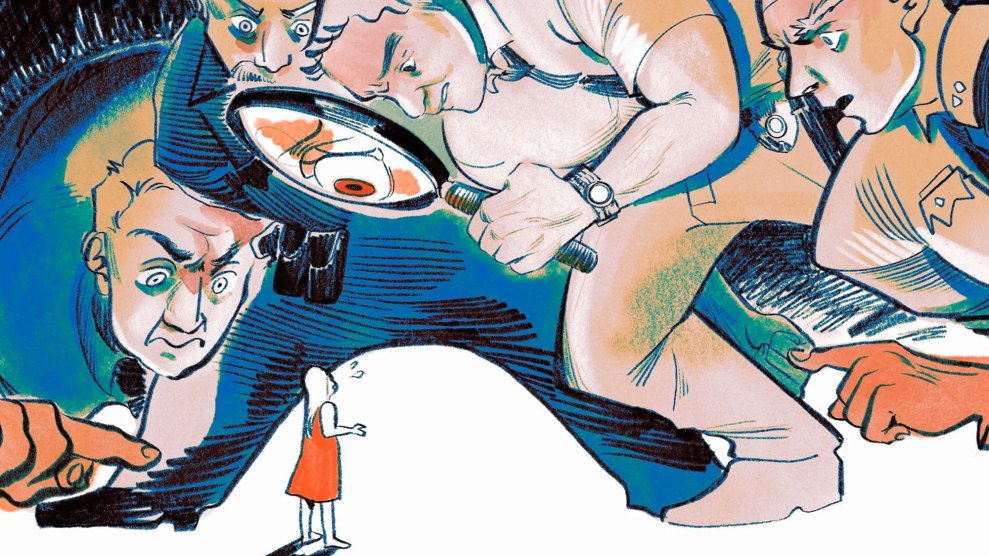
MB: The technology already exists for the government and the intelligence community to keep very close tabs on a lot of people. There’s been some recent action to mix private databases with government ones, which means that now you can find out almost anything about anybody with only a few keystrokes. And this of course can be used to all kind of nefarious ends. You can have this melding, this merging of the stuff the government knows on you and stuff the private sector knows on you, where you shop, what you buy, where you fly, what your drinking habits are. This information, if it fell into the wrong hands, could cause a lot of damage.
MJ.com: Physical surveillance is part of it too, isn’t it?
MB: Absolutely. Today we’re making incredible progress on things like face recognition. Technology can track us in ways we’re unaware of and this is just going to increase exponentially.
When I was doing this, I decided try and find the extreme example, so I went into Colorado and visited this farm that’s using technology called RFID. They’re implanting transponder chips the size of a pellet of wild rice into cattle and sheep, and so when they walk by a scanner and they’ll be able to tell if all their animals are accounted for
I heard rumors that I couldn’t confirm with the Pentagon that we were actually implanting some special forces, Black Hawk commandos, with these things, guys who couldn’t wear dog tags because they’re on sensitive missions. And lo and behold, I found that the Mexican prosecutor general and 160 of the top anti-drug cartel officers all had themselves implanted with these chips. They can walk into secure government buildings, and a scanner reads the fact that there’s a chip in these people and automatically opens doors and can access their computer. And if they’re kidnapped or killed by the cartel, these chips have GPS capabilities so satellites can find them. This is not James Bond stuff — Mexico is doing this. The stuff that I thought was science fiction a year and a half ago when I was writing is already happening. And soon we’ll take it as a norm that you’ll go to the airport and have an iris scan.
MJ.com: A main theme in your book is the CIA and FBI’s “failure of imagination” pre-9/11. Do the 9/11 Commission’s intelligence reform recommendations adequately address this?
MB: They’ve identified and brought into the political surface a problem that a lot of people have known about for a long time — it’s even entered popular culture. Everyone knows movies where an arrogant FBI official arrives on the scene and refuses to talk to the local cops or the CIA shows up and keeps everybody else out of the loop. The difference is that the 9/11 Commission seems to operate with a moral authority; it seems to be above the political fray.
I think that they great failing of the 9/11 commission was that they didn’t have the courage to say what we need. The FBI is perhaps the best law enforcement agency in the world, but it is not a counter-terrorist agency. We need one. We are the only industrial country in the world that doesn’t have a domestic intelligence agency. But politically, that would be declaring war on the Justice department, because the Justice department controls the FBI.
MJ.com: What do you make of the idea of creating an “intelligence czar”?
MB: I think in theory it’s a wonderful idea, just as in theory DHS is a wonderful idea. However, in practice, one individual, or even the office of one individual, won’t change anything. The corporate cultures of these institutions have been around for decades. They’ve been competing for points from elected officials for budgets, and there’s an ingrained distrust of each other. The fact that you all of a sudden have an intelligence czar isn’t going to make these guys go into each other’s arms and start hugging while whispering all their secrets in each other’s ear.
What might even happen, to the extent that it has happened with the DHS, is that rather than further streamlining the flow of information and the process of intelligence, it might add one more layer of bureaucracy. And it might further politicize it — especially with the elections coming — because, who’s going to appoint this person? And how long will this person serve for? And will this new czar be Republican or Democrat?
I suspect that after the election, nothing will come of this. Everyone will pay lip service, there will be commissions appointed to study the whole matter and very little will come of it. This guy can’t have a cabinet position, he can’t work out of the White House. It almost has to be a gig like the chairman of the Federal Reserve, where he’s appointed for something like eight years, or like a Supreme Court justice where he can’t be fired and he has ultimate control. But then you’re talking about giving someone extraordinary power and then letting them loose. I’m not sure if the political establishment is really ready — on either side — to do something like this.
MJ.com: You write about the difficulties in gaining access to the DHS and get a straight answer from their officials. If that’s the case, how then can the public hold government officials accountable?
MB: That’s the whole point. They don’t want you to. How many times have we heard “Arafat’s people were planning the following three horrendous crimes, but we can’t tell you what they are, just trust us, we had good reason to blow up that compound and kill innocent bystanders”? How many times have we heard from American politicians, “Trust us, we know we have WMD’s in Iraq, that Iraqis are behind 9/11? We can’t tell you the evidence because it will compromise the security of our sources, but trust us.” They can invoke secrecy. Often there are very legitimate reasons to do so in intelligence operations, especially if you have undercover agents whose life may be at risk. But for every one of those situations you might have 50 or 100 situations where people are just using this give a big snow job to the general public.
MJ.com: Is it true that, as you write, “freedom has a price, and some people were going to have to pay more than the rest of us?”
MB: I think that it’s clearly up to the legal system to set the boundaries. The Supreme Court has taken its sweet time, but they have already laid down the law and said this “enemy combatants” notion is bunk and unconstitutional. Emotionally, politically, legally, everywhere, we overreacted a little after 9/11, and now we’ve found that we’ve gone too far. The courts are now setting the limits, so the next time we’re not picking up 20 thousand Muslim immigrants. I think we’ve already begun establishing the parameters of what is acceptable within the social values and the legal system of this country.
But remember, when all these people were picked up, there was no big fish at all. The intelligence they gleaned was virtually inconsequential. In the end the United States government loses much, much more potential information and intelligence with these sweeps of detainees. Because in the case of 9/11, the Muslim community in the United States would have bent over backwards to disassociate itself from terrorism and to help US and to prove that “Hey we Muslim immigrants love this country as much as everybody else that’s why we came here.” And of course, who’s in a better position to know if something’s dodgy about some immigrant rather than the immigrant community itself. All the good will and the potential fount of information from guaranteeing the cooperation of the Muslim community went right out the window when we began locking them up and then deporting them by the planeload. Nobody wants to talk to the FBI now because, well, they might deport you and the whole family. So there is a tremendous waste of potential knowledge out there. And that’s just an example how one practice or policy ends up, in the long term, getting us far less intelligence, a lot of bad press and bad sentiment as well.
MJ.com: How do first responders and security officials feel about needed resources having been diverted to the war effort?
MB: Iraq has blown HS out of the water. The first responders feel frustration and that nobody cares about them. Everybody wore NYFD caps a year after 9/11, but that hasn’t translated to the equipment that they need, the political support that they need, the money that they need, and the training that they need. They’re extremely frustrated by what’s happened -– it’s just not a high profile issue. A paramedic just doesn’t seem to capture the public’s imagination the way the FBI or special ops people do. It’s a bit of a shame because when another catastrophe along the lines of 9/11 happens, innocent first responders will die without the proper radios or equipment they need. And we’ll have another round of soul searching and subcommittees, and we’ll say, “Oh yes, we’ll need to get them better equipment,” and we probably never will.
MJ.com: Why do policymakers keep pushing them aside?
MB: They just don’t have the representation in Washington. The President knows who the head of the FBI is. All of the policy makers on the intelligence committees and security committees, they know who the top FBI people are, and the same goes for the CIA, NSA, the military, etc. All the lobbies are very well established, but local law enforcement and first responders don’t have a powerful in-place Washington bureaucracy. There is not central Cabinet-level administration that handles these things. Ultimately the money that gets doled out in Washington gets doled out because of lobbyists.
MJ.com: What do you feel is the biggest potential threat still currently being overlooked?
MB: Clearly it’s the petrochemical industry. We have a plants in numerous high-population centers, and because of special interests, we are not defending them properly. I purposely decided to go see how the Israelis treat their heavy industry and I’m telling you its like Fort Knox. I couldn’t get within 50 feet of these things without underground sensors already picked me up and hidden speakers were screaming at me. This was a natural gas reservoir, and they protected these things the way we protect our nuclear silos. But a few months before I visited Hamas had tried to blow it up.
We definitely have the potential for a chemical Chernobyl in this country and we knew this right after 9/11. There were measures in Congress to increase security at plants and better regulate the transportation of chemicals. A single tractor-trailer that you see on the highway or rail car full of chlorine can kill tens of thousands of people. Imagine how many tens of thousands we have every day traversing the country. But the American Petroleum Institute lobbied to stop the bill from passing in Congress, so we’re just as vulnerable today as we were on 9/11.
MJ.com: Do you see a change in the way both the public and the media are responding to DHS?
MB: I think the issues have changed because they’ve become so politicized — now it’ s a pissing match over who’s got the bigger homeland security platform. And unfortunately the entire purpose of the 9/11 commission hearings was highjacked. The pundits and CNN focused on whether Condoleeza Rice and Richard Clarke’s testimonies had done damage to the White House. That’s is not what it was about. It’s about fixing the things that don’t work and highlighting what we’re doing well. That was lost on the American public. And this is a bit of the unfortunate experience with homeland security as well. The public has become so jaded with the absurdity of empty alerts they’ve become disengaged from it, saying the whole thing is overblown for political purposes because there isn’t really that much danger, there isn’t that much threat, they’re just making it sound like a big deal. And that’s dangerous as well, because then we won’t have the political will to make the sort of sacrifices financially to be proactive rather than reactive in terms of security.
The cynicism is rising, even to a point where people who I talk to who are conservative and republican are getting a little fed up with it. The DHS is coming under criticism even from conservative think tanks right now. There clearly is a rising tide, and it’s not just the media — it’s the general public and the policy establishment in Washington.
MJ.com:Where is the DHS headed?
A lot will be determined with the election. If the president wins, nothing will change. If Mr. Kerry wins, who knows? People are hoping things will change. Just the other day I was speaking with someone who works in one of the DHS agencies. He’s a conservative but he’s voting Kerry because he really wants things to change. A lot of his colleagues, like him, are extremely frustrated due to the lack of funds, the lack of respect, and the lack of authority they get. All of their successes are being highjacked by the politicians, and they’re just sort of stuck with the failures. When something goes wrong it’s always the fault of the Coast Guard, or Customs, or INS. When something goes right its always Tom Ridge or John Ashcroft that gets the credit. For the people who work in the rank and file, who don’t get paid a lot of money but do it because of love of country, they want recognition if they do their job well. And they’re not getting it under the current setup. So there’s a lot of frustration there.