Photo: Rudy Archuleta / Redux
If you’re like most Americans, you’ve spent your life invisibly attached to an electric meter. When you wake up and switch on the light, you nudge it forward a little faster. When you toast bread, watch TV, open the fridge, flick on the computer, you push its pace. For all practical purposes, it only goes one way.
But in the last few years, a small but quickly growing band of Americans have found out that you can make the meter spin backward. These are not the off-the-grid, back-to-the-land, composting-privy sorts who pioneered the renewable energy movement in its early days. No, these are suburbanites (and city and small-town dwellers) who are installing photovoltaic (PV) systems on their roofs — systems that tie directly into the power grid. They buy power from the local utility, just like always. But when the sun comes out, they are the local utility, pulling electrons from the sun and pushing the extra out to the grid.
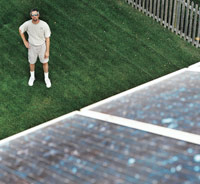
Christian Grieco, for instance. IT consultant for a cable TV company. Lives in a cookie-cutter suburb of Albany, New York — that’s him in the two-story colonial with the quarter-acre lot. And the 24 panels on the roof. He explains, “I called my neighbor over and said: ‘You see it spinning backwards? My electricity is going into your refrigerator.'”
I know how he feels, because we put 12 of these panels up on our roof last spring. Now, when friends come to visit, they are forced to ritually admire the new system, much as we once permitted them the pleasure of viewing, say, our infant’s new tooth. A stop by the electric meter to see it performing its trick is now de rigueur on sunny days.
Ten years ago, such a scene was all but impossible. For one thing, the local utility wouldn’t allow it — partly because it was a hassle for them, and partly because it was a danger to line repair crews. So the key invention was a simple and reliable “inverter” — mine is a little red box in the basement, a “Sunny Boy” model, built in Germany. It translates the electric conversation between my rooftop, which is now a 2-kilowatt power plant, and the rest of the grid; there’s a device performing much the same function at nuclear reactors and coal-fired power plants and hydro stations and all my brother providers. If I produce more power than I use in a given month, I get a credit. Most months, my electric bill just gets substantially smaller.
Which brings us to the other reason this didn’t happen a decade ago: The economics didn’t make sense. Though the sun provides energy for free, the cost of the panels and other gear was so high that solar couldn’t begin to compete with grid power. In a sense, it still can’t — solar energy in this country costs consumers something like a quarter per kilowatt-hour, compared with something like a nickel for conventional fossil fuel. But that’s starting to change. Not because regular electricity is getting a lot more expensive; with its abundant coal America can generate cheap power for a very long time. But because — sporadically, haltingly, and over the objections of the federal government — America is beginning to realize that the real cost of cheap energy is considerably higher. That burning coal means polluted air, sick kids, global warming. And so, in a few key places, government is beginning to tilt the balance. If you put in a solar system in New Jersey, the state will cover as much as 70 percent of the cost. In California and in New York, about half. A scattering of other states — including Arizona, Vermont, and Massachusetts — offer similar subsidies.
The pressure for such programs is increasing as the news about climate change becomes more urgent — in August, a study in Science reported that solar technology was developed enough to play a major role in fending off global warming, but only if we increased its use 700-fold in the next half-century. That sounds impossible — but it’s only a 14 percent annual increase, less than half the current global rate. “It was about three years ago that solar started to go into an overdrive growth rate worldwide,” says Christopher Flavin, director of the Worldwatch Institute, a Washington environmental monitoring group. More solar power has been harnessed on the world’s rooftops in the last two years than in all of previous history. And now Americans are stepping up to the plate in rapidly increasing numbers. One solar panel manufacturer calculates that the domestic PV market is growing as fast as 60 percent a year, fast enough that within a decade, California alone should have more solar panels than any single nation. “The global installed capacity will hit a gigawatt this year,” says Randy Udall, head of the solar program in Aspen, Colorado, one of the nation’s most advanced solar cities. On the one hand, that’s barely more than two big coal-fired power plants. Still, it’s enough to encourage an industry: The world spent $20.3 billion on development of solar and wind power in 2003, one-sixth of the total global investment in power-generation equipment. Notes Udall, “This is not a children’s crusade any more.”
The subsidy for renewable energy doesn’t come close to matching the billions in government support for fossil fuels, which includes everything from the oil-depletion allowance to the endless federal largesse for “clean coal” research. Still, the government help, almost all of it from states instead of the federal government, is crucial. “Absent that, I couldn’t have done it,” says Grieco, who took advantage of New York’s law to cut his costs in half. “I didn’t have $31,000, but I did have $15,000.” At that rate, he’ll have a 20-year payback on his investment, and the panels should last another 20 years after that.
Dori Wolfe’s company, Global Resource Options, installs systems across the Northeast. They did $1.3 million in sales last year. This year, thanks to the rebate laws, they were closing in on $3 million by September. Some states, like Vermont, consistently max out the government funding pool — “as soon as a customer commits,” says Wolfe, “I get the paperwork to the state capitol so they don’t miss out.”
In a perfect world, people would buy clean power even without subsidies, simply because they wanted to help clean the atmosphere. But, as Udall points out, much as Thomas Jefferson mystifyingly managed to overlook the fact that he owned slaves, we now collectively overlook our production of 45,000 pounds of greenhouse gases per family per year — enough to fill two Goodyear blimps. Surely our descendants will wonder why we didn’t notice, why we did nothing.
But instead of waiting for people to give up their slaves, the program Udall runs in Aspen will buy them back. Launched in 1994, it’s one of the most innovative and successful solar-subsidy operations in the country: When some movie exec builds a 10,000-square-foot palace in Aspen, he must either pay to install a large solar system on his roof, or write a check for $10,000 to the Community Office for Resource Efficiency, which uses it to underwrite zero-interest loans for other homeowners going solar. There are now solar mobile-home parks in the Mojave Desert and solar public schools in Massachusetts; the University of California at Berkeley has 312 panels atop the student union.
You’d kind of expect solar panels in Berkeley. But maybe not in Placer County, on the California-Nevada border, where a developer named U.S. Homes is planning a new 917-unit solar housing development. A smaller builder, Clarum Homes, has been building “zero-energy” houses in places like Watsonville, in California’s Central Valley. “Our goal is to bring green energy to entry-level home buyers,” Clarum cofounder John Suppes said earlier this year.
Not all of those panels are in places we think of as sunny. “If you look at a solar map of the United States,” says Wolfe, “down in Florida they get four hours of sun on an average day. In Vermont, it’s three. But of course, they need more electricity because everyone has air conditioning. It all evens out.” In fact, the map of installed solar capacity in the United States follows much more closely the map of rebates and tax credits — and the map of high electricity prices.
To really understand the math, consider Japan. It gets half the sunshine of California, but it has three times the installed photovoltaic capacity of the United States. “Electricity in Japan costs 20 cents a kilowatt-hour,” roughly four times the U.S. average, notes Flavin of the Worldwatch Institute. “They don’t have their own cheap fuel — they have nuclear plants, they have imported liquefied natural gas.” So they were open to the idea of solar panels, and in the early ’90s the Japanese government started offering subsidies for installations. After the country hosted the Kyoto conference on global warming in 1997, efforts increased: a “70,000 Roofs” program drew massive national publicity, and as of last year, the actual number of PV installations had reached more than twice that goal. That’s created enough momentum to drop the price of solar installations by as much as 80 percent since 1993 — and move most of the world’s panel factories to Japan. The result: Rooftop power now costs the Japanese, on average, between 11 and 15 cents per kilowatt-hour, well below the price of conventional juice. As Worldwatch researcher Janet Sawin detailed in a report last May, things have gone so well that government subsidies are now being phased out and it’s not making a difference: The market is expected to grow 20 percent a year even without the extra support.
Much the same has happened in Germany, where a 1991 law forced utilities to buy any renewable power that anyone generated, and at a generous price. Since then, the country’s solar capacity has been growing almost 50 percent annually. Germany has topped its “100,000 Rooftops” goal and is now aiming for a million; it already produces more energy from the sun than any nation except Japan. “It’s amazing to see,” says Sawin, who recently returned from an international conference on renewables in Germany. “You go up into the hills, into the Black Forest, and you can see where one house or one barn put up solar panels, and then it just swept through the community. You have whole swaths where all the south-facing roofs have panels.” You also have 10,000 people working in the solar industry.
Yet with the exception of BP, which is the world’s largest maker of solar panels, big energy still doesn’t take the new renewables seriously, says Sawin — after all, wind and sun still represent less than 1 percent of the world’s electric generation. “It mirrors the attitude of IBM toward Microsoft in the early 1980s,” she says. But the growth rates for solar power — 22 percent annually for a decade — are like those for personal computers or cell phones in their early years, fast enough, Sawin says, to “rapidly vault a new industry from insignificance to market dominance.”
Of course, buying a new cell phone means…buying a new cell phone. It’s new. Installing solar means turning your back on the electric connection that’s working perfectly well, and pretty cheaply. Inertia is hard to overcome. Still, the curve of installed solar capacity is growing not just steadily, but exponentially, with growth rates rising from around 18 percent in 1997 to 30 percent in 2003; the momentum is clearly increasing.
Some of the same momentum can be seen in U.S. states with aggressive subsidies, but the total numbers are much smaller. Our particular subsidy programs have been piecemeal, expensive, and not always very well designed; prices have fallen more slowly here than analysts had expected, partly because the state support has removed much incentive for manufacturers to lower them. Instead of simply giving cash payments or tax rebates and hoping that the increased volume will eventually bring prices down, David Morris, an energy expert at the sustainability think tank Institute for Local Self-Reliance, says governments should be purchasing panels directly from manufacturers, pledging increasing sales in return for decreasing prices. For the moment, though, that seems unlikely. The Bush administration’s energy policy has made token nods in the direction of renewables while preparing for a future that belongs to the oil, coal, gas, and nuclear industries. “The United States is widely seen as being on the sidelines,” says Flavin. “A bunch of us were at this conference on renewable energy [in Germany], and it was clear that it was designed to get around the obstructionism of the United States on topics like the Kyoto accords. It was really a kind of coalition of the willing.”
In certain ways, a solar panel on the roof is very much like a hybrid car in the garage — it works its environmental magic without asking any change in lifestyle. Because the hybrid switches back and forth between gas and battery, just like the grid tie-in switches back and forth between your roof and the power line, you never need to think about running out of anything. The old-fashioned, off-the-grid PV systems are like old-fashioned electric cars — the batteries will drain unless you’re careful. You need to start thinking: Do I need this appliance? How much TV am I going to watch this evening? Can I combine all my trips in one this week?
Remarkably, though, while the new systems don’t force you to conserve energy, they end up having the same effect — in much the way that hybrid drivers, who could get 47 miles to the gallon driving any old way, suddenly find themselves feathering the pedal to bring their average up to 54. “I remember a guy recently [who] put in a 2-kilowatt system,” says Wolfe. “He just wasn’t interested in conserving at all. Didn’t even want to talk about it. But after he watched the meter spin backward the first time, he said, ‘You mean I could make this spin backward faster?’ Now he’s putting in new lightbulbs, a new refrigerator, you name it.”
It’s weird, says Chris Andersen, a solar homeowner in Albany. Even though you’ve now got a new supply of free power, “the incentive of the meter spinning backward makes you take the time to hang out the laundry. I mean, I’ve got an efficient dryer, but now I use the clothesline all the time. It gives you the desire to walk the extra 10 feet to turn off the lights.” Grieco has retro-fitted his house with power strips on all the appliances, so he can make sure he doesn’t waste even a smidgen of electricity keeping the television in standby mode. “Why do I want to be wasting electrons?” he asks.
Every month, when the utility bill comes, it’s as if you’re being graded on your success. “I get grouchy — ‘You mean we haven’t reduced more?'” says Wolfe. “Our goal is always to net meter to zero — to try and live within our photovoltaic means.” Once, she says, she was outside watching her meter spin backward when all of a sudden she heard a sound from inside — “A zzzzzz, like someone had turned on the coffee grinder. And the meter started spinning forward. I mean, my shoulders just stiffened.”
In the end, it’s not about money. It’s that this power is somehow your power. If you grow a tomato in your garden, you’re going to pay more attention once it’s in your salad than if it came from the supermarket. Suddenly, once you’ve got your panels up, electricity goes from being an abstraction to being a creation, a product. Very few of us make anything very tangible anymore; to produce solar power is to churn butter or milk a cow or card some wool, but in a modern way. Atavistic urge, newfangled result.
And what’s more, it’s power in a delightful form. We’re used to thinking about energy as fuel — concentrated by nature over eons into a lump of coal or a barrel of oil. As Udall points out, though, solar and wind are energy flows. “Everyone gets some sun; it’s the most democratically distributed of fuels. And it’s so sweet. Those rays have come 93 million miles in eight minutes, absolutely hauling ass.” Every day 10,000 times more energy strikes the earth than we humans use. If the sun’s out, it’s hitting your roof right now, and bouncing back unused into the atmosphere—a wink unnoticed, a flirtation ignored, a gift refused.