Photo Illustration by: John Ritter
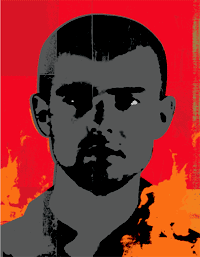
On December 2, 2001, John Walker Lindh made one of the strongest first impressions in American history. Captured in Afghanistan, there he was on CNN, scraggly, injured, occasionally wincing in pain. Though American, he seemed jarringly foreign, with his Arabic accent and heavy beard. He spoke of training camps and jihad, words that were especially potent so soon after 9/11, when Americans were still obsessively watching nightly replays of the carnage. It would be a month before Lindh was charged with any crime, but in a sense, his journey through the criminal justice system began with that TV appearance, which instantly labeled him “The American Taliban.” For much of the public, it established his guilt as a traitor — or worse.
Seven months later, Lindh — having eventually been granted access to the lawyer his parents had hired for him — agreed to serve 20 years in prison for providing service to the Taliban; then he dropped into the shadows. But the climate surrounding the war on terror has changed, and his case looks different with the benefit of hindsight. He made allegations about his treatment at the hands of U.S. captors — including being tied naked to a stretcher, blindfolded, and photographed with mocking soldiers — that are now more chillingly believable in the wake of the prison abuse scandal at Abu Ghraib. And since his plea, the government has come under mounting scrutiny for its legal tactics — and spotty record — in pursuing alleged terrorists. Not only have several much-ballyhooed cases petered out, but the government’s strategy has lacked consistency. Until recently, Lindh was considered lucky in that he got to appear in court, his prominent lawyers by his side. Meanwhile, “enemy combatants,” a loosely defined term applied to many deemed on the wrong side in the war on terror, were held at Guantanamo Bay or U.S. military brigs, without being charged and without access to lawyers or the courts. In June, the U.S. Supreme Court finally ruled that such prisoners couldn’t be detained indefinitely without the chance to challenge their standing.
Soon after this setback, word came that the Justice Department was willing to release Yaser Hamdi, a high-profile combatant whose case bears striking parallels to Lindh’s. Hamdi is also an American citizen captured in Afghanistan after allegedly taking up arms with the Taliban. While many details of the two cases remain classified, the seeming disparities in their outcomes are hard to ignore. Suddenly, Lindh’s sentence seems more draconian, belonging to a period when the prosecutorial zeal of John Ashcroft’s Justice Department went unchallenged.
After news broke of Hamdi’s pending release, Lindh’s lawyer, noted San Francisco attorney James Brosnahan, called on the government to revisit his plea agreement. Brosnahan won’t discuss any formal steps he might take, and his chances of ever getting Lindh’s sentence reduced are slim. Yet a fresh look at Lindh’s case says a lot about the administration of justice during times of intense national fear. “What’s interesting is being in the middle of a war psychology,” Brosnahan says. “The reason I think that’s interesting is we’ll be there again.”
It’s hard to separate Lindh’s prosecution from the times. When the 20-year-old kid from Marin County, California, made his unforgettable entrance into American living rooms, commuters on both coasts feared that bridges would blow, and the anthrax attacks were gaining a suspenseful horror each day. The nation was plastered with flags, and a sense of betrayal further ignited rage against Lindh.
He’d long since departed from any typical teenage path, arriving in Yemen several years before 9/11 to study Arabic. He found his way to Afghanistan well before the U.S. invasion, finding common cause with the Taliban in its fight against the Northern Alliance, which he saw as a brutal enemy. In other words, his lawyers say, he intended to fight in a foreign civil war out of religious belief — not a hatred of the United States. But a far more nefarious version of his story dominated the news, with headlines calling him a “rat” or “Johnny Jihad.” Even Mitch Albom, author of the sugary Tuesdays with Morrie, penned a merciless column about the “turncoat” Lindh, who was “willing to hold a gun to an American’s head.” Attorney General John Ashcroft spoke of Lindh’s “allegiance to those fanatics and terrorists,” and papers cited anonymous government officials who hinted that the death penalty would be sought. Weeks before he was charged, a Gallup Poll found that 70 percent of Americans thought he should be imprisoned or executed. As one former Justice Department official observes, Lindh emerged as “the second coming of Osama bin Laden.”
Frank Lindh, a lawyer with Pacific Gas and Electric, had once litigated a case opposite Brosnahan, and called him on a Sunday afternoon to ask him to take his son’s case. Brosnahan, a former Iran-Contra prosecutor and senior counsel at one of San Francisco’s biggest law firms, Morrison & Foerster, has handled many politically charged cases, including the defense of Arizona religious workers charged with sheltering illegal aliens. He “loves being on the side of the damned,” notes San Francisco attorney John Keker, a courtroom adversary and friend. Never was there a client as damned as Lindh. “It was a lonely case,” Brosnahan says. “We always have our supporters, but outside the family and the lawyers, we didn’t have anybody.” Faced with objections from some of his partners and fears about security, Brosnahan took the unusual step of keeping the firm’s name off court pleadings.
Although for much of the public Lindh’s guilt was a foregone conclusion, Brosnahan and his team mounted an aggressive defense to try to prove that Lindh’s alleged confession — both to CNN and later to the FBI — was coerced and should be kept from court. (He faced 10 charges in all, including conspiring to kill Americans and providing service to Al Qaeda.) The defense filed a detailed narrative of Lindh’s movements beginning in November 2001, when his unit, fleeing from Northern Alliance forces, went to a fortress outside Mazar-e-Sharif under a negotiated surrender. There, a prison uprising erupted, and Lindh took refuge for seven days in a fort basement. Shot in the leg, he watched 100 men die beside him as Northern Alliance soldiers poured fuel down air ducts and set it on fire, then flooded the basement with freezing, waist-high water.
According to the defense document, Lindh talked to CNN after emerging from the basement “wounded, starved, frozen, and exhausted,” while a medic worked on him and doped him up on morphine. As they interrogated him over five or six days, U.S. forces left the bullet in Lindh’s leg, kept him blindfolded, gave him little food, and “taunted [him] with derogatory epithets.” At one point, U.S. soldiers came into Lindh’s room and posed with him, scrawling “shithead” on his blindfold, the defense document stated. The soldiers told him he was “going to hang,” with one saying he’d like to shoot him on the spot. By the time he finally sat across from an FBI agent, Lindh had been stripped naked, taped to a stretcher, and kept in a cold, windowless shipping container for days. The New Yorker quoted a Navy doctor describing Lindh as “disoriented…suffering lack of nourishment…suicide is a concern.”
The government maintained that Lindh was treated well, countering in a court filing that “Lindh had to take extraordinary measures to insert himself into this war…and he should not now be heard to complain that life on the battlefield was unpleasant.” They also said that Lindh was “meticulously tended to” and “ultimately returned unharmed, healthy, and strong to the country he had forsaken.”
Beyond physical abuse, the defense claimed Lindh was denied his right to a lawyer. Military personnel did not read him his Miranda rights during initial interrogations — the government claimed an exception because he was captured on a field of war. During his crucial interview with the FBI, however, the government said it did inform Lindh of his rights. But his defense team claimed he was also told, “Of course, there are no lawyers here,” and he wasn’t informed his parents had hired counsel for him. Even if Lindh were told of his right against self-incrimination, his confession to the FBI should have been tossed, asserts criminal-procedure expert Yale Kamisar of the University of Michigan Law School. His treatment at the hands of the Northern Alliance and U.S. soldiers leading up to the interrogation mattered as much as anything the FBI did later. “Because of the incredible ordeal he went through, they had to do more than give the standard warnings,” Kamisar says.
“We had some very interesting issues there,” Brosnahan says. “It’s hard to describe how much we wanted to try this case as lawyers.” Brosnahan was planning to put Lindh on the stand at the suppression hearing, and “he was not going to be what America had been led to believe.” Lindh’s devotion to Islam began when he saw Malcolm X as a young teenager and was captivated by the scene of a pilgrimage to Mecca. Many profiles have focused on his obsession with hip-hop and his allegedly anti-American sentiments, but in Brosnahan’s telling he was a devout, bookish kid with a “very high IQ” and a decided naivete. “He thought you read books and the world would kind of be like that,” Brosnahan says. “He’s not a hater. He had no interest in fighting Americans. What he was, was a convert to Islam.”
The defense won an important point when U.S. District Judge T.S. Ellis III indicated that he would likely allow them to interview witnesses at Guantanamo who might back up Lindh’s version of events and undercut the terrorism charges. Otherwise, however, the defense’s prospects did not look good. The government had brought the case in Alexandria, Virginia; jurors could likely be government, even Pentagon, employees. Judge Ellis, courtroom observers say, showed little sympathy for the defense’s arguments. Lindh’s lawyers faced an extremely high legal hurdle to prove that he hadn’t made his statements freely. If they lost, they would be left to try their hand with the 4th Circuit Court of Appeals, the most conservative in the country.
The national political climate made proceeding to trial highly risky. Patrick Brown was a defense lawyer in another high-profile terrorism case in Lackawanna, New York, in which a group of men — initially described as a terrorist cell — had spent time in an Al Qaeda training camp in Afghanistan. (See “Living in an Age of Fire,” March/April 2003.) Brown, who says his client did not intend to train as a terrorist and left early, notes that such cases have few legal precedents, and the national mood “had a chilling effect on the ability of the client to say, ‘Let’s test all this.'” Brown says he’s now “embarrassed to be associated with” the Lackawanna case because “we basically buckled.” His client took a plea of eight years for providing material support to Al Qaeda.
When Lindh’s team conducted a survey to gauge the potential pool of jurors, “I’d never seen that level of animosity,” Brosnahan says. His attorneys would have to explain why he ended up at a training camp that was associated with bin Laden, and later joined Taliban fighters, and carried grenades. “It’s hard to imagine an innocent explanation for that,” says Katherine Darmer, a professor at Chapman University School of Law who’s written about the Lindh case. Brosnahan says Lindh “felt he was defending Islam” and went to a military — not terrorist — training camp. He joined the Taliban army, and was never a member of Al Qaeda. But at the time, distinctions about the enemy were barely on the radar. “In the eyes of many U.S. soldiers and lower-ranking intelligence agents, this was all one war,” notes Doug Cassel, director of the Center for International Human Rights at Northwestern University Law School. “Taliban, Al Qaeda, what’s the difference? Well, the difference was enormous.”
On the eve of what promised to be a dramatic showdown in court on the admissibility of Lindh’s statements, Brosnahan says a government lawyer approached him about a deal. The two sides negotiated in marathon sessions until Brosnahan visited Lindh in jail on a Sunday after midnight to finalize the agreement. While reports at the time said even Judge Ellis was surprised that a deal had been struck, both sides had ample motivation. Lindh faced three counts each calling for a life sentence. Brosnahan had been holding out hope that the jury would include one or two parents of teenagers who would understand the trouble they can get into, but “there are realities. There would be a jury called in that district, and the judge would be the judge.” And, Brosnahan says, the defense was told that even if Lindh won an acquittal, he could still be named an enemy combatant and held indefinitely. For the government’s part, striking a deal would mean that the defense wouldn’t interview witnesses at Guantanamo, nor would it introduce potentially embarrassing testimony about Lindh’s treatment at the hands of U.S. interrogators. (The U.S. Attorney who handled the case declined to speak to Mother Jones.)
At the time, a 20-year sentence for the American Taliban seemed almost cushy. “Because the administration had puffed up this case so much when it brought it, it was forced to seek a very harsh sentence,” says terrorism expert David Cole, a professor at Georgetown University Law Center. The terrorism charges were dropped, and Lindh pled guilty to providing services to the Taliban and possessing explosives while committing that felony. “Our goal, frankly, was to give him some kind of future in the chaos,” a chance at release while he was still in his 30s, Brosnahan told Newsweek at the time. Lindh had to stipulate that he was not “intentionally” mistreated by the military — language that, through the lens of Abu Ghraib, takes on new significance. The plea also contained the unusual provision that, for the rest of his life, the government could summarily designate Lindh an enemy combatant if it found he engaged in terrorism-related activities.
Being designated an enemy combatant is, of course, exactly what happened to Yaser Hamdi, a fellow American citizen captured in Afghanistan (Brosnahan says he emerged from the same basement as Lindh). Hamdi was held in solitary confinement for two years without access to a lawyer, let alone the ability to challenge his detention. The government never indicated that it wanted to charge him, says his lawyer, Frank Dunham, and its explanation for holding him was limited to an affidavit from a military official alleging that he had “affiliated with a Taliban military unit and received weapons training.”
Until recently, Lindh’s fate was widely viewed as preferable — the benefit of being obviously American, unlike Hamdi, who was raised in Saudi Arabia and not initially identified as a U.S. citizen. But much has changed in two years. Abu Ghraib has given allegations of mistreatment like Lindh’s a greater ring of truth. And in June, the Los Angeles Times gave a further boost to his credibility when it reported that previously undisclosed government documents showed that Defense Secretary Donald Rumsfeld’s office told military intelligence officers to “take the gloves off” when interrogating Lindh. A Defense Department spokesman told Mother Jones he was not aware of the Times article, but added that Lindh “enjoyed the fruits of the American legal system to the utmost.”
But that system has produced some questionable results. In late August, officials admitted that previously undisclosed evidence shot a hole through a highly publicized case involving an alleged “sleeper operational combat cell” in the Detroit area. Another case that deflated involved a sting operation in Albany, New York. Prosecutors argued in August that one of the defendants’ names had turned up in a notebook in an Iraqi terrorist camp with the notation “commander,” but later admitted they’d misinterpreted a word that meant “brother” or “mister.” The judge noted there was “no evidence” showing the man had “any contact with any terrorist organization.” A Justice Department spokesman says, “We’ve acknowledged that there may have been a mistake in Detroit,” but overall, “our record is strong.”
“The war on terror doesn’t look too black and white anymore,” says Juliette Kayyem, head of the national security program at Harvard’s Kennedy School of Government. “John Walker Lindh came up first, and everyone thought he was a bad guy. Now that we’ve seen case after case fall apart under the weight of evidence, you wonder, ‘Hmm, is that story about Lindh not what I thought?'”
But the biggest rebuke to the Bush administration came last June when the Supreme Court ruled that Hamdi had the right to challenge his status as an enemy combatant. At that, the government began negotiating with Dunham for his client’s release, perhaps because it lacked evidence to prove he was ever a true threat to the United States. (Hamdi didn’t give any damning TV interviews, and much of whatever the government had on him remains classified.) When he was released in September and was returned to Saudi Arabia, Hamdi had to give up his American citizenship. “It’s debatable whether he comes out better or worse than Lindh,” Dunham says.
Still, the Hamdi case begs the question of whether Lindh’s long sentence should be reassessed — at least in the court of public opinion. “Surely in his case we lost our sense of balance and proportion,” says Mary Cheh, a specialist in constitutional law and criminal procedure at George Washington University Law School.
There’s little legal recourse for Lindh, however. Judges run through a litany of questions to make sure defendants knowingly give up their rights before accepting a plea. Many people who commit similar crimes do different time. And some poor people without highly paid lawyers are waiting out sentences as long or longer than Lindh’s for selling or possessing small amounts of crack. To some degree, it’s tough luck.
If there’s any chance for a legal reconsideration of the plea, it might be a challenge based on the government’s implied threat that, even were he acquitted, Lindh could have been named an enemy combatant. While threatening to seek a harsh punishment like the death penalty is allowed in plea negotiations, before the Supreme Court weighed in, being designated a combatant would have meant having no right to have counsel, go to court, or appeal. “If they threatened Lindh with a no-win proposition, that calls for reexamination,” says Michael Greenberger, a former Justice Department official in the Clinton administration responsible for counterterrorism.
But the chances of a break for the American Taliban remain very slim. Since he never went to trial, much about him remains unknown, and since federal security rules forbid him from talking to the press, it’s unclear to what degree he could rehabilitate his image. “What the hell was he doing there?” Kayyem asks. “Normal Americans don’t do that. That’s what a lot of people felt about Lindh.”
“The question isn’t Lindh’s reputation,” says Greenberger. “What’s changed is that the government assessment of who is a terrorist has been shown to be very faulty. That may be something Brosnahan can play on.”
If Lindh’s punishment seems politically motivated, he’s hardly unique. “Criminal prosecutions are a result of the social context of the time, whether it’s Prohibition, spy prosecutions of the ’50s, or violent gang prosecutions of the ’90s,” notes Michael Simons, a former prosecutor and a professor at St. John’s School of Law in New York. “In hindsight, that gives rise to abuses, but that’s in hindsight.”
Patrick Brown, who handled the plea for one of the Lackawanna defendants, says, “Those of us who do this work are very down.” Meanwhile, Brosnahan reports that his client is as devoted to Islam as ever in the medium-security prison in Victorville, California, where he was moved in early 2003. He is allowed to see his family and lawyers, and he reads voraciously, everything from newspapers to James Joyce’s The Dubliners to “ninth-century Muslim philosophers whose names I can’t pronounce,” Brosnahan says. If he gets credit for good behavior, he’ll serve 17 years and emerge when he’s about 38.
Brosnahan is clearly bothered by his client’s long sentence, even if it was the best he thought he could achieve under the circumstances. He’s been keeping a list of other terrorism cases, and claims no one else has gotten as harsh a sentence as Lindh. He’s careful not to overstate the odds of getting the case reviewed. “It’s possible,” he says. “We’re never going to let it go.”