The United States, as we’re endlesssly reminded, is the most powerful and prosperous nation in the history of the world, its success firmly rooted in a distinctive culture and optimal economic arrangements (not to mention the particular affection of the Almighty). Nor is this happy state of affairs likely to change—at least not in the lifetime of anyone reading this. Let China take care of manufactured goods, and India services; the US, with the best—and best-funded—centers of learning and research in the world, and an attitude toward risk that’s uniquely congenial to innovation, will always find a way to do something different and better, and stay on top.
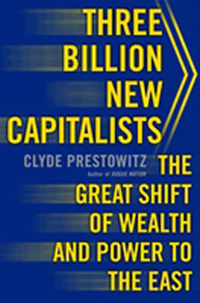
Well, that’s one view. But, as Clyde Prestowitz argues in his recent book, Three Billion New Capitalists: The Great Shift of Wealth and Power to the East, we’re basically kidding ourselves. America’s preeminence is precarious. We’re running unsustainable trade deficits; the dollar is dangerously overvalued; increasingly invention and technological innovation are happening elsewhere; 2.5 billion people in India and China are set to enter the world’s skilled job market; technology permits many formerly localized jobs to be done anywhere in the world; our public education system is a mess; America is a massive consumption machine, financed by Asian central bankers who must be starting to wonder if we’ll ever be able to pay them back.
Prestowitz argues that without a major change of approach the United States—and indeed the dangerously unbalanced global economy—could be headed for an “economic 9/11.” Unfortunately there’s little sign that either government or corporate leaders are doing the necessary hard thinking that such a change requires. His book, then, is intended as a wake-up call.
Prestowitz, a sometime Mother Jones contributor, is founder and President of the Economic Strategy Institute, a Washington think-tank. He served as counselor to the Secretary of Commerce in the Reagan Administration and is the author of several books, including Rogue Nation, which addressed the disconnect between how the US perceives itself and how it is perceived. He recently talked with Mother Jones from Washington D.C.
Mother Jones: Your book came out around the same time as Tom Friedman’s new one, The World is Flat. He takes a rosier view of global economic trends. What’s he missing?
Clyde Prestowitz: Both books are about globalization and the negation of time and distance by the Internet. The difference is that Tom looks at all this and says, “This is fantastic! All the knowledge centers in the world are being tied together, that’s going to accelerate R&D and innovation. Don’t worry about China and India getting rich, because that just means they’re going to be able to buy more than us, and we’re going to get richer. Of course, educate your kids, let’s spend a bit more on R&D, and let’s invest in our infrastructure—but basically, everything is terrific.”
I’m looking at the same thing and I’m seeing a structure of globalization that is undermining long-term US economic capability and leading us to some kind of a major crash. And I see a world in which the dollar is no longer the world’s money, in which oil is priced in euros or yen, or some combination. I see a world in which the US can’t afford to keep troops in Iraq and hundreds of bases around the world. And I’m saying, look, I don’t begrudge China and India getting rich, but they’re not going to buy more from us—because we don’t make anything. So I have a much darker view about where things are going right now.
MJ: How did we get here?
CP: Since the end of the Second World War America’s economic growth strategy has been consumption. We’ve built into our economy enormous incentives to consume and disincentives to save. We have been very innovative and a leader in high-tech for three primary reasons. One is that this is a society that does encourage innovation, it’s open, and it has a high regard for entrepreneurs and innovators. At the same time, we had a huge industrial policy called defense. We didn’t call it industrial policy, but it kind of was. We had the government, in the guise of the defense department, pouring billions and billions of dollars into science and technology and that funded an awful lot of innovation. We got a lot of spinoff; we educated a lot of people. Third, we had the world’s only mass market, the biggest and the first, and so you had a quick way, if you had something good, to capitalize on it, and you had economies of scale that nobody else could match.
Over the last 30 or 40 years we also began to create a global economy. That meant this mass market suddenly became available to other countries. The unique economy of scale that was available only to American producers was available to producers in other countries. And there’s nothing wrong with that; it certain served US consumers. But unless US producers were going to get the same kind of open markets abroad that the foreigners were getting here, then over a period of time there was going to be a disadvantage. In fact, foreign markets weren’t nearly as open as US markets, and to some extent the advantages of economies of scale shifted. If you were a Japanese producer you now had access to the Japanese market and the US market. But US producers didn’t have the same kind of access to the Japanese market. The rest of the world, particularly Asia, developed a growth strategy based on high investment, which requires high saving, and excess production, which meant export-led growth. So while the US was building a consumption machine—via, for example, home equity loans, credit card solicitations, and numerous tax incentives to consume—the rest of the world, particularly Asia, was building a production machine.
MJ: Asian banks, especially Chinese, are financing much of US consumption. So we owe them a lot of money. Isn’t that their problem?
CP: Well, yes and no. It can be a problem for them, but that doesn’t mean it’s not a problem for us. Yes, of course they don’t want to do anything that’ll make those debts turn bad. But you do get to a point where, if you’re a holder of dollars, you say, ‘Wow I really have a lot of dollars, and I don’t think the Americans are ever going to be able to make good on these. In fact, I’m beginning to think the Americans are going to inflate these away, which means I’m going to take a hit—unless I sell.’ You get to the point where the risk of selling is less than the risk of holding. And that’s the path we’re on.
MJ: So the US needs to close the trade imbalance somehow—most obviously through exporting more. But as you argue in the book, it’s not that straightforward.
CP: Right. In the short and medium term we don’t have the capacity to quickly ramp up exports to come anywhere near redressing these trade imbalances. Of course, in the long term you can build new factories, but you can’t build new factories in two or three years. So you have the problem that, since you don’t have the capacity to sell enough to close the imbalance, the only way to get there is by buying less.
MJ: Isn’t it the case, though, that our relationship with, say, China, say, is not zero-sum. If they make stuff cheaply so we have to pay less for it, we have more money to spend on other things.
CP: Well, there’s nothing wrong with outsourcing and offshoring; it enhances productivity and increases wealth when it is done in markets that are functioning efficiently and without distortion. The difficulty is that we’re living with markets that aren’t functioning efficiently and are highly distorted. If it were the case that we offshore jobs to China, which saved money that was then investing in the US, and that was creating jobs in the US and allowing us to produce things and sell them to Australia, then perfect. That’s what international trade is supposedly all about; but that’s not what’s happening.
What’s happening is that the the dollar is being systematically overvalued, and so when jobs and production move out of the US, and that leads to rising imports of products and services from abroad, and money is being invested in the US, but not in productive capacity. The money is being lent back to the US by the central banks of China and elsewhere, but it’s being lent basically to finance US consumption. So we have a steady drain, an outward movement of productive capacity, while we’re increasing consumption but not increasing productive capacity at the same rate.
MJ: Why do we need to be building factories? Isn’t the United States’ future in services?
CP: For a long time there was the view that we’re going to become a services economy, and a services exporter. And our government has spent a lot of time trying to negotiate the opening of services markets abroad pursuant to this view. The difficulty is that growth of services exports has been relatively modest and is now declining, and we’re probably looking at a services deficit down the road. It turns out that increasingly we’re able to import services that we used to think were going to be tied to home—because the Internet, say, allows us to get our taxes, or our brain scans, done in Bangalore. Furthermore, a lot of services are not exportable. The construction industry for example—you can’t export building houses. So if we’re going to cut our trade deficit in half, which is what most economists think is sustainable, you can’t do it without manufacturing exporting.
MJ: The erosion of manufacturing base has ramifications beyond the obvious ones, right?
CP: It does, because something like 70 percent of R&D is funded by manufacturing, and yet manufacturing today accounts for something like 11 percent of GDP. So as manufacturing declines the ability to maintain our lead in, say, high-tech declines. People tend to think that innovation takes place in a sequence: You begin in a lab, you have a great idea, you test it on a model and it seems to work, then you take it into a developmental stage where you come up with some prototypes and then you go to production. But in reality, as often as not somebody on the factory floor sees something and takes it back to the lab and says, ‘Hey, take a look at this.’ So innovation is really an iterative process, it goes back and forth between all the elements of the enterprise, and increasingly, if those elements are separate from each other, you don’t have the same scope for that iterative activity. We tell ourselves the future is in high-tech, but the ability to have a future in high-tech depends on investing in R&D.
MJ: One of the revelations of your book is that, despite what you see as a looming economic catastrophe, the folks who should be thinking about this stuff aren’t.
CP: There are two sides of the coin here, the corporate side and the government side. Corporate leaders understand that they have a responsibility to the shareholders and the stakeholders in the company, so they see their obligation as doing all they can to make the company run as efficiently and as profitably as possible, without regard to whether the production or the R&D or whatever it is takes place in the United States or China or Europe or some other place. And when you talk to the corporate leaders and you talk about the trends, the increasing moves offshore, not just low-end manufacturing, but high-end manufacturing and services and even R&D, and you ask them if it concerns them, they say, ‘Yes, it concerns me. I’m not just the head of this company; I’m an American, I’ve got kids, grandchildren, so it does concern me.’ But when you get to the question of what a corporate leader should do they say, Well, that’s not really my job; my job’s to run my company. I have a fiduciary responsibility to do that as best I can in the circumstances in which I find myself. It’s the job of the guys in Washington to worry about the circumstances.
MJ: And the guys in Washington are doing…what?
CP: Our mythology is that we distrust government and we don’t want it picking winners and losers. So when you talk to the government leaders, their philosophy is one of open trade, free markets, and so on; and when it comes to thinking about the impact of particular policies the first reaction of American government leaders is to ask, ‘Well, what to the corporate guys think?’
MJ: You argue that the US needs a strategy. What should it be?
CP: There are two levels, what I call “the big fix” and “the little fix.” The big fix is at the macro level. We’ve got ourselves a situation now such that because the US is the consumer of last resort, if US consumption were to quickly fall, and if consumption abroad did not rise, then the whole global economy would go into recession if not depression. So the first thing we’ve got to do is make a Grand Bargain between the US and the EU, Japan, China, the Asian export-oriented economies: We in the US are going to reduce our excess consumption, which effectively means we’re going to reduce our budget deficit. And we’re going to create incentives for US households to save. But we can prudently do that if the rest of the world is going to increase its consumption, and to increase incentives to consume.
MJ: And the little fix?
CP: That has to do with all of the myriad regulatory and tax and government spending decisions that affect the investment environment, that affect the efficiency and capability of firms. Look at telecommunications. Right now, the United States is number 17 in the world in the deployment of broadband Internet access. Now, for a country that says it’s the world leader in technology, being number 17 is not a very comfortable place to be. South Korea, which many Americans still think of as a developing country, is number 1. What’s going on? Ten years ago the South Korean government said, ‘Hey, this broadband technology can greatly enhance our competitiveness vis a vis the Chinese and the Japanese across a whole range of industries, and can help create whole new industries we never dreamed of before. But we’ve got to reach a kind of critical mass. So how do we get this Internet into as many places as possible as fast as possible? Well, if people filed their tax returns by email that would create more demand for this thing. So why don’t we give people a break on their taxes if they file by email? Or if people do their stock trades on the Internet? Why don’t we create incentives to induce people to do that? And so the Koreans took a very broad view of how they should be regulating and fostering competition in their telecommunications market.
At the same time the United States passed the 1996 Telecom Act, and spent really ten years ignoring broadband Internet deployment, focusing rather on how to create price competition among the telephone companies. And the way we did that was to force the telephone companies to lease their lines to newcomers at a discount, who would then resell the line to you or me. And there were huge disincentives to telephone companies to upgrade the lines or to install high-speed broadband lines because they’re just going to have to lease it to these other guys. So our policies, unlike the Koreans’, were unfriendly to broadband deployment. Our perspective was too narrow; we need to have a broader perspective, thinking about how does government facilitate innovation. We did this back in the early 20th century, but we kind of forgot about it.
MJ: OK, but doesn’t the United States have the best research and learning centers in the world?
CP: We constantly repeat that we have the best education system in the world. And that’s true of our elite educational institutions. But look at who studies at those universities, particularly in the graduate programs in computer science and engineering; well over half the students are not Americans. Now, I’m in no way opposed to having non-American students studying here, but the real difficulty here is that the number of American graduate students has declined both as a percentage and absolutely over the last 20 years, even as the population has grown. So what that means is that US students either don’t want to study in these institutions or can’t get in. And a lot of it is the latter; and the reason for that is that our secondary education is a disaster.
Also, we say we’re the leader in technology. And if you look broadly across all technologies, that’s probably still true. But it’s less true today than it was five or ten years ago. And there are many areas of technology that the US hardly plays in. So our superiority is less well founded than we like to tell ourselves.
MJ: What’s an area where the US hardly plays?
CP: One is flat panel technology. We use flat panels all the time—TVs, computers, cars.Americans don’t make that stuff and don’t have the technology; digital cameras—that technology is in Asia; night-sight vision technology, which is moving rapidly offshore; and even semiconductors, which are made with all kinds of esoteric equipment, the production of which is already heavily in Asia and becoming more so.
MJ: Won’t there always be areas in which the US still enjoys a comparative advantage?
CP: Yes, of course, but you have your comparative advantage has a lot to do with your standard of living. If you have a comparative advantage in making coffee beans, then you have a comparative advantage. But coffee beans have not historically been the basis of a high standard of living. And if you’re comparative advantage is in commodities or low-wage areas, then that’s not what you need to fulfill the American Dream. The second point is that one aspect of globalization that’s increasingly coming into play is the notion of absolute advantage. Increasingly, it seems to me, trade is being determined by this, because as the global economy becomes more integrated, manufacturers are looking at their costs on a global basis, rather than between countries, and so they’re calculating who’s the low-cost producer globally, not comparatively.
MJ: But those costs will rise over time, right? For example, wages in China will rise as demand for Chinese labor grows, diminishing the country’s advantage.
CP: Theoretically they should, and they have been, but in a kind of divided fashion. Skilled workers in China, particularly university graduates with advanced degrees who’ve been to, say, Harvard Business School or Stanford Business School, are in great demand. As you go down the skill level, wages in China haven’t been rising that much, and you have a situation where you have a vast reservoir of labor in the countryside, not of highly skilled workers but workers literate enough and skilled enough to be able to take a job in a factory and pretty quickly become reasonably productive. And that has acted, and will continue to act, as a damper on the wage-raising tendency. Now, over some long period of time, of course, if growth continues and demand continues to rise, and all those workers become absorbed into the economy, wages should rise and begin to equalize with the rest of the world. But you’re talking about hundreds of millions of people, so the long run could be very long.
MJ: So should we fear China’s economic rise?
CP: I don’t think we should fear it. In fact, I think we should welcome it. I think the truly fearful thing would be a failing China. It would be the source, eventually, of disruption and disease and all kinds of things you don’t want to think about. So we want China to succeed, but not at the expense of the United States. Better, China succeeds, and its success provides opportunities that allow us to continue to grow and raise living standards as well. So the issue is not whether we want China to get rich or not. We do. The issue is how China does that, and how do we take advantage of China’s development to improve our own situation?