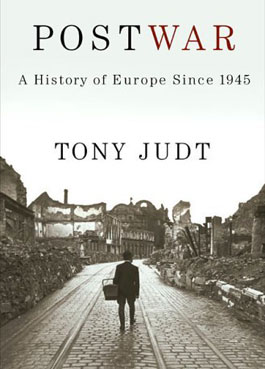
In the introduction to Postwar, his massive and brilliant history of Europe in the second half of the 20th century, Tony Judt recalls the precise moment at which he decided to write the book. It was December 1989. He was changing trains at Vienna’s main railway station. In Prague, where he’d just been, the Communist government was falling. A few weeks earlier, the Berlin Wall had been breached. Throughout central and eastern Europe the old Soviet regimes were collapsing.
As Judt puts it, “[a]n era was over and a new Europe was being born. This much was obvious. But with the passing of the old order many longstanding assumptions would be called into question…. Europe’s future would look very different–and so, too, would its past. In retrospect the years 1945-89 would now come to be seen not as the threshold of a new epoch but rather as an interim age: a post-war parenthesis, the unfinished business of a conflict that ended in 1945 but whose epilogue had lasted another half century. Whatever shape Europe was to take in years to come, the familiar, tidy story of what had gone on before had changed forever. It seemed obvious to me, in that icy central-European December, that the history of post-war Europe would need to be rewritten.”
Tony Judt has now rewritten that history, to great acclaim in both Europe and the United States, where Postwar was recently named one of the ten best books of 2005 by the New York Times—no small achievement for a tome weighing in at nearly 900 pages. His always lively narrative traces the continent’s uncertain progress as it emerges from the devastation of World War II and develops—unevenly, almost accidentally—into the Europe we know today.
Tony Judt, who was born in London in 1948, recently spoke with Mother Jones from his office at New York University, where he is Professor of European Studies and Director of the Remarque Institute.
Mother Jones: You mention in the introduction that many of the histories of Europe written before the fall of the Soviet Union were composed in a “lyrical key,” in a tone almost of self-congratulation.
Tony Judt: There were various different keys in which European history had tended to be written. One is the lyrical key, the idea that somehow, in Bretton-Woods in 1945, a bunch of well-intentioned men got together and said, “This can’t go on; let’s build a European Union.” And it just wasn’t like that. Another, of course, was a tremendously provincial key, so that you started in 1945 with the history of Western Europe and, starting in ’45, the history of Eastern Europe, which is normally just a footnote to Soviet history. And there was also a sort of institutional key, the idea that the history of Europe since 1945 is the history of European integration, and that seemed to be terribly teleological–viewing history backwards. I wanted to make it clear that this was a continent, in 1939, that had a shape that was very, very different than the one it had in ’45, and the old shape was the one that most European adults at the time knew.
MJ: And in 1945, as well as being split down the middle, Europe was utterly devastated.
TJ: Right. I wanted to convey two things that are connected. One was the sheer scale of the awfulness—and that’s particularly important when writing, as I partly am, for an American audience, because although the United States lost a quarter of a million men and women, civilians and soldiers, in World War II, that’s considerably less than the Russians lost in soldiers at the Battle of Stalingrad alone. It’s important to convey to countries and to people and to generations who have no experience of the 20th century as it was lived in Europe just how catastrophic it was.
The other half of it, of course, was to convey the sheer scale of what was then done in the next 25 years. I think I quote de Gaulle as saying it’s going to be a generation before this mess is even behind us, never mind building anything new. And of course that wasn’t true; it turned out to be done in 10 to 12 years. But that is a reminder also that you couldn’t just get over it immediately—the physical evidence remained around, not just in terms of absent people but also in the physical mess of the cities.
MJ: And at the time there was a very real fear that maybe there’d be no recovery at all, that Europe could very easily slide back into war.
TJ: Absolutely. There was a fear in two senses. One, that the sheer scale of the damage that had been done was such that Europe would never recover. The other, that after a war of this scale you could only expect more of the same. In the first three or four years people were afraid of a revival of fascism, or a complete switch to communism in Western Europe. But then, after 1948 people began to look forward and could begin to imagine building a future rather just prophylactically preventing a return to the past. And that’s why I try to emphasize that the Marshall Plan is enormously important, not because it dumped gazillions of dollars in Europe—although that clearly mattered as well—but because it made it possible for Europeans in that crucial period up to ’48, to imagine that they were going to recover. But before that, the assumption that Europe was a goner was very deep and widespread.
MJ: Not least because the more immediate reference point was the period between World War I and II, which was marked by economic depression and social and political unrest and the emergence of some very dangerous ideologies.
TJ: Right. It’s important to remember that World War II was experienced very much as a continuity in that sense. Most of World War II in most of Europe wasn’t a war; it was an occupation. The war was at the beginning and the end, except in Germany and the Soviet Union, and even there really only at the end. So the rest of time it’s an occupation, which in some ways was experienced as an extension of the interwar period. World War II was simply an extreme form, in a whole new key, of the disruption of normal life that began in 1914.
MJ: You write about the suppression and then recovery of memory over this 20 year period after the war. Do you think there was an upside to this, in the sense that people could get on with the task at hand, which was to rebuild their societies?
TJ: If I wear my hat as a responsible citizen today, I would say it’s appalling that there was this de facto conspiracy to forget or suppress the things that it was impossible to live with. On the other hand as an historian I have to say it was one of the reasons why it was possible to reconstruct civic polities and resume relatively normal life in places like France, the Netherlands, or indeed even in Eastern Europe, in places like Poland or Hungary. In the French case, de Gaulle knew perfectly well what had really happened in the war. Nonetheless, he had good reason to simultaneously encourage two myths. One of course is the myth of French resistance—the idea that almost everyone was heroically resisting the Germans—and the other is the idea that actually Vichy is not quite that terrible, because if Vichy were really that terrible, you’d have to ask much harder questions about the role of French people in it.
MJ: In this immediate post-War period two large political goals shape allied—and especially US—policy in Europe. One is to keep Germany down, but in; and the other is to keep the Soviet Union out. As we know, the Allies gave Stalin pretty much everything he wanted so that he’d stay out of the west. Was that a mistake?
TJ: Well, there were two things going on. One is that the Americans really didn’t plan to stay in Europe. The only model that existed for American leaders in 1945 was the post-1918 model, wherein they had gotten out of Europe as fast as they could; this time they didn’t want to do it in such quite a messy way, they didn’t want to leave troops there. And so they thought that the best way to handle this was to be as friendly as possible with Stalin and come to the best possible agreement–not because the United States was in any sense philo-Soviet or naïve about Soviet Union per se, but because, it was understood that there wasn’t much they could do about the territories he controlled.
MJ: And there was the moral price to be paid for that calculation.
TJ: Yes. The East European small countries have a sense of betrayal, of having been forgotten by Western leaders.
MJ: So the United States didn’t intend to stick around any longer than necessary. But that changed, and if I read you right, with the Korean war.
TJ: That’s correct. The American financial and military commitment really only kicks in with Korea. Not that Korea was the real game for the Americans; their real fear was that this was just the prelude to a second Korea in Germany. We now know from the Soviet archives that the last thing Stalin was going to do was start a war in Central Europe. The Americans didn’t know that, and it was the fear that he might which transformed NATO from a sort of shell game into a real military alliance. That total commitment basically transformed the Marshal Plan into military aid.
MJ: So, speeding forward through the decades, the 50s and 60s saw the wrapping up of the colonial project that had reached its height in the previous century. Why did it take that long? Or is that even the right way to ask the question?
TJ: Well, on the one hand colonialism might have lasted much longer. On the other hand, how did it last as long as it did? I think the answer is that the Second World War had a precipitating effect in that it discredited the empires, as well as bankrupting them. Not only could you no longer, if you were a colonial subject of France in Africa, look to France as a model of power and influence and civility after what had happened in the war. Nor could the French any longer afford to run their empire. And nor could the British, although they were not discredited in the way that the French were.
However, you had two kinds of colonies. You had those like India, and to some extent Indo-China and North Africa, which had quite an advanced nationalist movement between the wars, and most of them had large, urban, middle-class indigenous population that was willing to back the nationalist movement. And then you had colonies, primarily in sub-Saharan Africa, where that wasn’t true, where the local elites weren’t strong enough and had no longstanding history of political organization. In those places you the British and the French and the Belgians hand over independence to their colonies only after 1956, in the wake of the Suez crisis and the realization, on the part of the French and the British, that they can’t hope to hang on to their colonies.
MJ: So by the late 50s and 60s, we have an economic miracle bringing unprecedented prosperity to much of Western Europe. But you also have unrest culminating in the student rebellions in ’68. Your broad conclusion is that, on balance, the 60s didn’t amount to much in political terms.
TJ: My generation [those who were students in the late 60s] was always, in the words of the Who, talking about our generation. That’s what we thought of ourselves, as the most important thing since sliced bread. And the “we” that we meant was really the Western Europeans and American generation. And as I think back I suppose I have a sense of guilt on behalf of my generation, a sense that we were terribly provincial and didn’t understand the really important stuff that was going on in Eastern Europe. The 60s in Prague and in Warsaw–that’s the 60s that had long-term consequences, consequences for the end of Marxism. By comparison with that, we were being culturally playful. I think when you think about what really mattered in the 60s and the early 70s in the West—the ending of censorship, the legalization of abortion, the liberalization of divorce laws—was very much the work of older liberals rather than the young 60s radicals.
MJ: In your account, the early 1970s represent more of a hinge, or a pivot, in postwar European history.
TJ: Yes. The 60s were a continuation of the 50s much more than people realized. They were optimistic. Certainly in some countries, like Britain, there was still a culture of deference, whereas in the 70s we really are in a time of angry transition. The generation that came into young adulthood in the 70s couldn’t find jobs; that wasn’t true in my generation. They entered a time when two depressing things hit them both at the same time. One, there were less jobs to be had and in general the world seemed gloomier and darker and less optimistic. And two, they had just ahead of them a generation which was full of itself and convinced it had transformed humanity ten years earlier and there was nothing left to be done.
MJ: A striking feature of the book is that it doesn’t give short shrift, as histories often do, to the cultural production of the postwar period. So there’s a lot in there on, say, film. Did you wrestle with that approach or did it seem natural?
TJ: It seemed absolutely natural. The wrestling had something to do with the how to do it. I’ve always hated the kinds of history books where there’s a section in the back marked “Culture.” What I decided to do was make a virtue of necessity and focus above all on those arts that could be integrated either as an influence or reflection of the story I was telling, so they can become part of the story rather than just the fifth wheel. What that means is that the book neglects those aspects of cultural history that can’t be made to do that, like the sciences or difficult music for example, or the more marginal kind of fine arts. In some kind of ideal world I would have found a way to do that, but it seemed to me crucial with stick to the basic principles, which is that this in integrated history and I would integrate what I could without stretching a point to where it becomes silly.
MJ: Racing forward, we get to ’89 to ’91, when the whole Soviet edifice comes tumbling down. The standard narrative is that it fell under the weight of its own contradictions, and in your account that holds up pretty well. And yet, the way you describe it, there was nothing inevitable about the timing.
TJ: Right. It was easy to say at the time and it’s even easier to say in retrospect, that the dysfunctional qualities of the economies of these socialist states were such that they couldn’t carry on forever. On the other hand, there was no reason why at any given point they couldn’t carry on a little longer, as we’ve seen, because the defects were no different, let’s say, in 1981 than they were in 1987. The crucial variable is Moscow, and I wanted to emphasize that, because everything depended on the initiative coming out of Russia. If the Soviet Union chose to use tanks again, it could, and there’d be nothing to stop it. And that’s why Gorbachev becomes crucial.
MJ: Though he himself didn’t seem to have much of an idea of where it was all going.
TJ: Well, it’s the theory of unintended consequences taken to an unexpected conclusion. Gorbachev was a Communist as much as anyone else, he grew up in a Communist world; it’s the only world he knows, and it’s the only vocabulary of political behavior that he knows, and he has no intention of bringing the system down. He starts to do what many other Communist reformers, including Khrushchev at one point, tried to do, which is reform the economy without making structural changes to the political system. Now, previous reformers realized fairly early on that that’s not possible, so they abandoned economic reform, because politics matters much more. The difference with Gorbachev is that he doesn’t do that; he does the unexpected and accepts the need to change the political system–not all overnight, and not completely. But then there comes the unexpected—the complete unraveling of power, not merely a diminution of the dysfunctional bits of it.
MJ: So then we have a situation where the Soviet Union falls, which among other things seems a triumph for the West. But then very quickly Yugoslavia devolves into a vicious war.
TJ: Well, the larger story that Yugoslavia was the last multinational empire in a way—that’s not a reason why it would end up the way it did, but it provided the sort of material for internal division, which other countries no longer had, with the exception of the Soviet Union itself. The rottenness of politics in Yugoslavia didn’t come as a surprise. The main lesson is that this is a war which could have easily been stopped by Europe. What was lacking was any will to do so. It’s an irony of the achievement of Europe that it had lived for 40 years under the assumption of the unimaginability of internal wars, so it didn’t know what to do with it when it was confronted with one close up.
Yugoslavia served as a reminder that the lessons of World War Two were only partially learned. There’s a great line someone wrote in the middle of the 1990s, at the time when Clinton was agonizing about whether or not to go into Bosnia: “Everyone says, ‘Never again. Never again.’ But all they really mean is never again will Germans kill Jews in the streets of Warsaw.”
MJ: Europe today has its challenges, clearly. The population is graying; there’s no consensus as to what kind of organization the EU should be; there are questions about how sustainable enlargement is, particularly if it includes Turkey. And yet there are those who argue that the 21st century belongs to Europe, in the sense that the European model–of pooled sovereignty and adherence to overarching laws in everybody’s interests–is the most effective political arrangement available.
TJ: Well, I tend to agree. There’s no better model; at least, there’s no alternative model. And Europeans, accidentally it seems to me, have over the decades emerged with a workable model for the 21st century. Of course, Europeans don’t seem to understand that and don’t seem to know what to do with it or how to move forward with it. I’m not sure that it will work [for Europe], but certainly it is the only game in town.
MJ: And its chances of succeeding in Europe are enhanced if Europeans understand how their system came into being, right?
TJ: Absolutely. The different American experience of the 20th Century is crucial because the lesson of the century for Europe, which essentially is that the human condition is tragic, led it to have a build a welfare system and a set of laws and social arrangements that are more prophylactic than idealistic. It’s not about building perfect futures; it’s about preventing terrible pasts. I think that is something that Europeans in the second half of the 20th century knew in their bones and Americans never did, and it’s one of the big differences between the two Western cultures. I worry that even though most educated Europeans under the age of 25 today are now beginning to forget why the system that came about did come about, and therefore it becomes much easier to imagine doing away with it in the name of freedoms. I worry that we have forgotten that the de-ideologized, de-politicized, uncontentious public space of the last 50 years as Europeans have experienced it is not the normal human condition. We shall be sorry to have abandoned a little too quickly the institutions that were set up by our parents and grandparents to protect themselves against a return of the bad old world. Because the bad old world can still come back to haunt you.