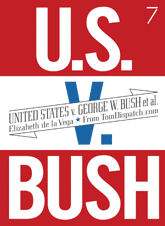
What do George W. Bush, Jeffrey Skilling, and the guy who sold some Florida swampland to your grandma have in common? According to Elizabeth de la Vega, they’re all scam artists who deserve to have the book thrown at them. For de la Vega, who spent more than 20 years as a federal prosecutor, that’s not just a cheap shot at Bush, it’s her considered legal opinion. In her new book, United States v. George W. Bush et al., she argues that in snookering us into an unnecessary war in Iraq, the president wasn’t simply guilty of dishonesty or incompetence, but guilty of fraud.
This isn’t another pro-impeachment tome, but rather a novel take on how Bush pulled off perhaps the greatest political bait-and-switch in our history. De la Vega lays out her case as the transcript of a hypothetical federal grand jury proceeding, where a prosecutor introduces an indictment against Bush (and co-conspirators Dick Cheney, Donald Rumsfeld, Condoleezza Rice, and Colin Powell) for defrauding the United States through “deceit, craft, trickery, dishonest means, and fraudulent representations, including lies, half-truths, material omissions, and statements made with reckless indifference to their truth or falsity.” Though not exactly Law and Order, it’s a remarkably snappy read, punctuated by banter with jurors and presented with a “just the facts” tone that makes it clear that de la Vega sees this as a serious matter of law, not a Bush-basher’s daydream.
The particulars of the case will be familiar to anyone who’s followed the unraveling of the White House’s pitch for invading Iraq (no WMDs, no Saddam-Al Qaeda link, etc.). But the legal lens through which de la Vega asks us to view these facts is unique. As her fictional prosecutor tells the jurors, “We may be increasingly accustomed to public officials deceiving us, but it is still the law of the United States that once politicians become Executive Branch officials, they are legally required to be honest and forthright about public matters.” This simple idea may seem unfamiliar at first—It’s a crime for our public servants to lie to us?—but once its implications sink in, the impunity still enjoyed by the administration is all the more perplexing.
De la Vega emphasizes that her book is about accountability, a principle rooted in her career as an assistant U.S. attorney. “It’s not about vengeance,” she explains. “I really hate the idea of people who are powerful taking advantage of people who are powerless. But I also think it is possible to get redress. I still have this faith that there is a way to get information out there in a rational format that will make a difference.”
Excerpts from United States v. George W. Bush, including its hypothetical indictment, have appeared at TomDispatch.com. De la Vega spoke with MotherJones.com by telephone from her home in Northern California.
MotherJones.com: How did you get the idea of charging George W. Bush with fraud?
Elizabeth de la Vega: I’ve worked on a lot of fraud cases over the course of my career. In particular, I was working on one in 2003 and 2004 that involved elderly people who were defrauded in an investment scheme. So I was refamiliarizing myself with the law of fraud and I realized that many of the precepts that applied to everyday fraud cases were applicable to what the president was doing. I couldn’t do it while I was still an assistant U.S. attorney, but in the back of my mind I thought, “This is a project I really need to do.”
MJ.com: How’d you go about trying to build this hypothetical case?
I started doing the research for the book when I was writing an article for The Nation, “The White House Criminal Conspiracy.” It was fairly obsessive-compulsive, actually. I read every single speech by the president I could find on the White House website. But I also went through the entire Department of State website and the Department of Defense website. I poured over the Senate Select Committee on Intelligence report, the Conyers report, the Robb-Silberman report, the 9/11 Report. And of course I read all these different books, like the Woodward book—I probably read 15 of those. A lot of what’s in those books can’t be used as evidence. Like Woodward’s books, for example—very little of it can be used since it’s not attributed to anybody. I was very careful not to use anything that wasn’t corroborated or attributed to an actual person. I used the same kind of standards I’d use in a criminal case. And I did what I always did with any case of any complexity: I put all of the information I could find in a timeline. So I made this humongous timeline. There were piles of things all over my house.
MJ.com: After assembling all this evidence, what laws did you think you could confidently accuse the White House of breaking?
EDV: There were many, but the main one is conspiracy to defraud the United States. That is Title 18, United States Code section 371. It’s a very old statute. The statue itself is really very simple: It says it’s against the law to conspire to defraud the United States. There are several very old cases where they define what that means. The statute is used a lot against defense contractors who present false information to get overpayments on their contracts. But it was also used against some defendants in Watergate and Iran-Contra. It seems kind of like a vague statute, but it’s actually very simple—it means using deceit of any kind in order to impair the function of a government agency. In this case, the deceit was the broad pattern of deception that the administration directed towards the public and Congress.
MJ.com: So Bush made up his mind that he wanted to invade Iraq and then misled the public and Congress so he could get what he wanted. Not to be cynical, but isn’t that what elected officials do all the time—deciding what they want to do and then getting it done by any means necessary? If you take the standard you’re applying in this case, doesn’t that mean that elected officials are breaking this law all the time? Applied rigorously, this law is being broken left and right.
EDV: It probably is. But when you look at any possible criminal case, you really have to look just at the one you’re looking at. The fact that other people may have committed other crimes really has no affect on it. But it doesn’t make it OK. You can think of it like a murder case: You can say, “Well, other people have committed murder.” But the reason I think it is imperative that we look at this one is because the consequences have been so dire. They have affected everything else in this country. This is such an egregious example. And it’s so egregious not just in the harm done but in the conduct. They set up the White House Iraq Group specifically to do this deceit; they even admitted it, really. We know they set about to do this persuasion and we know they did in fact deceive. So there you have concerted action.
MJ.com: At one point in your book, the assistant U.S. attorney explains, “Whether Bush et al. committed a crime in misrepresenting the prewar intelligence on Iraq is not a question of lying; it’s a question of whether they committed fraud.” Can you explain the distinction?
EDV: The reason I made that distinction is that a lot of people are really confused. They don’t believe that Bush lied because they believe he didn’t know anything. They don’t think that he had enough information to lie. Fraud is much broader than just lying. Say for example, the president made these statements about the aluminum tubes, but he had not really looked into any of the underlying information. Well, that’s fraud, because you can’t go out as the president of the United States and make an assertion that you know people will rely on when you haven’t looked into the underlying information.
MJ.com: So essentially, as an elected official or the president, you have an obligation to do due diligence.
EDV: Exactly.
MJ.com: And having done that due diligence, if you find anything contradictory, you’re obligated to acknowledge that publicly.
EDV: Right. Obviously, there are times when the president doesn’t have to say everything to the public; I’m not saying that. But when he takes it upon himself to persuade the public of a case, he’s affirmatively decided to make representations about a topic. He has to have actually looked into it. But people don’t have any expectations of the president anymore. It’s really important to understand that this idea that politicians can lie is totally false. It’s not what the law says. The law requires the president and our elected officials to follow all the laws of the United States, including those relating to fraud.
MJ.com: Not to harp on it, but that’s such an interesting concept—
EDV: Following the law? [laughs]
MJ.com: Well, it really is. Clearly, the political will is not there to pursue cases like this. But I have never heard this concept raised before. People talk of impeachment or throwing the bums out, but you never hear about criminally trying elected officials for not living up to their word.
EDV: I’m not saying somebody should right go out and indict the president. What I am saying, though, is that people should be aware that in criminal law the standard for an indictment is probable cause. Here we have far more than probable cause to know [the administration] violated the law. We are entitled to expect that our elected officials follow the law, just as we are entitled to expect our corporate officials to follow the law. It’s almost as if we are a battered country—a bunch of victims who are just so beaten down that we don’t insist on what we’re entitled to get.
MJ.com: When you’re a U.S. attorney, you have to anticipate how a defendant will respond to your charges. How do you think the administration would respond to a case like this—assuming they don’t claim executive privilege and stonewall you for three years?
EDV: Their response, I think, would be the same kind of defenses they’ve made all along—that they made a mistake, that they believed there were weapons of mass destruction. As I explain in the book, the law says that it doesn’t matter what you believe if you try to deceive people along the way to get them to go along with what you believe. That’s not a defense. Many times with investment frauds, the people doing the defrauding convince themselves that this is going to work out in the end. There’s a lot of self-deception on the part of those who commit the fraud in the first place.
MJ.com: That raises an interesting point. I’m curious if the administration handled itself in a way that’s characteristic of fraudsters?
EDV: It’s precisely the same. Their main focus was to persuade people who already trusted them and liked them, which is what people who commit fraud do all the time; they focus on people in their church or their neighbors and they take advantage of that relationship. They also tried to quash any objections or dissent in very personal ways; they did not respond to conflicting information or attacked whoever was making the statement. That’s actually a classic sales technique. When people are selling an investment, for example, and somebody says, “I want to talk to somebody else about it,” [the fraudster will] say, “Well, you can make your own decisions.” It’s a way to squelch any discussion. [The White House] even went further by accusing anyone who questioned them of being treasonous or not supporting the troops. Another thing is shifting rationales, that’s another classic tactic. But self-deception is key. More and more, they began to talk themselves into the validity of what they were saying.
MJ.com: You don’t mention impeachment at all in this book. Why is that?
EDV: I think people are so confused about what impeachment really means. It’s simply a process of investigation. I didn’t want to get off on that track because it confuses people. My goal in writing this book is to just make it clear that what the president and his staff have done is, on one hand, a horrific crime, but on the other hand, it’s an everyday kind of crime.
MJ.com: Is there something frustrating or depressing in putting together a case that, realistically, is a non-starter?
EDV: No, that’s not depressing to me. I don’t think it’s a non-starter that there will be hearings. It would be very depressing if we didn’t have hearings. Not just to hold people accountable; we need to get to the truth of what happened in Iraq in order to get out. The president is still making the same claims. He was, as of yesterday, still failing to acknowledge the true nature of what’s going on in Iraq. He’s still talking about Al Qaeda fomenting this violence. If we were in a trial, by this point the opposing counsel would be able to stand up and say, “Objection—assumes facts not in evidence.” And we wouldn’t even be talking about this anymore. I’d like the public to have the same reaction. Every time they hear “Al Qaeda and Saddam Hussein,” they should be thinking, “Wrong!” It’s not something people should be polite about anymore. We’re way past that point.