Heritage Foundation on Hunger: Let Them Eat Broccoli
Poor people aren't hungry; they're fat.
While most Americans were planning for the annual ritual of overconsumption known as Thanksgiving, the good folks at the Heritage Foundation, Americas leading architects of conservative thought for at least three decades, were doing their part to add to the holiday cheer. According to a November 13 Heritage article, well-off revelers could stuff their faces unhampered by guilt about the less fortunate, because there are no longer any hungry people in the United States.
You have to hand it to Heritage for always being first out of the gate to exploit the latest event or finding to advance its aims—this is the same think tank that issued a comprehensive strategy, two weeks after Katrina hit shore, for using the hurricane as an excuse to slash federal social programs. This time, its thinkers found inspiration in the U.S. Department of Agriculture's annual report on Household Food Security in the United States, which is as close as the federal government comes to providing statistics on hunger among the nations poor. The latest report states that 11 percent of Americans were "food insecure" for some part of 2006, and 4 percent—11.1 million people—experienced "very low food security."
These Orwellian euphemisms are a triumph for the conservative agenda; the USDA altered its terminology last year on the recommendations of an "expert panel" convened back in 2003. "Very low food security," for example, used to be "food insecurity with hunger." The experts asked the department to eliminate "hunger," which, they argued, "should refer to a potential consequence of food insecurity that, because of prolonged, involuntary lack of food, results in discomfort, illness, weakness, or pain that goes beyond the usual uneasy sensation." To some, that might better describe starvation, but the panel's reasoning wouldn't be a stretch for the Bush administration, which claims "torture" must entail pain "equivalent in intensity" to the pain of "serious physical injury, such as organ failure, impairment of bodily function, or even death."
But the Heritage folks are looking beyond semantic tweaks: Far from having too little to eat, they argue, poor people are eating too much. By the time the USDA report went public, Heritage had readied its own salvo, titled "Hunger Hysteria: Examining Food Security and Obesity in America." In recent years, the U.S. media and public have become increasingly obsessed with the "obesity epidemic." And what better way to attack the idea of deprivation among the poor than to note that they are getting fatter? Rightly or not, people still associate obesity with the sins of gluttony and sloth, which jibes nicely with the concept that welfare recipients are lazy people who would rather feed at the public trough than get an honest job.
"Hunger Hysteria" is the work of Robert Rector, Heritage's senior domestic-policy man and a main proponent of welfare "reform." He argues that while the USDA's numbers might sound "ominous" on the surface, "the government's own data show that the overwhelming majority of food insecure adults are, like most adult Americans, overweight or obese." While "they may have brief episodes of reduced food intake, most adults in food insecure households actually consume too much, not too little food."
His next step is to attack proposals that would give the poor more cash for food despite the fact that most...already eat too much." More food money, he suggests, will only make them fatter. Instead, Rector says, they ought to be encouraged to "avoid chronic overconsumption of calories" and to simply "spread their food intake more evenly over the course of each month to avoid episodic shortfalls."
Rector goes on to attack common "misconceptions," such as the argument that "poor people become obese because they are forced, due to lack of financial resources, to eat too many junk foods that are high in fat and added sugar." Junk foods, he counters, aren't particularly cheap—for example, Coke and Pepsi cost more than milk. "Snack foods such as potato chips and donuts [sic] cost two to five times more per calorie than healthier staples such as beans, rice and pasta." In other words, if the poor want to eat junk food and get fat, fine, but lets not finance such behavior. The solution, Rector argues, resorting to the perennial trope, isnt a more-equitable society or expanded social programs, but greater "personal responsibility" on the part of poor people.
There's another side of the story, of course, that addresses realities Heritage and its followers choose to ignore. Adam Drewnowski, professor of epidemiology and director of the University of Washington's Center for Obesity Research, believes diet is determined by economic and social factors far more than by personal choice. "Healthier diets are more expensive," he says flatly. It's easy to point to specific exceptions like doughnuts vs. beans or Coke vs. milk (well, not always; my local Safeway charges 40 cents more for a half-gallon of milk than for a two-liter bottle of Coke). But research generally has shown that "energy-dense foods," which often are high in refined grains and added sugar and fat, "provide dietary energy at a far lower cost than do lean meats, fish, fresh vegetables, and fruit," as Drewnowski wrote in a 2004 article for Nutrition Today. Processed foods also dominate store shelves in poor neighborhoods, are quick to prepare, and simply taste better to some people than some nutritious foods available on the cheap—think cabbage, condensed milk, and canned fish.
Drewnowski calls Rector's arguments "rubbish, written from a position of class privilege—let them eat broccoli, indeed." He cites the suggestion that the poor should purchase cheap, nutritious foods rather than processed stuff. "When you suggest that people buy rice, pasta, and beans," he says, "you presuppose that they have resources for capital investment for future meals"—since these healthy staples come in large bags—"a kitchen, pots, pans, utensils, gas, electricity, a refrigerator, a home with rent paid, the time to cook. Those healthy rice and beans can take hours; another class bias is that poor people's time is worthless. So this is all about resources that middle-class people take so much for granted that they do not give them another thought. Not everybody has them."
On the other hand, he says, "buying a doughnut for dinner does not involve any of those middle-class resources. You pay 55 cents for this meal only and there you are. Yes, rice would be cheaper if only people had the time and were not working two jobs on minimum wage."
The Food Research and Action Center, a D.C. public interest advocacy group, seconds Drewnowskis findings in a position paper: "One factor that may contribute to the coexistence of obesity and food insecurity is the need for low-income families to stretch their food money as far as possible. Without adequate resources for food, families must make decisions to maximize the number of calories they can buy so that their members do not suffer from frequent hunger."
The situation is likely to worsen, since rising food costs have outpaced inflation. According to the Department of Labor, prices rose more in the first half of 2007 than in all of 2006. If this continues, 2007 will mark the largest annual increase in food costs (7.5 percent) since 1980. Nutritious foods are even harder to afford; a study by Adam Drewnowski and Pablo Monsivais just published in the Journal of the American Dietetic Association shows that prices for the healthiest foods have ballooned nearly 20 percent in the past two years, while those for fatty and sugary fare have actually decreased a bit.
Against this backdrop, the safety net of food stamps and other social-welfare programs continues to shrink. Since the Reagan years, Washington has been dominated by New Victorian attitudes championed by neoconservative doyenne Gertrude Himmelfarb—wife of Irving Kristol and mother of William—who in her writings seems to yearn for the days of nineteenth-century Britain, when "every measure of poor relief...had to justify itself by showing that it would promote the moral as well as the material well-being of the poor." Reaganites worked hard to trade the entitlement programs of the despised New Deal and War on Poverty for the tough love of faith-based charity, where a prayer could get you a bowl of soup.
Democrats bought into a version that was only nominally kinder and gentler. In the 1990s they signed on to President Bill Clintons famous welfare-reform bill—the "Personal Responsibility and Work Opportunity Reconciliation Act of 1996—suggesting that the causes and the solution to poverty lay with the poor themselves. At times these pious and punitive ideologies have taken a more inventive, supposedly scientific turn, hiding behind statistics and the seemingly disinterested policymaking of such things as risk-benefit analysis. But they have seldom been seriously challenged by either party.
Indeed, President Bush appears determined to cut funding to the Special Supplemental Nutrition Program for Women, Infants, and Children. The program, which provides healthy foods, nutrition counseling, and healthcare referrals to some 8.5 million low-income pregnant and post-partum women and children under five, heretofore has had bipartisan backing in both Republican and Democratic governments and has been considered quite effective. But Bush has threatened to veto the 2007 farm bill unless cuts are made to discretionary spending, including WIC. If Bush prevails, local WIC centers will have little choice but to turn women away, putting some on a waiting list and cutting others from the rolls—more than 500,000 mothers and young children would be dropped from the program.
The fate of food stamps is also tied to the farm bill. "Cuts Congress enacted in 1996 are shrinking the value of food stamps more with each passing year, making it increasingly difficult for millions of poor families to afford a healthy diet," says Robert Greenstein, director of the Washington-based Center on Budget and Policy Priorities. "Right now, food stamps average only about $1 per person per meal, well short of what these families need."
The House has passed a version of the bill with measures to help food stamps keep pace with inflation, but the legislation—problematic in many other ways—is stalled on the Senate floor. "The single biggest thing we can do to improve the diets of food-stamp families," Greenstein says, "is to raise their food purchasing power so they can afford more nutritious foods instead of having to rely on cheap high-calorie, low-nutrient foods."
This is the context in which Heritage is attacking better funding for food stamps and other nutrition programs for the poorest Americans. Instead of having well-off taxpayers feel for poor people in New York or Los Angeles trying to survive on a buck a meal, the organization has them think about all those fat people they saw last time they drove through a low-income neighborhood with the windows rolled up. But even the comfortable may not remain forever distant from the realities of hunger in America. Of the food supplies and resources middle-class people take for granted, Adam Drewnowski remarks, "Given the current economic situation, many people may not have them for much longer."
Mr. Ridgeway is wrong, wrong, wrong. Real food is far less expensive than processed food.
$1 per meal per person is not enough. Give me a break. I'm a grad student and my budget is $2 a day for food. I'm not eating filet mignon, but I'm not starving either. No, I don't have a particularly healthy diet, but I'm not asking the government for handouts either. BTW, I can tell you from personal experience that all it takes to cook dried beans and/or rice is a bowl, water, and a microwave oven. It can be done.
Cynthia - for you, "real" food may be less expensive because of two reasons: 1)you have the resources to plan future meals with the real food you buy... the poor do not always have this luxury because many literally live meal to meal; 2) pull up a map of grocery store distribution in a poor area near you, compared to a well-off neighborhood. In DC, for instance, there are a drastically lower number of grocery stores in poorer neighborhoods... making access a huge issue. Often, the convenient mart down the street is the best option for many people (with obviously a lack of healthy choices). Further, healthy/fresh food is far MORE expensive in poorer neighborhood grocery stores than it is in your middle to upper class grocery stores. It's sickening, but true... even within the same grocery chain (i.e. Safeway). Therefore, the poor may buy bulk food that will last them awhile and food with preservatives is almost always the cheaper way to go. Fresh produce expires quickly.
And I think many people forget that the poor are not the slackers sitting around all day when they could be grocery shopping/cooking. Many of them work multiple (and more labor-enduring) jobs, as this article mentions, to keep their families going and don't have the time, energy, or location to get the most nutritious meals for themselves.
do we also forget that the "poor" education status may be a little different than our own? support the programs designed to promote awareness and education to people who simply don't know why they choose one food over the other
"But research generally has shown that "energy-dense foods," which often are high in refined grains and added sugar and fat, "provide dietary energy at a far lower cost than do lean meats, fish, fresh vegetables, and fruit," as Drewnowski wrote in a 2004 article for Nutrition Today." Since when was peer reviewed research wrong, wrong wrong?
"ritual of overconsumption" ... aw c'mon man. Why do people get cynical about Thanksgiving? It's a wonderful holiday. It's not about "overconsumption". That's Hummers and Shopping malls you're referring to.
Fascinating.... the thing is that this is issue of philosophy. Both ridgeway and Heritage foundation are correct! It is people's responsibility to eat well and there's no question that poor people (who tend to be poorly educated) eat more junk food and are disproportionately obese. But why is that? Are they dumb? Do we need to protect them? Is that the right philosophy? Are the simply manipulated by those in power who don't care? See, those are the real issues here.
The overarching issue here is that the neoliberal position is to chip away, bit by bit, at ALL public programs until they are gone or weakened to the point of ineffectivness. The New Deal was and has been such a seething insult to the Friedmanite view of the world that it must be eliminated by these economic fundamentalist idealogues as a matter of course.
Unless you have been poor in the US, you cannot imagine how difficult it is to afford really nourishing food. As pointed out, the cheap stuff is macaroni and cheese, ramon noodles or a plain McDonald´s hamburger, which will make anyone fat as a steady diet.
Adding rice or beans does not round it out nutritionally either.
I finally found the solution was to join Costco, even though the dues, for me, were high and I needed a taxi to bring my food home. Even then I was always in awe of shoppers there who were able to afford huge industrial pallets of food in unbelievable quantities. I supposed they had vans to carry it home, large freezers and pantries to store it in.
How much the middle class Americans take for granted......Heritage Foundation be damned.
It is indeed expensive to be poor in this country. Store specials, coupons, quantity discounts, etc. all require you to have cash when the opportunity arises. A couple can often latch on to twice as many bargains as a loner simply by passing different stores on the way to different jobs. Our whole "volume discount" mentality discriminates against the poor, but we are too fond of it to consider trying to change it.
As to the unhealthy bias a shopper gets by buying the cheapest calories, that is a factor that is bound to stay with us a long time, given the incredible political power of US Corporations. The only defense against this is education.
I just don't buy that people can't eat healthily because they don't have time and can't afford it.
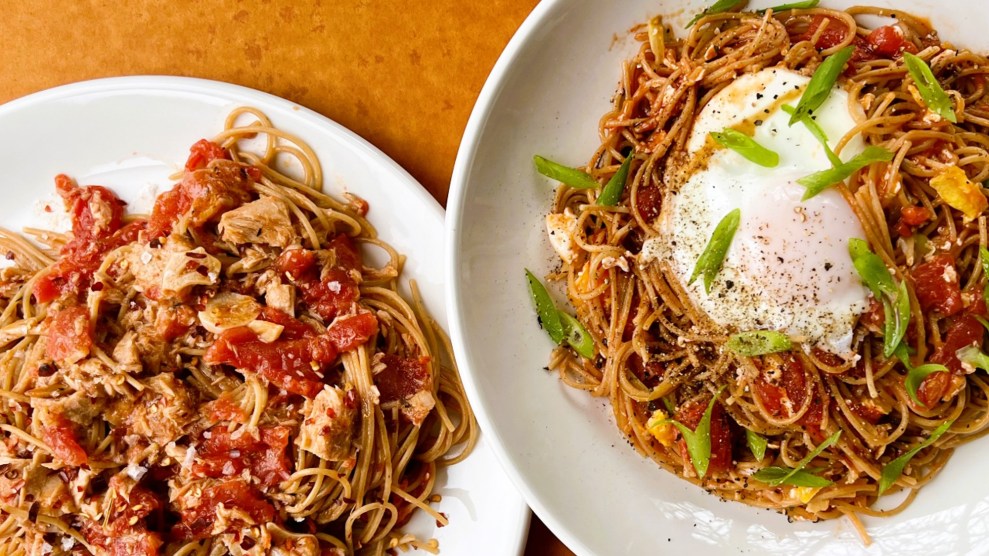
For the price of an Egg McMuffin in New York City, you could buy an organic low-fat yogurt and a piece of fruit. For the price of a Taco Bell meal, you could visit one of the thousands of salad bars in delis all over the city. For $4, you could buy enough whole wheat pasta and marinara sauce to feed several people.
There's no reason ever to drink sugary soft drinks. If you buy store-brand selzer or still water, it's cheaper than soda.
I am rarely in agreement with the Heritage foundation, but in this case I am. People get fat because they eat too much. If you must eat mass quantities of salty, sugary stuff, of course the mass-produced unhealthy variety is going to be cheaper than the equivalent amount of many nutrient-rich food. And food stamps aren't going to help people if all they buy is highly processed packaged foods.
It just becomes more and more apparent that the Republicans and this Republican president don't give a rip about the poor in this country. Perhaps the hope is that, by decreasing food stamps and WIC, that they eventually will all starve to death.
By the way, WIC is a proven program that supports the concept of Healthy Mothers, Healthy Babies. Of course the Republican elite do not care about that either.
kathryn must not need very much food - i could never get through the morning on a yogurt and an apple. or on a pile of pasta either. and i'm not overweight or poor. and i'll call bull[deleted] on that $4 pasta for a crowd. since it probably costs $4/lb or more, you're maybe getting a quarter pound dry, tops. and it's no better nutrition than a bag of cookies, it just lacks the sugar. and soda is cheaper than milk now, especially if you don't get a name brand. gimme a break.
and has anyone here ever been in a third world country where rice and beans are the staples? people who are barely subsisting do get fat on that diet. you have to have an awful lot of non-root vegetables to have them be the basis of a healthy diet.
i gotta say, it is pretty sickening to see "well i could do it why can't they" crap on this site like i'm seeing here today. you people have no clue - especially the slumming it grad student.
I just bought a gallon each of orange juice and milk, it cost more than eight dollars, more than a lot of people bring home for an hours work. I can't imagine living on minimum wage and having two children and no spouse...
As a member of the not-so-elite citizens living far below the poverty level, with an income of less than $700 a month from Social Security Disability and Supplemental Income, here's the deal: It is virtually impossible for the poor to eat "real" food. Healthy food? No, it's not on the menu. I am a vegan by circumstance, not choice. Pasta and rice are known to cause weight gain, even when eaten in moderation, due to the carbohydrates that turn to sugar in our systems. In my home, the diet staples consist of ramen noodles, spaghetti, and bread. I "splurge" on salad foods when I can and would love to be able to enjoy broccoli and many of the wonderful fresh vegetables and fruits available -BUT I CANNOT AFFORD THEM! Anyone who thinks it is easy collecting government money really needs to rethink that position. In my case, I went from being a productive professional to a fully disabled person in the blink of an eye, and I am not enjoying the situation. The only way I can earn a salary is to work from home, and jobs like that are scarce. Kathryn said: "For the price of an Egg McMuffin in New York City, you could buy an organic low-fat yogurt and a piece of fruit. For the price of a Taco Bell meal, you could visit one of the thousands of salad bars in delis all over the city." Well, yes, you could, if you had access to and the money for transportation. Good health and mobility helps witht that, too. A piece of fruit does not have a very long shelf life - further complicating the issue of how to eat well when one lives under the poverty level. I'm thinking that, as Patricia said, "Perhaps the hope is that, by decreasing food stamps and WIC, that they eventually will all starve to death." We probably will NOT starve to death, but likely outcomes of poor diets are well-documented. Increases in heart disease, cancer, and so on are linked to poor diet. Maybe they, the 'ubiquitous' they of the Heritage ilk, are just waiting for us to die off ... especially since our medical needs are not met in this country, either. Enough said.
Wendy: Most people don't know what a healthy weight is or what healthy eating is. I was talking about eating on the run, and the no time claim. For another 50 cents, you could add oatmeal. For another 75 cents, you could add a whole wheat bagel (hold the grease). People make bad food choices and they eat too much. I have been dirt poor, and when I was I didn't get fat and I didn't starve. There is something going on here that people are afraid to talk about, class and food choice. I look at what people put in their shopping carts. If someone is grossly overweight, it's inevitably A LOT of trash food. I don't believe that this means that food stamps should be stopped or reduced or anything like that but that a lot of Americans don't have any idea how much and what kind of food should be eating. When I was in college I thought pizza was good for you because it had tomato, bread, and cheese, covering three food groups. It doesn't help that we are bombarded by food advertising and are so overworked that convenience foods are a staple rather than a treat. A few months back I was watching a reality show called "Honey, We're Killing the Kids," which chronicles the bad eating habits that make children fat. In this particular episode, this non-poor, overweight mother was completely befuddled by the produce department. She didn't know how to cook anything fresh. Americans have a very screwed up relationship to food, and, yes, a yogurt and an apple is normal breakfast for me sometimes, and I am not rake thin. The point is you can make better choices if you want to.
I have been poor, living at poverty level with my husband and child, in an apartment complex with lots of other families in the same situation. I had no car and did not live in an urban area. I walked, rode my bike, and used public transportation to travel the miles to school and work, pick my child up from daycare and shop for groceries. I had a small, fixed amount to spend each week on groceries and I cut coupons, planned my shopping around stores that had sales and and planned meals to get the most out of what I purchased. It is absolute nonsense that people don't have time to prepare food. Folks need to get their priorities straight. While I prepared nutritious meals with fresh vegetables for my family, worked my way through school, and kept my house in order, my neighbors popped frozen meals in the microwave, collected what they could in government handouts and sat in front of the TV all day. On the other hand, I didn't own a microwave or a television, o I guess I just had to "make do"!
I don't consider myself to be at the
poverty level; but, it is very difficult to consistently provide truly
healthy foods for my family. LEAN meats, fresh fruits and vegetables cost a great deal of money. My "pantry" is often low. 1% milk is
about $3.69 per gallon. The fact that
Bush is willing to cut WIC is unconscionable. I don't think that anyone chooses not to eat healthy. If you've never been hungry; it's very easy to blame the victim. I have been in homes where the food that was thrown away at ONE sitting, would have fed me and my daughter three meals. The amount of waste and gluttony is far more prevalent among those who don't have to worry if they will have 3 meals in a day to provide for their children. Please....why has it become so popular to lose our compassion? Have we numbed ourselves down to the point that we can no longer empathize with those who TRULY are much less fortunate than so many of us. There have literally been times when I've had to choose between quality food and having gasoline for my car and having a roof over my head. The cost of living is exorbitant. If we cannot have compassion and mercy for those who cannot promote themselves to middle, upper-middle class.....who will help them?
Several of the people replying are assuming that the poor people being discussed can afford stoves, refrigerators, microwaves, etc. I have discovered a raw vegan diet can be incredibly inexpensive, and requires none of these thing. It does, however, require a lot of education in order to be done safely. Perhaps we could offer a much more extensive dietary education to people in addition to foodstamps, etc.
Well done, BR!!!! Very good t bring in the distance to a food outlet and quality of food in poorer neighbourhoods. That is very true and often not taken into account. I live in Johannesburg, South Africa and the same is true here. I disagree with you on poor people buying bulk - they often have only enough for the smaller sizes of each item, ending up paying much more than if they had enought to buy the bigger packages.
What is wrong with you people? It's already been pointed out that poor people do not usually have pots, pans, electricity or gas, vehicles to go to the cheaper stores, etc! And it's designed this way. But that's okay, because the middle class is going to understand it from the poor perspective soon enough, as our unbacked, fiat currency collapses, the dollar ceases to be the world's reserve currency, and we plunge into the greatest depression this country has ever seen. Wait till they ship your job overseas, you uncompassionate a-holes, driving around in your mamoth trucks and SUVs--you people make me so mad. And you speak of "education"--it's you that need to be educated about how this country is descending into Corporatism-aka,Fascism. Americans just don't want to face the truth, shoulder the responsibility that the way we live our lives--and practically everyone in this country is obese, rich and poor alike--that our lifestyles require most of the rest of the world to live an intolerable existence. We're something like 8% of the world's population and use up 25% of its resources. It is very easy to fall through the cracks in this country, and there's a big wake-up call on the way--though people probably won't listen until it's too late.
To the person who said:
"For the price of an Egg McMuffin in New York City, you could buy an organic low-fat yogurt and a piece of fruit. For the price of a Taco Bell meal, you could visit one of the thousands of salad bars in delis all over the city."
That may be true, if, if, a) This would actually be filling to someone likely working with their hands. b) any were that close to them, especially in more spread out places. c) If more people actually knew that eating such foods was bad for you! This is not being taught to people. Especially in the Bush era.
Ask a poor person and what they would tell you is that; It's not bad for me! Otherwise the government would not allow them to sell it. The person who downs a donut and a bag of Doreto's has no idea that they are only supposed to be snacks eaten infrequently and how bad they are for you. Hell, most middle class people don't even know!
Our current government's only goal to is allow businesses to make more money. Education is an anathema to that.
A good book I recommend is - The Omnivore's Dilemma by Michael Pollan.
As a survivor of both Hodgkin's and Thyroid cancer, my metabolism is slow. Medical expenses have reduced me to the use of food stamps to survive. In three years my allotment has been reduced three times to $0.83 per meal. Eggs prices has risen 44% and milk prices 23% to name two items. The 'think tank' Heritage Foundation is thinking the unthinkable - let the poor starve. Hunger is hunger and it is real. Mr Ridgeway is right! I don't eat process food; but, real food still costs.
Oh, and what is "the neo-liberals" are chipping away at social programs? While I have no sympathy for the spineless Democrats, it's the "neoconservatives" that want to end all social programs. A lot of these neo-cons, and Bush and Guiliana Republicans basically believe that, if you weren't born into money, or had parents that understood economics and could put you thru college, then "screw em" I know this personally from talking to many of them. I'm not saying they're all that way, but a lot of them are. And the "self made" men don't seem to understand that, while some things were tougher in their generation, putting together a business, or getting a good education, was a LOT easier and cheaper. And these entitled people have conspired to "dumb down" Americans, because in order for them to live their workless, rich, waited upon lives, they need a large body of basically serfs, or manual workers, to wait on them, and give them a nice chunk of their money via income taxes, which the corps. and CEOs avoid through complex transactions involving moving their profits to off-shore accounts. Our income tax doesn't pay for infrastructure, either-it goes to pay the debt on the interest of the money the gov't has to borrow from our Central Private Bank--a cabal of banks--The Federal Reserve...it's no coincidence that the Federal Reserve Act and the 16th amendment were both passed in the same year--1913. Watch Aaron Russo's "America:Freedom to Fascism"...you can watch it for free on google video. The American people have been shafted...everything our forefathers fought against in the American Revolution was undone by the Fed.Res. Act. And it's set in motion a process that will eventually lead to the collapse of our economy--which was always our true strength, not the military.
ditto to EVERYTHUNG alan says!!! and unfortunately no one is gonna even look up from their shopping until it all falls out from under them. and that's when they pull our free speech.
i have worked in the food business for 25 years. i have trouble making as much as i did 20 years ago as the service economy has expanded. and i work in philadelphia with many talented and experienced hard workers who are in the same boat. the main advantage over many of them i have is that i own a car, and don't have to commute for hours on top of a grueling work day on my feet. this large important city has truly awful mass transit, and every year it gets cut back further. what i can drive in less than a half hour can take 3 times as long on the bus, which might run just once an hour during rush hour even, adding more time. and then you're gonna cook for your family? this is the reality for millions of americans at this minute.
millions more live in hotel rooms, cars, and on the street. that population will soon grow to proportions we've never seen in our lives.
all i can say is i'm glad i know how to grow and keep food, organically and intensively, and have friends who have enough land to grow some on. i just might learn to use a gun too.
"Of all the preposterous assumptions of humanity over humanity, nothing exceeds most of the criticisms made on the habits of the poor by the well-housed, well-warmed, and well-fed." ~ Herman Melville.
A gentle reminder for the priviledged to always check their assumptions.
Guns, Germs, and Steel by Jared Diamond actually makes an interesting/parallel/applicable argument about the reason that some civilizations were able to develop more advanced technologies than others. The more time a society could save in harvesting nutrient-rich foods (raising animals for food and work; the commonly konwn nutrient-dense grains) the more free time the society had to specialize in crafts. Societies without the ability to do this never freed up enough time for people to develop technologies. In a parallel situation, if individuals spend all their time working and commuting, how much energy can we expect them to have to devote to nutrition when perfectly viable sources of energy and calories are at the ready? I second the thoughts about the "real" cost of the food--the time it takes to prepare, how long the food is viable before spoilage, the number of calories you get for your money, the materials involved (from appliances to basic ingredients like oil, salt, pepper, spices, butter, milk), if you read the research time and time again it's borne out that fast food, donuts, chips, etc are a better value for your money.
Did anyone but me notice that the link for the "Comprehensive strategy" for dealing with Katrina suddenly doesn't work? I wonder why...
Not where I live! I buy real food -- but it's costing us way more than it would if we were willing to eat the mac & cheese in the blue box!
The bigotry and sheer ignorance and hatred towards the poor from some of the commentators on this site is very disturbing. To bread shortages that threatened to starve the poor Mair Antoinette was alleged to have replied, "let them eat cake". The numbskulls on this site reply similarly to the poor in their own country, "let them eat yoghurt".
Sorry about the typo...I meant Marie obviously.
Eating properly takes an astounding amount of both time and money. My girlfriend and I spend a stupefying amount of money and damn near a full time job between the two of us preparing meals from non-processed (mostly organic) foods. We are relatively well-off professionals (she’s a full-time college student but works an almost full-time job), and even for us it just ain’t easy. I remember when I was poor white folk working two jobs. Spending the time and money that we do now to eat “properly” simply was not an option. Even now it’s hard at times. I challenge any of these Heritage Foundation turdburglars to feed themselves a reasonable diet on a regular basis. Ordering the salad every time you go out to eat doesn’t count. Let’s see one of them chopping leaves twenty nights a month when they have to be up before dawn to earn a living, then maybe they’ll have the slightest bit of credibiliy on the matter.
I challenge all of you - for one month, feed yourself and your family for $2.00 each per day. You can use up the fresh food in your house, but you can't use any bulk staples, seasonings, sauces that you might have on hand. No treats not on that budget for special occasions. You may use your existing refrigerator, stove, microwave, running water, power and utensils. You may not use any herbs and spices unless you buy them out of your food allowance. At the end of the month, read your comments to this article again.
I guess some people assume everyone has access to a microwave and the time to cook their 5 kids rice and or pasta in it between working their 2-3 minimum wage jobs to provide for necessities.Have you been to the food mart at the gas station where some people buy food? You'll find a definite lack of fresh fruit and vegetables and a large selection of processed food.Real grocery stores move away from poor areas. Their tiny profit margins don't allow for dispensing food to poor people.
The solution for some folks,to fill the food gap ,is the food pantry. These are sometimes empty before the end of the month.
We used to be a country that helped folks down and out get back up. Now we have the mean spirited folks that think anyone who isn't working must be lazy[and fat too]. No,I guess those folks have always been around,looking for the workhouse for the poor.God help em'if they ever end up in those straights.
With any luck, Mr. Hecter and the Heritage Foundation will stop torturning the poor and the obese under the current starvation plan and move quickly on to the next positive step: gas chambers and crematoria. Yes, Mr. Hecter and the Heritage folks could become real leaders in Positive Thinking and Green Politics. They could start heating their offices with this great renewable resource of skin, bone and flab. After all, the poor (and now the obese) will always be with us, if we work it right. So let's stop being so wasteful and use this resource proudly to keep Mr. Hecter and the Heritage Foundation warm!
Several rambling thoughts: It is far cheaper to purchase a "deluxe" box of easy-to-prepare macaroni and cheese, than to purchase ANY of the healthier items listed. If this type of highly-affordable "staple" is purchased in quantity (for those with functioning kitchens and appliances), then there's always something available to hungry kids between primary meals, if not served as part of the primary meal, and if there ARE primary meals. The manufacturers sure seem to know that inexpensiveness and kid-friendly prep. ease are sure selling points; but, then, it may be that different regulating factors are in-play, for differing types of foods. A $3.00 per-pound-bag of about 10 Gala apples will last about 3 days in a 4-person household, if the members are apple-eaters. On currently stocked grocery shelves, canned tuna presents several quality levels and correspondent prices (the mushy texture of the cheapest makes for a texture-less tuna salad - but hey, beggars can't be choosers - the premium brand, packed in olive oil, is what ALL canned tuna used to be like!). I'd also like to remind interested parties, that being poor is similar to having a traumatic condition in need of rehab. (yes, tends to the chronic, if untreated); depression and anxiety will alter body chemistry, if experienced long enough over time (may also present weight issues). Minimal subsistence, for any citizen, is not acceptable to me, as an American in an America trying to show the rest of the world how to live. My final question is this: why can't food stamps be spent at state-affiliated Farmers' Markets (wow: assuming that poorer people can get transportation to those locales, and manage carrying goods). Obviously, there's more to the overall issue than will "meet the eye," than can be addressed in one column, or corrected by a largely elitist government.
Provide free tubal ligations and sadly go to the chinese position of mandatory sterilization after one or two "mistakes" by welfare folks, they will gripe but it is the right thing to do. I work with them, IT IS THE BEST IDEA for the society and the planet.
Dried beans in a microwave? Obviously, you have never actually tried that. Take my word for it, it doesn't work if you want something that has taste.
I feed a family of 6 for about $10 per meal, bare minimum for nutrition.
I could feed them top ramen with added canned vegetables or meat for about $1.00 per meal, or perhaps a bowl of cereal with toast. But you are talking about a diet void of most fresh fruits and vegetables. Have you seen the price of a grapefruit lately? My local Smith's has them on sale for $1.89 each. A pound of cherries is $6 and unless it's in season corn on the cob is $1.00 each. Also, you have to go to the market every day or, at least, every other day to get it fresh instead of frozen or canned. That is hard for some people. I happen to live in one of those "food insecure" states where diabetes is the usual ailment. It takes a lot of hours out of my day to prepare nutritious, low cost, meals.
Of course, it would be cheaper for me to buy a pizza in more ways than price, think of the time I would save. Working parents don't have time.
When I was a child in the 70's, our Saturday morning cartoons were filled with Public Service Announcements educating us about the importance of eating from the 4 food groups. Now, the cartoons are filled with only commercials for sugary cereals, candies and artificial drinks. Public schools also lease their cafeterias and vending machines to these same companies. For more info, make sure to see the highly entertaining documentary "Super Size Me".
Government can do more to educate children by disseminating nutrition information on our airwaves and in our schools.
wow julianne- you are heartless. sterilization? i am very afraid.
I am shocked and dismayed at the number of comments that are parroting the stance of the current administration. We can afford to kill people in Another country, but we can't care for the needy on our own soil? Many years ago, I had to go on a government program "Aid for Dependent Children". That was the only way I could provide healthcare for my daughter. I was a single mom, working at a low paying job, wanting to go to college. I am now a college graduate, earning a very good salary. I would not have been able to accomplish that, if that program had not been there, when I needed it. Not every one receiving aid is doing so, because they are lazy. My husband had abandoned me and my child, and I was working very hard. WIC is in place to help women and children. It is interesting that the very people who are against abortion, are also against caring for children once they come into the world.
I have noticed that produce in lower-class neighborhoods tends to be both expensive and low-quality. I live in a neighborhood that borders both middle class and poor neighborhoods, and I have seen a big difference in produce quality and availabilty of choices in the groceries that serve the various neighborhoods. This holds true for even large chains like Safeway. Even if someone made the sacrifice to buy fresh produce in the poor neighborhood stores, they are buying produce that has an even shorter shelf life than normal, and most likely a greatly reduced nutrient content.
Just to clarify Alan, Neo-liberal is term used also to describe followers of a purist free-market economic philosophy AKA: neo-conservative.
Suggesting sterilization sounds quite heartless, but this type of reaction can be understandable given a cultural environment where having children is an assumption rather than an option and a policy environment where any mention of family planning is forbidden. I certainly don't buy into the "welfare queens" stereotype, but I do think that we should work toward a society where every child is wanted and can be cared for. When such a reasonable goal seems so far out of reach, the dystopian solutions start to brew.
That salad takes a long time to eat, too.
Before the Food Stamp Program as we know it today existed people who were in need of food received actual food items from the Government. Food stamps currently can not be used to buy certain items. Expanding that list to exclude unhealthy foods would not only be beneficial to food stamp recipients but would also give food providers an incentive to make more nutritious foods available to all of us. The Government could also go back to distributing surplus farm produce to those in need.
If mandatory tubal litigations were forced on those folk that have children they are unable to care for I don't think most of the recipients would complain because I don't think anybody enjoys having a child for whom they can not provide the basic necessities of life. Most of the complaints would come from the anti abortion folk who are against the child not being born but who are not willing to accept the responsibility of caring for the child once it gets here.
Yes. This idea that one is mind rested and free to "make better choices"..and we're assuming a high education that most people who have little don't have access to either, especially in a country that since the first Bush puppet I remember, Reagan, began it's program of destroying that "dangerous" education in the US as well as any sense of safety and time to think, react or care. When you're ready to drop and the kids are mad, acting up, hungry you just get soemthing on the table that you could pick up on the way home: There is neither time nor energy to "Prepare" meals, much less think a week in advance what would be a balanced meal. Everyone is in front of the tv to relax where they're being sold and mindblasted with Cokes and Pepsi, candy, etc and the message that fruit and veggies are for those other rich and\or educated people, certainly not meant for me honey. Get real..The Heritage Foudation has always been a very highly paid source of dis-information, there is nothing new about that. What is new is that people believe they know what they(the HF) are talking about. Because if you have a country that mostly can just barely read, they CANnot of course judge and talk back and create other real solutions easily. Which was the point of cutting education..etc. I'm glad to see people speaking up about what it is really like to live without, when you're old,or older or disabled, or
exhausted or ill. The grad student is young, and assumes he will not live like this for more than a few years..HE has no idea--and makes sure, it looks like not to think about that--what it would be like when tired, older, NOT 25 or 30 even, but 45, with kids etc etc. Such blind vanity. Bless you all for speaking up. And Bon courage.
"Rightly or not, people still associate obesity with the sins of gluttony and sloth..." "Rightly or not" -- what does that mean? Are you calling into question that fact that most of those "underprivileged" bubble-butts in my high school spend their copious free time swigging sugary pop, stuffing pork rinds into their purulent faces and trying to decide whether to cater their frequent drug parties at KFC or Taco Bell? Do any of us seriously suspect that most of them are suffering from some hormonal imbalance, and that their obesity has noting to do with gluttony and sloth? Until you live and hang out with the underachievers you so love to idealize, please refrain from sneering at those who would attribute to the poor a measure of personal responsibility.
Conservatives are a breed of animals that dote on the insecurity of the poor. They want the poor to suffer poor health as a consequence of their misfortune. It is a phenomena that has developed in a society hypnotised by power, greed, superstition and fear that will worsen as polarity increases in the swarm of have and have nots. I personally dream each day and night of seeing Americans destroyed...hopefully by the forces we fear most.
Unfortunately for Alan's rambling diatribe, the 16th Amendment and the Federal Reserve Act were passed by... gasp... LIBERALS. Just remember Alan, liberalism always results in the exact opposite of its stated intention.
People just need to stop making excuses for the poor choices that they, themselves, and others make in their lives. Everyone on here is complaining about how "unhealthy" low cost foods are and that they are the cause of obesity. This might be a shocker to some of you, but despite the fact that they do have a higher calorie content, this can easily be offset by EXERCISE. It all comes from this little thing called SELF-DISCIPLINE. When it comes to getting fat, time and money are just an excuse. Show some self-control.
Wow Richard Conn... You "personally dream each day and night of seeing Americans destroyed...hopefully by the forces we fear most." What a nice outlook on life you have. It's funny though that apparently "conservatives" are the ones that are heartless and without compassion. How does that old saying about glass houses and throwing stones go...?