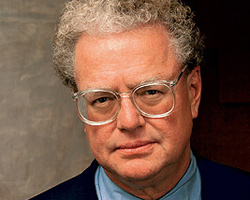
The Fall of a Corporate Crime Fighter
Famed class action attorney Bill Lerach's pursuit of corporate fraud cases landed him on the wrong side of the law.
Lerach tells Greider, "There is no criminal accountability for white-collar crime at that level; there simply isn't any. The head of J.P. Morgan Chase does not give a crap if he gets caught in Enron and he has to use the Morgan shareholders' money to settle $2 billion in civil claims. He's still going to have his four homes; he's still going have his $300 million, his yacht, his life . But if he knew he had a real credible threat of going to jail for three years, he would behave differently." As for trial lawyers, whose reputations are on par with some of those crooked CEOs, Lerach said, "We may not be perfect, but we are not corruptible."
So it's no small irony that Lerach will soon be joining some of those corrupt CEOs in federal prison. On Monday, a federal judge handed Lerach a two-year sentence after he pleaded guilty to a felony count of conspiring to obstruct justice. He was charged for his role in a long-running illegal scheme at his former law firm, Milberg Weiss, a scheme designed to give Lerach and his partners an upper hand in major national class actions. For 25 years, lawyers at the New York City-based firm, including Lerach, allegedly paid kickbacks to plaintiffs in shareholder lawsuits. The firm paid one plaintiff, a California ophthalmologist, nearly $7 million to use him, his family members, and other of his associates as plaintiffs in at least 70 class action lawsuits.
The scheme had very little to do with combating corporate fraud and a lot to do with making money. The first lawyer to file and win certification for a class action usually controls all the other litigation on that particular claim nationally, and thus, gets the biggest fees. That's why Lerach worked so hard to win the race to the courthouse by having plaintiffs essentially on retainer should a ripe target emerge. The details of the Milberg Weiss prosecution paint a pretty sleazy portrait of class action law. (The plaintiffs were actually paid in cash out of a safe in a Milberg office.) Two other Milberg partners have already pleaded guilty, as has the ophthalmologist. Milberg Weiss reportedly netted some $250 million in fees from those cases, and the firm itself has also been indicted, similar to the fate of the accounting firm Arthur Anderson in the Enron case.
Some of that money went to back political campaigns. Lerach himself has given about $1.3 million to Democratic Party entities and candidates since 1993. (He also served as a fundraiser for John Edwards' presidential campaign until his plea agreement last Fall.) Milberg Weiss employees have given hundreds of thousands of dollars to Democrats since 1990, and more than $800,000 in donations to 527 groups supporting Democratic presidential candidates in 2004. This generosity may be one reason why Lerach's guilty plea doesn't seem to have muted his liberal folk-hero status.
Consumer activist Ralph Nader told the Wall Street Journal on Monday that "given the corporate crimes that Mr. Lerach has brought to justice during his long career, his crimes pale by comparison." After Lerach pleaded guilty, a host of supporters wrote letters to the judge asking for leniency in his sentencing. The list reads like a minor Who's Who of the liberal establishment, whose members apparently feel that Lerach may be a criminal but he's their criminal. There's Nader; Robert Borosage, head of the Campaign for America's Future; Pamela Gilbert, the former executive director of the Consumer Product Safety Commission and her law partner Jonathan Cuneo; Sen. Carl Levin (D-Mich.); Robert Monks, the "dean" of shareholder activists; and even Kenneth R. Feinberg, the former special master of the 9/11 victims' compensation fund. None of the support, though, did any good. Lerach had asked for a six-month sentence but got the max, 24. And that may be a good thingeven for liberals enraged with the corporate excesses he exposed.
Lawyers like Lerach who push the envelope in litigation under the guise of defending the little guy have had a ruinous effect on the integrity of the civil justice system. Large corporations have long argued that class action lawyers are nothing more than extortionists who shake down big companies every time their stocks fall, forcing them to settle or risk fiscal ruin from a big jury verdict. Given whats known now about how Lerach operated his law firm, it's hard to say that the perception is only spin. Lawyer misconduct has also given a big assist to big corporations' long-running campaign to eviscerate consumer-protection laws. Corporate lobbyists have successfully persuaded legislators to pass measures immunizing businesses from lawsuits, claiming they need protection from the likes of Lerach. These laws have helped dramatically reduce the ability of injured people to hold companies accountable for wrongdoing.
Nonetheless, as The Nation article illustrates, Lerach is skilled at presenting himself to the press as David fighting corporate Goliaths. He is charismatic and persuasive, and usually right about what he sees as the ills of the business world. (Of course, it doesn't hurt that he has employed the services of spinmeister Chris Lehane, Al Gore's former press secretary, to help tell his side of the story.) In November, after pleading guilty to the federal charges, Lerach took to the op-ed pages of the Washington Post and opined about the subprime mortgage meltdown and, of course, to defend himself. In his editorial, he declared, "I'm on my way to prison because, in my zeal to stand up against this kind of corporate greed over the years, I stepped over the line." Perhaps the prison sentences Lerach once championed for errant CEOs as a way of cleaning up corporate fraud will have a similar effect on those in the legal profession.
Many commentators, experts and legal scholars have expressed opinions regarding the effects of plaintiff payoffs. While the undisclosed compensation paid to lead plaintiffs is universally recognized as prohibited, many appear to consider these arrangements to be a minor affair that only cheats other lawyers. Pundits have shown a disturbing tendency to minimize the gravity of these allegations, rationalizing perjury by a lead plaintiff at the direction of lead counsel in securities class actions as only lying to the court. Claims of damages to the interests of the classes represented by Milberg Weiss and these house plaintiffs are often dismissed as speculative and uncertain. Nothing could be further from the truth.
The role of a lead plaintiff in federal securities class actions involves far more than owning or trading stock during the applicable class period. The payment of undisclosed compensation to lead plaintiffs by lead counsel is not a benign technical violation of procedural rules, or a questionable way to cut corners. There is far more at stake than lead counsel cheating other firms out of the financial benefit of running a particular case, or the sharing of legal fees with non lawyers. These hidden arrangements eliminate an important safeguard for the class members being represented by these lawyers and plaintiffs. Alteration of the relationship between a lead plaintiff and their chosen lead counsel has serious consequences for all class members. There is far more going on here than meets the eye.
It is true that gaining the role of lead counsel is the initial benefit of having house plaintiffs on the payroll. While getting appointed is obviously a key first step, it is far from the only important benefit of this arrangement to lead counsel. In practice, even after the Court appoints lead plaintiff and counsel for a case, the house plaintiff retains great value. The conduct of the case is completely in the control of lead counsel. This power extends far beyond control of the legal fees. The Court simply does not evaluate or question in any way the judgment of lead counsel regarding conduct of the case. The oversight of lead counsel by the lead plaintiff is the only protection afforded class members by the statutory scheme.
The house plaintiff will always be completely satisfied with the course of the litigation. The Court will only ask one substantive question of lead counsel – is the settlement fair and reasonable. There is never an objection to any proposed settlement from the house plaintiff. This is assured by the additional compensation they receive. Neither the Court approving the settlement, nor the class members that are legally bound by its terms know anything about this additional compensation. The house plaintiff is the only party legally entitled to challenge the absolute power of lead counsel to conduct the case and propose settlements as they see fit. How many plaintiff objections could we expect if any class was fully informed about the secret payments made by lead counsel to the class representative selected by the Court?
The lead plaintiff can unilaterally kill any settlement proposal by lead counsel. Objections raised by the lead plaintiff have great weight with any Court. Institutional shareholders are preferred by most courts to serve as lead plaintiff precisely because of this oversight function. The legislative history of each rule change relating to this process clearly reflects the essential failsafe role that the lead plaintiff is expected to play in class actions. The only chance for oversight of the lawyers is eliminated by the payment of undisclosed compensation to house plaintiffs. This ongoing value of house plaintiffs is confirmed by the fact that Milberg Weiss continued to pay the undisclosed compensation long after the race to the courthouse was discontinued by statute.
The role of lead counsel includes built-in conflict. As a rational business they want the most pay for the least work. As a lawyer they are obligated to proceed with the case in the clients’ best interest. Lead counsel is not obligated to go bankrupt taking a weak case to trial, yet they are not allowed to settle a strong case for a song after doing a personal cost benefit analysis. It is a judgment call each and every time, which is why the integrity of the selection process for lead counsel was considered so important. Trust is the essential element overlooked by those seeking to minimize the effects of this pernicious conduct on the classes represented.
One would like to think that the corruption of this process by Milberg Weiss is unique to the firm. Milberg Weiss invented and dominated the field of securities class actions for decades, but such success breeds competition. Firms competing with Milberg Weiss, and its stable of house plaintiffs, were in a difficult situation. Some firms found other ways to create their own success, such as developing a relationship with a few institutional investors, or aggressively searching for clients with large losses. Others remained content to be well paid secondary firms, billing time where they can and referring their plaintiffs to better situated lead counsel firms. Another group of firms replicated the business model of Milberg Weiss on a smaller scale through development of their own house plaintiffs.
The business model has evolved by developing other ways to circumvent the rules. At worst, a house plaintiff deprives class members of the honest services of counsel operating with the intended oversight of a legitimate lead plaintiff. At best, it just looks that way to most observers. Even if Milberg Weiss were to be completely eliminated by further government action, the problems created by use of house plaintiffs will persist. The process of selecting lead plaintiffs and counsel in securities class actions has been slowly corrupted by years of Milberg Weiss’ unfair dominance. Everyone else was forced to search for ways to level the playing field and replicate the success of Milberg Weiss. All these years later the race to the bottom is complete.
The issues raised by the indictment of Milberg Weiss involve the essence of class action representation. A lead plaintiff is expected to act as a representative of the class. The oversight function of the lead plaintiff is an essential element of the statutory scheme created for class action cases. The Court relies on the lead plaintiff, as does the class. There is nobody else authorized to supervise the lawyers. The effects of these arrangements are the same whether lead plaintiff is paid by cash, check or deductible contribution. Any undisclosed compensation paid to lead plaintiffs exposes class members to representation by attorneys who operate outside the law when winning appointment as lead counsel, when eliminating oversight by a legitimate lead plaintiff and when directing their house plaintiff to lie to the Court about their additional compensation.
The concept that these are benign activities that have little or no effect on the value of the settlements negotiated is laughable. There have been years of questions by class members and commentators about securities class action settlements of pennies on the dollar, or useless corporate governance changes in lieu of cash compensation for huge losses. Even the strongest, airtight cases have no chance of going to trial. The Milberg Weiss indictment and the effects of the activities it describes confirm what critics have claimed for years, but could never prove. Unsupervised lawyers are putting their own interests ahead of their clients because nobody is watching, and the Courts are unable or unwilling to stop it. Unfortunately, it is just that simple. For more details go to www.stoplegalfiction.org
barack obama mike huckabee vs machine
huckabee obama:
we understand your disgust.
subversion of democracy.
know this:
gravel kucinich paul nader
will fight any ticket
with clinton or mccain on it.
your eyes & ears are open...
Mike Gravel Dennis Kucinich Dr Ron Paul Ralph Nader
united by truth elicit fear smear blacklist.
Too many lies,
democracy rising democracy now.
Rage against the machine.
Honesty compassion intelligence guts.
No more extortion blackmail bribery division.
Divided we fall.
What this guy did, from what I understand, was highly unethical but only became illegal under a HIGHLY creative reading of the USC provisions re: Obstruction of Justice. Essentially, he committed no crime, until one was customized just for him. The problem is that every single day, hundreds of actions which VASTLY exceed his act in severity are committed by the US Bench and Bar. If he is guilty, so are 10% of the judges in the USA and half the lawyers.
He was getting pay-back for being a severe thorn on the side of corporate America (Wall Street).
It's true that lawyers like Lerach damage the integrity of those fighting for justice against white collar crime. Yet the other side has absolutely no integrity whatsoever but hold themselves up as sterling examples of capitalism. Exxon/Mobil hasn't paid a dime for the damage they did to those in Prince William Sound and it has been sixteen years. But let's not minimize the gravity of Lerach's actions...bull[deleted].
Paying off Plaintiffs to testify? Considering the odds, the length of time for a lawsuit, how would you have expected an ordinary person to stand up, through the years? That such individual could ever find employment is just nthinkable, whether he/she wins or loses. Does the end justify the means? Then why do you think CEO's get their enormous swag?
Even at that, how do you think the Federal Government gets its witnesses?
With perjury running rampant, from family court to criminal court, and prosecutors seemingly unwilling or unable to go after the liars is amazes me that we have any faith in either the civil or criminal justice systems. Until the crime of perjury is taken seriously, and prosecuted fully it will remain a corrupting influence in all trials, politics and every segment of our society.
Fraud begins with a lie. And when the lie perverts justice, society suffers.
The problem with ambulance chasers;) is that they kind of end up just adding fuel to the fire. When you hit a company with a lawsuit, and damages get awarded, you're just siphoning their profits. Then, they hire better lawyers to get rid of YOU, and the cost gets passed on to the customer, and then it sucks to be everyone involved.
I think if they took after Starbucks, and just sued for a dollar, then everyone might take the business a little more seriously, and look closely at the problem rather than seeing it all as a highly polarized money battle.
If a company is doing something bad, and you want em to change, then take it before the court, and sue for that dollar. "We are being sued for a dollar" might sound frivolous, but if the business of the lawyer is to help someone, a victim, winning the dollar is an admission of wrongdoing on the part of the party being sued, without bleeding their company dry. That removes the motive on the part of the lawyer to go nuts and sue for bleventyzillion dollars, and themselves be used as a tool by someone filing suit under false pretenses. People aren't above lying in order to get money from The Man etc. Win the dollar, and arrange for the two parties to resolve their differences civilly afterwards. If there was an instance of wrongdoing, then the offended party should get something, but corporations are just sitting ducks, legally, if there isn't some kind of clearheaded understanding at the outset that this isn't a go-for-the-jugular issue, but rather that LarryBob got his arm severed in the corn binder that wasn't taken care of properly, and hence is out of the workforce, and still has to pay rent etc. That doesn't mean that Larrybob is entitled to a Taj Mahal, though. Balance. Just like those legal scaly-waly thingjobber things...also if
it turns out that Larrybob DELIBERATELY jammed his arm in the corn binder in a sacrifice play or something, that prevents Larrybob from automatically be coming the new CEO and burning down the company in the pursuit of blankies and beer...
Wow, a very dim lightbulb flickers tenuously over the head of the Mother Jones staff. A faint proto-insight can be detected that Trial Lawyer Inc. and corrupt "activist" judges may not be beneficial in any way for consumers.
Could it be the endless array of utterly worthless coupons we all receive, while the class action extortion industry gets huge cold cash payouts from these judges?
He should be locked up. Even though he attacked other criminals, he was a criminal himself- so it's really no different than one gang member being locked up that used to beat the crap out of every other gang on the street if they messed with his people.
the courts are generally opposed to human rights because they mainly protect corporate elites and corporate welfare....... THE PRISON INDUSTRIAL COMPLEX ENCOURAGES PRISON RAPES AND LAWYER PERJURY.