The Convicts and the Dame

What drew a British natural-cosmetics magnate to three guys in a Louisiana prison?

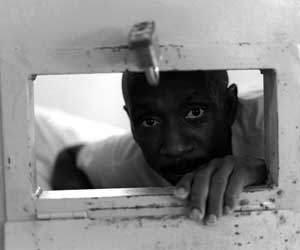
—Photo: Johnny Green/PA
Fri March 6, 2009 3:47 PM PST

I hadn't quite got used to the wordsstrungtogetherwithoutabreath speed with which The Body Shop founder Anita Roddick spoke. We had been working together on a publishing venture for less than a year; that day in the summer of 2001, she began our phone conversation with the usual "Oh hi, it's me." Then she switched to hyperspeed: "I've just heard the most amazing story and I want you to find out all about it. There are these men, and they've been in solitary confinement for 25 years I think. They are these incredible civil rights activists and political prisoners. They're called the 'Mississippi 8' or 'Tennessee 6' or something like that. Our friend Sophie is a brilliant photographer and she lives in the flat next to the lawyer for these guys in Oakland. Okay, bye!" I'm not sure I managed to even clear my throat to let her know that I was in fact on the other end of the line.

I sat down at my laptop to verify Anita's story. Google and Nexis turned up nothing on the "Mississippi 8" or the "Tennessee 6," although I was fairly sure that I had heard of some miscarriage of justice in the South with a similar name. The West Memphis 3? Dead end.

Half a dozen phone calls finally led me to photographer Sophie Maher, who then put me in touch with Scott Fleming, a recent graduate of the UC-Berkeley law school who had taken on the case of Albert Woodfox, Herman Wallace, and Robert King—the Angola 3. Like Roddick, Fleming had come across the case by chance, via reading a letter from Wallace at a protest event; now he was working for the men pro bono.


story continues below story continued from above

I put together a briefing for Anita and filled in as many blanks as I could. Most of her questions I couldn't answer, though: Why didn't there seem to be any coverage of this? (Maybe it was the Black Panther angle that scared them off?) Was it legal to hold someone in solitary for 30 years? (I would hope not, but I had no idea.) Were they innocent? (Scott thought so.) What could we do to help them? (Get the word out maybe?)

Two months later, Fleming drove us the two and a half hours from New Orleans up through Baton Rouge and into plantation country. At the end of a seemingly interminable two-lane, the front gate of Angola prison loomed into view. "My god," was all Anita said.

We were on the visitors list, I for Wallace and Anita for Woodfox. We passed through security, with requisite pat-downs and drug-sniffing dogs. A guard asked Anita about her accent and learned she was a Dame of the British Empire; as we waited for the bus to take us to the solitary wing of the prison, Anita regaled the guards with gossip about the royal family. It annoyed her that Americans disliked Prince Charles, and she argued in his favor. The guards, particularly the women, fell in love with her on the spot. Over the subsequent years, some recognized her on sight, squealed, and embraced her as an old friend.

We spent six hours with Woodfox and Wallace that day. Anita interviewed them as though she were David Frost, and you could tell they were both electrified and entirely confused by her.

Over the next seven years, Anita became completely dedicated to the cause of the Angola 3. She wrote articles about the case for magazines and newspapers around the world, although she remained confounded by the American press' indifference. Anita poured the lion's share of her energy and a good chunk of her fortune into the legal defense of the A3; several times a year, we traveled back down to the bayou for a visit.

Why was she so drawn to the case? I never fully understood, though in a sense, the Angola 3 represented a kind of perfect storm for Anita. She had been working on genocides and war crimes for a decade by then—huge, seemingly hopeless issues on a global stage. What happened at the Louisiana State Penitentiary, to her, was a very concrete encapsulation of the human rights issues she was passionate about. "They were on the bottom of everybody's shit list," says her husband, Gordon. "They were not getting justice or likely to." Also, she first learned of the case through a valued family friend, who wasn't seeking to recruit her, but only to share an outrageous story. Still, none of her engagement would have endured had it not been for that first meeting with Woodfox. "It was the human element" that clinched it, says Gordon. "It was when she first went down and visited Albert, and she came home and told me about him—and then later, when she encountered the force of nature that is Herman."

Everything about the case was personal to Anita. During one of our trips, she was summarily ejected from the prison for visiting in the company of the one free member of the Angola 3, Robert King. Although King, who had been released from Angola less than two years before, was on the visitors list legitimately, Warden Burl Cain claimed that his presence proved that Anita was conspiring with the Angola 3. The visitors were escorted brusquely to the edge of the property, and Anita fumed. She dialed up Warden Cain as we drove away; from the backseat, I could hear the poor guy sputtering on the other end of the staticky cell phone line.

On another occasion, her book, A Revolution in Kindness, which contained essays by both Wallace and Woodfox, was banned from the prison on the grounds that it could incite violence. I think it took Anita a few hours to stop laughing.

One visit got tense when Wallace tried to bring Anita a gift of jewelry he had designed. Because it included a fist in the likeness of a black-power salute, the chief duty officer confiscated it, as well as a poem Wallace had written about his "keepers." Things grew increasingly strained as the duty officer got on the phone to take the issue up the chain of command. While he waited for instructions, Anita did what Anita was wont to do: She told the duty officer a supremely filthy joke involving elves, penguins, and nuns. The tough guy cracked a smile, and you could feel the animosity drain out of the room. We were given another hour with Wallace and Woodfox before being asked to leave.

Anita last saw Wallace and Woodfox about a month before she died in September 2007. She was feeling tired and unwell, but was still traveling extensively. The last night we spent in New Orleans was full of great food and conversation, but there was something restive about Anita. She wanted creative, "revolutionary" strategies to get her friends out of Angola. And she was frustrated by our lack of original insight. In truth, many of us there that night, myself included, were exhausted by years of fighting without meaningful progress. Not Anita.

Gordon once said that the day Anita died, she said that her greatest priority was to see Wallace and Woodfox go free. If it happens, it will be because of her.
Get Mother Jones by Email - Free. Like what you're reading? Get the best of MoJo three times a week.
Comments
no profile pic for comment author

Brilliant article, about the

Brilliant article, about the test of the human spirit not only of Albert and Herman but of Anita. Let's keep up the fight and see them set free!!!

no profile pic for comment author

Never give up, we WILL get

Never give up, we WILL get them out, justice will prevail. Stay strong, keep spreading the word around and NEVER GIVE UP!

no profile pic for comment author

Highest incarceration rate of world

The British lady does indeed an important work. US prison are not what someone would expect from a 1st world country. They are overcrowded, brutal and inhuman. Draconian laws and punishment (3 strikes law etc.) are just two reasons why the situation is so out of control. Actually the entire very expensive US justice system is on the brink of collapse. Unfortunately there are still many Americans, conservatives in particular, who think that the tougher the punishment the better the deterrence. The reality proves them of course wrong but that doesn't convince stubborn and narrow-minded people who still believe that George W. Bush was the greatest president America ever had.
--United States incarceration rate (Wikipedia):


The United States has the highest incarceration rate in the world. It is home to a little less than 5% of the world’s population, but holds 25% of the world’s prisoners.[4] According to a U.S. Justice Department Report, as of this year, over 7.2 million people are in prison, on probation, or on parole. That means 1 in every 32 Americans are in the system.[5][6] According to the International Center of Prison Studies at King’s College London, out of that 7.2 million 2.3 million are behind bars. China is in a far second place with 1.6 million, although China’s population is over 4 times that of America.

Not only does the U.S. have the highest number of inmates, the United States is number 1 in highest incarceration rates as well. America has about 751 people in prison for every 100,000 in population.[2] In comparison to other industrialized nations, Russia comes in 2nd with 627 prisoners for every 100,000 in population. For comparison, with other industrialized countries, Germany has 88, England’s rate is 151, and Japan has a rate of 63. The median of the world is 125. This is about 1/6th of the American rate.

Causes
According to New York Times, “If lists were compiled based on annual admissions to prison per capita, several European countries would outpace the United States.” It’s the length of these sentences in the United States that is a huge cause of such high numbers. One of the criticisms of the U.S. system is that America has much longer sentences than any part of the world. Even though other countries have more prisoners annually, the fact that America keeps their prisoners longer causes the total rate to become higher. To give an example, the average burglary sentence in the United States is 16 months, compared to Canada’s 5 month and England’s 7 month average. Looking at reasons for imprisonment will further clarify why the incarceration rate and length of sentences are so high.

No place for tourism

One of the biggest contributors is the United States’ spike in the war on drugs. Around 1980, the U.S. had 40,000 people in prison for drug crimes.[citation needed] Currently, the U.S. houses over 500,000 prisoners for these crimes. Ethan Nadelmann of the Drug Policy Alliance said, “We now imprison more people for drug law violations than all of Western Europe, with a much larger population, incarcerates for all offences”. On the other hand, it should be noted that for example Japan and Sweden have applied zero tolerance for illicit drugs at the same time as they have few people in prison and low drug use, so the connection between drug laws and number of prisoners is not simple.[8][9]

One partial, but significant cause of high incarceration rates is that America locks people up, some for a long time, for nonviolent crimes. The United States is one of the only advanced nations that imprison people for minor property crimes such as writing bad checks. Not only do these people serve time, some are sentenced to long stretches.

Many also believe a cause for such a high rate is the United States’ high violent crime rate.[who?] The murder rate in the U.S. is four times higher than western Europe.

Effects
Within three years of being released 67% of the ex-prisoners are rearrested and 52% are actually re-incarcerated.[10]

In 1995 the government allocated 5.1 billion dollars for new prison space. Every $100 million spend in construction will cost $1.6 billion in finance and operational costs over the next three decades.[11] Taxpayers spend $60 billion a year for prisons. It costs Approximately $30,000 a year to keep a prisoner alive.

http://en.wikipedia.org/wiki/United_States_incarceration_rate

no profile pic for comment author

Great series of articles

I have really enjoyed this series of articles, and I appreciate Mother Jones focusing on something which is so controversial. Very often, the issue of political prisoners in the US is under-reported, even in the 'alternative media'.

I have just written this piece at Alternet if folks are interested in checking it out here:

http://www.alternet.org/rights/139222/the_angola_three%3A_torture_in_our_own_backyard/

no profile pic for comment author

I find this topic very

I find this topic very interesting for writing speeches.
custom speech writing

no profile pic for comment author

this is a great series of

this is a great series of articles. I just love your writing.

Post a comment
Alternately, you may login to or register an account
The content of this field is kept private and will not be shown publicly.
  • Web page addresses and e-mail addresses turn into links automatically.
  • Allowed HTML tags: <a> <ul> <ol> <li> <blockquote> <img>
  • Lines and paragraphs break automatically.

More information about formatting options


Jail.org - Inmate Search
Criminal records, instant public records & people search & current court records. www.jail.org

U.S. Public Records Search
Search County & State Court Records, Criminal records, Vital and Adoption Records www.PublicRecordsInfo.com

Records.com - People Search
Public Records and Background Checks. Instantly Search Criminal Records, Addresses and Court Records www.Records.com

Court Records & County Records
Find Instant Public Records, Criminal Records as Well as County Property Records Search. www.PublicRecordsIndex.com

Mother Jones Podcast
Get in on the conversation! We talk about culture, politics, the environment, the economy and more. Listen now!

TalkBackTees.com
A treasure trove of liberal wit, wisdom and quotations, from ancient to modern, on colorful, cotton tees.

Support Independent Artists
Amazing art, crafts, apparel, paper-goods and more. A carefully curated selection of sundries since 1999.

FREE CONNECTIONS FOR GREEN SINGLES
Meet progressive singles in the environmental, vegetarian & animal rights community who share your values