Panning Geithner's Plan

A former Wall Streeter on why Treasury's toxic assets program stinks.

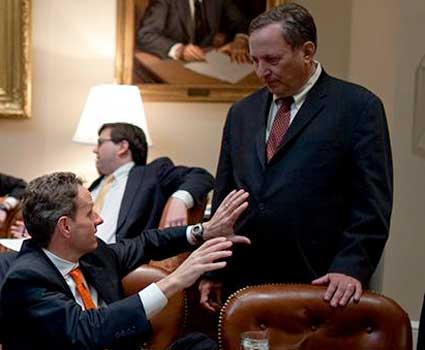
—White House photo.
Tue March 24, 2009 5:00 AM PST

Though the stock market may have lifted off on news of Treasury Secretary Timothy Geithner's purchase plan for toxic assets, don't be fooled by Wall Street's optimism. The plan is even worse than the one floated by Geithner's predecessor, Henry Paulson, last fall. At least Paulson wanted the government simply to buy the banking industry's junk outright—and spend less doing so.

Under Treasury's complicated Public-Private Partnership Investment Program, which was unveiled on Monday morning, Geithner wants to strike a deal with private investors who wouldn't touch these assets without serious incentives. The program will essentially give investors between $500 billion and $1 trillion dollars—at this point, what difference does half a trill make?—of spending money to go shopping for the bad assets that banks are dying to get off their books. And the kicker? The White House says the private sector is doing us a favor.


story continues below story continued from above

In the rosiest scenario, the assets will have some value one day. In that case, the government will have entered the hedge and private equity fund prime brokerage business. That is, the business of lending money to private funds backed by small amounts of collateral that the funds themselves post. In this instance that collateral would consist of—you guessed it—toxic assets. Remember, it was all the leverage, or borrowing, in the system that created the current mess. Surely, someone in Washington must question how more leverage, on the back of the same toxic assets, makes sense. At any rate, if this strategy pays off, private investors would profit more than the government, or taxpayers, because they risked less capital to buy the assets in the first place.

But here's another possibility: The assets have little or no value, because they have no incoming cash or no buyers—otherwise known as the situation we're presently in. To this day, we don't even have any knowledge of what exactly these assets are. The government won't tell us because the banks won't tell the government. And if the assets zero out, the private investors will largely be covered. The taxpayers, of course, won't.

That plan is based on the assumption that private funds want to bother with any of this. One thing's certain, though: The sweeter the deal the government makes to entice investors to buy assets they'd otherwise have no interest in, the worse it is for taxpayers. That's the brand of capitalism that was at work before this crisis, and it seems to have survived the economic collapse intact.

Geithner told the Wall Street Journal last week, “Our judgment is that the best way to get through this is if we can work with the markets…We don't want the government to assume all the risk. We want the private sector to work with us.”

The private sector helped create and spread a toxic stew of derivatives. Yet Geithner's strategy to “fix” the financial system is to ask its riskiest, most opaque players—the companies that shirked the most in taxes and were led by the execs who made the most money during the build-up years—to buy the system's junky assets in order “to cleanse it.” And this will come after $350 billion of capital injections and trillions of dollars of Federal Reserve loans haven't fixed the problem.

On top of this, Geithner doesn't think investors who participate in his program should be subject to any restrictions. No executive pay caps, no nothing. Moreover, the toxic assets to be brokered under this plan will be selected by the players that have not been able to unload them so far. It's like going to a used car dealership and saying to the car salesman, “I've got $100,000 to buy whatever you have to sell me,” and expecting him to provide you with his most valuable inventory.

Of course, bank stocks rallied on this cheery news. The Dow perked up like a heroin addict about to get a fix. Why wouldn't banks welcome the chance to participate in a government-sponsored program to clean their polluted balance sheets, where their old clients, the same ones who wouldn't be caught dead purchasing these toxic assets, could be paid for participating?

This is how Christina Romer, chair of the White House Council of Economic Advisers, described the plan on Sunday night: “What we're talking about now are private firms that are kind of doing us a favor, right? Coming into this market to help us buy these toxic assets off banks' balance sheets." She added, "They are firms that are being the good guys here—coming into a market that hasn't existed to try and help us get toxic assets off banks' balance sheets."

Which good guys? The financial firms that had their profits taxed at 25 percent rather than at 35 percent, like the rest of us, and made oodles of money in 2006 and 2007 before their bad bets greased the way to an economic collapse? Or the ones that bet housing-related securities would fail, in a self-fulfilling manner?

I've never been a fan of any toxic asset purchase plan (nor of the capital injection through stock purchase plans). Randomly buying a bunch of heavily layered, heavily leveraged securities and expecting them to be profitable some day has never made sense to me, especially when nothing is being done to bolster the underlying collateral. The White House and Treasury Department are throwing money at the banking and finance industry, while simultaneously doing little about the loans and borrowers at the bottom of the crisis—not to mention the very risky and overleveraged structure of the banking system itself.

The administration is caught up in crafting big plans to solve the problems of big banks. Instead, it should be dissecting the system into transparent, quantifiable, and understandable parts—and then dealing with those elements that can and should be assisted. Geithner ought to jettison the too-big-to-fail nonsense and keep it simple: Break up the banks into their commercial and speculative parts, and separate the assets along similar lines. Let the speculative parts die, and tend to the rest. As it stands, the present solution—propping up the entire system in a complex, highly leveraged manner that depends on the kindness of the culprits that caused this mess—is a colossally expensive exercise in bipartisan stupidity.


Get Mother Jones by Email - Free. Like what you're reading? Get the best of MoJo three times a week.
Comments
no profile pic for comment author

Toxic debt/taxpayer burden

I question all this shady government largesse to banks/investment houses that essentially 'blew it'. Maybe they didn't set out to decieve and defraud, but now that there's all this red ink that the government(taxpayers) are supposed to mop up like the aftermath of a bloody car wreck so that people can go back to driving normally, which I always thought was kind of questionable, nothing like a twisted piece of metal that used to be a Lexus sitting by the side of the road to get drivers to slow down and check that seatbelt, but anyway, the financial 'superhighway' has been littered with wrecks that AAA government towing has been assigned to drag off to the boneyard/chop-shop, and salvage what can be salvaged out of the whole thing. A couple of the reckless drivers have been arrested, Bernie's on to the Big House, now, but he's not alone, and he's not without precedent, either. Remember Ivan Boesky, Mr. Insider Trading? How about Enron? MCI? What other blatant garbage and public fiscal hazard lies in wait in the halls of Wall St., waiting for its' opportunity to take out some unwitting prospective investor? What other kind of sunshine stories(sure, it's SAFE, you can trust ME, I'm an expert! Riiight) are currently being spun to lure the unwary layman in for the 'kill'?
There was a guy on TV, some weeks ago, not sure where he was from, but anyway he basically said that the people on Wall St. want to make a killing, and it's not like they held a gun to everybody's head to get em to sign up for loans and mortgages and all that jazz. Well, it could be argued that they aimed something much, much worse, called 'a television' at the general public, and the sweet-smelling aroma of investment promises lured more and more people into the offices of their local banks or to sign over percentages of their monthly income to play these games.
Well, the fire is pretty much out, and it sounds like they've even got the engine started, but just like Christine about 3/4 the way through the movie, there's a lot of damage evident, maybe they think it'll be just like that Magic Evil Possessed Movie Car, and heal itself, with Barack taking the role of Arnie Cunningham, apparently. Because to say 'wall street' is also to say the United States, because Wall St. is our national business center, and if there's anything sinister under the hood, well, it could go runaway again. Maybe time to call the Pope to have him bless off on about a million gallons of holy water, and shake it all about in the general vicinity, there. Dreamcatchers glued to the monitors? Lucky rabbit's foot? Letter from Ed McMahon? YOU may have already won....

Klaatu marachas necktie

Trollstein

More business as usual

All these plans suffer from the same fatal flaw. They are inherently gimmics, to cover the fact that our system of priorities has become so badly corrupted that we can not produce anything and now only manipulate commodities and too often, cheat in the process. Mr. Obama knows what he needs to do. Sadly, he may not do those things.

A few days ago, U.S. Senator Bernie Sanders (Independent--Vermont) announced federal legislation to cap interest rates at 15%. http://www.benningtonbanner.com/local/ci_11903592

It is very necessary that this measure passes the sub committees and is voted into law. Not only because it is a wise measure that would help stabilize our economy and its the right thing to do. But because--if both the "Ds" and the "Rs" can not get together on this one, that would mean we are all screwed--beyond redemption. Everyone knows that no one pays above 15% interest (if they can at all help it). In fact, certain states have their own laws regulating consumer interest rates. But these state regulations do not apply to national banks. Thus, federal measures are required if we are to stop the bleeding of the American household. For people to have any chance of working out their debt without loosing their credit rating, a 15% cap is essential. Therefore, I ask that you help by doing three things:
1. Send a note to Sen. Sanders supporting his efforts. A jpg image (screen-shot) of his contact page is attached. Say whatever you like but I told him: "I support your pending legislation to cap interest rates at 15%."
His contact page is: http://sanders.senate.gov/comments/
2. Next, send the same (or similar) message, e.g.: "I support Sen. Sanders' 15% interest rate cap. Please vote for it" to your federal representatives (U.S. House and Senate). They are easily located: http://directory.usayfoundation.org/
3. Lastly: Please forward this to to your email list of friends and family--asking them to do the same.

Thank you.

Respectfully submitted~
Absolute leader of the Troll Kingdon (for life)
www.trollstein.com

no profile pic for comment author

Saving the economy without spending a dime

In spite of all the talk of spending hundreds of billions of dollars, our leaders are not talking about the mammoth in the room – the Derivatives market. This will be the next shoe to drop and it will flatten all our efforts so far and make them look like playschool practice. Some economists will tell you this market is no big deal because the bets are counterbalanced – that is, if one goes up, the other goes down. First of all, you must ask yourself: if you were holding a ton of bricks in one hand and a ton of rocks in the other, would you be balanced, or would you simply be crushed? The amounts are so enormous that they effectively cannot be collected, even in a significant portion, because the financial institutions don’t have anything like the required amount of resources. Second, and even more importantly, even a slight loss in relative terms would be unrecoverable by the financial institutions that made the bets. As we’ve seen, the financial players don’t have anywhere near the kind of precision in their modeling to protect themselves from currency fluctuations (where most of these bets reside) or, for that matter, much of anything else. The issue of how reliance on quantitative models actually causes the failures that its promoters seek to avoid is the subject for another article, but I will say, their managers should study more of human nature and less of non-real world mathematical models.

Getting back to the derivative crisis; to resolve it, and to save the worldwide economy, Obama must assume FDR-like powers, something he has seemed reluctant to do so far, despite his mandate to do so. The first thing he should do is to declare all derivatives placed outside of legally regulated markets (90% of them are unverified contracts) null and void. These "bets" - worth $180 trillion according the U.S. Office of the Comptroller of the Currency in America alone, and over half a quadrillion dollars worldwide - could not have been made in traditionally regulated markets, because the players had insufficient collateral, i.e. they flouted the law and their fiscal responsibility.

Because for every buyer there is a seller, the amounts lost would zero out and no one would gain an advantage. We would just get to reset the clock. This is as fair as things can be made given where we are. Right now, this enormous sum is only good for driving companies into bankruptcy and tying up the courts for years while the "winners" of these bets squabble over the crumbs of the bankrupt companies. This is already happening with creditors fighting over the last crumbs of Lehman Brothers. This is a pointless and destructive squabble and the administration must act to prevent years more of these.

If the parties object to the elimination of their derivative bets, they should be reminded of the penalty for fraud.

What's causing the panic in the markets right now is the realization that the losers have insufficient money to pay the winners. The domino effect of multiple collapses cannot be stemmed by any government, even by running the printing press overtime. The only solution is to wipe them off the books and ensure these bets are never made again by sending those who make them in the future to jail.

This won’t solve everything, but it will allow us to put the big insolvent banks into receivership without worrying about what other institution’s bets will be uncovered. THAT, and not the inability of subprime borrowers to pay, as bad as that is, is what is really keeping the Administration acting like deer caught in the headlights, paralyzed and unable to react effectively. Of course, they do not want this to get out, so when it does, it must be dealt with finally and thoroughly.

no profile pic for comment author

Geithner's plan

While Geithner's plan may be distasteful, the important objective it achieves is getting bad assets off the banks' books. That, if the banks behave, will get credit flowing again. Once credit is flowing Americans at all levels can invest and purchase once more - hopefuilly, with sanity in the mix!

no profile pic for comment author

The Praise of the Banks

Lesson fourteen – in the banks we trust

I pledge allegiance to the banks of the Incorporated Estates of Earth and to the Rulers, whom they enrich, one Command throughout the land - obedience - with conformity and subservience for all.

Good vassals learn the Bank Pledge by heart when still wet from the womb. And with good reason. The Bank Pledge can take a vassal far in the Incorporated Estates of Earth. The banks are divine, and vassals mere mortals who owe their breath to the going rate of exchange. Few vassals would rather defy banks and starve than obey banks and have a chance. All is fair in love and banks.

Vassals may rent themselves freely, offering themselves upon the altar of the market at whatever rate the market and banks command. For those vassals with little or no market value: prisons. Thankfully. Not to mention urban concentration camps, reservations, and many a moonscape in the countryside. These all happily embrace the poor, once the banks have done with them.

Banks decree equitably one a vassal or a lord, depending upon your wealth. Which vassals and lords prosper enough to receive just conditions of life? The banks judge. Justice flows both to and from the banks and their best depositors. The most just depositors are the richest ones, of course, the least just the poorest. Vassals who can make no deposit at all might be thought of as the scourge of banking. Not so. The impoverished scarcely interfere with the balance sheet, thus the banks could not care less. What could be more reasonable and just than that? ...

http://apracticalpolicy.org/2009/03/18/lesson-fourteen-in-the-banks-we-trust/

no profile pic for comment author

thanks

thanks.......

no profile pic for comment author

cam balkon

good ıda

no profile pic for comment author

Its easy to be a critic, but

Its easy to be a critic, but hard to be the lead actor. This guy pans Geithner for trying to set up a market solution to pricing and getting toxic assets performing again. Imagine a bond backed by 500 homeloans with face value of $100 million, some of which are bad (but maybe can be reworked), some are ugly (foreclosure) and some of which are paying (like Amber and Scott), but not enough for the bank to keep up with their promised payments to bondholders. What is the bond worth? Nobody knows and the market that used to price these is frozen. And everybody has to assume the worst, that they have zero value. While that's not true, you can't assume any value without a way to measure it. Geithner proposes setting up a new market with private buyers backed by government gurantees to price them and move them. They may be worth $20, 30, 40 or even 50 million, depending on where they are from - better ones in midwest, east coast, and riskier ones in Las Vegas, Detroit, Florida. Say you buy one for $30 million, borrow $25 million from the government and hold it for three years. The economy comes back and the bond is now worth $90 million, so you sell and pay off the government and keep the rest. This is a calculated risk based on the willingness of investors to play and steady improvement in the economy. The government has upside and a loan repayment.

The alternative, this guy doesn't mention specifically, is to nationalize the banks, have government guys sort out the good, bad and ugly. Keep the good assets and resell the bank to the private sector. The bad assets get restructured and may or may not be worth much, and the ugly ones go in the trash. This will take a long time, relies on government guys to determine values and is full of pitfalls.
If they undervalue assets - the government loses and if the overvalue them the buyers won't buy.

It appears the economy is slowly restarting - so they must be doing something right.

no profile pic for comment author

Okay so Goldman Sach's got

Okay so Goldman Sach's got the most money from the bailout of AIG combined with the TARP funds. Seems like James A. Johnson might be the link between the politicians and the bank. Info on him is limited, anyone know anything about him?

Post a comment
Alternately, you may login to or register an account
The content of this field is kept private and will not be shown publicly.
  • Web page addresses and e-mail addresses turn into links automatically.
  • Allowed HTML tags: <a> <ul> <ol> <li> <blockquote> <img>
  • Lines and paragraphs break automatically.

More information about formatting options


Jail.org - Inmate Search
Criminal records, instant public records & people search & current court records. www.jail.org

U.S. Public Records Search
Search County & State Court Records, Criminal records, Vital and Adoption Records www.PublicRecordsInfo.com

Records.com - People Search
Public Records and Background Checks. Instantly Search Criminal Records, Addresses and Court Records www.Records.com

Court Records & County Records
Find Instant Public Records, Criminal Records as Well as County Property Records Search. www.PublicRecordsIndex.com

Mother Jones Podcast
Get in on the conversation! We talk about culture, politics, the environment, the economy and more. Listen now!

TalkBackTees.com
A treasure trove of liberal wit, wisdom and quotations, from ancient to modern, on colorful, cotton tees.

Support Independent Artists
Amazing art, crafts, apparel, paper-goods and more. A carefully curated selection of sundries since 1999.

FREE CONNECTIONS FOR GREEN SINGLES
Meet progressive singles in the environmental, vegetarian & animal rights community who share your values